How to Grow and Care for Painted Lady Philodendron
Keep a Painted Lady philodendron colorful and upright: learn where to place it, when to water, how to train its vine, and how to diagnose common problems.
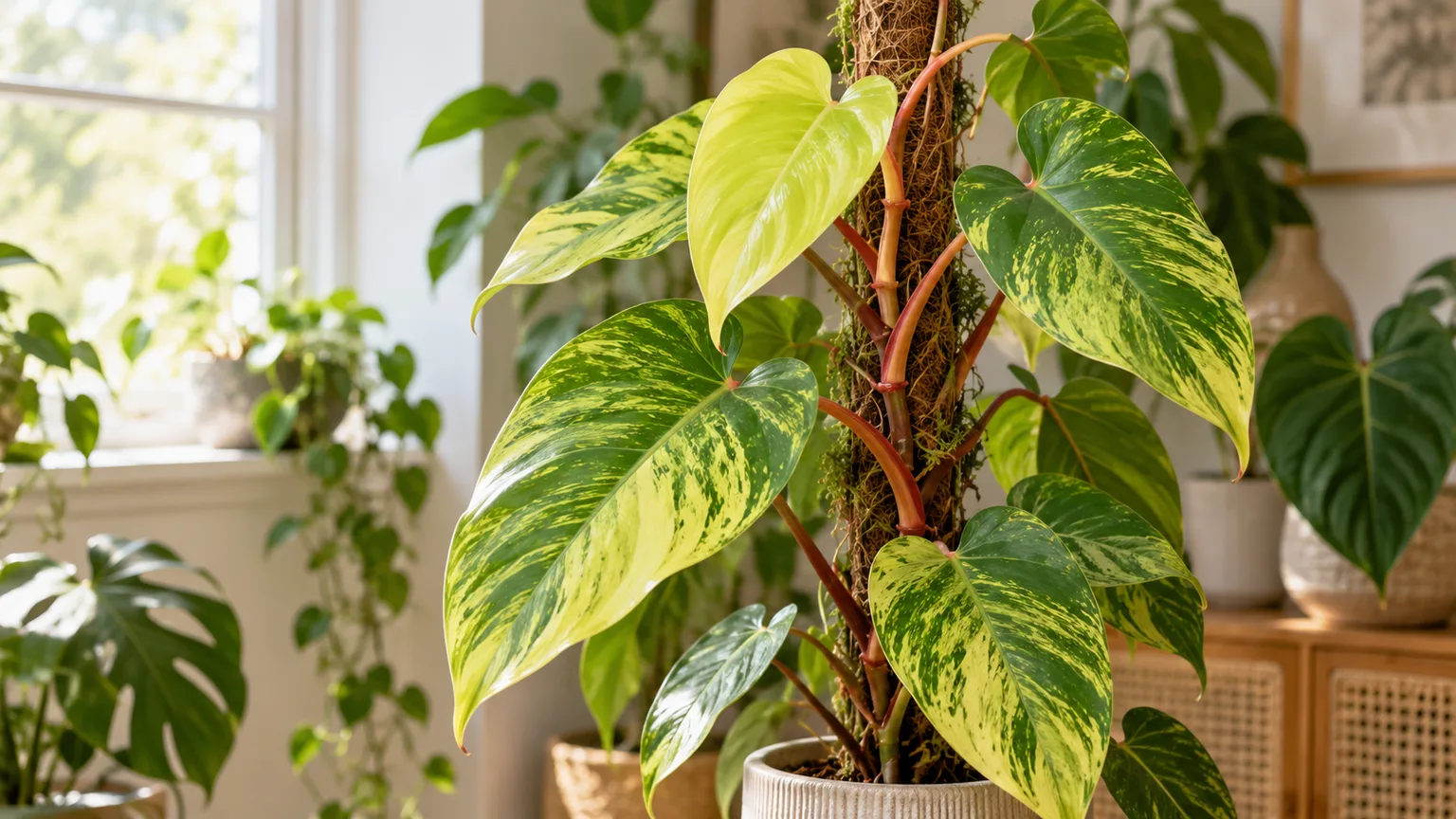
Painted Lady philodendron is easiest to keep attractive when you treat it as a climbing, variegated tropical plant—not as a plant that needs constant misting or a fixed weekly watering day. Give it bright filtered light, a potting mix that drains but does not dry to dust, and a support before the vine sprawls. Then use the plant’s newest leaves and the pot’s drying pattern to decide what to adjust.
Know what is normal for this colorful cultivar
The plant sold as Painted Lady is a climbing philodendron with conspicuous lime, yellow-green, and deeper green markings and pinkish stems. It is commonly associated with Philodendron erubescens, a climbing tropical species in the arum family; the precise parentage assigned to cultivated hybrids is not consistently documented across horticultural references. NC State Extension describes P. erubescens as a warm-growing climber, while the Royal Horticultural Society’s species profile records the same climbing habit and evergreen foliage. (NC State Extension Plant Toolbox, RHS plant profile)
Color changes as each leaf matures. Costa Farms notes that Painted Lady leaves emerge golden yellow with chartreuse markings, then shift toward light green and deeper green as they age. That means a fresh leaf may look much paler than the older foliage without being bleached or unhealthy. Check the petiole and leaf texture, and wait for the leaf to harden before judging its final color. (Costa Farms Painted Lady profile)
Variegation is not a meter that changes instantly when you move the pot. A naturally greener leaf can be part of the cultivar’s variation; several successive leaves with less pattern, longer spaces between leaves, and a stretching stem point more strongly to low light or a growth point that has shifted toward green. More light can support healthy new growth, but it cannot recolor a leaf that has already matured.
Painted Lady philodendron quick care guide
| Need | Practical starting point | What to watch |
|---|---|---|
| Light | Bright, indirect light; a few feet from a bright east or west window is a useful starting point | Long bare stem gaps suggest too little light; pale dry patches on the window side suggest sun scorch |
| Water | Check the top 1–2 inches of mix; water when that layer is dry | The interval changes with pot size, temperature, light, and mix |
| Mix | Airy aroid mix with bark and perlite or pumice | The root ball should not stay wet for days or repel water completely |
| Temperature | A steady warm room; roughly 65–85°F suits the related species | Avoid cold panes, drafts, and direct HVAC blasts |
| Humidity | Average indoor humidity is workable; add a humidifier if new leaves repeatedly stick | Humidity cannot compensate for a cold, wet root zone |
| Support | A stable pole or trellis once the stem begins leaning | Attach the stem loosely; do not cinch the petioles |
These are starting conditions, not guarantees. The same plant may need water more often in a small nursery pot near a warm bright window than in a larger ceramic pot in a cool room. The NC State species profile lists warm conditions and moist but well-drained soil; the cultivar-specific grower guidance from Costa Farms likewise emphasizes a medium-to-bright position and watering after the surface mix dries. (NC State Extension Plant Toolbox, Costa Farms Painted Lady profile)
Give it enough light without bleaching or burning leaves
Set the plant where the room is bright for much of the day but the leaves are not exposed to a long stretch of harsh direct sun. An unobstructed east-facing window is often a forgiving choice. A west or south window can work if the plant sits farther back or behind a sheer curtain; a shaded north window may keep it alive but often produces slower, leggier growth and less vigorous new leaves. A species care profile from Gardenia also describes filtered light and warns against the combination of weak growth in low light and leaf damage from excessive direct exposure. (Gardenia: Philodendron erubescens)
Do not move a plant from a dim room directly into strong sun to “bring back” the color. Acclimate it in steps: move it closer to the window over several days, watch the exposed leaves, and stop if you see crisp pale or tan areas that stay in the same place. Sunburned tissue will not turn green again. New growth is the useful signal; assess its spacing, size, and pattern over a few leaves rather than chasing a brighter color on one existing leaf.
Adjust the window distance before adding a grow light
If natural light is limited, try a bright window position first, then use a grow light to extend the day or raise the light available at the leaves. Keep the lamp at the distance recommended by its maker and use a timer for a consistent day-night cycle. There is no need to leave a household grow light on around the clock; extra hours do not fix poor drainage, root stress, or a naturally green section of the vine.
Rotate the pot a quarter turn every week or two if one side is leaning toward the window. Wipe dust from the leaves with a soft damp cloth so it does not form a dull coating, and keep the plant away from a hot glass pane or a heater. A gradual change is easier to interpret than moving it among several different spots in a single week.
Water when the mix dries, not on a calendar
Check the mix instead of assigning the plant a weekly drink. Push a finger into the top inch or two; for a deep pot, a wooden skewer pushed farther down gives a better read of the center of the root ball. When the upper layer is dry and the lower mix is no longer saturated, water slowly until excess runs from the drainage holes. Empty the saucer or decorative cachepot after it drains. A Painted Lady does not benefit from sitting in runoff, and repeated wet soil deprives roots of air.
The correct interval can range from several days to more than a week. Bright light, active growth, warm temperatures, a small pot, and a coarse mix make the root ball dry faster; cooler weather, low light, a large pot, or dense mix slow it down. “Top inch dry” is a cue to check, not an instruction to pour water regardless of the lower soil. Gardenia and Teak & Terracotta both advise allowing some drying between waterings while avoiding persistently soggy conditions. (Gardenia: Philodendron erubescens, Teak & Terracotta: Philodendron erubescens care)
If the mix has become so dry that water races down the sides, water in two passes a few minutes apart so the center can re-wet. If the pot remains heavy and wet for many days, do not respond by watering more often; inspect drainage, pot size, and mix structure first. A limp leaf alone cannot distinguish thirst from root damage, so check the soil before treating droop as a watering signal.
Use an airy mix that holds a little moisture
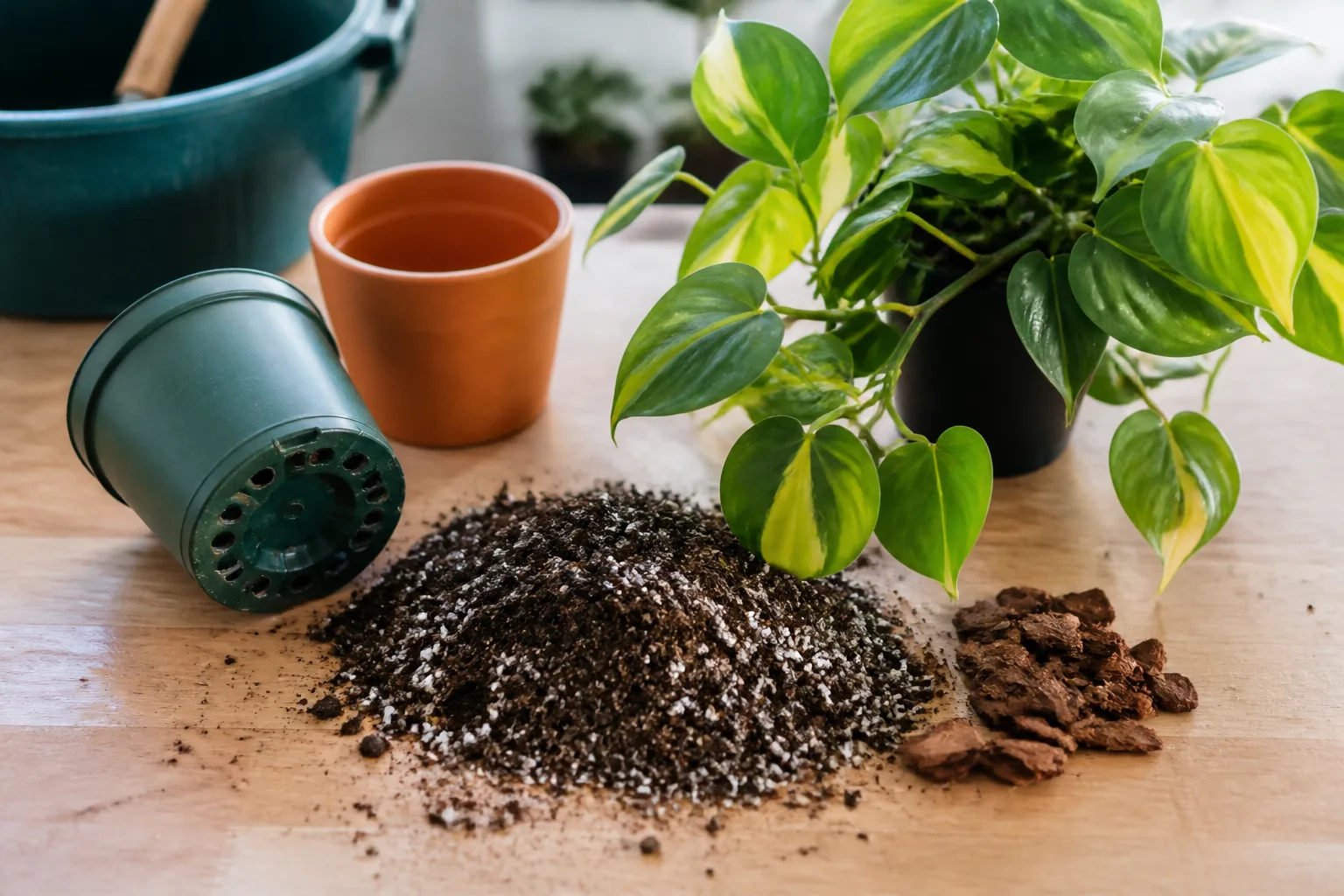
Choose a mix that lets water move through while leaving small air spaces around the roots. A practical starting blend is one part indoor potting mix or coco coir, one part orchid bark, and one part perlite or pumice. The fine component holds some moisture; bark and mineral particles reduce compaction and help excess water drain. If your home is hot and dry, keep a little more fine mix in the blend. If it is cool or humid and the pot stays wet, increase the coarse portion instead of trying to fix the problem with a calendar.
The goal is not to make a mix that dries as fast as possible. Very coarse bark in a warm, bright room can leave roots thirsty and make watering erratic; heavy garden soil or dense indoor mix can stay waterlogged around the roots. NC State Extension recommends organic-rich, well-drained soil for the species, and the Painted Lady care notes from Plant Proper also emphasize drainage. (NC State Extension Plant Toolbox, Plant Proper Painted Lady care)
Use a pot with open drainage holes and choose a container only modestly wider than the root ball. A large volume of unused wet mix dries slowly, even if the top looks dry. Do not add a layer of gravel at the bottom as a substitute for drainage holes; the whole profile needs to drain freely. If the plant is in a decorative cover pot, keep it in a draining nursery pot inside and pour off runoff after watering.
Keep it warm and make humidity optional
Warm, stable room conditions suit this tropical vine. NC State Extension gives 65–85°F as a suitable range for P. erubescens and advises protecting it from cold drafts; the RHS lists the species as a conservatory or greenhouse climber rather than a cold-hardy outdoor plant. Keep the pot away from winter window glass, exterior doors, air-conditioner outlets, and heating vents. Sudden cold exposure can damage leaves and slow water use, which makes a normally reasonable watering routine too frequent. (NC State Extension Plant Toolbox, RHS plant profile)
Average indoor humidity is usually enough for steady growth. A humidifier can help when new leaves repeatedly catch in their sheaths or emerge with dry, torn edges, especially in a heated winter room. Put the humidifier nearby rather than directing a cold mist at the foliage, and keep air moving gently. Repeatedly misting the leaves is a short-lived way to raise room humidity and can leave foliage wet without correcting a dry room.
If the leaves brown at their edges, check several causes before buying a humidifier: dry mix, direct sun, fertilizer residue, a vent blowing on the plant, or root stress can look similar. Humidity can improve comfort for the plant, but it does not replace a draining mix, sound roots, or appropriate watering.
Add support while the vine is still manageable
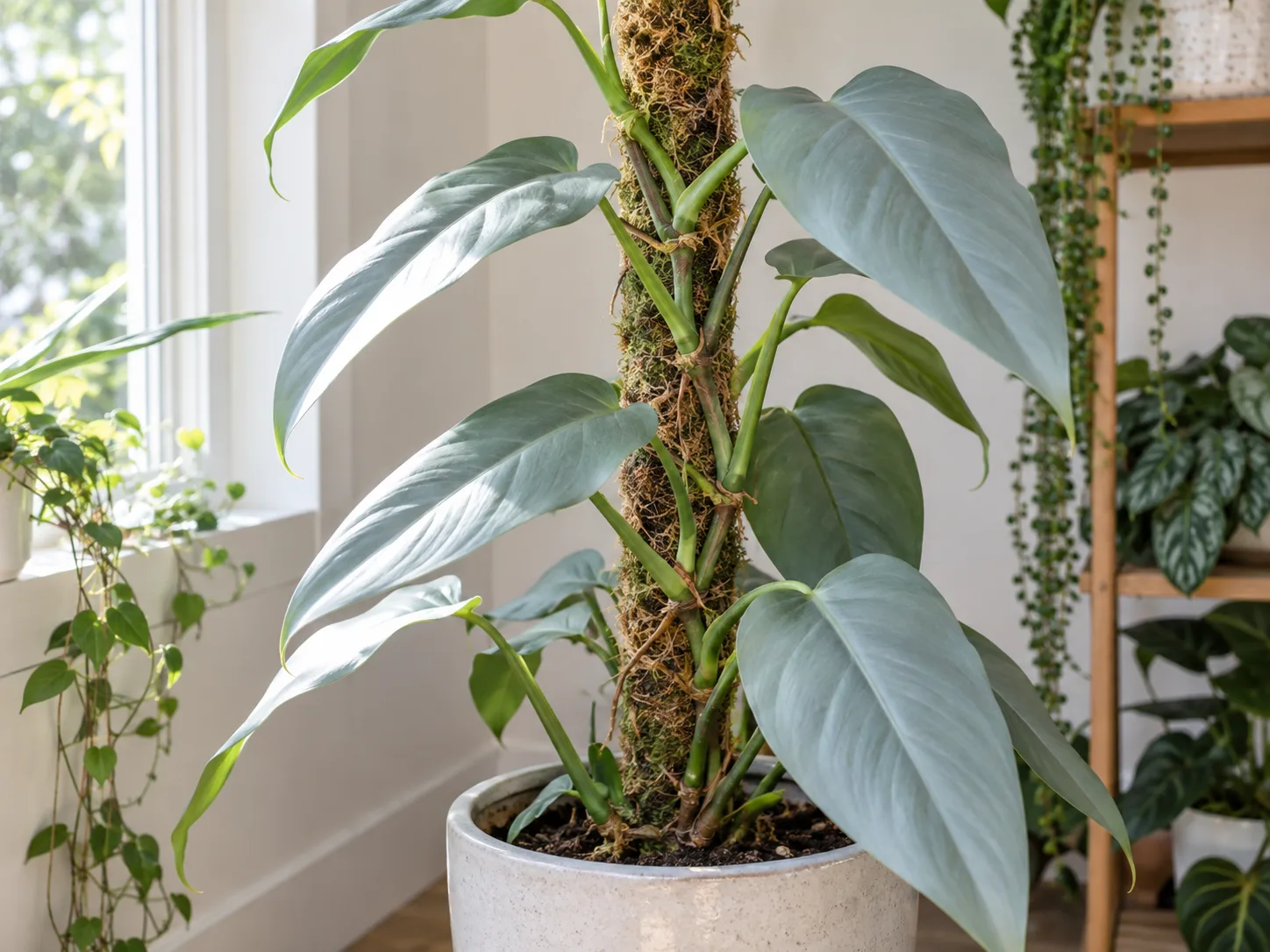
Painted Lady is a climbing philodendron, so a vertical support keeps its stems organized and gives aerial roots a place to attach. Install the support before the vine becomes heavy and difficult to reposition. Push a stable moss pole or trellis into the pot near the stem, taking care not to spear the main root mass. Then use a soft plant tie to secure the stem at a node or sturdy section; leave enough slack for the stem to thicken.
The plant can trail from a shelf, but a hanging position makes it harder to guide aerial roots and keep the leaves facing the light. A pole also helps distribute the vine upward instead of letting a long stem bend under its own weight. Costa Farms notes that the plant develops a climbing form and can be trained on a trellis or moss pole; extension references describe Philodendron as a climbing genus with aerial roots. (Costa Farms Painted Lady profile, RHS plant profile)
Choose a moss pole or trellis by how you want it to grow
A moss pole offers a softer surface for aerial roots to contact and is useful if you want a compact, upright display. It needs occasional checking because the stem may outgrow its ties and the pole can dry faster than expected. A trellis is easier to keep dry and can support several stems across a wider shape, but the roots may not attach as readily to smooth plastic or metal. Either can work as long as it is anchored firmly and the stem is tied loosely.
Do not force every aerial root into the potting mix or cut them all off. You can gently guide a flexible root toward a damp pole or back toward the soil, but a dry, brittle root is easier to leave alone than to bend. If you need to reposition the plant, move the ties and stem gradually rather than pulling a mature vine away from the support in one motion.
Feed lightly during active growth
Use a balanced liquid houseplant fertilizer during active spring and summer growth, following the product label or starting at a conservative dilution if your product permits it. Feed only when the plant is making new leaves and the roots are healthy; a nutrient dose cannot repair low light, waterlogged mix, or a damaged root system. Water the soil before applying fertilizer if the mix is very dry, which lowers the chance of concentrated salts touching dry roots.
Reduce or pause feeding when growth slows in darker, cooler months. If you see a white crust at the mix surface or pot rim, brown tips after repeated feeding, or a plant that is not actively growing, stop fertilizer and flush the mix with plain water through the drainage holes. Teak & Terracotta and Costa Farms both place feeding in the active growing season and warn against overdoing fertilizer. (Teak & Terracotta: Philodendron erubescens care, Costa Farms Painted Lady profile)
Repot when roots have used the pot
Repot when roots circle densely around the root ball, emerge in quantity from the drainage holes, or the plant dries unusually fast despite a sound mix. A single root peeking out is not an emergency. If you have to water every day or the plant repeatedly wilts shortly after a thorough drink, check whether the pot has become root-filled before changing the watering method.
Move the plant during active growth if possible. Choose a pot about one size larger, loosen only the roots that are tightly circling, and remove mix that falls away easily. Keep the plant at its previous depth, backfill with fresh airy mix, and water until it drains. Do not jump into a much larger decorative pot; extra wet mix can stay unused around the roots. If you find mushy brown roots, trim only the soft damaged portions with clean snips and use fresh, airy mix in a clean draining pot.
Propagate from a stem node to preserve the cultivar
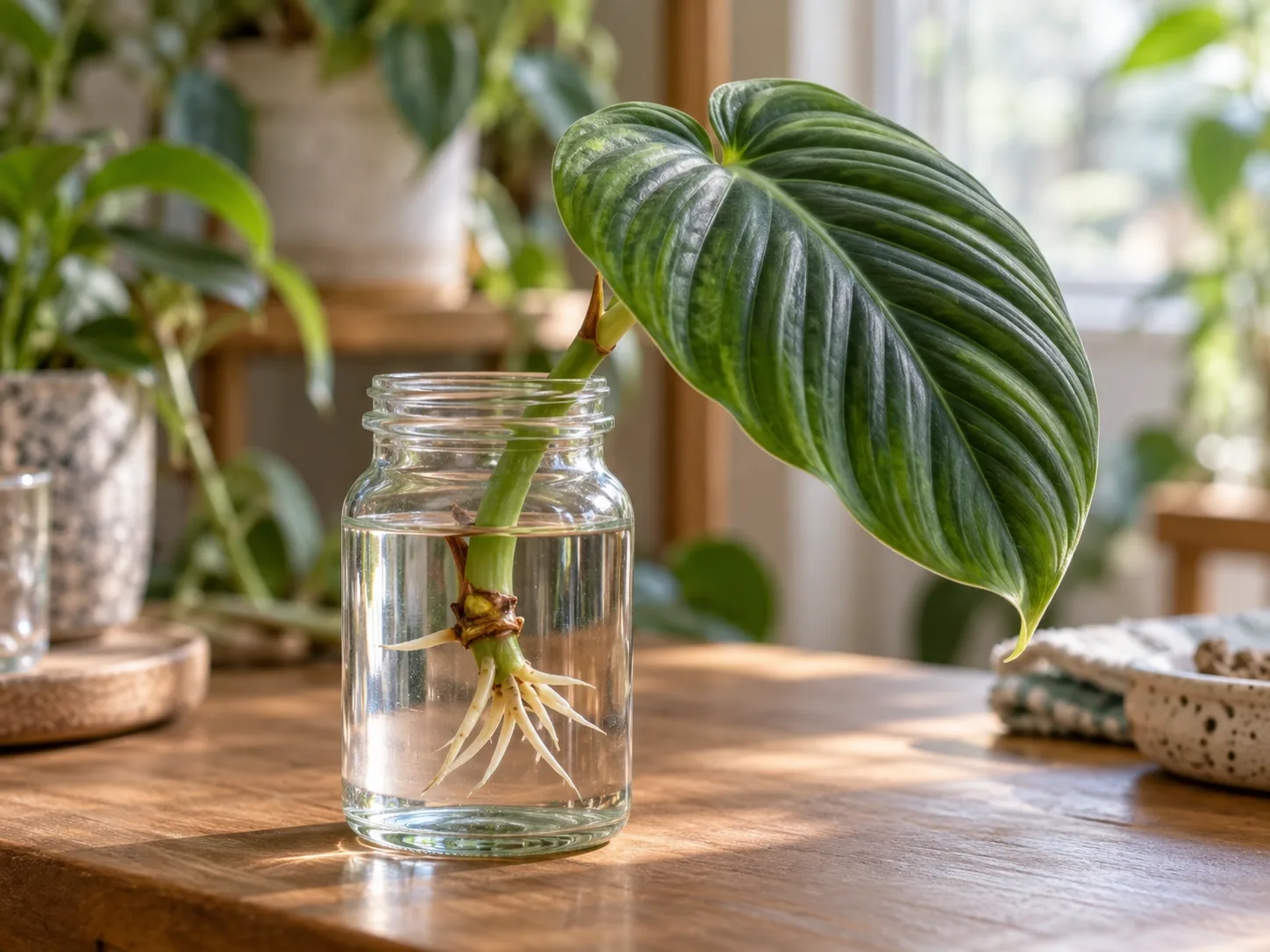
A viable cutting needs at least one node, the joint on the stem where a leaf and growth point attach. A leaf without a node may stay green for a while but will not create a new climbing shoot. Use clean scissors and choose a healthy section with a visible node and at least one leaf. If you want a fuller mother plant, take a cutting from a long vine and leave enough stem and leaves below the cut for the original plant to keep growing.
Make the cut just below the node, remove any leaf that would sit under water or substrate, and keep the leaf blade above the rooting medium. A single-node cutting is more space-efficient, while a longer cutting with multiple nodes gives you more than one potential growth point. Painted Lady’s variegation is carried by the growing tissue; choose a cutting from a section with the pattern you want, because a cutting taken from a persistently all-green section may continue producing greener growth.
Water or substrate: choose the transition you prefer
For water rooting, submerge the node while keeping the leaf above the waterline. Use a clear container so you can see the roots, refresh the water when it becomes cloudy, and keep the cutting warm in bright indirect light. Move it to mix after it has developed several branching roots rather than transferring it the moment a tiny root appears. Water-grown roots can take time to adjust to a less saturated substrate, so keep the new pot evenly damp for the first few weeks without leaving it soggy.
For substrate rooting, set the node into a small pot of lightly moist, airy mix, firm it gently, and keep the cutting stable. A clear humidity cover can slow drying if the air is very dry, but open it regularly so stagnant moisture does not collect on the leaf. In either method, there is no exact rooting deadline: temperature, light, node maturity, and cutting health affect how quickly roots appear. If a cutting turns soft or black at the node, remove the damaged tissue and restart with a clean cut from healthy stem.
Prune for shape and clean leaves gently
Pruning is mainly for size, shape, and propagation, not a requirement for flowering or survival. Use clean sharp shears to remove a dead leaf at its base or shorten a vine above a node. A healthy cut below a node can encourage a new shoot from the remaining stem, though branching is not guaranteed at every node. Avoid removing many leaves at once; the plant needs foliage to support fresh growth.
If a stem produces several successive leaves with little or no variegation, first improve light gradually and wait for new growth. If the section remains green and is shading patterned growth, you can cut back to a node that has produced variegated leaves. This is a shaping choice, not a way to recolor the existing green leaves. Wipe dust with a damp cloth and avoid oily leaf-shine products, which can leave a film on the foliage.
Read symptoms before changing the routine
Look at the whole pattern, not just one leaf. A single old leaf yellowing at the base while the rest of the vine is firm may be normal turnover; several leaves yellowing together, especially while the mix is wet, deserve a root and drainage check. NC State Extension lists overwatering-related root rot and leaf spot among issues for P. erubescens, so recurring symptoms are a reason to inspect conditions rather than add a fungicide by default. (NC State Extension Plant Toolbox)
| What you see | First check | Sensible first response |
|---|---|---|
| One lower leaf turns yellow | Is it the oldest leaf, with the rest firm and growing? | Remove only after it is mostly yellow; monitor the next leaf |
| Several leaves yellow together | Is the mix staying wet; does the pot drain? | Stop watering until the mix dries appropriately; inspect roots if decline continues |
| Long gaps and smaller leaves | Is the vine reaching toward a window or hanging without support? | Improve filtered light and train the stem; change one thing at a time |
| Crisp pale patch on the window side | Did the plant recently move into stronger sun? | Filter the light and leave damaged tissue until you see new growth |
| Brown edge or tip | Is the mix bone dry, fertilizer crusted, or air blowing on that side? | Fix the identified cause; do not assume every brown edge means low humidity |
| Small spreading dark spots | Do spots enlarge while leaves remain wet or crowded? | Isolate the plant, keep foliage dry, improve airflow, and remove badly affected leaves |
The table is a triage order, not a diagnosis from a photograph. If roots are firm and pale, the problem may be environmental; if many roots are soft and dark with a sour smell, root damage is more likely. After a change, give the plant time to respond through new growth. Repeatedly changing its window, pot, and watering on the same day makes it hard to learn which factor mattered.
Check for pests and leaf spot early
Inspect the leaf undersides, petiole joints, and new growth every week or two. Mealybugs look like small cottony clusters; scale can resemble fixed brown bumps; spider mites may leave fine webbing and stippled leaves. Isolate a suspect plant before treating it so pests do not spread to nearby houseplants. Remove a small number of visible pests with a damp swab or rinse the foliage, then use only a labeled houseplant product if an infestation persists. Follow its label and test a small area first, especially on a variegated leaf.
Avoid keeping the foliage wet for long periods. Water at the soil line, space leaves enough for air to move, and remove fallen plant material from the pot surface. Rusty or dark spots that keep expanding are different from an even tan patch caused by sun; photograph the pattern and inspect both sides of the leaf. NC State Extension notes that leaf spot can affect the species and recommends keeping water off the foliage as a preventive measure. (NC State Extension Plant Toolbox)
Keep the sap away from mouths and eyes
Philodendrons contain insoluble calcium oxalates that can irritate the mouth when chewed. The ASPCA lists heartleaf philodendron as toxic to cats and dogs and identifies insoluble calcium oxalates as the toxic principle; the RHS also classifies P. erubescens as harmful if eaten and a potential skin or eye irritant. Keep the plant and pruned pieces away from children and pets, and wash hands after cutting or repotting. Gloves are sensible if you have sensitive skin or tend to touch your face while working. (ASPCA toxic and non-toxic plant list, RHS plant profile)
If a pet chews the plant, contact a veterinarian or animal poison-control service for case-specific instructions instead of waiting for symptoms or trying home treatment. A veterinary reference describes oral irritation and drooling among possible signs after philodendron exposure; the response depends on what was eaten and the animal involved. (FirstVet philodendron toxicity guide)
Shift care with the season
In spring and summer, brighter days and new leaves usually mean the plant uses water faster. Check the pot more often, feed only while growth is active, and guide new stem sections onto the support while they are flexible. If you put the plant outdoors for warm weather, acclimate it gradually in bright shade and protect it from direct afternoon sun, heavy rain, and cold nights before moving it back indoors.
In fall and winter, indoor light often drops while heaters dry the air. Move the plant closer to a bright window if needed, but keep leaves from touching cold glass. Let the mix dry at its usual depth before watering and expect the interval to lengthen if growth slows; do not use the summer frequency by habit. Pause fertilizer if the plant is not actively growing. If a leaf unfurls slowly, first check that the room is warm and the plant is not severely dry before raising humidity or tugging the leaf open.
Conclusion
Start with a bright, filtered location and a draining pot, then learn how quickly that particular mix dries in your room. Water thoroughly only when the upper mix has dried, empty runoff, and add a stable support before the vine becomes awkward to handle. If the leaves change, compare several new leaves and inspect the roots before making a major correction. That steady approach protects both the Painted Lady’s colorful foliage and the roots that sustain it.



