How to Grow and Care for Peegee Hydrangea
Learn how to grow Peegee hydrangea with guidance on planting, sun, watering, pruning tree or shrub forms, bloom color, winter care, and common problems.
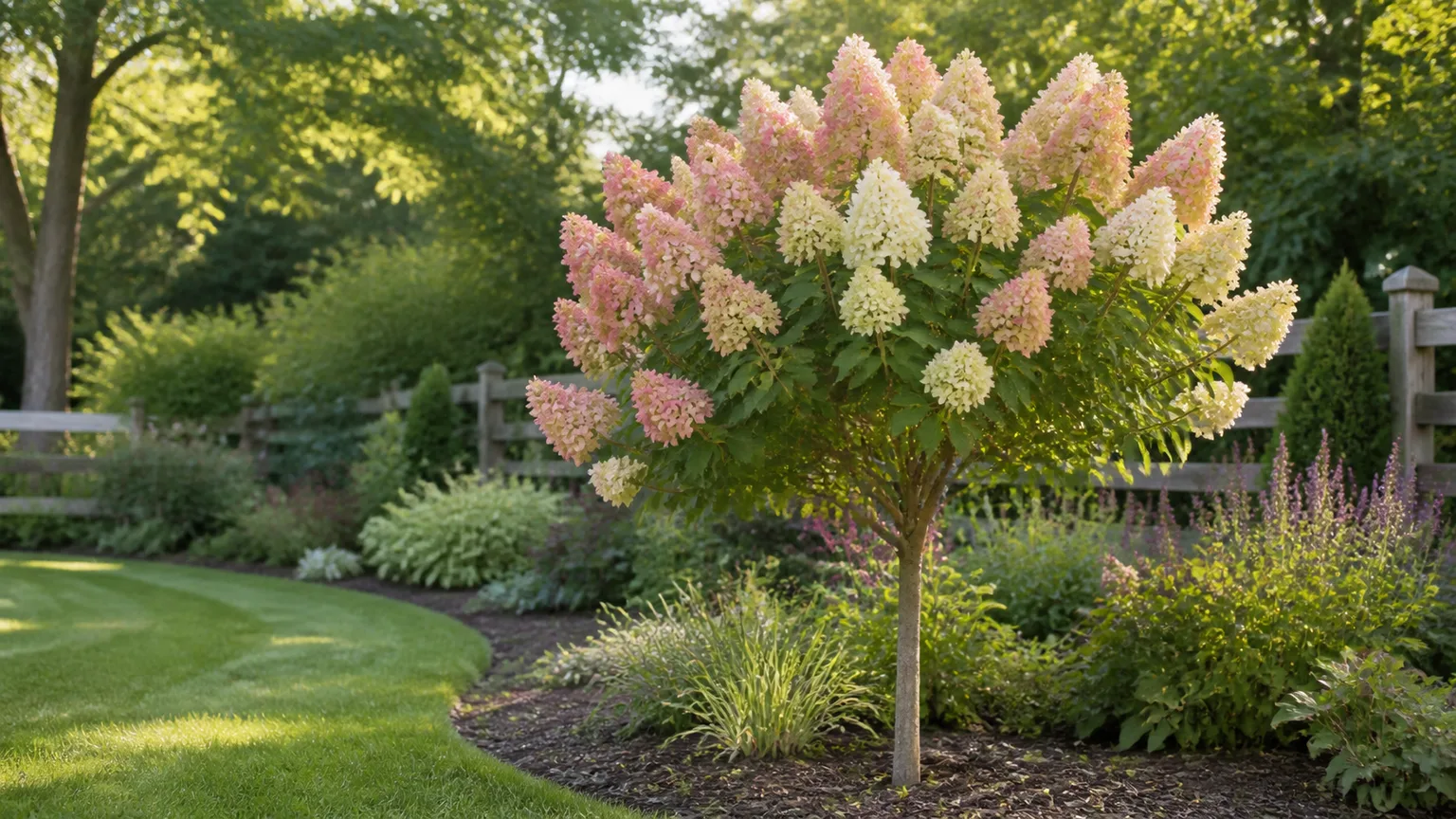
A Peegee hydrangea can become a generous flowering shrub or a small, tree-shaped focal point, but it needs more room than many nursery tags suggest. Its biggest care decisions are made before planting: choose a site with enough sun and root space, keep the soil evenly moist while it establishes, and prune to preserve strong branches rather than cutting it back automatically every year.
“Peegee” usually refers to Hydrangea paniculata ‘Grandiflora’, an old-fashioned panicle hydrangea with large cone-shaped flower clusters .The name is also used loosely for panicle hydrangeas as a group, so check the botanical name on the label if you are choosing a plant specifically for its mature size, flowering time, or tree form .The species is cold-hardy across USDA zones 3 through 8 and more sun-tolerant than many hydrangeas, but it is not immune to drought, waterlogged soil, or heat stress
.Check the hardiness range on the specific cultivar label, since selections can differ.
The short answer: give it room, light, and even moisture
Plant Peegee hydrangea where it receives full sun to partial shade, in soil that holds some moisture but drains freely .Morning sun with relief from the hottest afternoon rays is a safer arrangement in hot-summer regions; in cooler areas, more direct sun usually supports heavier flowering .Water newly planted shrubs deeply when the root ball begins to dry, then taper irrigation as roots spread
.Mulch helps moderate soil moisture and temperature, but it should not sit against the stems.
Prune in late winter or early spring if you need to remove dead wood, reduce size, or shape the framework. Because panicle hydrangea blooms on growth produced in the current season, dormant-season pruning does not remove already-formed flower buds. It still does not mean you must cut the entire shrub down hard: a large plant can remain unpruned, and selective thinning often makes a sturdier specimen than repeated severe shortening. NC State Extension’s panicle hydrangea profile describes its current-season flowering and broad landscape uses.
Identify the plant and plan for its mature size
What “Peegee” means—and what it does not
Peegee is a common name associated with Hydrangea paniculata ‘Grandiflora’ .The “P.G.” nickname refers to the initials in paniculata grandiflora .The plant is a deciduous woody shrub with dark green, toothed leaves and upright to arching branches that end in conical flower clusters
.Its large white blooms typically develop a soft pink, rose, or tan cast as they age .“Peegee hydrangea tree” describes a growth form, not a separate hydrangea species: a multi-stem shrub can be trained over time with one dominant trunk, while many garden plants are simply allowed to grow as shrubs.
The word Peegee is sometimes applied more broadly to panicle hydrangeas, including cultivars other than ‘Grandiflora’ .That matters because a named compact selection and the vigorous old ‘Grandiflora’ do not have the same footprint .A plant sold as a peegee may eventually reach roughly 10 to 15 feet or more when left to develop, and some mature specimens become larger
.Reference sizes vary by region and growing conditions: the RHS profile for ‘Pee Gee’ lists a maximum height of 2.5–4 metres, while NC State gives 8–15 feet as typical for the panicle species and notes that it can grow taller .Treat those as planning ranges, not a guarantee for every plant.
Measure the planting area against the tag’s mature width as well as height .Do not place a vigorous Peegee under low eaves, in a narrow walkway, or where a hedge will eventually swallow its crown .If the available space is small, buy a specifically compact cultivar rather than relying on annual hard pruning to hold a large shrub to miniature proportions
.A crowded, repeatedly cut plant can look lollipop-shaped and flower poorly along its lower branches.
Choose a site with useful sun and fast drainage
Panicle hydrangeas are among the more sun-tolerant hydrangea types .Six or more hours of direct light is a useful target for a strong display, although a little afternoon shade may be valuable where summers are hot or the site reflects heat from pavement, stone, or a south- or west-facing wall .In a cool climate with moisture-retentive soil, an open sunny bed can work well
.NC State Extension favors morning sun and afternoon shade as a reliable balance and notes that this hydrangea is cold-hardy.
Adjust exposure for summer heat
Do not treat “full sun” as an instruction to put every new plant in the hottest corner of the yard .Sun exposure, air temperature, reflected heat, soil texture, and water supply work together .A Peegee hydrangea in a hot inland garden may do better with morning sun and light shade later in the day, while the same plant in a cool northern garden may need a sunnier position to flower well
.If it has healthy leaves and stems but consistently makes sparse blooms in shade, insufficient usable light is a more plausible first check than fertilizer.
Keep the root zone moist, not waterlogged
Peegee hydrangea tolerates a range of soil textures but performs best in fertile, well-drained ground with steady moisture .It has a relatively shallow, spreading root system, so it benefits from organic mulch and can suffer when the surface root zone dries repeatedly .Yet “likes water” does not mean “likes wet feet
.”A planting hole that stays saturated after rain deprives roots of oxygen and raises the risk of root problems .The RHS growing guide for shrubby hydrangeas recommends moist but well-drained conditions and watering during hot, dry spells, including for established plants.
Before planting in heavy clay, observe the spot after a soaking rain .If water remains pooled for a long time, choose a better-drained position or improve the broader bed rather than filling a deep isolated hole with a different soil mix that can act like a sump .In sandy soil, add organic matter across the planting area and mulch the root zone to slow drying
.Do not chase soil acidity for pink or blue flowers: H. paniculata flower color is not controlled like that of some bigleaf hydrangeas.
Plant it without burying the crown
Early spring and fall are generally easier planting windows because cool weather lowers water stress while the roots settle. Avoid planting during a heat wave or immediately before a long dry period unless you can provide reliable irrigation. Check the cultivar name and mature size first, then position the plant where its mature canopy will not hit buildings, paths, or neighboring shrubs.
For a container-grown plant, water the pot before planting .Dig a hole about twice as wide as the root ball and no deeper than the root ball’s height .Loosen circling roots gently at the edge, set the shrub so the top of the root ball is level with the surrounding soil, and backfill with the soil you removed
.Do not bury the crown or create a deep basin that traps water against the stem base .Water slowly after planting so moisture reaches the full root ball and the adjacent soil, then refill any settling pockets without compacting the bed.
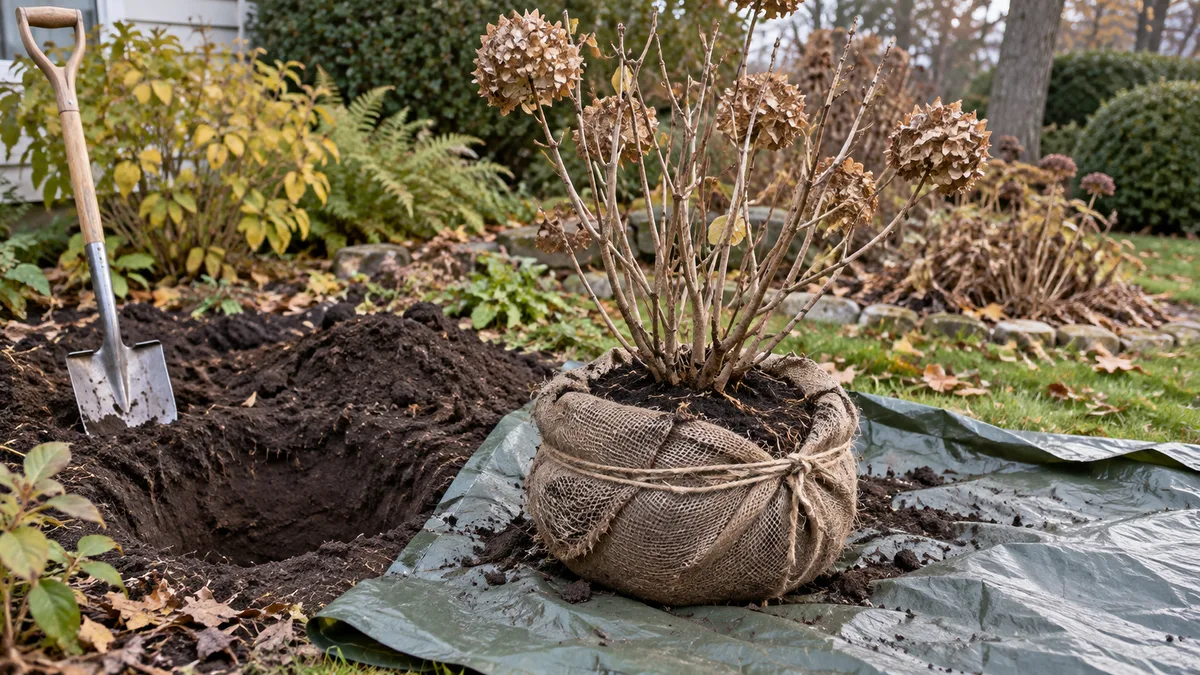
Leave enough open ground around the crown to accommodate the plant’s natural spread and airflow .In a group planting, space according to mature width, not the current size of the nursery pot .A layer of shredded bark, composted leaf mulch, or another suitable organic mulch can conserve water; spread it over the root zone and keep it a few inches away from the stems
.The plant’s size, not just its species, determines whether a single specimen or a loose screen is the better landscape use.
Water and mulch while the shrub establishes
A newly planted Peegee hydrangea needs closer monitoring than a mature shrub .During the first growing season, check the root ball and nearby soil every few days in warm weather, more often in fast-draining soil and less often after rain .If the soil a few inches down feels dry, water slowly and deeply at the base
.The aim is to wet the root ball and the surrounding soil, not to keep the surface constantly shiny or soggy .As roots establish, lengthen the time between checks and let rainfall do more of the work.
Do not use a fixed rule such as watering two or three times every week for every garden .A plant in clay after rain, a plant in sandy soil during a heat wave, and a new shrub in a small root ball have different needs .Soil texture, rainfall, temperature, wind, sunlight, and establishment all change how quickly water is used
.The University of Minnesota Extension’s guidance on watering established shrubs warns against light, frequent watering and explains that overwatering can also damage shrubs, especially in clay or compacted soil.
During prolonged dry spells, water the root zone thoroughly rather than wetting the leaves for a few minutes each day .A soaker hose or drip line can distribute water slowly and keep foliage dry .Maintain an even mulch layer over the root zone, refreshing it as it breaks down, and pull it back from the stems to discourage persistently damp bark
.Established plants usually tolerate a brief dry period better than new ones, but extended drought can reduce growth and flower size and cause temporary wilting.
Fertilize only when the soil or growth calls for it
A healthy Peegee hydrangea growing in reasonably fertile soil may not need routine fertilizer .Start by improving the root zone with organic matter and mulch, not by applying a high-dose bloom product .If a soil test or clearly weak growth indicates a nutrient need, use a balanced, slow-release fertilizer in early spring according to its label and local recommendations
.Keep granules away from the trunk and water them in as directed.
Excess nitrogen can push long, soft stems and abundant foliage that is more likely to bend under heavy flower clusters .It can also create vigorous shoots that make the shrub larger without improving the overall structure .Avoid late-season fertilizing that encourages tender growth as the plant should be moving toward dormancy
.For a shrub with pale leaves or poor growth, first check drainage, root competition, planting depth, and light; fertilizer cannot fix a waterlogged root system or a plant that is starved of sun.
Soil pH is not a useful color-control lever for Peegee hydrangea .Unlike some cultivars of bigleaf hydrangea, panicle hydrangeas do not shift from pink to blue when soil chemistry changes .Do not add aluminum sulfate or lime just to recolor these white panicles
.A soil test can still be useful if you have a broader nutrient or pH concern, but the normal flower transition is an aging response, not a sign that the soil needs adjustment.
Prune for a strong frame, not just huge flower heads
Peegee hydrangea flowers on new wood: the shoots that grow during the current season carry that season’s flowers .That makes late-winter or early-spring pruning relatively forgiving compared with hydrangeas that set flower buds on the previous year’s stems .The University of Minnesota Extension pruning guide recommends cutting panicle hydrangea stems just above a plump bud and notes that dried flower heads can be left for winter interest
.The RHS guide describes a framework-based annual cut as a way to encourage more prolific flowering, but pruning is still a choice based on the form and size you want.
Start by removing dead, broken, rubbing, or badly crossing wood .Make clean cuts just above a healthy outward-facing bud when shortening a branch, or remove a whole branch at its point of origin if thinning is the better choice .Do not shear every stem to the same height by habit
.If the shrub already has strong structure and fits its space, removing only damaged and misplaced growth may be all it needs.
Keep a balanced multi-stem shrub
For a shrub form, retain several well-spaced main stems and a range of sturdy branch sizes .To lower the overall height, shorten selected stems rather than cutting every branch drastically .A hard annual cut can produce fewer, larger flower heads on vigorous new shoots, but those shoots may be thinner and less able to hold the flowers upright, especially after rain
.A light-to-moderate cut usually produces more numerous, somewhat smaller blooms on a more substantial framework.
If an old plant has become an oversized tangle, renew it in stages: remove a few of the oldest, weakest stems near the base over successive late winters while retaining the stronger framework. A panicle hydrangea can tolerate harder renovation than an old-wood hydrangea, but a severe cut still changes its shape and can temporarily reduce its display. The Iowa State University Extension pruning guide likewise describes selective size reduction and late-winter rejuvenation for panicle hydrangeas.
Maintain a tree form without weakening its crown
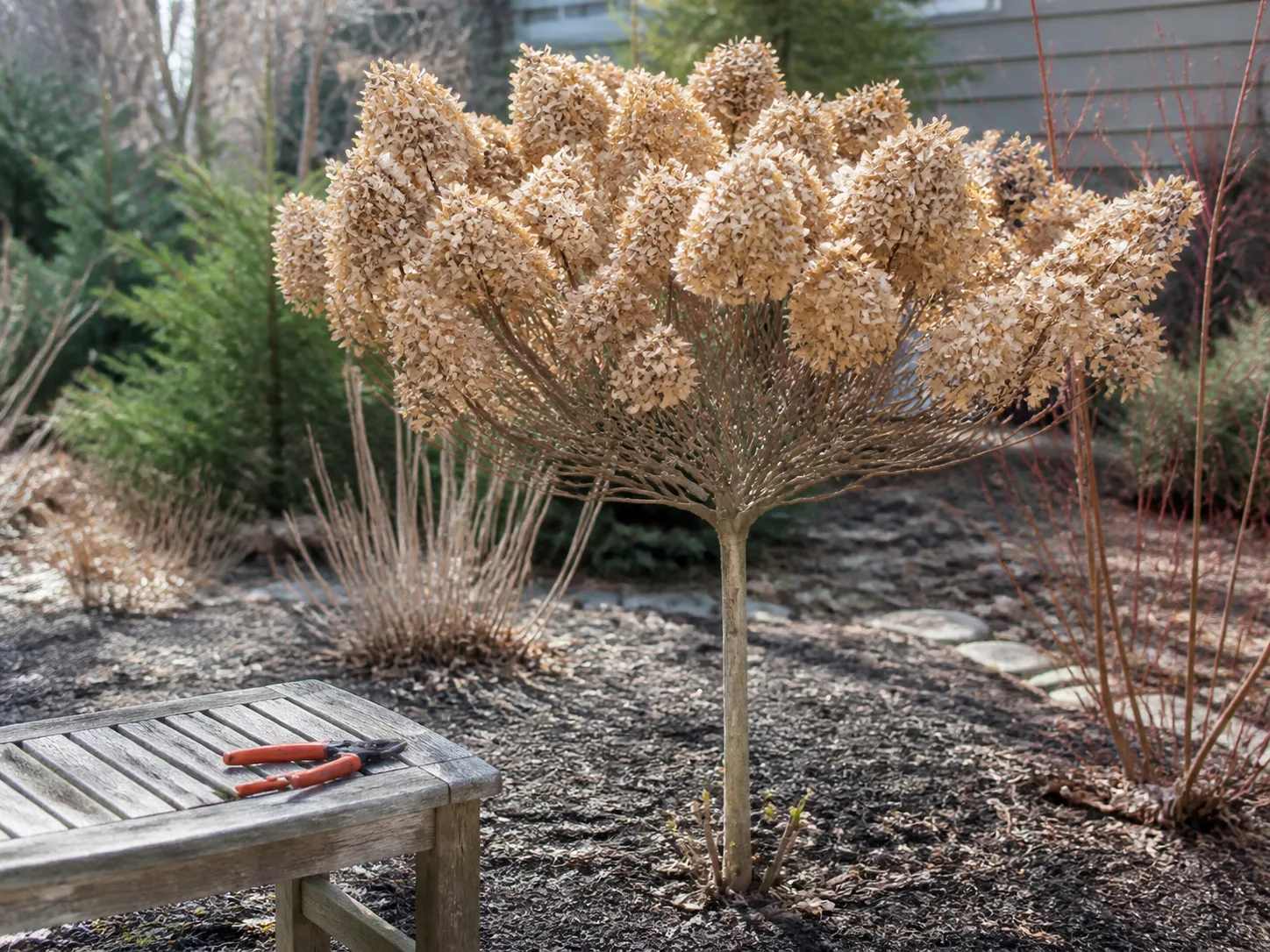
A “Peegee tree” is a hydrangea trained with a clear trunk and an elevated crown .Once the trunk and main branches have developed, preserve that structure: remove shoots growing from the base or trunk when they are not part of the desired form, and prune the crown selectively to clear dead, crossing, or poorly attached branches .Do not cut the crown back to a few tiny stubs merely to force smaller flowers
.New, thin growth will not necessarily support heavy panicles better than older, thicker branches.
If you are training a young multi-stem plant toward a single trunk, choose the strongest upright stem or stems and develop the framework gradually .Remove competing lower shoots over time rather than stripping a young plant all at once .Remember that a tree form still needs the same root-zone moisture as a shrub and can become top-heavy if repeatedly pruned into a dense crown with weak branches
.The University of Connecticut’s hydrangea guidance notes that panicle types can be trained into tree form and that pruning should preserve the trunk and top branches.
Understand the flowers and their seasonal color change
Peegee’s flower clusters are conical or pyramidal, not rounded like a classic mophead .Individual panicles contain small fertile flowers and larger showy sterile florets .They generally open creamy white in summer; as the season advances, many age through pinkish tones and eventually dry to tan or brown
.Temperature, local season length, exposure, and the plant’s exact cultivar affect when the change happens and how strong the color looks .The NC State Plant Toolbox describes the species’ creamy panicles and their later pink-to-brown transition.
Bloom time is commonly mid- to late summer into fall, but it is not a fixed date .A plant in a cool region may flower later than a similar plant in a warmer garden, and young or recently transplanted shrubs may need time to establish before producing a full show .If the shrub is healthy but blooms poorly, review light, previous pruning, and nitrogen use before blaming the pH
.Pruning in early summer can remove the growing shoots that would have made flowers, even though winter pruning is normally safe.
Deadheading is optional .Cut off a faded head if you want a tidier appearance or fresh stems for a vase, but do not expect deadheading alone to trigger a second flush of flowers .Many gardeners leave the dried heads through winter for texture and remove them during late-winter pruning
.For dried arrangements, harvest when the flower heads have begun to feel papery and show some of their mature color; heads picked while fully fresh often wilt rather than dry attractively.
Diagnose drooping, scorch, and leaf spots before treating
A wilted Peegee hydrangea does not automatically need more water .Check the soil several inches down first .If it is dry around the root ball, water deeply and reassess later
.If it is wet or compacted, stop adding water and inspect drainage .Leaves that droop during a hot afternoon but recover by evening can reflect temporary heat stress; persistent wilt in wet soil points in a different direction than wilt in dry soil .The difference matters because adding more water to saturated ground can make root stress worse.
| What you notice | First check | Useful first response |
|---|---|---|
| Midday wilt that improves in the evening | Soil moisture and recent heat | Observe, then water if the root zone is actually dry; consider afternoon shade for a young plant |
| Wilt that persists in cool weather | Soil that stays wet, planting depth, root damage | Pause irrigation and improve drainage; do not respond with more frequent watering |
| Brown, crisp leaf margins | Dry root zone, wind, heat, reflected sun | Water deeply if dry and reduce exposure stress where practical |
| White powdery coating or discrete leaf spots | Crowding, prolonged leaf wetness, airflow | Remove badly affected fallen leaves, improve air circulation, and water at soil level |
| Flower heads bending after rain | Stem strength, pruning history, panicle weight | Keep more mature framework and avoid severe annual cuts; support only if needed |
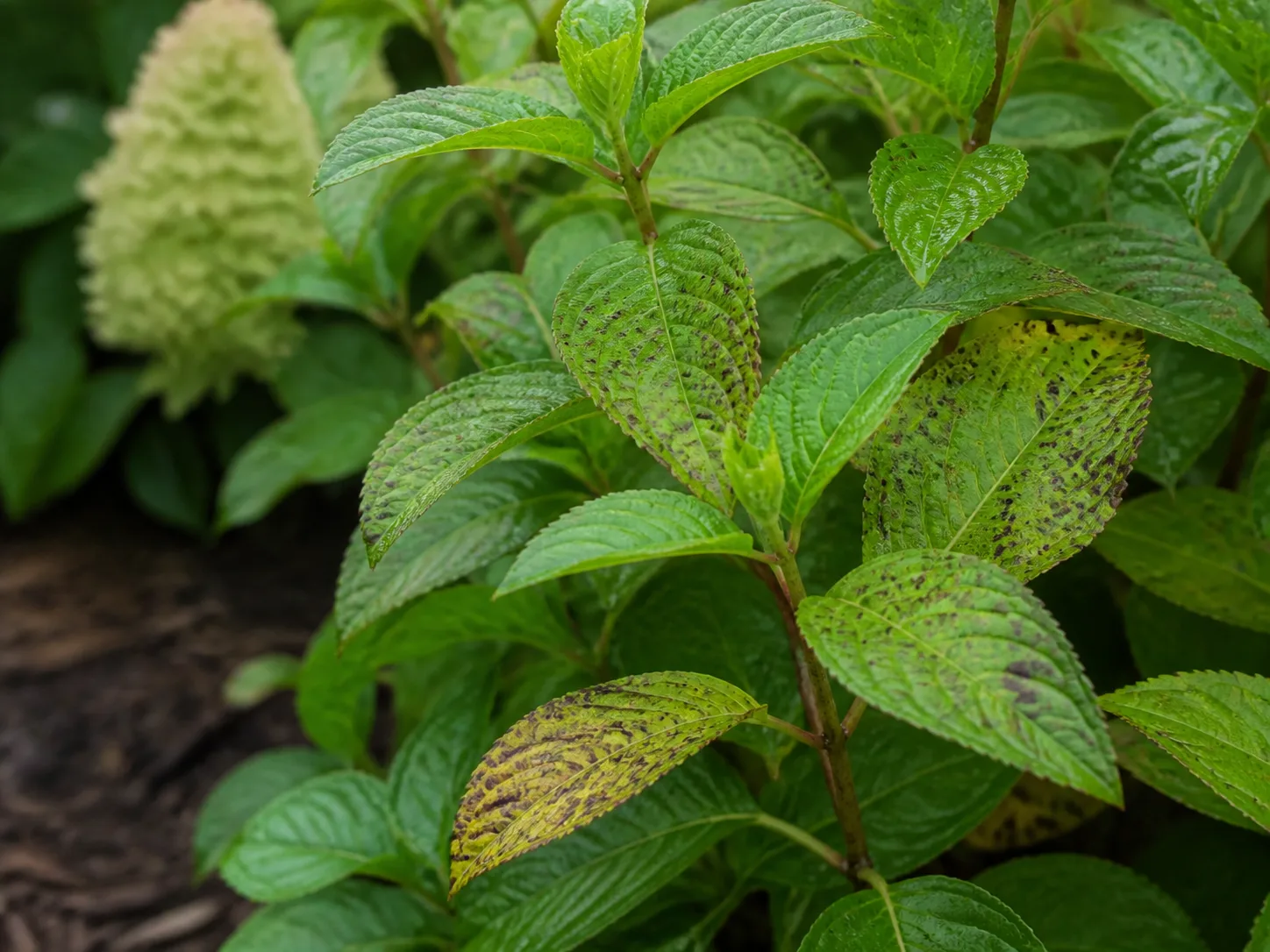
Panicle hydrangeas are generally robust, but aphids, scale insects, mites, leaf spot, powdery mildew, rust, and other problems can occur .NC State Extension notes that several pests may be present but are rarely serious; the plant can also have brittle stems that are vulnerable to wind .Inspect the pattern before using a pesticide: scattered insect feeding, uniform edge scorch, and fungal spots are different problems
.Remove diseased leaves as they fall, give crowded plants airflow, avoid prolonged overhead watering, and use a pesticide only when the pest is identified and the label allows that use.
Propagate a Peegee hydrangea from softwood cuttings
A softwood cutting taken from healthy, nonflowering growth is a practical way to make another hydrangea. Cultivar rights can restrict propagation of patented or protected selections, so check the label before multiplying a named modern variety. For an unprotected plant, take cuttings in late spring or early summer while shoots are flexible but not limp.
Use clean, sharp pruners to take a 4- to 6-inch stem with at least one or two nodes .Remove the lower leaves, leaving one or two sets near the tip; if those leaves are large, trim their blades to reduce water loss .Insert the lower node into a clean, moist, free-draining propagation mix
.Rooting hormone is optional .Cover the pot loosely with a clear humidity dome or bag that does not press against the leaves, and place it in bright indirect light away from hot direct sun.
Check the mix often enough to keep it lightly moist, not saturated, and ventilate the cover if condensation stays heavy .Tug very gently after several weeks; resistance can indicate roots, but do not keep pulling to test every day .The University of Connecticut’s propagation guidance also recommends nonflowering shoots, reducing excess leaf area, and keeping the rooting medium moist but not soggy
.Once new growth is steady and roots hold the mix together, pot the cutting into a small container and harden it off gradually before planting it outdoors.
Prepare the plant for winter and handle it safely
Peegee hydrangea is notably cold-hardy compared with many garden hydrangeas, and established plants usually need little special winter protection where the species is hardy .In exposed sites, a healthy mulch layer helps protect roots from repeated freeze-thaw cycles and moisture swings .Do not wrap the branches tightly or prune away every flower head solely for winter: dried panicles add structure, and the plant will be pruned when dormant if shaping is needed
.For a newly planted shrub, consistent moisture through fall matters more than a late fertilizer application.
Keep hydrangea foliage, flowers, and stems away from pets that chew plants. The Pet Poison Helpline hydrangea profile lists Peegee as a common name and notes that all hydrangea parts contain cyanide-forming compounds; the risk depends on how much an animal eats and other factors, so contact a veterinarian or pet poison service promptly if ingestion occurs. Gloves are sensible while pruning if your skin is sensitive, and pruned stems should go into yard waste rather than where pets can mouth them.
Conclusion: match the plant to the site before you prune
Peegee hydrangea is a cold-hardy, summer-flowering panicle shrub that can become much larger than a small foundation plant. Give it enough room, sun that suits your summer climate, moisture that reaches the root zone, and soil that drains after rain. Confirm whether your label names Hydrangea paniculata ‘Grandiflora’ or another panicle cultivar, because common-name use can blur very different mature sizes.
Prune in late winter or early spring when you need to shape or renew the plant, but keep the framework sturdy and remember that annual hard cutting is optional. When leaves wilt or flower heads droop, check soil moisture, drainage, light, and stem strength before reaching for water or fertilizer. Those few choices do more for a resilient shrub and a dependable display than a rigid care calendar.



