How to Grow and Care for Philodendron Imperial Green
Keep Philodendron Imperial Green compact and healthy. Identify Imperial Red, water by soil dryness, troubleshoot yellow leaves, and choose a safe location.
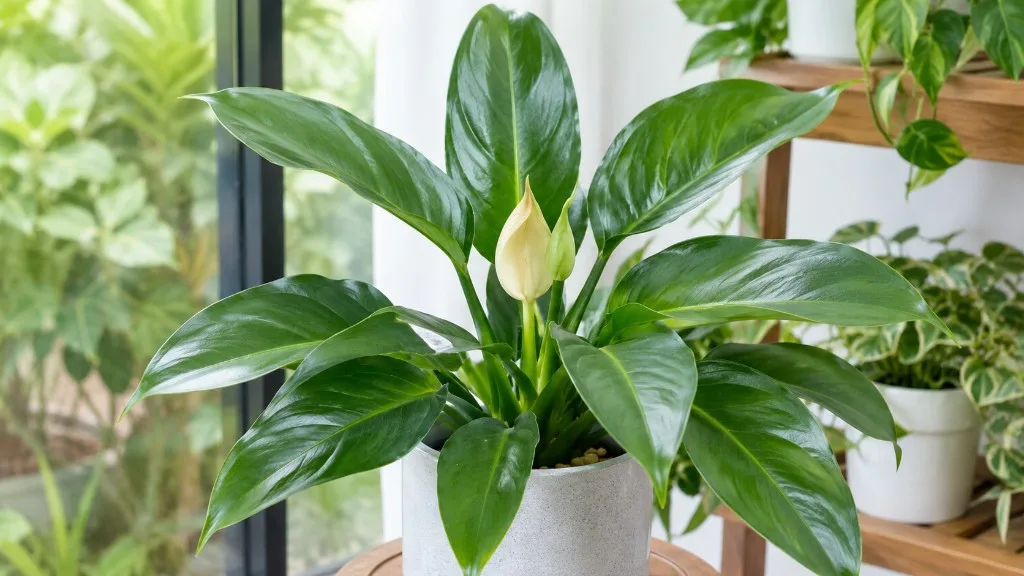
Philodendron ‘Imperial Green’ is an upright, self-heading philodendron with broad, glossy leaves. It usually needs no moss pole. Its care becomes easier once you stop treating it like a trailing vine: the plant’s dense crown can stay upright even while its roots are stressed, so a damp pot and several yellowing lower leaves deserve a soil check before another watering.
Give it bright to medium indirect light, a draining potting mix, and a warm room. Water thoroughly only after the upper mix has dried, then empty the saucer or cachepot. Those habits matter more than a fixed weekly schedule, a humidity gadget, or strong fertilizer.
Philodendron Imperial Green care at a glance
Start with the plant’s new growth and the pot’s moisture, not a care calendar. A well-placed plant should produce firm leaves and a reasonably compact crown; the pot should drain freely and become lighter as the mix dries between waterings.
| Care factor | Practical starting point | What to check |
|---|---|---|
| Light | Medium to bright indirect light | Are new leaves broad, with compact petioles? |
| Water | Let the upper 2–5 cm (about 1–2 in.) dry, then soak and drain | Is the root zone still wet or the pot still heavy? |
| Soil | Loose, organic-rich, free-draining mix | Does water move through instead of pooling? |
| Temperature | Warm indoor conditions; avoid cold drafts | Is the plant next to a cold pane or vent? |
| Fertilizer | Dilute, balanced feed during active growth if needed | Is growth active and the mix already moist? |
| Support | Usually none | Is it stretching toward light rather than lacking a pole? |
These are starting points, not cultivar-specific laboratory thresholds. The Royal Horticultural Society advises indirect light, temperatures above 15°C (59°F), average household humidity, and allowing compost to dry slightly between waterings; NC State Extension gives a warmer 18–29°C (65–85°F) range for P. erubescens. In a typical home, keep the plant warm and avoid sudden extremes rather than chasing one exact number (RHS; NC State Extension).
Understand its self-heading growth habit
“Self-heading” describes how leaves emerge close together from a short central stem, forming an upright clump or rosette. Many philodendrons climb or trail, but UF/IFAS describes hybrid philodendrons as large-leaved and upright, and notes their containers should be stout enough to prevent toppling. UConn likewise distinguishes philodendrons that do not require support from climbing types (UF/IFAS; University of Connecticut).
That growth pattern changes what you troubleshoot. A weakly lit Imperial Green may stretch its petioles and loosen its crown; a plant in a narrow lightweight pot may tip as the leaves enlarge.
Neither problem is solved by adding a moss pole. Give the crown balanced light, rotate the pot periodically, and choose a broad-based container that can support the leaf mass.
The name is used for a cultivated hybrid sold in the Philodendron erubescens group. The species can climb in habitat, but the compact houseplant form is selected for upright growth. Do not use care directions for a vining heartleaf philodendron as a reason to cut this plant into stem sections or train it up a pole.
Tell Imperial Green apart from Imperial Red
Imperial Green and Imperial Red share a similar upright form, so check the color of several newly opening leaves rather than relying on a loose nursery tag. Imperial Green is selected for foliage that emerges green and matures green. Imperial Red typically shows conspicuous burgundy or reddish new growth before the leaves darken; exact tones shift with cultivar, lighting, and growing conditions.
| Clue | Imperial Green | Imperial Red |
|---|---|---|
| New leaves | Green to lighter green | Commonly red, copper, or burgundy tinted |
| Mature foliage | Glossy green | Dark green with warmer red or burgundy tones |
| Habit | Upright, self-heading | Upright, self-heading |
| Moss pole | Usually unnecessary | Usually unnecessary |
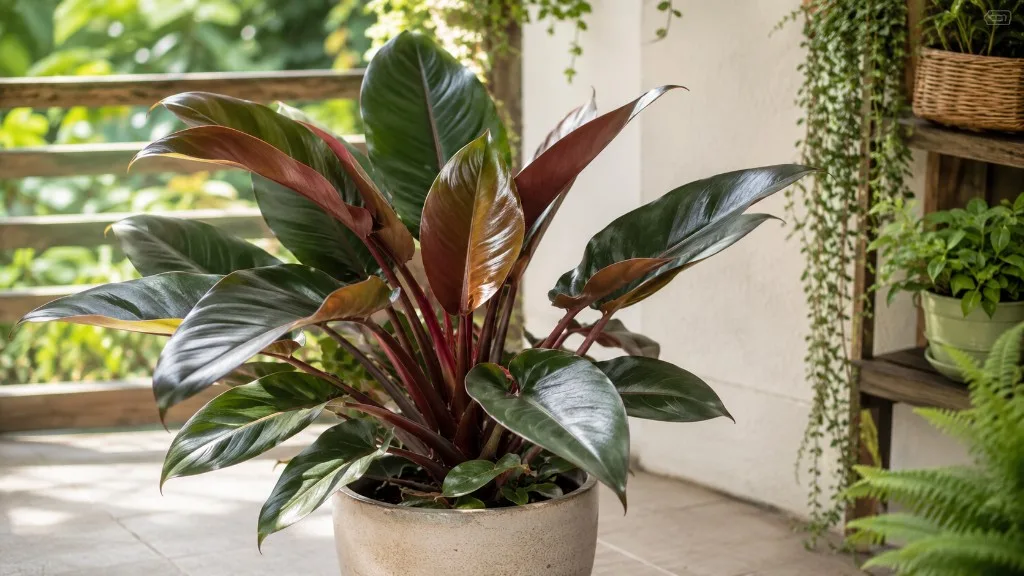
If a plant sold as Green repeatedly pushes wine-colored new leaves, ask the seller to confirm the cultivar before changing fertilizer or light. Red coloration by itself is not a deficiency symptom. Other self-heading hybrids, such as Congo types or Birkin, can also look similar from a distance, so compare several mature and emerging leaves and, when possible, the original grower’s label.
Choose light that keeps the crown compact
Place Imperial Green near a bright window where the leaves do not receive prolonged, hot direct sun. An east-facing window often supplies useful morning light.
A south- or west-facing window can work with a sheer curtain or a little distance from the glass; a north-facing window may be too dim in winter, especially if it is across the room. UF/IFAS recommends medium to bright indirect light for hybrid philodendrons, while NC State notes that the parent species prefers partial shade or dappled conditions and should be protected from direct sun (UF/IFAS; NC State Extension).
Judge the location by the next leaves, not by how bright the room looks to you. Longer petioles, smaller blades, slow growth, and a crown leaning toward a window point toward insufficient or uneven light.
Bleached tan patches or dry, sun-facing areas after a sudden move suggest that the leaves received more direct sun than they could handle. Garden Design’s philodendron guide also cautions that direct sunlight can burn foliage and recommends a window location where sunlight does not land directly on the leaves (Garden Design).
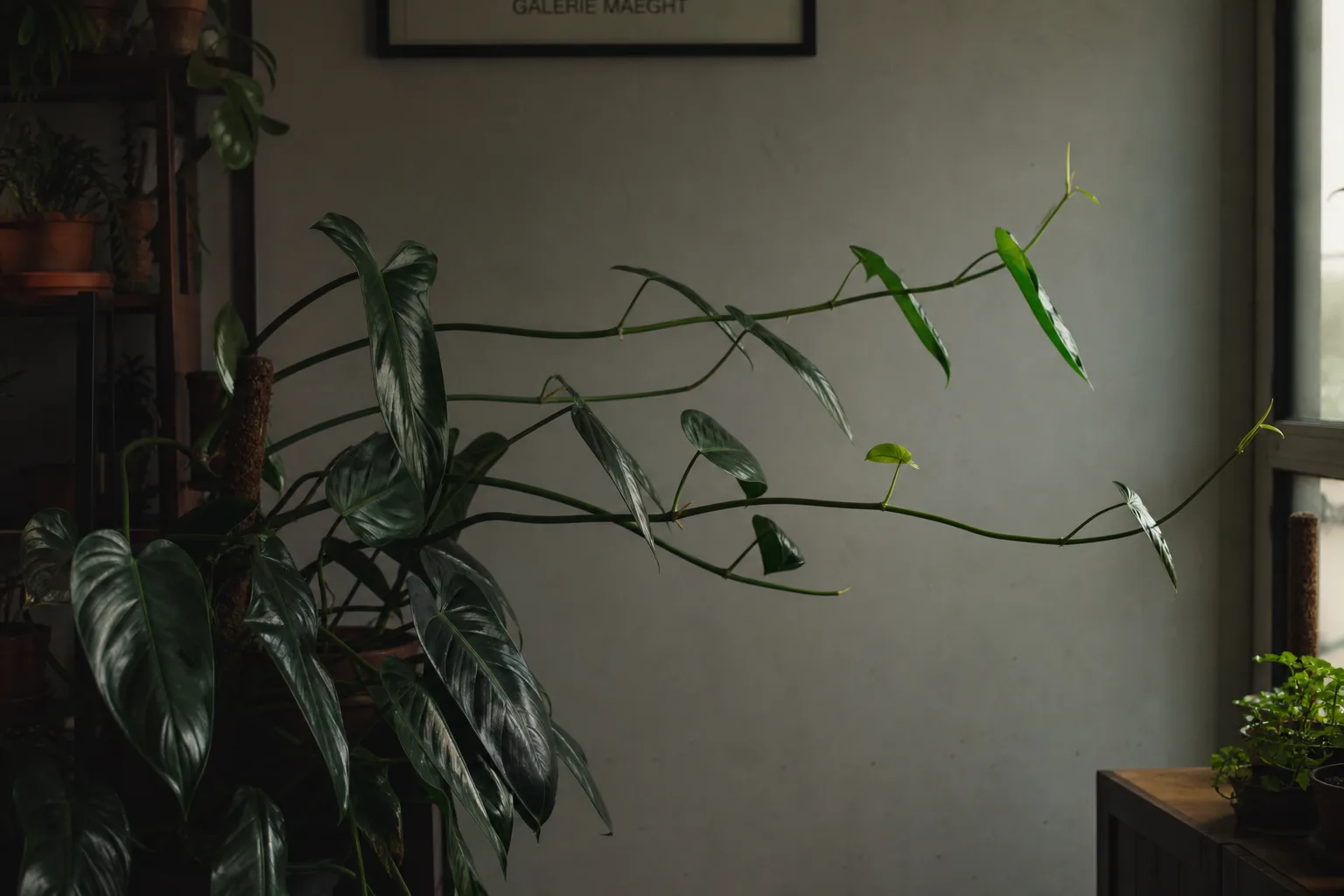
If you move a plant from a dim corner to stronger light, step it brighter over about a week instead of putting it against hot glass in one jump. Turn the pot a quarter turn every week or two if growth consistently faces one direction. A full-spectrum grow light can help in a windowless room, but use the fixture’s distance and duration instructions; an overly close lamp can warm or scorch leaves.
Water after checking the potting mix
Check the top 2–5 cm (about 1–2 inches) of mix with a finger or wooden skewer. When that layer is dry and the pot has become noticeably lighter, water slowly and evenly until excess runs from the drainage holes.
Let it drain fully, then empty the saucer or decorative cachepot. UF/IFAS recommends watering hybrid philodendrons when the top inch of soil feels dry; the RHS similarly advises allowing compost to dry slightly and avoiding overwatering (UF/IFAS; RHS).
Do not interpret “dry on top” as permission to let the whole root ball become bone dry for long periods. The surface dries before the center of a large pot, so use the finger test together with pot weight.
A small plant in a warm, bright room may need checking more often than a large specimen in a cool office. Plastic, glazed ceramic, dense peat, a tight cachepot, and low winter light all slow drying.
Yellow leaves are not an automatic signal to add water. If the pot is still heavy, the mix smells sour, or lower leaves yellow while the petioles soften, pause and check drainage.
Waterlogged roots lose access to oxygen and may die, which reduces the plant’s ability to take up water even when the mix is wet; the Missouri Botanical Garden explains this root-oxygen problem in its overwatering guidance. Conversely, a very light pot with dry mix and limp leaves is more consistent with thirst. Correct the likely cause before trimming healthy foliage.
Build an airy root zone and choose a stable pot
Use a loose, organic-rich potting mix that drains freely and still holds some moisture. UConn recommends well-drained soil high in organic matter, and RHS calls for loose, free-draining compost.
A practical home starting mix is ordinary indoor potting mix amended with coarse perlite and a modest amount of orchid bark; adjust the blend if it stays soggy for many days or dries before the plant can use the water. The goal is a root ball that wets evenly, drains, and then regains air—not a fixed recipe that works identically in every climate (UConn; RHS).
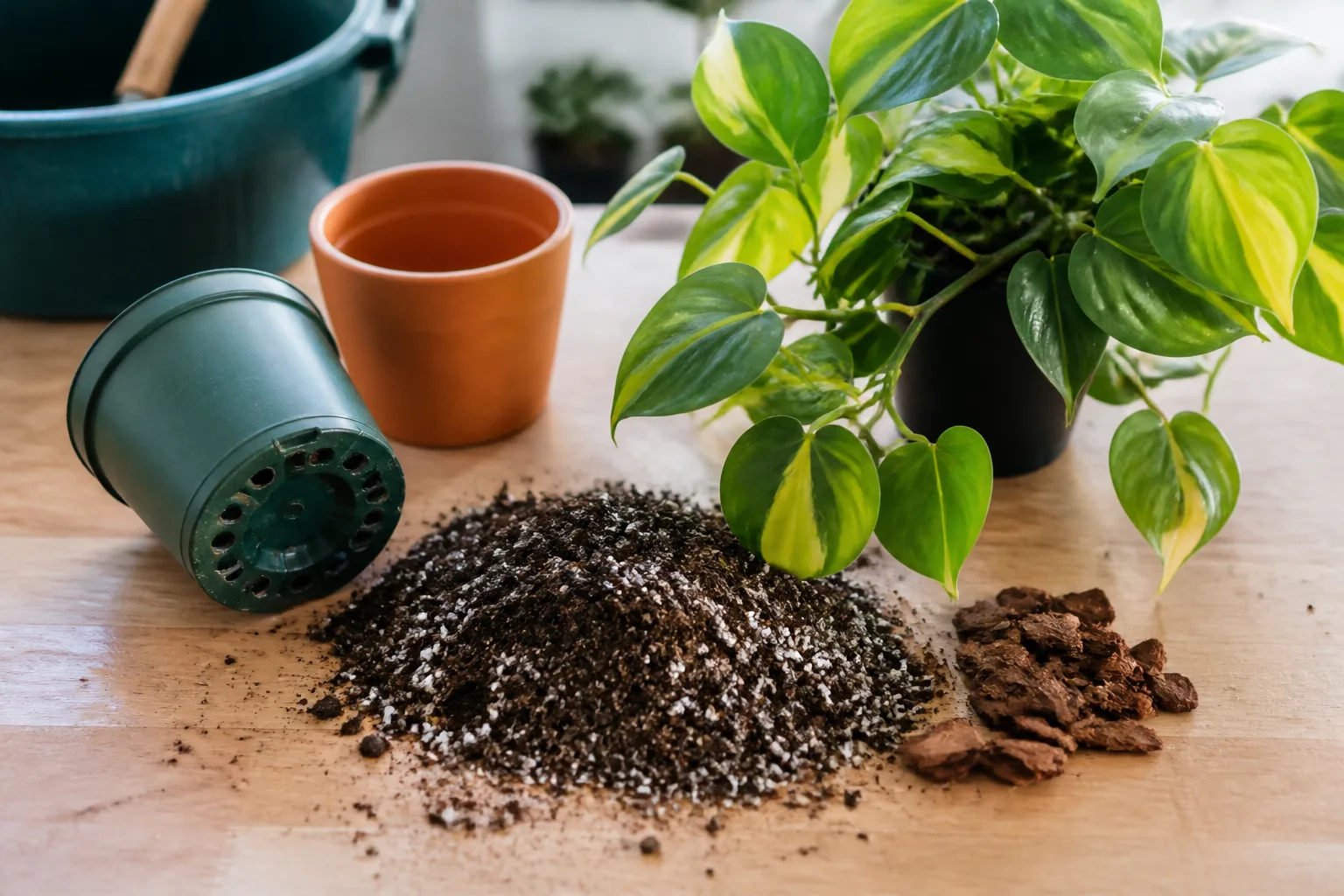
Choose a pot with open drainage holes and a wide enough base to resist tipping. When repotting, move up only slightly; too much unused mix stays wet longer than a closely fitted root ball.
Terracotta can dry faster than plastic, which helps a grower whose mix remains wet, but it also means more frequent checks in a warm, bright room. Whichever pot you use, never leave the bottom sitting in runoff.
Keep temperatures warm and humidity moderate
Imperial Green is a tropical foliage plant, so protect it from cold drafts, chilled window glass, air-conditioner blasts, and heating vents. NC State lists 65–85°F (18–29°C) as the preferred range for P. erubescens and advises protection from cold drafts. The RHS says philodendrons can manage typical indoor humidity if kept above 59°F (15°C), which is a useful lower boundary, not a target for rapid growth (NC State Extension; RHS).
Average household humidity is usually workable. If leaf edges repeatedly dry in heated winter air, first rule out underwatering, salt buildup, and direct airflow; then consider grouping plants or using a room humidifier.
A brief misting does not reliably change room humidity, and leaving foliage wet for long periods is not a substitute for root care. Keep leaves from touching cold panes, particularly overnight.
Feed lightly during active growth
Fertilizer can support new leaves, but it cannot compensate for poor light or failing roots. During active spring and summer growth, use a balanced liquid houseplant fertilizer diluted according to its label.
If you want a cautious starting dose, use half strength on already moist mix and observe the plant before repeating. UConn recommends more frequent half-strength feeding rather than a single strong dose and says to apply fertilizer to soil that is already moist; it also notes low-light plants need less feeding than actively growing ones (UConn).
Reduce or stop feeding when growth slows in winter, after root disturbance, or while the plant is recovering from pests. A white crust around the pot rim or mix surface and persistent crispy tips can signal fertilizer salts.
If drainage is good, flush the pot with plain water and let it drain thoroughly. Do not add a stronger dose because a leaf is yellow; diagnose moisture and light first. UF/IFAS lists excess fertilizer and improper watering among causes of brown leaf tips on hybrid philodendrons (UF/IFAS).
Repot when the roots need room
Repot when roots densely circle the container, emerge repeatedly from drainage holes, the root ball dries unusually fast, or the plant becomes unstable. A calendar interval alone is a poor reason to disturb a healthy plant. Spring or early summer is convenient because growth is resuming, but a pot with no drainage or a persistently waterlogged mix needs correction when you discover the problem.
Slide the root ball out gently and look for firm roots and a mix that still drains. If roots are healthy, loosen only the outer circling roots, place the plant at its previous depth in a pot one size larger, and fill around it with fresh mix.
Do not bury the crown or compact the mix hard. Water once to settle the medium, allow excess to drain, and wait for the usual dry-down cue before watering again.
If roots are dark, soft, or sour-smelling, remove clearly decayed tissue with clean snips and discard the stagnant mix. Use a clean pot with working drainage and fresh airy medium. Recovery is uncertain when rot has reached the central crown, so avoid repeatedly unpotting a plant that is stabilizing; check for firm new growth instead.
Propagate only from a viable growth point
Imperial Green is less straightforward to propagate than a trailing philodendron. A stem cutting needs a viable node or bud; a detached leaf or leaf stalk alone usually cannot form a new plant.
The compact crown also hides short internodes, so it may be hard to take a useful cutting without damaging the parent. General philodendron propagation advice varies because the genus includes both vining and self-heading forms; Gardening Know How distinguishes these habits, while RHS recommends division for non-vining philodendrons (Gardening Know How; RHS).
The lowest-risk home method is to divide a basal offset only when it has its own roots and at least one growing point. At repotting, separate the offset gently with a clean blade, keeping its roots attached, then pot it in a small container that fits its root system.
Keep the medium lightly and evenly moist while it re-establishes, not saturated. If no rooted offset is present, leave the plant intact rather than cutting the crown to experiment.
Do not expect every plant to produce offsets, and do not promise that a stem cutting will root just because other philodendrons root readily. Commercial tissue culture is one reason compact hybrids are commonly sold as established plants; it does not mean home division is impossible, only that the plant’s actual growth points determine whether propagation is practical.
Prune and clean without damaging the crown
Remove a fully yellow, badly damaged, or dead leaf by cutting its petiole near the base with a clean, sharp tool. Avoid nicking the central growing point or pulling a leaf out with force. One older lower leaf yellowing while the rest of the plant produces healthy growth can be normal; several leaves changing at once call for a check of water, drainage, and recent environmental changes.
Wipe dust from broad leaves with a damp soft cloth so you can inspect the surface and undersides. Avoid leaf-shine products, which do not fix plant stress and may leave residue. If you divide or prune, wash tools afterward and wear gloves if plant sap irritates your skin.
Troubleshoot yellow leaves, brown tips, and leaning
Change one likely cause at a time, then watch the next leaf. Existing brown patches will not turn green again, so use the rate of new damage and the condition of new growth to judge whether the correction helped.
| What you see | Check first | Useful next step |
|---|---|---|
| Several lower leaves yellow; mix stays wet | Cachepot, drainage holes, low light, sour smell | Empty trapped water; allow the mix to dry partly; inspect roots if decline spreads |
| Limp leaves; pot very light and mix dry | Dry root ball, especially near the center | Water slowly until runoff; recheck in a day rather than repeating a small splash |
| Long petioles and smaller new leaves | Light level and distance from window | Move brighter gradually; do not add fertilizer first |
| Tan, crisp patches on the window side | Direct sun or hot glass | Filter the sun and acclimate any future move |
| Dry leaf tips with otherwise firm growth | Low humidity, salts, irregular watering, or vent exposure | Check the mix and fertilizer history; move away from airflow before changing several things |
Overwatering is not simply “too much water at once.” It is often a root zone that remains oxygen-poor because the pot, mix, light, and watering rhythm keep it saturated.
The Missouri Botanical Garden notes that roots in waterlogged soil may die when they cannot absorb the oxygen needed to function; damaged roots then fail to supply the plant normally. If the crown is firm and only one old leaf is fading, avoid an unnecessary emergency repot. If the root ball is sour and soft, address drainage and inspect it promptly.
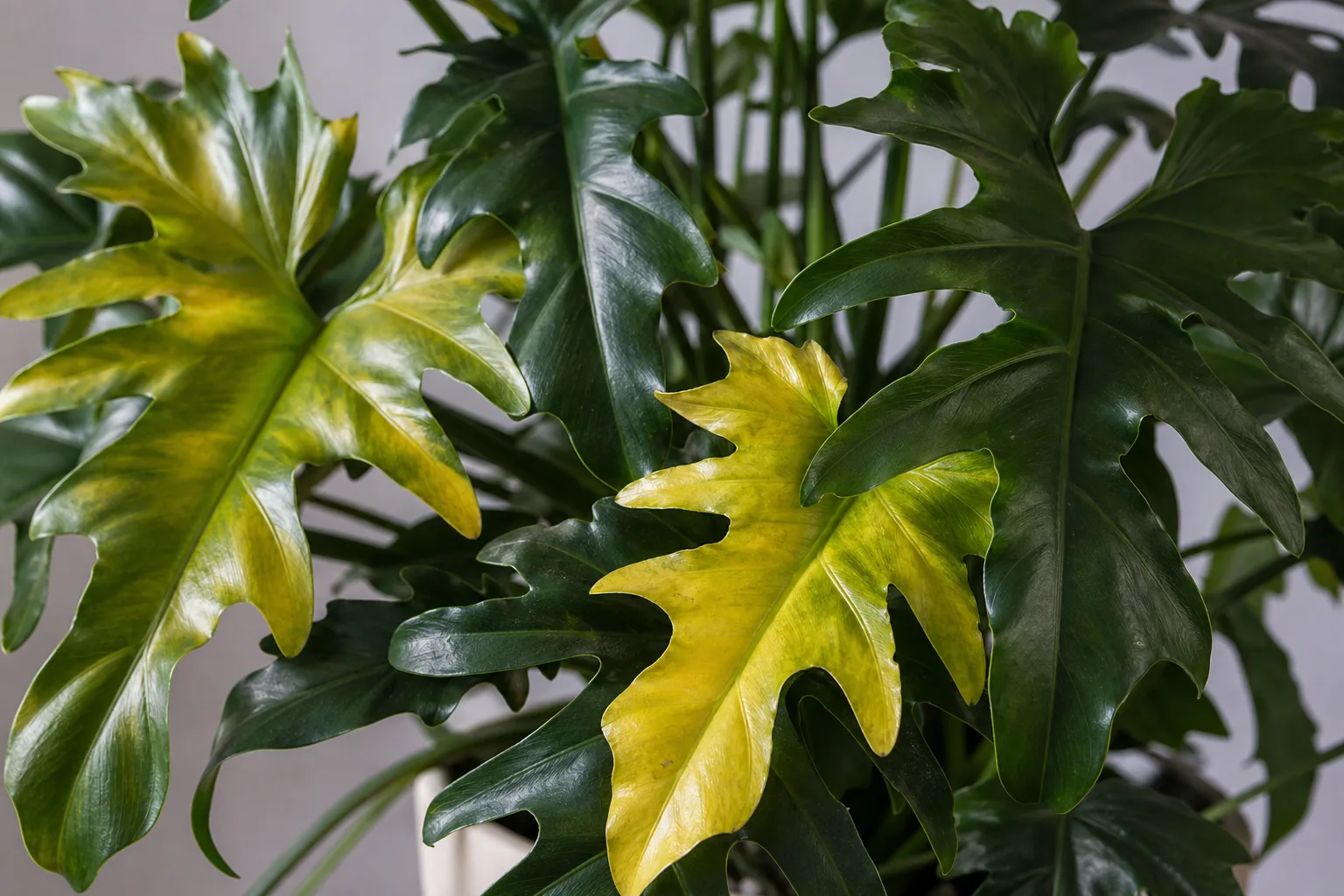
For brown tips, check the fertilizer history and nearby vents before increasing humidity. For a leaning crown, distinguish a simple tilt toward the window from a stretched plant with long petioles; rotate the former and move the latter to brighter indirect light. If a problem worsens after a correction, revisit the diagnosis instead of layering on more water, fertilizer, and pruning.
Check for pests and quarantine new plants
Inspect a new plant before it joins a collection, then keep it separate for about two weeks if space allows. Examine leaf undersides, the crown folds, and the points where petioles meet the stem.
Mealybugs look cottony, scale appears as fixed bumps, aphids gather on soft growth, and spider mites can leave fine webbing with pale stippling. NC State lists spider mites, mealybugs, aphids, and scale among pests to watch on P. erubescens (NC State Extension).
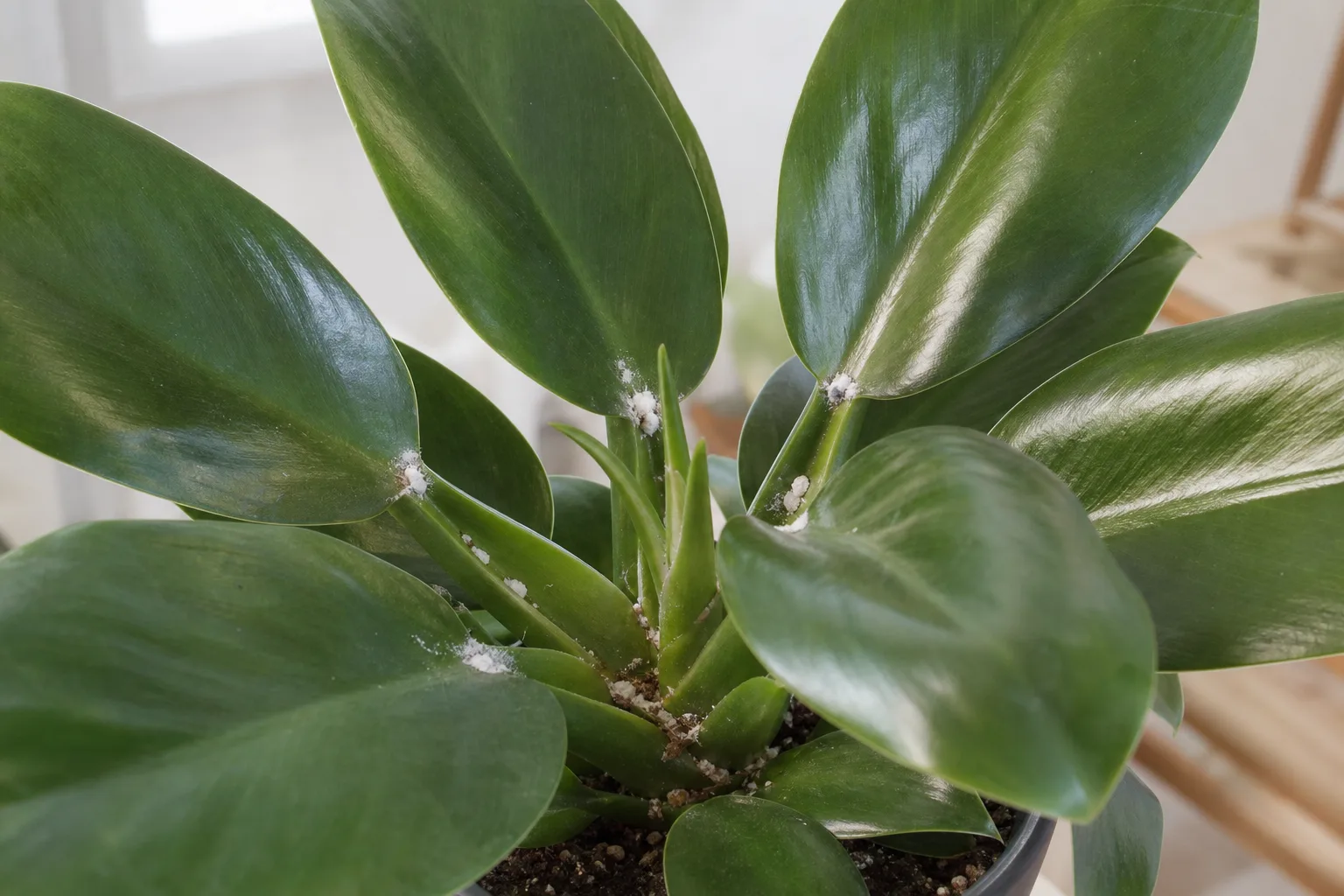
If you find pests, isolate the plant and identify the pest before choosing a control. A rinse or careful wipe can remove small populations; for a labeled insecticidal soap or horticultural oil, follow the product label and test a small area first.
Repeat only at the label interval because one wash rarely removes hidden eggs or insects. Do not apply household dish soap as a pesticide; its ingredients and concentration are not standardized for plant safety.
Move the plant outdoors only in suitable weather
Imperial Green is most predictable as a houseplant in temperate climates. In a warm, frost-free region, it can spend time outside in bright shade if the container drains and the location is sheltered from wind. The species information from NC State describes P. erubescens as tropical and advises protection from cold and direct sun; broad philodendron care guidance also emphasizes shade and well-draining soil outdoors (NC State Extension; Gardening Know How).
Do not carry a plant from a dim room into strong midday sun. Acclimate it outdoors gradually in shade, check the pot more often as wind and warmth speed drying, and bring it back inside before nights become chilly. A patio stay is optional, not a requirement for healthy indoor growth.
Protect pets and children from plant tissue
Keep Imperial Green where children and pets cannot chew it. Philodendron tissue contains calcium oxalate crystals; the National Capital Poison Center describes immediate irritation and swelling after chewing or sap exposure, with drooling and painful or difficult swallowing possible in more serious oral exposures. NC State flags P. erubescens as a problem for cats, dogs, and children (Poison Control; NC State Extension).
Because this plant is a floor-sized specimen with reachable leaves, putting it on a tall stand only helps if pets cannot knock it down or climb to it; a closed, pet-free room is safer in a determined-chewer household. Wear gloves if sap causes skin irritation and wash hands after pruning.
If a person chews the plant, remove any plant material and contact Poison Control at 1-800-222-1222 for guidance; severe swelling or breathing trouble needs emergency care. For a pet exposure, call a veterinarian or ASPCA Animal Poison Control at (888) 426-4435. Keep a clear photo or the plant label available when you call, and do not induce vomiting unless a professional instructs you to do so.
Conclusion
Good Philodendron Imperial Green care starts with recognizing the upright crown and then responding to the conditions around it. Give it indirect light, use a draining mix in a stable pot, let the upper substrate dry before a full watering, and keep runoff out of cachepots. Add fertilizer only during active growth, repot when roots need room, and divide only a rooted offset with a clear growth point.
If new leaves are shrinking and reaching, improve light before feeding. If lower leaves yellow while the mix stays wet, pause watering and inspect drainage before assuming the plant is thirsty. Keep the leaves beyond reach of pets and children, and judge progress by healthy new growth rather than a fixed watering date.