Powdery Mildew: Treatment and Control on Plants
Learn how to treat powdery mildew on houseplants, flowers, vegetables, and shrubs with diagnosis, sanitation, airflow, and label-led control.
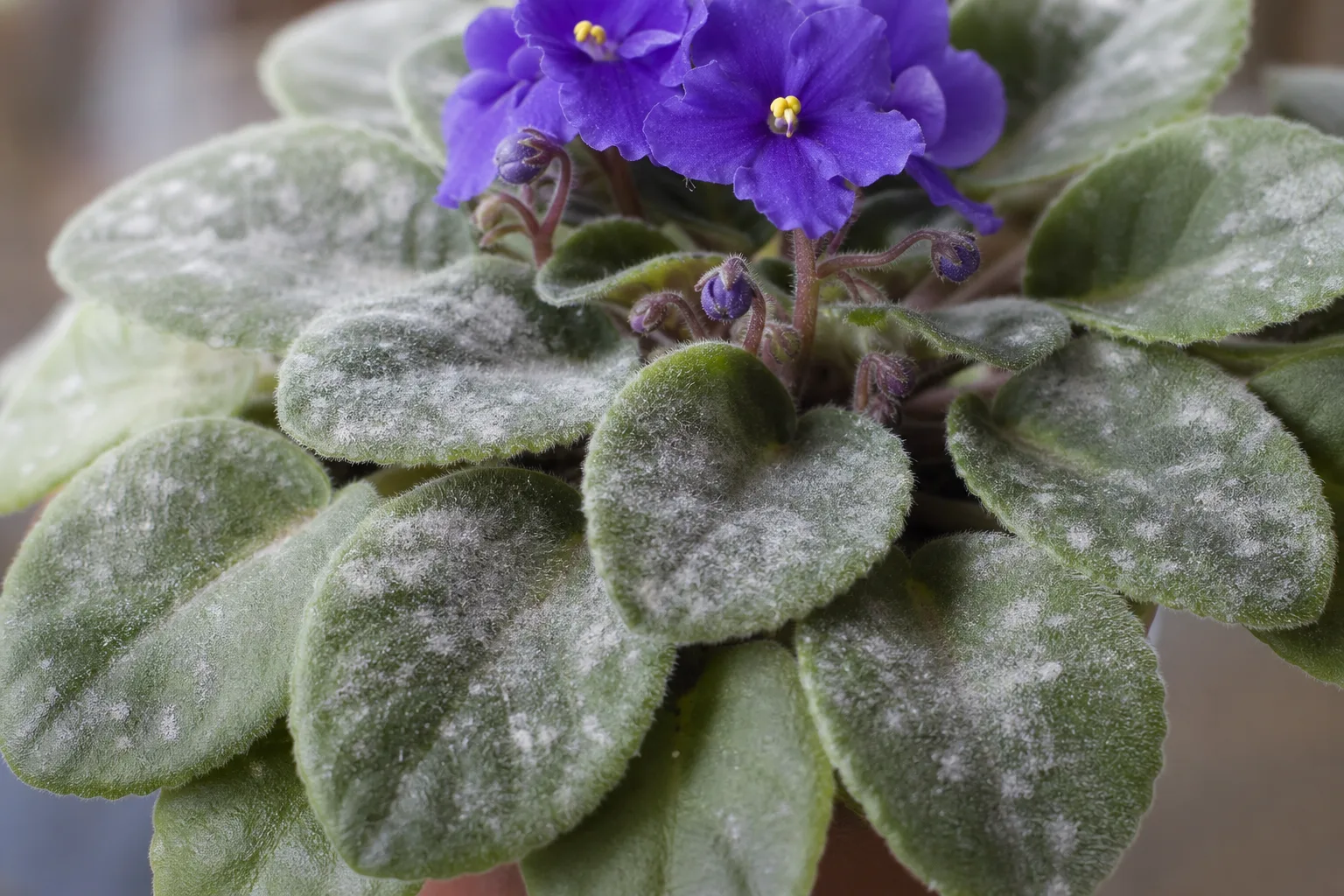
Powdery mildew is the white coating that looks like flour or confectioners’ sugar on a leaf. It is usually a fungal disease, but the most useful treatment starts with a better question than “Which spray kills it?”: Is this actually powdery mildew, and how much living tissue is involved?
If the diagnosis is right, act in this order: isolate the plant or mark the affected bed, remove the worst infected tissue, clean anything that touched it, correct stagnant growing conditions, and use a product labeled for powdery mildew only if the infection keeps producing fresh spots. A fungicide can protect new tissue or slow spread; it cannot repaint a damaged leaf green.
Start with the 60-second diagnosis
Before pruning or spraying, inspect both sides of several leaves, the newest growth, stems, buds, and nearby plants. Powdery mildew often starts as separate round spots and then joins into a soft-looking white film. A hand lens may reveal the powder as chains of tiny spores, but you can usually make a practical field diagnosis without one.
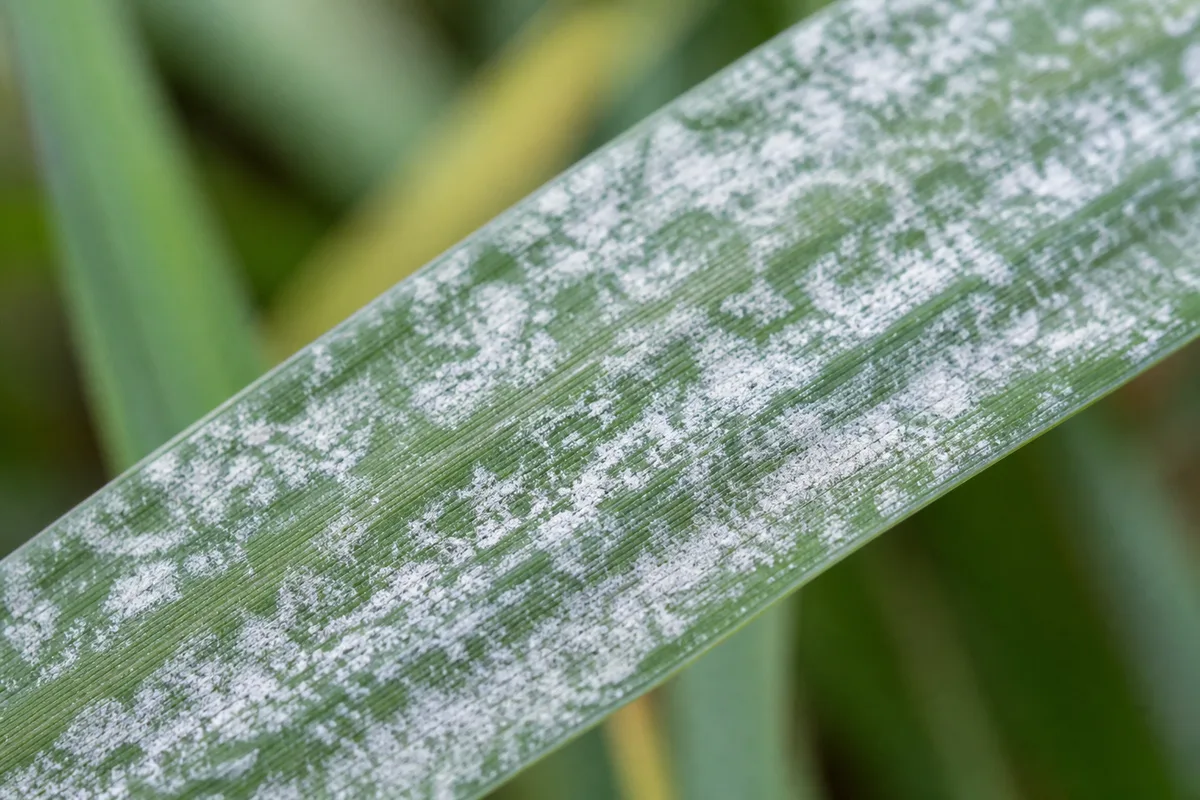
A close view of powdery mildew: the white growth sits on the leaf surface and spreads in irregular patches.
How powdery mildew looks on leaves, stems, buds, and flowers
The first sign is commonly a few circular white or gray patches on a leaf surface. They may appear on the upper surface, underside, or both, and can spread onto petioles, stems, flower buds, petals, and, on some hosts, fruit. New foliage is often more vulnerable than mature leaves, so a plant may look fine at the base while its newest shoots are already coated.
As the infection expands, affected leaves may yellow, curl, twist, brown, or drop early. Flowers can be fewer or misshapen, while vegetables and fruiting plants may lose yield or quality because a heavily coated leaf makes less food for the plant. Established shrubs and perennials often survive, but “rarely fatal” is not the same as harmless: a severe, repeated outbreak can weaken a plant and shorten its productive season.
The fungus is mostly growing on the plant surface while sending feeding structures into the outer cells. That surface habit is why early removal, light, and moving air matter so much. Penn State Extension describes the familiar flour-dusted appearance, the vulnerability of young foliage, and the way severe infections can stunt growth, yellow leaves, and reduce flowers or fruit.
Powdery mildew vs downy mildew, dust, and fertilizer salt
White on a leaf is not a diagnosis. Use the pattern and the location to rule out the common false alarms before applying anything.
| What you see | More likely explanation | Useful next check |
|---|---|---|
| Soft white spots that enlarge and merge on living leaf tissue | Powdery mildew | Check both leaf surfaces and nearby new growth; look for spreading circular patches. |
| Yellow or pale angular areas on top with gray, fuzzy growth underneath after prolonged leaf wetness | Downy mildew or another leaf disease | Inspect the underside and review recent rain, misting, or overnight wetness. |
| A thin, loose coating that wipes away cleanly and does not return in matching patches | Dust or residue | Wipe one leaf, photograph it, and recheck in two or three days. |
| Hard white crust concentrated on the pot rim, soil surface, or drip marks | Fertilizer or hard-water salts | Clean the pot and review fertilizer and water quality; salts do not behave like a spreading leaf infection. |
| Cottony clusters around nodes or leaf axils, sometimes with visible insects | Mealybugs or another pest | Look for insects, honeydew, and webbing rather than a uniform surface film. |
Downy mildew is especially important not to confuse with powdery mildew because the two diseases prefer different conditions and need different management. Powdery mildew commonly favors warm, moderately dry weather, shade, and humid air trapped around the plant; downy mildew is more associated with cool, wet conditions and fuzzy growth on leaf undersides. UC Integrated Pest Management notes that powdery mildew species can also produce unusual symptoms on certain crops, including yellow patches with little visible powder. If the pattern does not fit, pause before treating.
Why powdery mildew appears in warm, dry weather
Powdery mildew is not a single fungus. Different species tend to specialize in different plant groups, which is why a mildew outbreak on squash will not automatically colonize every rose, tree, or houseplant nearby. Spores travel on air currents, but successful infection still depends on a susceptible host and a favorable pocket of weather around its leaves.
The humidity paradox and the indoor winter pattern
The disease’s most confusing feature is that many powdery mildews do not need a film of water on the leaf to germinate. Moderate temperatures around 60–80°F, humid air, shade, and stillness can be enough. High humidity helps spores form and infect, while drier moving air helps them disperse; direct sun and temperatures above about 90°F slow many species. Penn State Extension and UC IPM both emphasize that powdery mildew can develop without free water on the leaf.
That is why “keep the leaves wet” is poor general advice. A brief midmorning rinse can physically remove spores in some outdoor situations, but a misted plant in a dim room is more likely to get a long period of damp, stagnant air—and may invite bacterial or other fungal diseases. For most home growers, water the soil, not the foliage, and improve air movement instead.
Indoor outbreaks often appear in winter when a plant is close to a cool window, receiving less light, surrounded by other pots, and exposed to little ventilation. Purdue’s Plant and Pest Diagnostic Laboratory lists African violet, begonia, ivy, jade, and Kalanchoe among common indoor hosts and recommends ventilation, no misting, early isolation, and removal of infected tissue. Purdue PPDL’s houseplant guidance is particularly useful because the “dusty” look is easily mistaken for ordinary household dirt.
First response: stop the next round of spores
The first response is mechanical and environmental, not chemical. Spores are produced in the visible patches, so reducing the amount of active mildew and preventing leaf-to-leaf contact can slow the outbreak before you decide whether a product is warranted.
Isolate, inspect, and prune strategically
Move an infected houseplant away from the collection, ideally to a bright, ventilated area where its leaves do not touch other plants. Outside, do not drag a heavily coated plant through the bed; work in place, or move it only if doing so will not brush spores across neighbors. Check plants with overlapping foliage, shared grow-tent air, or the same sheltered wall first.
Remove leaves with broad, active patches, badly infected flower heads, and shoots that are coated from tip to base. On a shrub or vine, thin enough healthy foliage to open the canopy, but do not strip every leaf in one session. A plant needs green tissue to recover, and aggressive pruning can replace one stress with another. If only a few spots are present, remove those leaves promptly. If most of the canopy is covered, cutting away the worst tissue may be more useful than trying to make every leaf look perfect.
Bag the cut material as you work. Do not shake infected leaves over the plant or toss them into a nearby mulch pile. A clean cut that removes an entire infected leaf is usually better than rubbing the surface and scattering spores across the remaining canopy.
Clean tools and dispose of infected debris
Wipe pruners between plants and after cutting infected tissue. A practical home routine is to remove visible sap and debris, then wipe the blades with 70% isopropyl alcohol or another disinfectant suitable for garden tools; let the tool dry before the next cut. Wash your hands after handling an infected plant, especially before touching a healthy plant in the same collection.
Dispose of heavily infected leaves and stems in a sealed bag or the local green-waste stream that accepts diseased material. Compost guidance varies by pathogen, climate, and how hot and well-managed the pile is. Because a typical home pile may not reliably reach or maintain the required temperature, trash is the safer default for a severe outbreak. Remove fallen leaves from under outdoor hosts in autumn so dormant infections and resting structures have less plant material in which to persist.
Choose treatment by stage and setting
Think of powdery mildew control as a program, not a single rescue spray. Choose the least disruptive step that fits the situation, then watch for new patches on fresh tissue. If the disease is already widespread, a product may protect new leaves but will not reverse yellowing, curling, brown scars, or dead flowers.
Light infection: cultural cleanup before a spray
For a few spots on an otherwise vigorous plant, start with isolation, selective removal, more light, wider spacing, and gentle air movement. Stop misting. Water consistently at the root zone so the plant is not swinging between drought stress and saturation, but do not keep the potting mix wet in an attempt to cure a leaf disease.
Recheck every two or three days for a week. If no new patches appear and the plant is producing clean growth, you may not need a fungicide. This approach is especially sensible for houseplants because sprays can smell, mark furniture, irritate people or pets, and injure tender foliage when applied in a closed room. Take the plant outside for any product whose label requires outdoor application, and keep people and animals away for the label’s stated interval.
What labeled fungicides can and cannot do
When fresh spots continue after sanitation and environmental correction, select a product whose label specifically lists powdery mildew and the plant or crop you are treating. Common active-ingredient groups include potassium bicarbonate, horticultural or plant-based oils, sulfur, copper-based products, and biological fungicides such as certain Bacillus formulations. Availability, permitted crops, rates, protective equipment, and harvest intervals vary by country and product, so the package label is the controlling instruction—not a recipe copied from a different bottle.
Most products work best as protectants or early treatments. They may suppress spore production and protect new tissue, but they cannot restore a leaf that has already lost chlorophyll or erase a fungal film instantly. Apply thoroughly to the surfaces named on the label, including undersides when the label calls for it, and repeat only at the stated interval. Do not increase concentration because the first application did not make old marks disappear.
If you are treating edible crops, confirm that the product is labeled for that crop and follow the preharvest interval. If you are treating a valuable tree, a greenhouse collection, or a disease that returns despite correct use, ask a local extension office or plant diagnostic laboratory for host-specific advice. Different powdery mildew species and different cultivars can respond differently, and repeated use of one chemistry can select for less-sensitive populations.
Oils, sulfur, heat, and plant-safety rules
Oils can help with mild to moderate infections, but they are not automatically gentle. Test the label-directed dilution on a few leaves first and wait to check for injury. Avoid spraying drought-stressed plants, tender new growth, or foliage already heated by sun. Do not use oil when temperatures are too high for the product, and do not combine oil and sulfur applications without respecting the interval on both labels. UC IPM specifically cautions against oils after sulfur and in temperatures above 90°F.
Sulfur is often most useful preventively or at the first sign of disease, but it can burn foliage in heat and on sensitive plants. Copper products can also injure some plants and accumulate in soil with repeated use. Neem oil is a plant-based option, but it is still a pesticide: it can affect insects that contact wet spray, so avoid blooming plants with active pollinators and follow the label’s timing and application instructions.
Do not rotate products casually just to “use everything.” Rotate only among compatible, labeled modes of action when a recurring problem truly needs a program, and record the active ingredient and date. That small note prevents accidental back-to-back oil and sulfur treatments and helps you notice whether the outbreak is actually slowing.
Why homemade sprays are a poor default
Baking soda, milk, vinegar, dish soap, and mouthwash are common online suggestions, but “common” does not mean universally safe or equally effective. Sodium bicarbonate can add salts to the leaf surface or soil and burn foliage when overused. Vinegar and alcohol-containing products can damage the cuticle. Milk can smell and spoil in hot weather. Household dish soap is not the same as a labeled horticultural soap or surfactant and may strip leaf waxes.
If you choose a home mixture despite those limitations, treat it as a small-area experiment: identify the plant, test a few lower leaves, avoid drought, heat, and strong sun, and stop at the first sign of spotting or burn. Never use an untested kitchen recipe on an entire bed of edible crops or a prized collection. A labeled product with clear crop, rate, and safety directions is usually the more predictable choice.
The Royal Horticultural Society’s powdery mildew guidance takes a conservative position on fungicides and does not recommend homemade products because they are unregulated and often untested. The Farmers’ Almanac treatment guide is useful for practical timing and the reminder to test any spray on a few leaves, but its home recipes should be treated as options with plant-specific risk, not as a universal cure.
Prevent recurrence in the garden and home
Prevention works because powdery mildew spends much of its life on the plant surface. If you remove the sheltered, overfed, poorly ventilated conditions that let spores establish, you often need fewer sprays—or none at all.
Airflow, light, spacing, and watering
Give susceptible plants the brightest location their species can safely handle. “More sun” does not mean moving a shade plant straight into scorching afternoon light; it means avoiding a dense, dim pocket where leaves stay cool and airless. Outdoors, do not tuck a mildew-prone plant tightly against a wall or fence. Indoors, leave space between pots, keep leaves from touching glass or each other, and use a small fan on low so air circulates around the collection rather than blasting one plant.
Prune crowded centers and thin crossing stems before the season when mildew usually appears. Stake floppy plants, train vines away from one another, and remove weeds or volunteer hosts around a bed. Improve drainage and water deeply enough to prevent repeated drought stress, but apply water to the soil line when possible. If overhead watering is unavoidable outdoors, early-morning or midmorning timing allows rapid drying; do not turn a routine indoor misting habit into a disease-management plan.

Airflow matters more than chasing a particular humidity number: give leaves space and keep air gently moving.
High humidity is not automatically bad for a tropical plant, and lowering humidity until the plant wilts is not a cure. The practical target is humid enough for the plant, open enough that air does not sit motionless around the leaves. That distinction is especially important in bathrooms, grow tents, propagation shelves, and closed plant cabinets.
Resistant varieties, nitrogen, and seasonal scouting
When choosing seed or nursery plants, look for powdery mildew resistance or lower susceptibility for the specific crop. Resistance is not immunity, and a resistant cucumber in a crowded, shaded bed can still become infected, but the choice lowers the pressure from the start. Because powdery mildew species have narrow host ranges, a resistant cultivar is most useful when it matches the actual plant and local disease problem.
Avoid pushing a susceptible plant with repeated high-nitrogen feeding. Tender, lush growth is attractive to powdery mildew and can close the canopy before you notice. Feed according to the plant’s needs, keep the root zone healthy, and do not fertilize a severely stressed plant in the hope that a flush of new leaves will hide the damage.
Scout the plants that have failed before, especially when nights are cool, mornings are humid, and the canopy is thick. Check lower leaf surfaces, shoot tips, and flower buds once or twice a week. A small patch caught early is a pruning decision; a white film across the whole plant is a much harder recovery project.
Use a plant-specific playbook
For roses, lilacs, phlox, bee balm, zinnias, and other ornamentals, prioritize resistant cultivars, open spacing, early pruning, and removal of infected leaves or flower clusters. Cosmetic damage may be acceptable on an established shrub if new growth is clean, while a prized annual or a plant grown for flowers may justify early labeled protection.
For cucumbers, squash, pumpkins, melons, and other fruiting crops, start prevention before the first white patch: choose resistant varieties, give the vines room, avoid excess nitrogen, and scout regularly. Once leaves are heavily infected, protect the plant’s remaining healthy canopy rather than expecting a spray to restore old leaves. Keep the product label, crop listing, and harvest interval in view.
For houseplants, the environment usually matters more than the calendar. Isolate the pot, stop misting, move it away from a cold or dim corner, remove infected leaves, and clean the windowsill, pot rim, and tools. If it is a small plant with a widespread outbreak, replacing it may be kinder to the rest of the collection than maintaining a permanent source of spores in a closed room.
For edible herbs and plants that will be harvested soon, be stricter about product labeling and waiting periods. A “natural” active ingredient can still be a pesticide, and an edible crop can still be damaged by an incorrect concentration. When the disease is not clearly powdery mildew, get an identification before spraying food plants.
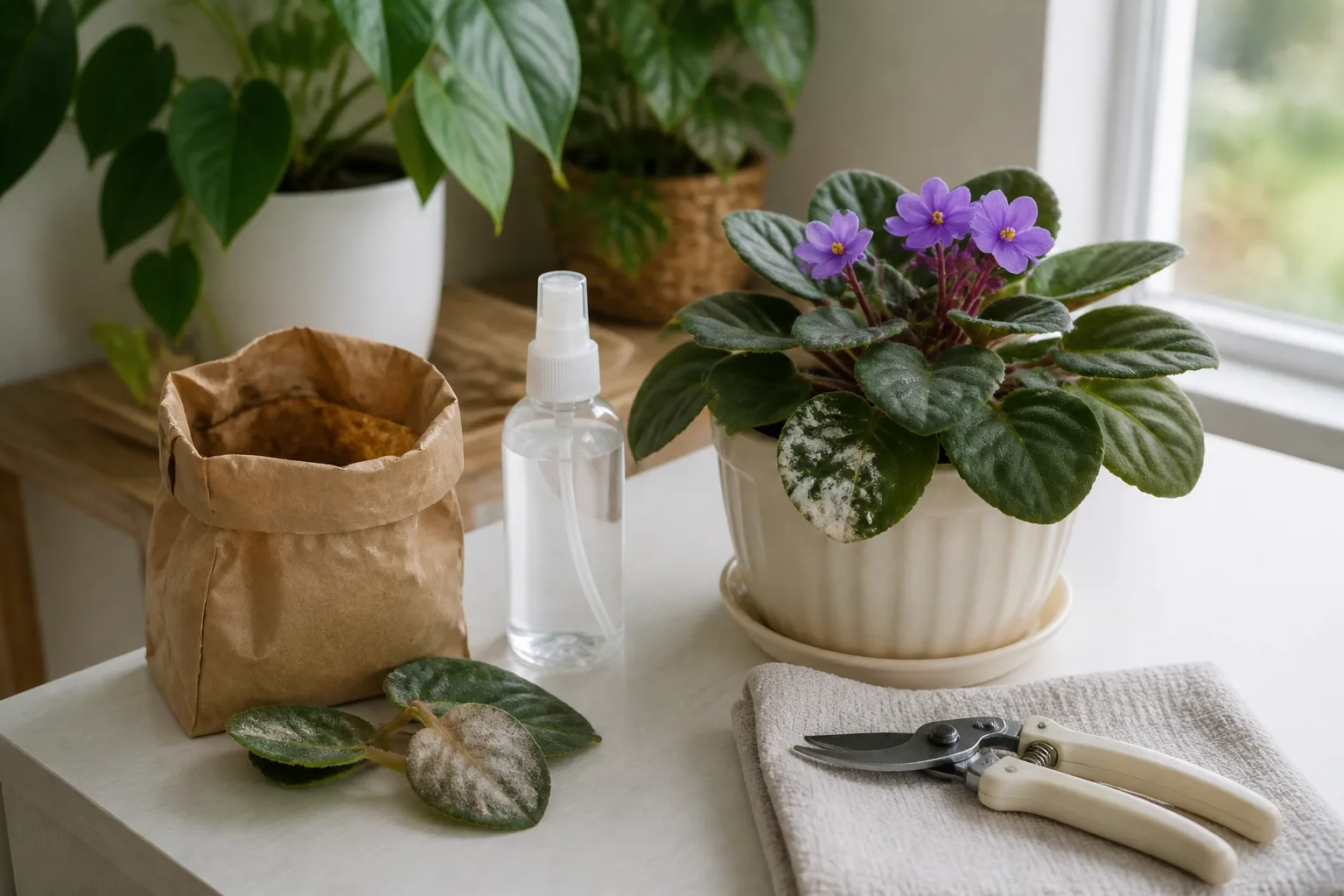
A useful treatment setup is simple: isolate the plant, remove infected tissue, clean tools, and keep the spray decision separate from the cleanup.
When to keep, replace, or ask for a diagnosis
Keep the plant when the infection is limited, the plant is valuable or vigorous, and you can change the conditions that caused it. You should see fewer fresh patches after sanitation and improved airflow, even if old leaves still look marked. New growth is the best recovery signal.
Consider replacement when most of the canopy is coated, the plant is inexpensive and easy to replace, repeated treatment is harming the foliage, or the pot sits in a closed collection where spores can reach many susceptible neighbors. Discarding one badly infected annual can protect a whole bed; discarding a rare plant is a bigger decision, so take healthy cuttings only if the cutting is truly free of symptoms and local guidance supports that approach.
Ask an extension service or diagnostic lab for help when the white growth does not behave like powdery mildew, when yellow or brown lesions dominate, when a valuable plant keeps relapsing, or when treatment fails despite correct label use and environmental correction. A photograph of the whole plant, a close-up of both leaf surfaces, the growing conditions, and the timeline will make an answer more useful than a single cropped leaf.
Conclusion
Powdery mildew control is most reliable when you treat the conditions and the disease together. Confirm the pattern, isolate the plant, remove the worst active growth, clean tools, open the canopy, and keep leaves dry while maintaining appropriate root-zone moisture. Then use a labeled product only when new infection continues, applying it at the correct rate and interval for that plant.
The realistic goal is not to erase every white mark from an old leaf. It is to stop fresh spore production, protect clean new growth, and make the plant’s growing space less hospitable to the next outbreak.



