How to Identify Ladybug Larvae in Your Garden
Ladybug larvae look like tiny alligators, but they are valuable aphid hunters. Learn the life cycle, lookalikes, and ways to keep them in your garden.
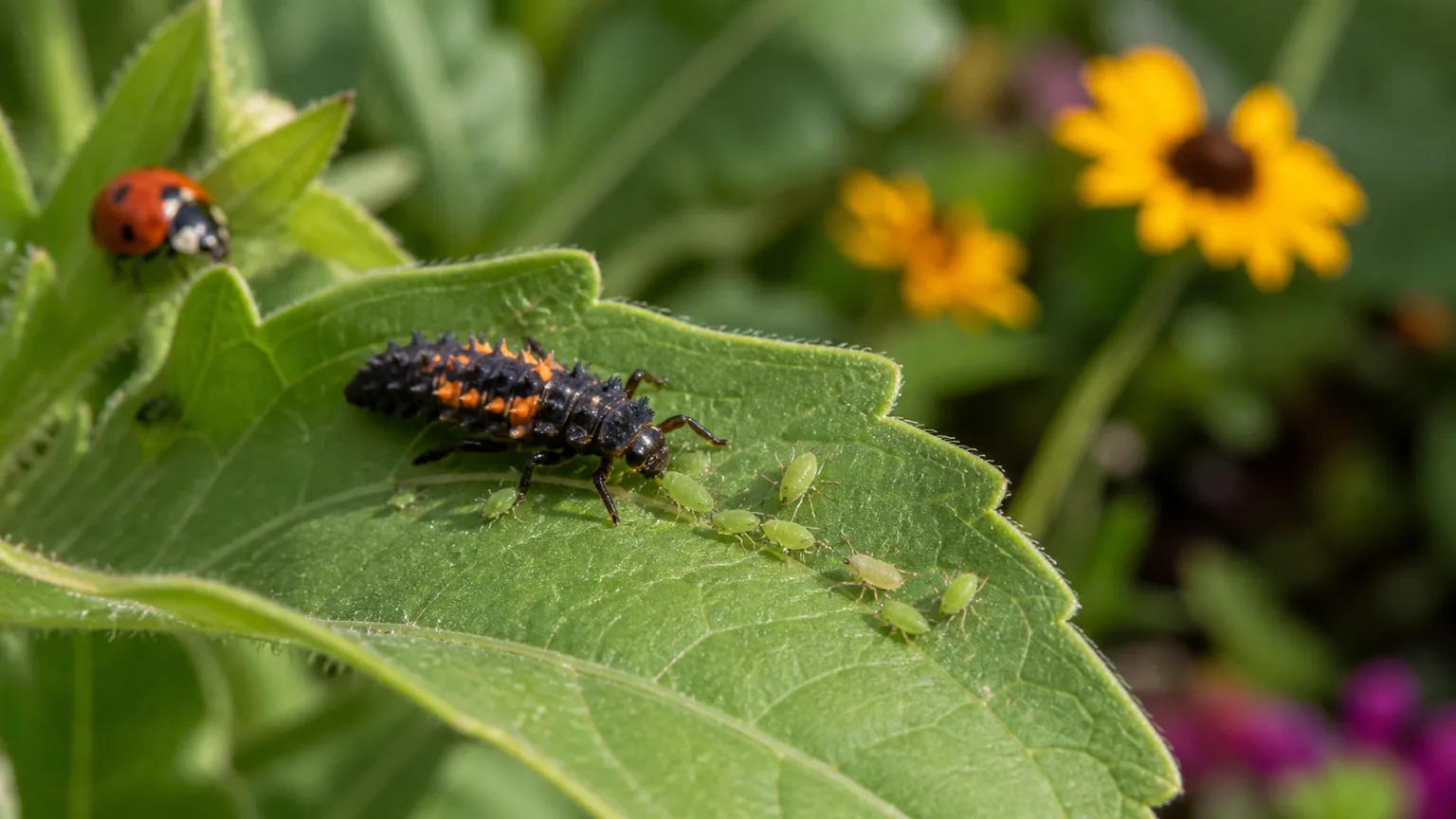
If you find a black, orange, and spiky insect crawling across a leaf, do not assume it is a pest. Ladybug larvae look more like tiny alligators than miniature ladybugs, and that disguise causes gardeners to kill one of the most useful predators in an aphid outbreak.
The quickest way to make a good decision is to look for three clues together: an elongated body with visible legs, orange or yellow markings, and a nearby colony of aphids or another soft-bodied pest. Most ladybug larvae are harmless to people and feed on insects, not on your plant. The important qualifier is “most”: a few lady beetle species eat plant tissue, so identification still matters.
Quick answer: what ladybug larvae look like
A typical ladybug larva is longer and narrower than the adult, dark gray, black, or blue-black, and covered with small bumps, spines, or fleshy projections. Orange, red, yellow, or white markings run across the body, and three pairs of legs stick out from the front half. The larva may be only a few millimeters long when newly hatched and close to 12 millimeters, or about half an inch, when mature; size and pattern vary by species.
The larva usually moves quickly over stems and leaf undersides, probing into curled growth where aphids hide. It may stop to seize an aphid with its chewing mouthparts, or it may wander briefly after a colony has been exhausted. The UC Statewide IPM identification guide describes common convergent and seven-spotted lady beetle larvae as elongate and alligator-shaped, while Colorado State University Extension notes the dark body, side-projecting legs, and yellow, orange, or blue markings seen across many species.
Why they are larvae, not nymphs
“Nymph” is the wrong biological term for a ladybug’s immature stage. Nymphs belong to insects with incomplete metamorphosis, such as true bugs, and usually resemble smaller, wingless adults. Lady beetles undergo complete metamorphosis, so the sequence is egg, larva, pupa, and adult; the larva has a different body plan and a different job from the adult.
That distinction is more than a vocabulary lesson. It tells you why the insect on your plant looks so unfamiliar and why an adult ladybug may appear a week or two after you find a strange dark larva. University of Illinois Extension and Colorado State University Extension both describe lady beetles as insects with complete metamorphosis and a mobile, feeding larval stage.
The field marks that identify a ladybug larva
A photograph from above is useful, but you can often make a safe first decision in the garden without catching the insect. Look at its body, its movement, and the plant damage—or lack of damage—around it.
Body shape, legs, markings, and size
Ladybug larvae are tapered, slightly flattened, and usually widest near the front. Their legs are obvious rather than hidden, and many species have branched or spiny projections that make the insect appear armored. The markings are not a universal orange-and-black pattern: some larvae are mostly gray, some have red or yellow spots, and some are covered with pale waxy filaments that help them blend into mealybug colonies.
Do not use color alone. Species vary by region, and a dark larva may be a lady beetle even if it lacks the bright orange bands in a guidebook photograph. The safer combination is dark elongated body + visible legs + predator behavior + soft-bodied prey nearby. If the insect is legless and maggot-like, it is more likely a hoverfly larva; if it has long sickle-shaped jaws and a slender body, it may be a lacewing larva.
What the larva is doing on the plant
Ladybug larvae are active hunters. They crawl across new growth, leaf axils, stems, and the undersides of leaves because those are the places aphids, scale crawlers, mealybugs, whitefly immatures, and mites tend to collect. They do not make a silk nest, chew neat holes in leaves, or carry a leaf case as part of their normal behavior.
The surrounding evidence matters. A larva found beside sticky honeydew, curled leaves, cast aphid skins, or a visible aphid colony is likely working as a natural enemy. A plant that is developing ragged holes or skeletonized leaves while several larvae feed directly on the tissue deserves closer identification; plant-eating beetle species are real exceptions.
The four stages of the ladybug life cycle
Lady beetles do not appear by magic when aphids arrive. Adults find prey, lay eggs nearby, and produce a short-lived but hungry larval generation. In warm weather the cycle can move quickly; in cool weather it slows, and the exact timing changes with species, temperature, and food supply.
Eggs: yellow clusters near prey
Most predatory lady beetle eggs are spindle-shaped and yellow, cream, or orange. They are usually laid in clusters on a leaf, stem, or other surface close to prey rather than at random. Some species that hunt scale insects or mites lay eggs singly, so a lone egg is not automatically a different insect.
The egg stage often lasts about five to seven days in suitable conditions, according to Colorado State University Extension. A cluster under a leaf is easy to mistake for a pest egg mass, but the location is a clue: lady beetle females choose a site where newly hatched larvae can begin feeding without traveling far.
Larva: the feeding stage
The larva is the stage that does the heavy pest-control work. It molts as it grows, and its body pattern may change after each molt. A newly hatched larva can be tiny and mostly dark; an older one is easier to spot because the markings and projections become more pronounced.
Depending on the species and weather, larval development takes roughly two to four weeks. Growing In the Garden describes a two- to three-week feeding period in one garden context, while extension references emphasize that temperature changes the rate. Treat the calendar as a guide, not an identification test: seeing larvae in April, June, or September can all be normal in different climates.
The larvae cannot fly. That makes a resident larva especially valuable: if it is on an aphid-covered plant, it is already in the right place and will keep hunting until prey declines or it reaches the next stage. This is also why spraying the whole plant can erase the predator that would have handled the next wave of aphids.
Pupa: the quiet transformation
When a larva has finished feeding, it attaches its rear end to a leaf, stem, fence, or other firm surface and becomes still. Its body contracts into a compact shape, and the pupa can look like a small yellow, orange, black, or mottled bump stuck to the plant.
The pupa is not an egg, scale insect, or dead larva. It is a living transition stage. The UF/IFAS Extension account describes watching a larva shed its outer skin and become a pupa attached to a leaf; the pupa later opened to release a pale, soft-bodied adult. Leave an attached pupa alone unless it is on a stem you must prune.
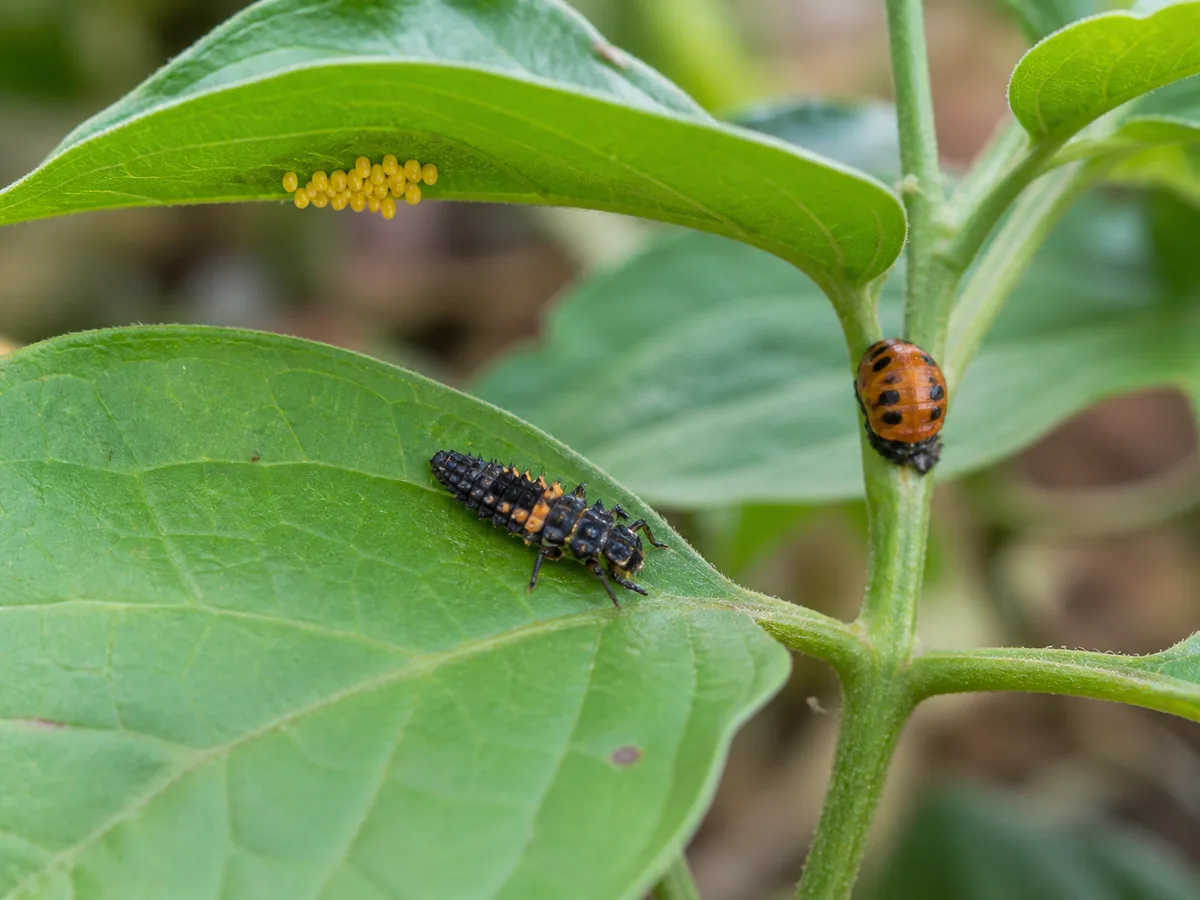
Lady beetles pass through egg, larva, pupa, and adult stages; the larva is the mobile feeding stage.
Adult: reproduction and dispersal
The newly emerged adult is often pale yellow or orange and soft before its wing covers harden and its final color develops. Adults feed on aphids and other small insects, but many species also supplement with pollen, nectar, or honeydew. They mate, lay eggs near prey, and move to new patches when food or shelter changes.
This is why an adult ladybug may disappear while a larva stays put. The adult can fly away in search of a better food patch; the wingless larva has to keep hunting on foot. University of Minnesota Extension warns that mobility is one reason purchased adults often do not remain where a gardener releases them.
What ladybug larvae eat—and what they do not
For most garden species, aphids are the main meal. Ladybug larvae may also eat soft scale, mealybugs, whitefly immatures, thrips, mites, insect eggs, and other small arthropods when those prey are available. The exact menu is species-specific: a mite-eating lady beetle is not interchangeable with a broad aphid predator.
The larvae generally do not eat leaves, flowers, roots, or fruit. That is the practical reason to protect them when you find one on a plant. Colorado State University Extension describes adults and larvae as predators with chewing mouthparts and notes that most have fairly broad tastes, while UC IPM shows larvae hunting aphids in crop foliage.
There are two important limits. First, ladybug larvae are not a guaranteed cure for a severe infestation; a colony can grow faster than predators can consume it, especially on a seedling or a curled shoot. Second, “lady beetle” is a large group rather than one species. A small number of lady beetles, including Mexican bean beetles, feed on plants and can damage beans. A useful insect name is never a substitute for checking the actual behavior.
Why a resident larva is more useful than a purchased adult release
Finding a larva is evidence that your garden already has three things a predator needs: prey, a host plant, and conditions suitable for reproduction. That local combination is more meaningful than seeing a packet of adult beetles arrive in the mail. The larva is already committed to the plant, and its lack of wings makes it less likely to vanish before it feeds.
Buying adult ladybugs can sound like a quick fix, but outdoor results are unpredictable. Oregon State University Extension explains that released predators often scatter in open landscapes and that establishing them requires the right prey, temperature, humidity, and habitat. Minnesota Extension similarly notes that released lady beetles may leave within days and that large outbreaks can require repeated releases of thousands of insects.
If you are considering a purchase, first identify the pest and ask whether lady beetles are a good match. A greenhouse or screened enclosure gives you more control over release timing and escape, while an open yard gives adult beetles many directions to fly. Do not release an unknown species into a natural area, assume a “native” label is proof of local suitability, or expect one shipment to create a permanent population.
The durable outdoor strategy is habitat: keep a tolerable amount of prey, provide small-flowered plants, protect overwintering shelter, and reduce unnecessary insecticide exposure. A population that can reproduce locally is more useful than one that must be repurchased after every aphid flare-up.
How to protect ladybug larvae in a garden
Identify the pest before you spray
The best protection is a short pause. Before treating an aphid-covered plant, inspect the newest leaves, stems, and leaf undersides for ladybug larvae, lacewing larvae, hoverfly larvae, parasitized aphids, and eggs. If natural enemies are present and the plant is not in immediate danger, monitor for several days before choosing a broad treatment.
If aphids are causing minor damage on a sturdy plant, a firm stream of water directed at the colony can be more targeted than coating the whole bed. On edible crops, tender seedlings, or plants showing curling, wilting, or virus-like symptoms, use a faster response and consult local extension guidance. The point is not to tolerate every pest indefinitely; it is to choose a response that does not destroy the predators you are counting on.
Broad-spectrum insecticides are especially disruptive because they can kill beneficial insects along with pests. Even a product marketed as gentle can harm a larva through direct contact. If a labeled pesticide is genuinely needed, spot-treat the confirmed pest, avoid open flowers and active insect traffic, and follow the current label rather than copying a rate from an old garden post.
Ants deserve a quick check. Aphids and some scale insects produce honeydew, and ants may protect those colonies from predators in exchange for the sugary food. If ants are repeatedly climbing an infested stem, reducing the ant–aphid relationship can help the larva do its job; spraying the entire plant for ants can create a larger predator problem.
Provide prey, flowers, and shelter
Lady beetles need more than one aphid colony for one afternoon. Adults benefit from pollen, nectar, and honeydew, while larvae need prey. A succession of small, open flowers—such as alyssum, dill, coriander, yarrow, cosmos, or flowering herbs—can make a garden easier for adults to use. Choose plants that fit your climate and do not treat the flowers indiscriminately once they are attracting insects.
Shelter matters between meals and through winter. Leave some leaf litter, brush, bark, or an untidy edge where appropriate instead of turning every garden margin into bare soil. Minnesota Extension specifically recommends consistent flowers, some leaves or brush, a tolerable amount of aphids, and limited pesticide use; RHS guidance on aphid predators likewise treats aphids as part of a wider food web rather than a problem that must always be eliminated on sight.
You do not need a special saucer of water to keep ladybug larvae alive. Open standing water can create mosquito habitat, and larvae obtain what they need from prey and the garden environment. Focus on shelter, flowers, and pesticide restraint; keep irrigation appropriate for the plants rather than trying to build a damp insect dish.
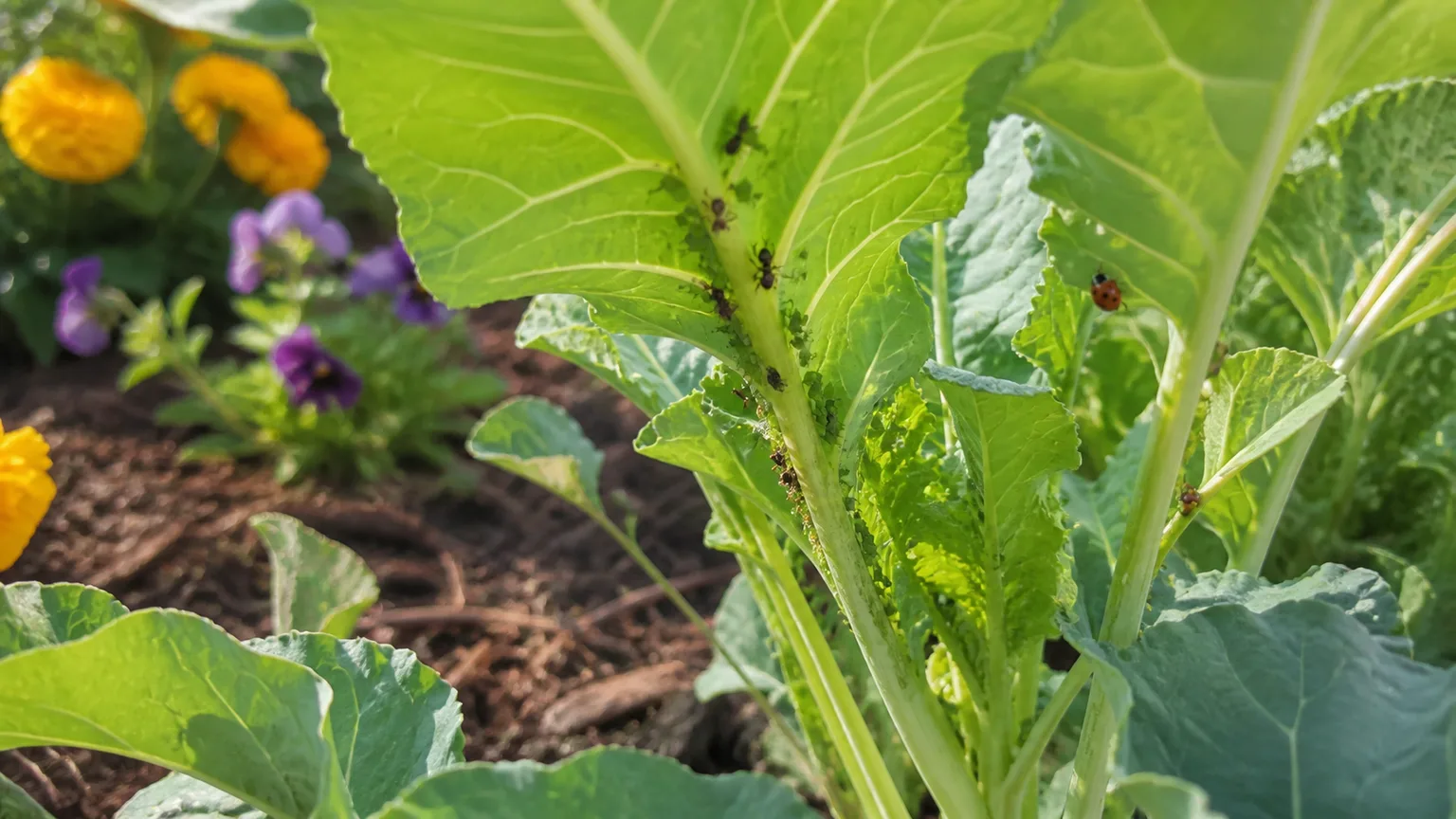
An aphid colony can look alarming, but it also explains why adult lady beetles and larvae are visiting. Scout the whole plant before deciding what to remove.
Ladybug larva lookalikes and important exceptions
The alligator comparison is helpful but not exclusive. Several beneficial insects have predatory larvae, and some plant-feeding beetles can be mistaken for them. Use the plant’s symptoms and the insect’s body structure together rather than trying to identify a blurry silhouette from color alone.
Lacewing and hoverfly larvae
Green lacewing larvae are slender hunters with curved, sickle-like jaws. Some species carry the empty skins of their prey or bits of debris on their backs, so they can look bristly and mobile rather than like the delicate green adult lacewing. Like ladybug larvae, they eat aphids and other small pests.
Hoverfly larvae are usually legless, soft-bodied, and tapered, with a maggot-like appearance. Some are translucent enough that internal contents show through. They often occur in aphid colonies, which is why a gardener can mistake them for a harmful worm. The RHS aphid-predator guide compares these natural enemies and gives the useful structural clue: ladybird larvae have legs, while hoverfly larvae do not.
Plant-feeding lady beetles
Not every lady beetle is a garden ally. The Mexican bean beetle and squash beetle are plant-feeding members of the broader lady beetle family. Their larvae are more likely to be found among skeletonized leaves, chewing damage, and the beetle’s host crop rather than actively picking aphids from stems.
University of Illinois Extension notes that most lady beetles are predators but identifies plant-feeding exceptions. If you see a larva on beans and the leaves show expanding lace-like damage, do not protect it solely because it resembles a ladybug larva. Photograph the insect and damage, then use a local extension or master gardener identification service before treating or transporting it.
What to do when you find one
Use this sequence before you reach for a spray:
- Look closely without touching it. Note the body shape, legs, markings, speed, and whether it is feeding on an insect or on plant tissue.
- Inspect the plant. Check new growth and leaf undersides for aphids, scale, mealybugs, whitefly immatures, mites, sticky honeydew, and chewing damage.
- Photograph the insect and its context. A close view plus a picture of the whole plant is more useful than a cropped image with no host plant.
- Leave a likely predatory larva, egg cluster, or pupa in place. Delay pruning or spraying that would remove it if the plant can tolerate a short monitoring period.
- Escalate only when the damage is increasing. Use physical removal or a narrowly targeted, labeled treatment that matches the pest and protects beneficial insects as far as the label and timing allow.
If the larva is indoors on a houseplant, check for aphids or mealybugs rather than assuming it is eating the plant. A predator without prey will not thrive inside for long. If the plant can safely go outside and local weather is suitable, move the plant—not the insect by hand—to an appropriate outdoor location; otherwise seek a local identification before releasing an unknown species.
Conclusion
Ladybug larvae are the dark, spiny, alligator-shaped stage of a complete life cycle, and they are often the most useful stage to find during an aphid outbreak. They stay on the plant because they cannot fly, hunt soft-bodied pests with chewing mouthparts, and eventually attach to a leaf or stem to pupate.
Protect them by identifying before spraying, leaving a little prey when plants can tolerate it, growing small-flowered plants for adults, and keeping some sheltered garden habitat. Treat purchased adult beetles as a specialized, situation-dependent tool rather than a guaranteed rescue. When the insect’s shape or feeding behavior does not fit a predatory larva, pause and identify the species—the right bug decision starts with observation.



