How to Repot Pothos: Pot Size, Soil, and Steps
Repot pothos with a pot that fits the root ball, a breathable mix, careful root handling, and aftercare that helps you avoid overwatering.
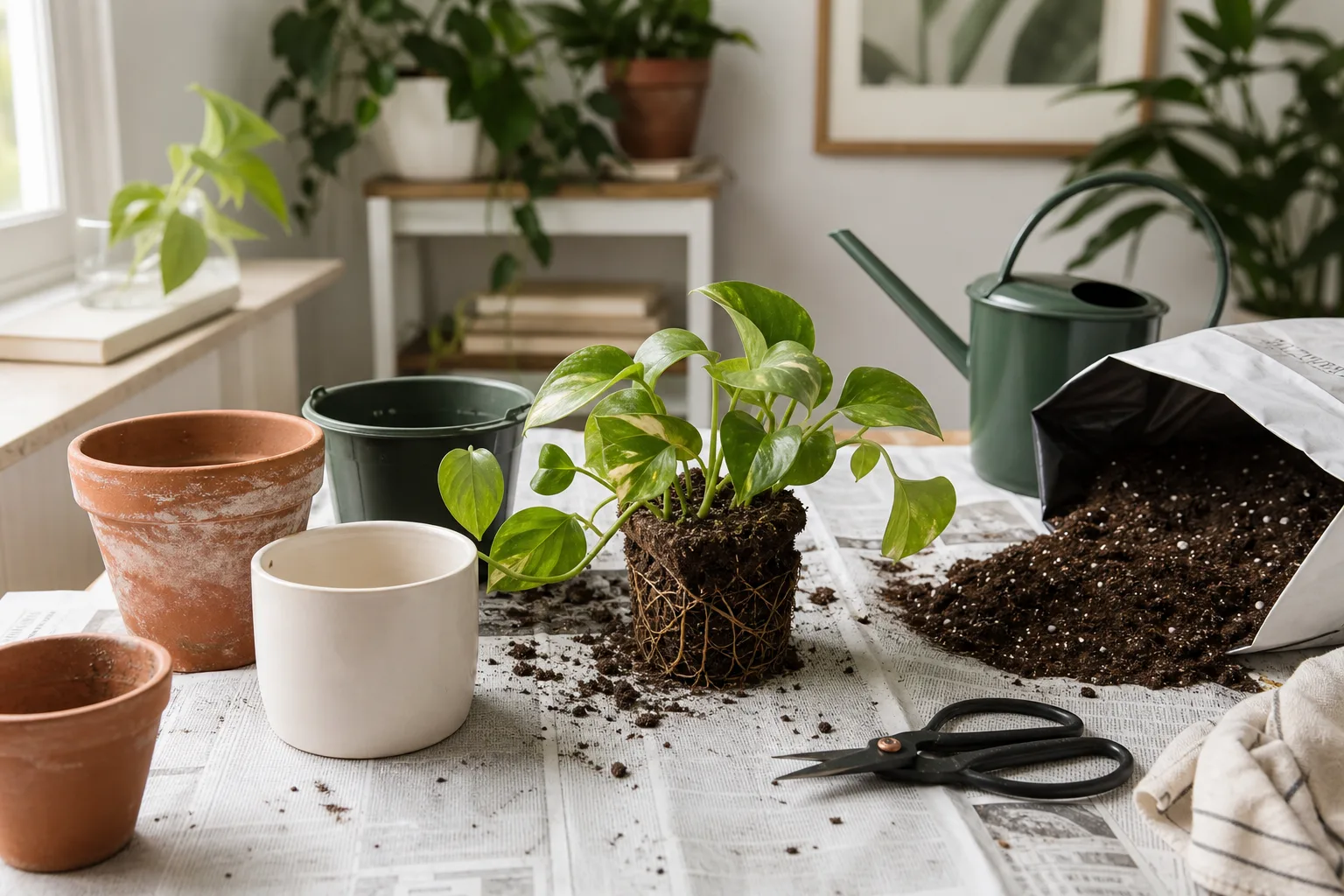
A pothos can trail across a shelf for years while its roots quietly outgrow the nursery pot beneath it. The vine length alone does not tell you to repot: what matters is whether the roots have filled their container, the potting mix has stopped working well, or a drainage problem is putting the plant at risk.
The safest repot is a modest one. Choose a container only a little wider than the root ball, use fresh mix that lets water drain while holding some moisture, and disturb only the roots that need attention. If the root system is healthy and the pot still works, you may not need to move the plant at all.
First decide whether your pothos needs a new pot
Pothos does not need a larger pot every year by rule. Inspect it when growth slows during the active season, water starts moving through the pot unusually fast, or roots appear from the drain holes. Then, if the plant is stable enough to handle, slide it out once and judge the entire root ball rather than making the decision from one exposed root.
A root-bound pothos has a root ball crowded enough that there is little open mix left between the roots. The roots often wrap densely around the sides and bottom, the plant may dry much sooner than it used to, and water can channel down the pot edge without wetting the center. Penn State Extension’s repotting guide lists drainage-hole roots, circling roots, and a root ball with very little visible mix among signs that a houseplant needs repotting. Its pothos care profile also notes that pothos grows well in a well-draining soilless potting mix.
Root signs worth acting on
The clearest signal is a dense mat of roots wrapping the root ball, especially when the plant is also drying quickly or becoming top-heavy. A few roots at the drainage hole are a reason to inspect, not a reason to immediately move the plant into a much larger container. Roots may simply have found the opening; they do not prove that the whole pot is full.
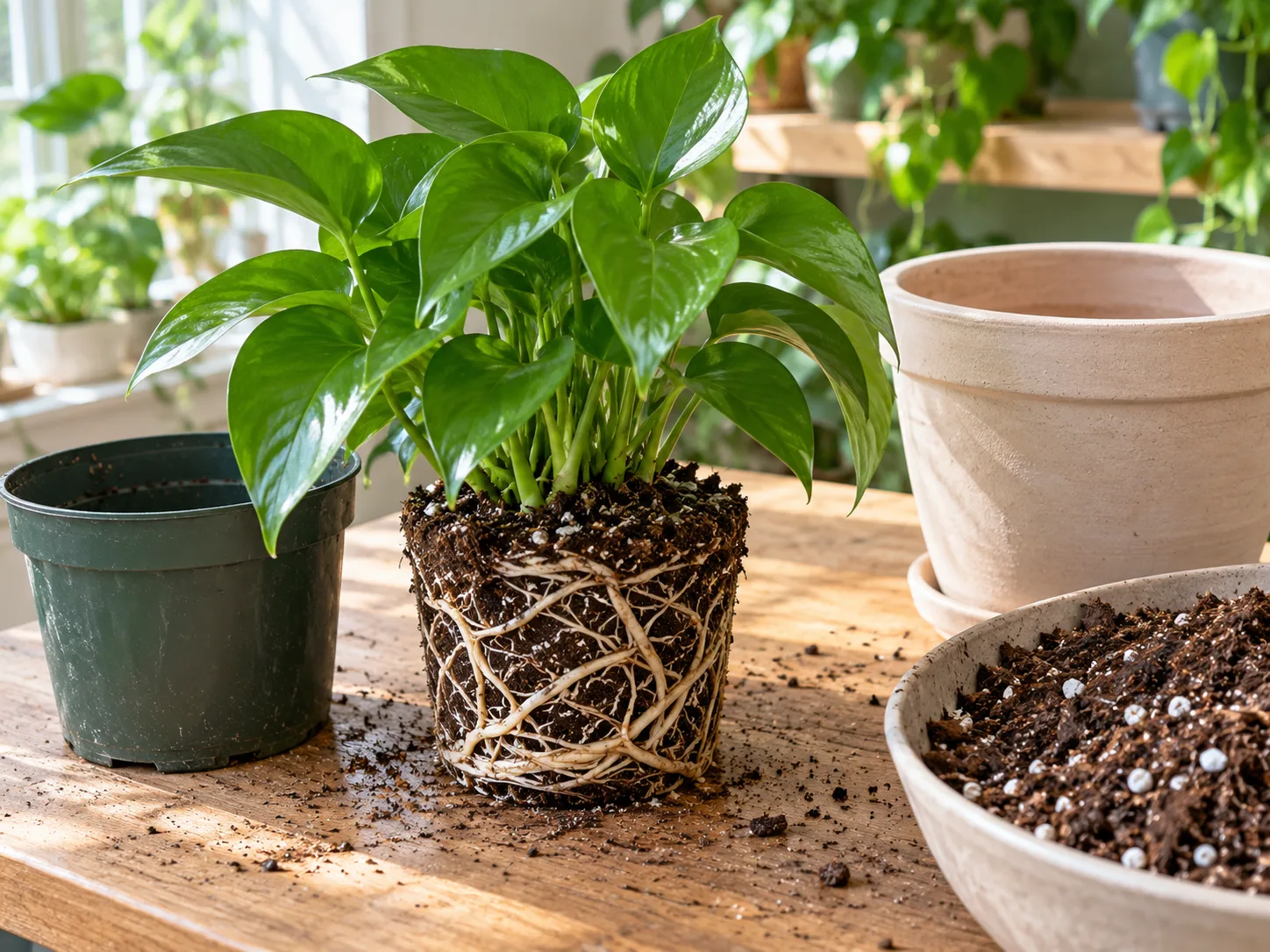
Other useful clues include roots visible across the soil surface, new leaves that are consistently smaller during good growing conditions, or a plant that wilts between waterings despite a normal watering routine. The University of Illinois Extension includes these among repotting indicators, but no single symptom identifies root binding on its own. Combine above-ground changes with a look at the root ball.
A calendar can help you remember to inspect. Fast-growing pothos may need a larger pot within a year or two in bright, warm conditions; a plant in lower light or a cooler room may take longer. Treat those intervals as a cue to check, not a schedule that requires repotting a healthy plant.
Symptoms that can mislead
Long vines are not evidence that a pothos needs more root space. A plant can make trailing growth while the roots still fit comfortably. Similarly, yellow leaves, slow growth, and drooping can come from watering problems, low light, cold exposure, pests, or root damage. Repotting without checking the cause can add stress while leaving the real problem untouched.
If a pot dries fast, check that the root ball is actually crowded. A dry, compacted, or water-repellent mix may send water around the outside even when roots have room. If the mix stays wet for a long time, the cause could be a pot that is too large, a dense medium, poor light, or a cachepot holding standing runoff—not necessarily an undersized pot.
Keep a healthy plant in its current container when the root ball still has loose mix, the plant’s watering pattern is predictable, and it is growing normally. If the mix has degraded but the root volume is fine, a same-pot refresh may be enough. Repotting is a tool for correcting a real limitation, not a routine that makes every pothos grow faster.
Choose a timing window, with one emergency exception
For a routine move, choose a period when the pothos is actively growing and the home is warm and bright. Spring or early summer often provides that combination in temperate regions. The University of Illinois Extension recommends repotting while a plant is actively growing, typically in spring or early summer; the RHS guide likewise identifies spring as a good general window.
Indoor plants do not follow the outdoor calendar perfectly. A pothos kept in a warm room with good light may continue growing through winter; one by a chilly window or in a dim room may barely grow. Use fresh leaf growth and stable room conditions as your guide. If the plant is healthy but growth has paused, wait for the next active stretch so new roots can explore the fresh mix.
Do not delay a corrective repot for a plant with a broken pot, blocked drainage, or roots that are soft and rotting in saturated mix. Those conditions need attention even in winter. The aim is to stop the ongoing damage; keep the plant in stable light and temperature afterward and avoid combining the emergency repot with unnecessary pruning or a dramatic move to a new location.
Pick a pot that fits the root ball
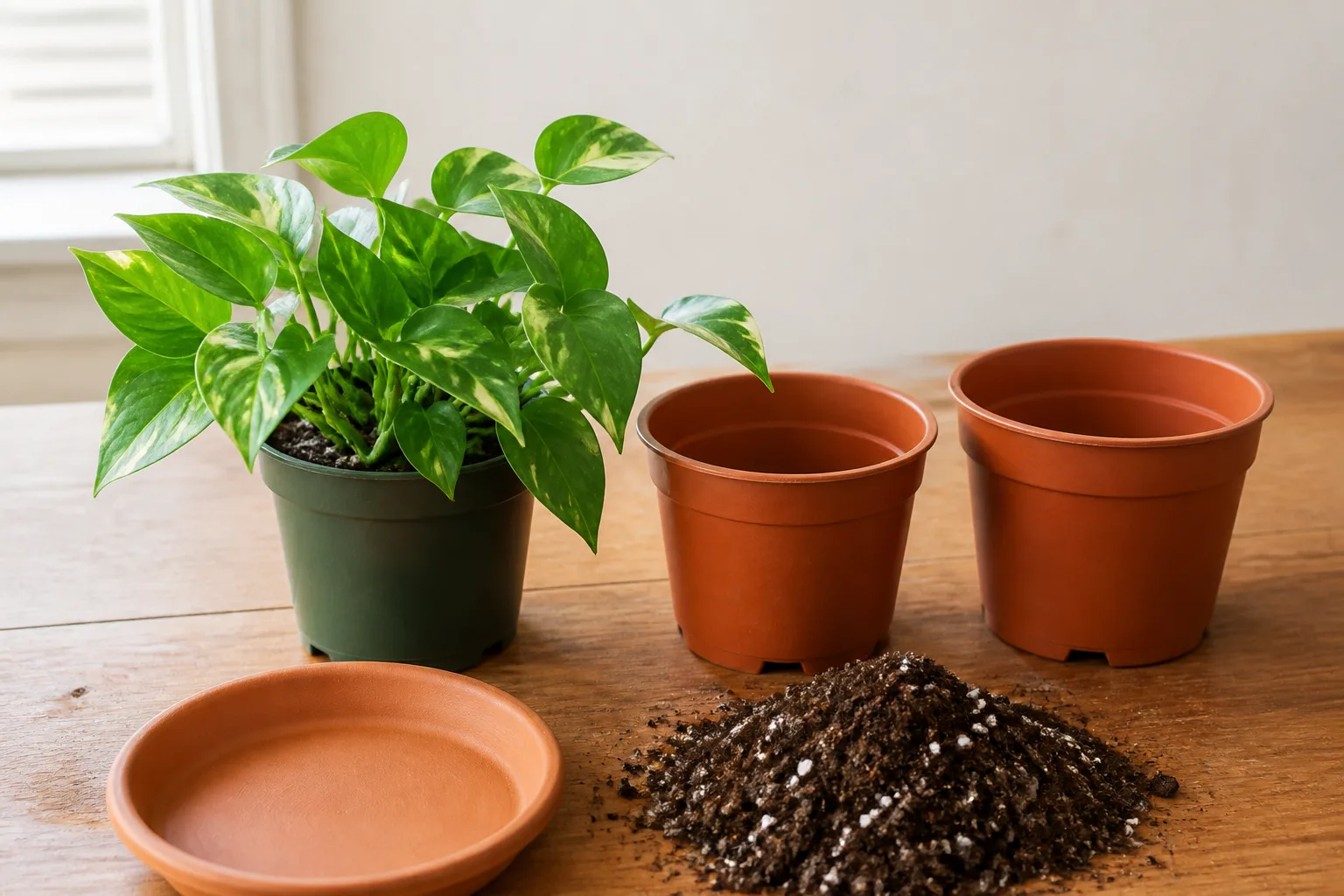
For a typical pothos, choose a pot about 1 to 2 inches (2.5 to 5 centimeters) wider in diameter than the current pot, provided the root ball fills much of that container. The new pot should give the roots room to enter fresh mix without surrounding a small root system with a large reservoir of unused wet soil. The RHS advises that a pot for a plant moving up should be no more than one-third larger than the current one; for smaller containers, its guide suggests a 1- to 2-inch increase.
Size the new pot to the root ball, not the canopy or the length of its vines. A large trailing plant can have a surprisingly compact root system, and a pot selected to match the foliage may stay wet long enough to stress the roots. If the root ball is still much smaller than the current container, use the same pot or a slightly smaller one only if the roots and medium need work. Do not overcorrect by leaping several sizes.
Drainage holes, cachepots, and pot material
Use a pot with at least one open drainage hole. The hole allows excess water to leave so the root zone can regain air after watering. You can set a nursery pot inside a decorative cachepot, but take the nursery pot out to water, let it drain, and empty any water left in the outer pot. A decorative container without a hole is harder to water consistently and makes it easy for the bottom of the root ball to sit in runoff. The University of Illinois Extension’s container guidance explains why drainage and a pot only 1 to 2 inches larger reduce the risk of overly wet mix.
Do not add a layer of gravel or pebbles to the bottom as a substitute for drainage. It does not create a drain hole, and it takes up usable root space. The University of Maryland Extension’s repotting instructions specifically advise against gravel in the bottom of a pot. If mix escapes through the hole, use a small piece of mesh that does not block it.
Pot material affects how quickly the mix dries. Unglazed terracotta loses moisture through its sides and can suit a grower whose pothos mix stays wet too long; it may require more frequent checks in a warm, dry room. Plastic and glazed ceramic retain moisture longer and weigh less, which can be useful for hanging plants. None is best for every home. Pair pot material with light, room temperature, humidity, and your actual watering habits.
Use an airy mix that holds some moisture
Pothos needs a potting medium that supports roots without staying waterlogged. A quality indoor potting mix is a sensible starting point. Penn State Extension describes pothos as suited to a well-draining soilless mix; a dense, garden-like soil is a poor choice for a container because it can compact and limit air movement.
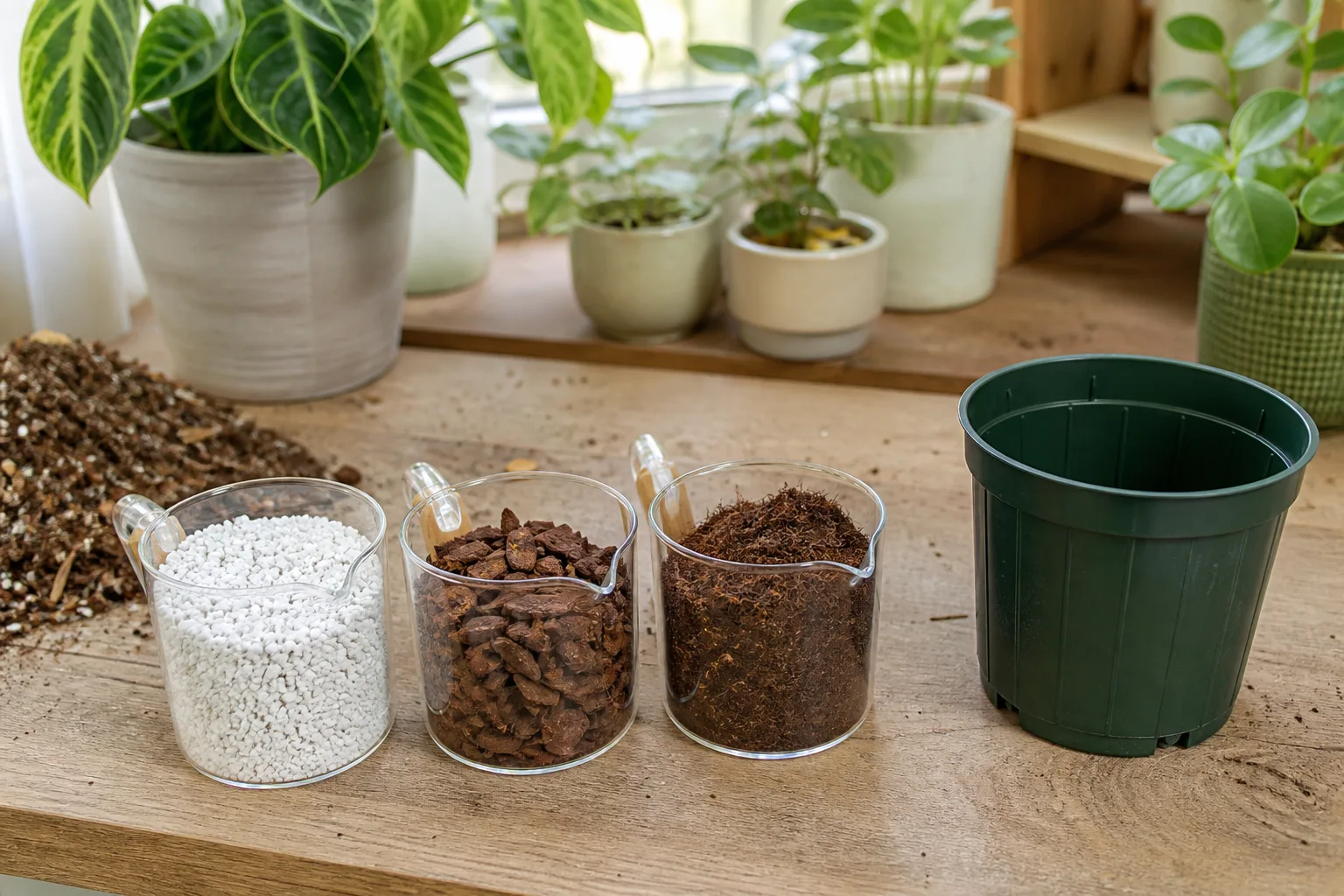
If your indoor mix feels heavy or tends to stay wet for many days in your conditions, blend in a modest amount of perlite, pumice, or fine orchid bark to create a looser structure. A practical starting blend is about three parts indoor potting mix to one part perlite or pumice. This is a starting point, not a formula every pothos requires: a warm, bright room may dry a pot quickly, while a cool, dim room needs a mix that does not remain saturated. The pothos-specific repotting advice from Martha Stewart also describes using an airy indoor mix with perlite or orchid bark.
Avoid using pure orchid bark or a coarse succulent mix for a standard soil-grown pothos unless you know how to adjust watering around the fast drainage. The roots need oxygen, but they also need moisture between waterings. Do not mix in garden soil, compost-heavy amendments, or fertilizer granules at the root ball just because the plant is being moved. Fresh commercial mix often already contains nutrients, and newly disturbed roots do not need a concentrated feed.
If the old mix looks fluffy and drains evenly, you can keep most of it around healthy roots and add fresh mix to the outer space. If it has collapsed, become hard to rewet, or smells sour, remove more of it and use a fresh medium. The goal is to improve the root environment without stripping away healthy roots just to replace every crumb of soil.
Gather supplies and prepare the plant
Before you start, gather the new pot, fresh mix, a tray or sheet to catch soil, clean sharp scissors or pruning shears, and a small stick or chopstick for guiding mix into gaps. Wash a reused pot to remove old soil and residue. If you are using a hanging planter, set it at a workable height or have a second person help support the vines.
Aim for a root ball that is slightly moist and cohesive, not bone-dry or soaked. If the mix is very dry and falling away from the roots, water the plant the day before so the ball is easier to handle. If the mix is still wet or you suspect rot, do not add more water before removing it. The Martha Stewart repotting guide likewise suggests watering a healthy plant before the move, but the condition of the root zone should decide whether that advice fits your plant.
Take a quick photo of the plant before starting if you need to remember which side faced the window or how the vines were arranged. Keep the plant near its regular growing spot when you finish. A stable setup makes it easier to recognize whether drooping later is a short adjustment or a continuing water problem.
Repot pothos with a low-disturbance method
A useful sequence is: prepare the pot, release the plant, inspect the roots, position the root ball, backfill, and water. Work deliberately, but do not leave exposed roots sitting out while you make a potting mix from scratch. Having everything ready first lets you finish with less drying and handling.
Free the root ball and inspect it
Add enough fresh mix to the new pot so the top of the root ball will sit just below the rim, leaving room to water. Lay the current pot on its side and support the soil and stems near the base as you ease the plant out. Squeeze a flexible nursery pot or tap the sides to loosen it. Do not pull on the leaves or yank a vine to free the plant. Tipping the pot sideways while supporting the plant near its base is also the practical removal approach in Homes & Gardens’ pothos repotting guide.
If roots emerge through the drainage hole, do not drag them through a narrow opening. Gently tease them back through if they slide free; if they are firmly lodged, cut the old plastic pot or trim only the root that is trapped. Sacrificing one root is safer than ripping a bundle of fine roots while pulling the whole plant.
Once the plant is out, inspect the sides and bottom. Healthy roots should feel firm rather than slimy. Root color varies with age and growing medium, so do not cut a firm root only because it is tan or brown. The RHS repotting guide recommends checking for and removing soft, rotted roots; that texture-based check is more useful than judging color alone.
Loosen only what needs loosening
If the roots are loose, preserve the root ball. Brush away only mix that falls off easily, then set the plant in the new pot. If roots circle densely around the outside, gently tease the outer roots downward and outward with your fingers or a blunt stick. The aim is to expose some root tips to fresh mix, not to untangle every strand or bare-root the plant.
Trim roots that are clearly dead, soft, hollow, or damaged with clean shears. If there is a small amount of rot, remove the affected tissue and any saturated, degraded mix nearby, then use a clean pot and fresh airy medium. Keep healthy roots. A drastic root trim is unnecessary for an ordinary pot-up and can leave a large vine system with too few roots to support it.
If the root ball is too dense for a pot one size up, consider a conservative same-pot refresh rather than forcing it into a much bigger container. Remove loose old mix from the outside, tease the root mat, and replace the removed volume with fresh mix. For a severely crowded root ball, a small division or careful root reduction may be more appropriate, but it is a separate decision from routine repotting.
Set the plant at the old soil line
Center the pothos and check the height before filling around it. The stem bases should remain at the same depth they were growing before; burying them under several inches of damp mix can keep the crown wet. Fill the sides in small amounts, using the chopstick to guide mix into open gaps without stabbing or packing the roots.
Press gently with your fingertips to steady the plant and remove large air pockets. Do not compress the whole pot into a hard mass. Leave about half an inch of space between the finished mix and the rim so water can soak in rather than spill over. If the surface settles after watering, add a little mix while keeping the stems uncovered.
Water once, then let the mix guide you
For a healthy pothos in fresh, well-draining mix, water slowly and evenly until a little excess exits the drainage hole. This settles mix around the roots and helps reveal whether the pot drains freely. Let the pot finish draining before putting it back in a cachepot or on a saucer, and discard any runoff.
That first thorough watering does not mean the plant needs another drink on a calendar schedule. Repotting changes the mix volume, pot material, and the amount of root currently drawing water, so the old watering interval may no longer fit. Wait until the top inch or two of mix is dry before checking whether the root zone needs water again; Martha Stewart’s pothos guidance gives the same top-layer check for post-repot care.
There is an exception for active root rot. If you had to cut away many damaged roots, the priority is to avoid keeping the remaining roots in saturated mix. Use a fresh medium that is barely moist, keep the drainage hole clear, and water again only when the mix has dried to the depth the remaining root system can use. Do not leave the pot standing in water to “help it recover.”
Keep aftercare calm for the first few weeks
Return the plant to the light it was already used to, ideally bright indirect light, and keep it away from cold drafts, hot radiators, and abrupt direct sun. A newly repotted pothos does not need a special dark recovery corner. It does need stable conditions while the disturbed roots resume taking up water.
Check the mix before each watering rather than following the pre-repot routine. A larger pot usually holds more mix, so it can take longer to dry; a terracotta pot may dry faster than a plastic nursery pot. If the soil remains wet, do not add water because a leaf droops. If it dries very quickly, confirm that water is soaking the whole root ball instead of running down a gap at the edge.
Hold off on fertilizer immediately after repotting. Fresh mixes may include slow-release nutrients, and the roots need time to settle before another dose. Check the mix label and resume the normal, diluted feeding routine once the plant is stable and actively growing rather than applying fertilizer as a treatment for drooping.
Yellow leaves, drooping, and other warning signs
One older leaf turning yellow shortly after repotting can be a temporary response to root disturbance, especially if the rest of the plant remains firm. Remove a leaf only after it has yellowed fully, and check moisture before changing the care routine. A plant that wilts in dry mix may need water; one that wilts while the mix is wet may have damaged roots or poor aeration.
Watch the trend, not one leaf. If more leaves yellow, stems soften, or the pot stays wet and develops a sour smell, check drainage and inspect the root zone rather than repeatedly watering. If the mix is drying normally and the plant holds its leaves, leave it alone and give it time to resume growth. Avoid repeated unpotting to check whether it has recovered; that adds more disturbance without providing a useful day-to-day signal.
Handle root rot and severely crowded roots differently
Root rot is not the same as a crowded but healthy root ball. If the roots are firm and the mix drains, a routine move is enough. If roots are soft and collapsing, the mix is saturated or foul-smelling, and the plant is declining, remove the plant, discard the old mix, cut off only the damaged roots with clean tools, and repot in a clean container with drainage and fresh mix. Correct the cause as well: an oversized pot, standing runoff, dense mix, or repeated watering before the root zone dries can recreate the problem.
For a mature pothos that has filled its pot but should not get larger, you can refresh the same container. The RHS guide describes same-pot repotting and root pruning as alternatives to potting up. For a home pothos, keep the reduction conservative and preserve a generous portion of healthy fine roots; if the root mass is too large for the container and plant to remain balanced, divide the plant or shorten selected vines rather than removing most of its root system at once.
Long vines can make a repot awkward, but they do not need to be cut just because the plant is being moved. Gather them loosely over the pot or support them on the table while you work. If you want a shorter plant, prune a few vines separately and root the cuttings after the main plant is settled. Avoid simultaneously making a large root cut, removing much of the canopy, changing the pot by several sizes, and moving the plant to a new light level.
Conclusion
Repot pothos when the whole root ball is crowded, the mix has broken down, or a drainage problem needs correction—not just because the vines are long or a year has passed. Use a pot only 1 to 2 inches wider, choose fresh mix that drains while holding some moisture, and preserve healthy roots as you move the plant at its original soil depth.
Water the new mix once and let it drain, then let the plant’s moisture and growth tell you when to water again. If you find rot, treat that as an urgent root-health problem; otherwise, keep the move small and the aftercare steady.



