How to Grow and Care for Strawberry Sundae Hydrangea
Learn Strawberry Sundae hydrangea care: choose sun, manage soil moisture, prune for sturdy stems, understand bloom color, and protect container roots.
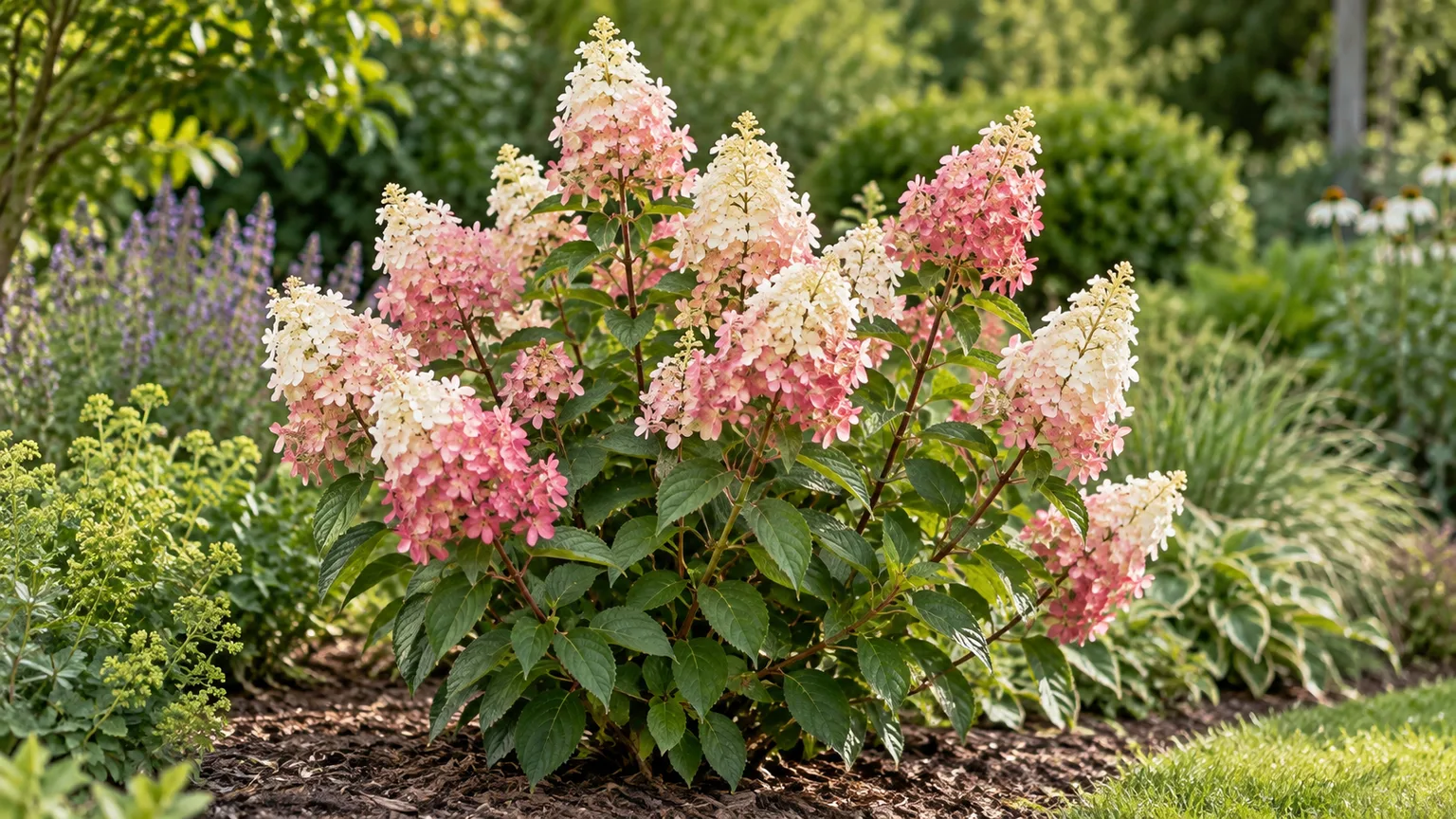
Strawberry Sundae is a compact panicle hydrangea for gardeners who want late-summer color without planting a shrub the size of a small tree. Its cone-shaped blooms open creamy white, then age through pink shades that can deepen toward strawberry red. The color shift belongs to the flower as it matures; soil acidifiers that turn some bigleaf hydrangeas blue will not make this cultivar blue.
The most useful care plan starts with what this plant is: Hydrangea paniculata ‘Rensun’, a deciduous shrub that flowers on new growth. Give it sun that suits your climate, soil that holds moisture but drains, and a first-year watering routine based on the root ball. Pruning is forgiving because flowers form on current-season stems, but how hard you prune affects the shrub’s structure and the size and weight of its panicles.
Identify the cultivar and set realistic expectations
Strawberry Sundae® is the selling name for Hydrangea paniculata ‘Rensun’; plant tags may also use the name Sundae Fraise. Look for ‘Rensun’ on the label when you want the specific cultivar rather than a similarly colored panicle hydrangea; Gardening Know How’s 2026 cultivar guide also notes that Sundae Fraise appears as an alternate name. The cultivar’s U.S. Plant Patent PP25,438 identifies a compact, uniform shrub with reddish-brown flowering stems and flowers that open white and mature pink. Pleasant Run Nursery’s cultivar profile lists a mature height of about 5 feet and width of about 4 feet; actual size depends on climate, age, and pruning.
This is smaller than Vanilla Strawberry™ hydrangea, H. paniculata ‘Renhy’, which shares the white-to-pink look but grows larger. Strawberry Sundae fits a smaller border, foundation bed, or large patio container more easily, though “compact” does not mean miniature. Leave room for the full width instead of planting it tight against a wall and expecting annual shearing to hold it at nursery-pot size.
The patent record says fertile flowers are rarely produced and documents softwood cuttings as the method used to reproduce the cultivar true to type, so seed is not a dependable way to get another Strawberry Sundae. The U.S. record is Plant Patent PP25,438; if you plan to take cuttings for sale or distribution, check the current patent and plant-rights status where you live first. For a home planting, buying a correctly labeled nursery plant is the simplest way to preserve the cultivar’s expected habit and flower sequence.
What the flower color and plant size really tell you
A young plant may take time to build a root system and a branching framework before it produces the full display shown on a mature specimen. Even an established shrub will not turn every panicle strawberry red at once: new heads can remain pale while older ones blush. The patent’s original observations were made under specific growing conditions in France, so its bloom dates and dimensions are reference points, not a promise for every North American climate.
The First Editions Strawberry Sundae profile lists the cultivar for USDA Zones 3 through 8, but a zone number describes average winter minimums, not every exposure, wind pattern, or container situation. The broader species is cold hardy, yet a small plant beside a wind tunnel or in an above-ground pot faces more root stress than an established shrub in garden soil. Check the tag from your local nursery and consider the actual microclimate, especially near the limits of the listed range.
Choose a site with enough light and room
Panicle hydrangeas take more sun than bigleaf hydrangeas, but Strawberry Sundae still needs dependable root-zone moisture in an exposed, hot spot. In a cooler summer climate, several hours of direct sun or full sun can support a fuller bloom display. In a hot-summer location, morning sun with light afternoon shade can reduce heat stress and keep foliage and flowers from drying as quickly. NC State Extension describes panicle hydrangea as more sun tolerant than other hydrangea species while noting a preference for morning sun and afternoon shade; the RHS Hydrangea paniculata profile allows full sun when soil remains reliably moist.
Watch the proposed spot from morning through late afternoon before planting. A site can look sunny at breakfast and spend most of the day beneath a tree canopy; the reverse can happen beside a pale wall that reflects afternoon heat. Avoid deep shade if bloom is the priority, but also avoid assuming that the brightest, driest corner is best. When summers are intense, afternoon protection can be more valuable than squeezing out one extra hour of direct light.
Allow room for mature width and air movement. Do not position the shrub where a downspout saturates its roots, where a roof sheds ice onto the stems, or where a narrow path forces you to prune it into a flat plane. If you are planting a row, use the plant tag’s mature width to set spacing and leave enough space for foliage to dry after rain. Crowding limits airflow and makes routine inspection harder.
Adjust afternoon exposure to your summer climate
If leaves wilt during the hottest part of the day but the soil is still moist and they recover in the evening, heat may be the immediate trigger; adding water to already wet soil can make matters worse. If the root zone is dry several inches down, water slowly at the base. For a plant in harsh afternoon sun, try improving the soil’s moisture retention with mulch or move a container to morning sun and afternoon shade. A grounded shrub cannot be shifted, so choose its exposure with local summer heat in mind from the start.
Build a moist, well-drained root zone
Strawberry Sundae grows best in soil that remains evenly moist without staying waterlogged. RHS Hydrangea paniculata profile recommends moist, well-drained soil and notes that the species can grow in clay, loam, or sand. That range does not mean drainage is optional: heavy clay can grow hydrangeas if water moves through it, while a low spot that stays saturated after rain can suffocate roots and invite decline.
Use the soil you have as a starting point. Before planting, observe how quickly a test hole drains after rain or a slow hose soak. If water remains for a long time, select a better-drained position or address drainage across a broad area rather than filling one small hole with a different mix; an amended pocket in dense clay can act like a sump. In sandy soil, organic matter and mulch help the root zone hold moisture longer, but avoid burying the crown under a mound of compost.
Flower color is not a useful reason to alter soil pH here. The blue-versus-pink response to aluminum availability is associated with certain bigleaf hydrangeas, not with the natural aging sequence of a panicle hydrangea. Strawberry Sundae’s white-to-pink change is built into its cultivar traits. Do not add aluminum sulfate, sulfur, lime, or “blueing” fertilizer to change the panicle color; Iowa State University Extension’s hydrangea guide confirms that panicle flower color does not respond to soil pH. Test soil and amend it only for a documented soil need.
Plant at the right depth and establish it carefully
Plant during a cool stretch when soil is workable and you can water the root ball consistently. Spring and early fall are generally useful windows in temperate climates; avoid planting into frozen ground, waterlogged soil, or a heat wave if you cannot protect the new plant from drying. Water the nursery pot before removing it so the root ball is evenly moist rather than dry at the center.
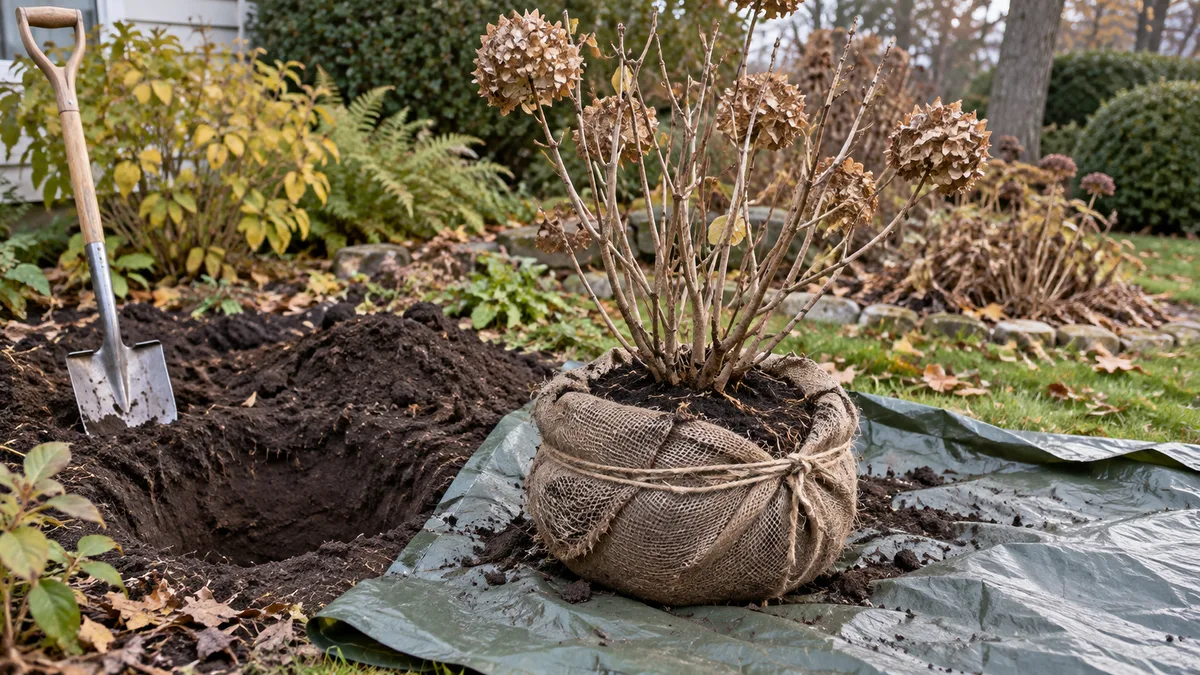
Dig a hole about two to three times as wide as the root ball and no deeper than its height. Set the shrub so the top of the root ball sits level with the surrounding soil. Loosen tightly circling roots at the outer edge, backfill with the excavated soil, and water slowly to settle it. University of Minnesota Extension: Planting Trees and Shrubs likewise emphasizes a wide planting hole and planting shrubs at the depth of the root ball. Do not bury the stems or pile mulch against the base.
For the first growing season, the goal is not to keep the entire bed constantly wet; it is to prevent the original root ball from drying while new roots move into nearby soil. Nursery mix and surrounding garden soil can dry at different speeds. Check both, especially during the first summer and during dry spells. A plant that wilts repeatedly before it has established may lose leaves or pause growth even if the planting itself was done correctly.
Water by checking the root ball, not the calendar
There is no dependable single weekly amount for every Strawberry Sundae hydrangea. Rainfall, temperature, wind, soil texture, mulch, plant age, and container size all change how quickly the roots dry. Instead of following “one inch every week” as a rule, check the soil around the root ball. If the top few inches are dry and the soil below is only slightly moist, give a slow, thorough soak at the base; if it is wet or sticky, wait and investigate drainage before adding more.
Newly planted shrubs need closer checks than established ones, especially in their first hot season. Water deeply enough to moisten the root ball and nearby soil, then let excess drain. A slow trickle is often more useful than a brief spray that runs off the surface. Once the shrub has established, water during prolonged dry weather when the root zone is drying rather than on a fixed schedule.
Container plants dry faster because they have less soil volume and more exposed sides. Check pots daily during hot, windy weather, but water only when the mix needs it and let excess drain through the holes. If water runs straight down the sides without wetting a shrunken, dry root ball, re-wet gradually in several passes. Do not leave a hydrangea pot standing in a full saucer for long periods; saturated roots can look wilted even when the plant has received plenty of water.
Mulch and fertilize only when the plant needs it
A 2- to 3-inch layer of organic mulch helps stabilize shallow roots, reduce evaporation, and limit weeds. NC State Extension notes that panicle hydrangeas have shallow roots and benefit from mulch. Keep the mulch a few inches away from the stems so the crown remains open to air. Replenish as it breaks down; do not stack a fresh thick layer on top of years of old mulch.
Strawberry Sundae usually does not need repeated fertilizer if it has good color and makes healthy new growth. A thin compost top-dressing in spring may be enough to support soil structure, but more fertilizer is not a shortcut to more or redder flowers. High nitrogen can push leafy growth, while runoff from excessive fertilizer can harm waterways. University of Minnesota Extension soil testing guidance recommends basing fertilizer choices on a soil test rather than applying nutrients without knowing what the soil needs.
If growth remains weak despite appropriate light, moisture, and drainage, test the soil or ask your local extension office about a sample before feeding. Do not fertilize a drought-stressed or waterlogged shrub to “perk it up.” Correct the root-zone problem first. In a container, use a potting mix and fertilizer labeled for shrubs or woody ornamentals, follow the product rate, and avoid stacking multiple feeds on top of fresh compost.
Prune in late winter to manage shape and stem strength
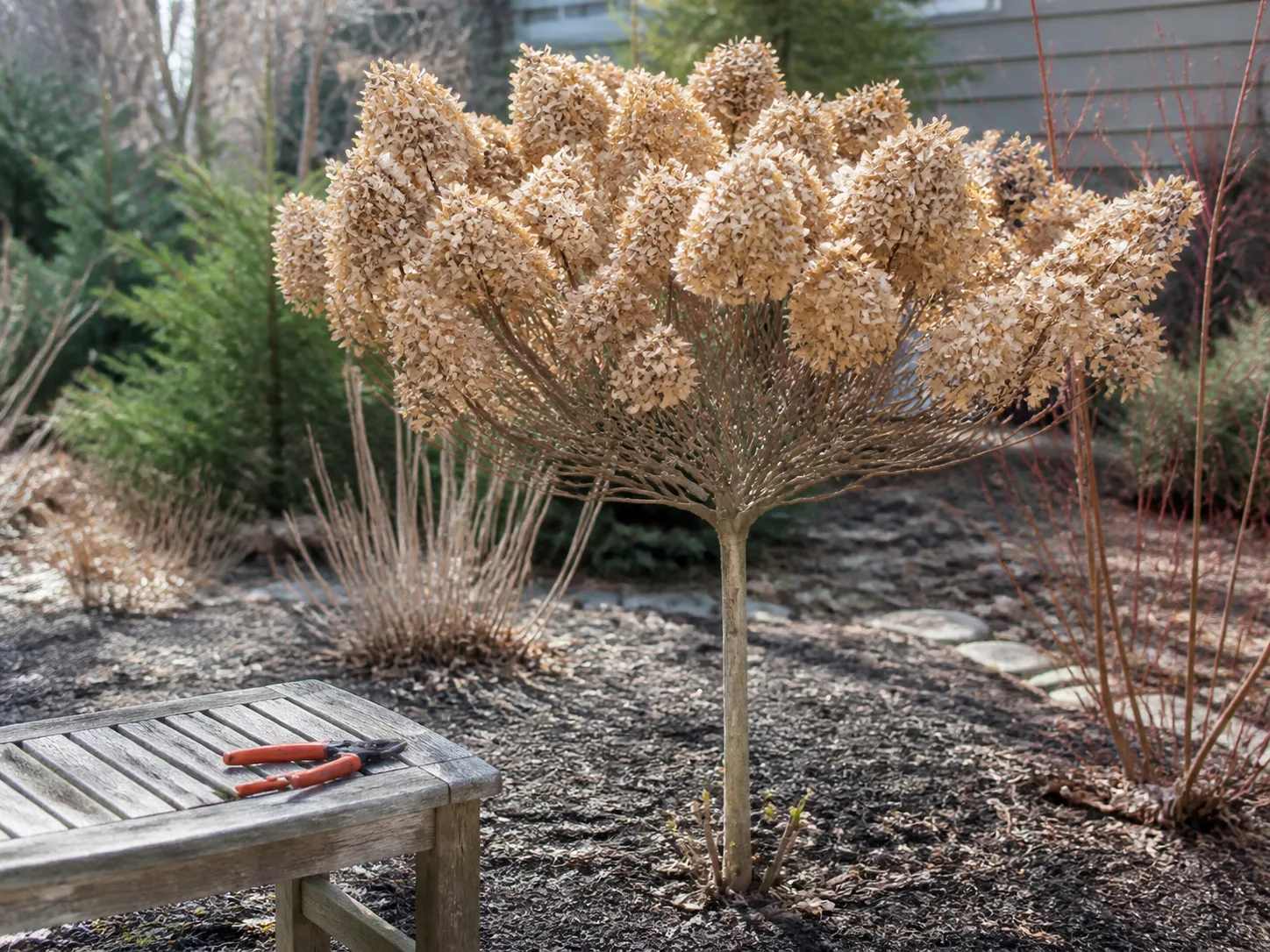
Strawberry Sundae is a panicle hydrangea that flowers on new wood: flower buds develop on shoots made during the current growing season. That makes pruning more forgiving than it is for old-wood hydrangeas, but it does not make every pruning style equally useful. University of New Hampshire Cooperative Extension recommends pruning panicle hydrangeas in late winter to early spring before leaf emergence. Leaving the dry flowerheads through winter also preserves seasonal texture; you can remove them when you shape the shrub.
Use clean, sharp bypass pruners for small stems and loppers for thicker ones. First remove dead, broken, crossing, or rubbing branches. Make cuts just above a healthy pair of buds when shortening a stem, or back to the branch collar when removing a whole branch. Avoid leaving long stubs, but do not cut flush into the main stem. If you are unsure where growth is alive after a cold winter, wait until buds begin to swell and prune to healthy tissue.
Choose a framework instead of cutting every stem short
A hard cutback often produces fewer, larger flowerheads on vigorous shoots. Those heads can be heavier, so the resulting branches may arch or droop after rain. If you prefer many smaller blooms on a sturdier outline, retain more of the previous year’s branching framework and shorten stems modestly. The Fine Gardening pruning guide describes leaving roughly 18 to 24 inches of framework as one way to help support new growth and reduce flopping in panicle hydrangeas. Treat that as a technique, not a required height: plant age, shape, and local conditions matter.
Avoid shearing the whole shrub into a tight ball. Repeated shearing makes a dense outer shell and can leave weak or crowded growth inside. If an older specimen has become awkward, remove a few of the oldest stems at the base over several seasons instead of removing nearly all its structure at once. If the plant is young, prioritize establishment and let it build a stronger branching base before hard pruning.
Understand bloom timing and the white-to-pink change
Flowering usually begins in summer, with the precise start depending on region, sun, plant maturity, and seasonal weather. Each flower cluster is a branched, cone-shaped panicle, not a round mophead. New heads appear creamy white; older ones gradually blush pink, and the color can deepen to strawberry tones later in the season. For weeks, one shrub may carry several shades at once because not every panicle opens on the same day.
Expect variation from year to year. The cultivar’s grower notes that its pink color develops as night temperatures cool (First Editions); a hot season with dry roots may produce a different display, and the age of each panicle also affects its appearance. The original plant patent describes flowers changing from white to pink as they mature, and nursery profiles describe the extended display into early fall. Neither color nor calendar date is a guarantee. The patent also records no fragrance, so choose the shrub for its form and color rather than scent. A flower that remains mostly white may simply be young or growing in a climate where the pink stage develops slowly.
Do not treat soil acidity as the color control. The blue/pink chemistry commonly discussed for some bigleaf hydrangeas does not apply to this white-to-pink panicle. Adding acidifier or aluminum can waste effort and disturb soil conditions without changing the cultivar’s genetically determined progression. If all heads seem pale, check whether they are newly opened before changing fertilizer or soil pH.
You can leave faded panicles on the shrub for fall and winter texture, then remove them during late-winter pruning. For fresh arrangements, cut stems when the heads are colored and firm rather than when all sepals have browned. If you want to dry them, harvest after the fresh color has developed and the heads feel papery; avoid taking so many stems that the shrub loses its natural form.
Grow it in a container only if you can manage summer and winter care
The cultivar’s smaller size makes container growing possible, but a mature woody shrub still needs a substantial pot. Choose a stable container with several unobstructed drainage holes and enough volume to buffer heat and moisture swings. Retail advice commonly starts in the 16- to 24-inch-wide range; choose the larger end for a plant you intend to keep for several seasons. A tiny decorative pot dries too quickly and leaves little room for roots.
Use a high-quality outdoor potting mix, not dense garden soil in a container. Set the crown at the same level it grew in the nursery pot and water until moisture drains from the bottom. Place the pot where the plant receives useful sun but can get some relief from the hottest afternoon exposure in very hot climates. A light-colored or insulated container can reduce root heating in direct summer sun. The trade-off is practical: containers are movable and fit patios, but they need more frequent moisture checks and their roots face colder conditions in winter.
Repot when roots circle densely, water races through the container, or the shrub dries out unusually quickly despite proper watering. Move up one pot size or root-prune only if you are comfortable with the recovery period and the plant is dormant or just beginning spring growth. Do not automatically repot every year. A large, healthy plant with adequate drainage can remain in its current pot until roots actually constrain water uptake or growth.
Protect the exposed root ball in winter
A shrub that survives winter in the ground may be injured in a pot because its roots are surrounded by air rather than insulated by the earth. Before a severe freeze, move the container to a sheltered, unheated space, sink the pot into garden soil, or insulate the sides with a larger container and dry mulch. University of Illinois Extension container overwintering guide stresses protecting the soil mass from freezing while maintaining some moisture; the RHS winter guidance also flags pot-grown plants as especially exposed.
Keep the plant dormant and cold rather than bringing it into a warm living room, where it may break dormancy too early. Check the pot periodically during winter thaws; water sparingly if the mix has dried and is not frozen, then let it drain fully. In a sheltered garden bed, a healthy established panicle hydrangea generally needs less winter intervention than an exposed container, though mulch around the root zone can help moderate freeze-thaw cycles.
Diagnose weak bloom, yellow leaves, and drooping panicles
When flowering is sparse, check the site and pruning history before buying fertilizer. Dense shade can limit flowering; a plant in its first year may still be establishing; and a late spring cut can remove new growth that was about to form buds. Also inspect the soil for extremes: drought during active growth stresses the shrub, while persistently wet ground damages roots. If the plant has lush leaves but few flowers, review nitrogen inputs and avoid adding a bloom booster without a soil test.
Yellow leaves do not point to one cause. Older interior leaves may yellow and drop as new growth shades them, especially in a dense shrub. Yellowing across many leaves can also signal drought, waterlogged soil, or a nutrient problem. Check the pattern and the soil: scattered older inner leaves with healthy outer growth are different from widespread pale foliage and a persistently soggy root zone. Correct only what the evidence supports instead of pruning healthy stems just to “open the center.”
Flower stems that bend under wet panicles are often responding to weight, not disease. A very hard prune may create fewer, larger heads on long, vigorous shoots; wind and heavy rain add leverage. Next winter, leave a stronger framework, remove weak crossing branches, and avoid excessive nitrogen. Do not tie every branch upright as a permanent fix unless a temporary support is protecting a young or storm-damaged plant. If stems are broken, cut them cleanly to a healthy side branch or branch collar.
Prevent common pests and leaf diseases
Aphids, mites, and other sap-feeding pests may appear, but inspect the underside of leaves before treating. A few insects seldom justify routine spraying. On a small aphid cluster, a firm stream of water may be enough; for a persistent pest, use a product labeled for that pest and ornamental shrubs, following its directions and pollinator precautions. Avoid spraying in high heat or applying oils to drought-stressed foliage.
Powdery mildew, leaf spot, rust, and related leaf problems are more likely when foliage stays wet, plants are crowded, or airflow is poor. The NC State Extension profile for panicle hydrangea lists several possible pests and diseases, including aphids, mites, powdery mildew, leaf spot, rust, and bacterial wilt. Water the soil rather than routinely wetting leaves, remove badly diseased fallen foliage, and thin only enough to improve airflow without stripping the shrub bare. If spotting spreads or stems decline, take a clear photo or sample to a local extension diagnostic service; different diseases can look alike, and a diagnosis is more useful than a general-purpose pesticide.
Hydrangeas may also be harmful if eaten by pets. The RHS panicle hydrangea profile flags ingestion risk for dogs and cats. Keep curious animals from chewing leaves or flowers, and contact a veterinarian if you suspect ingestion; do not assume that drying or deadheading makes plant material safe.
Conclusion
For reliable Strawberry Sundae hydrangea care, begin with a sunny or lightly shaded site that fits your summer heat, then give the shrub moist but freely draining soil. Water the root ball when it is drying rather than obeying a fixed weekly amount, mulch without burying the crown, and fertilize only when the plant or a soil test gives you a reason.
Prune this new-wood bloomer in late winter or early spring, choosing how much framework to leave based on whether you prefer larger heads or sturdier stems. Let the flowers age naturally from creamy white to pink; changing the soil pH will not change that sequence. If you grow it in a pot, plan for more summer watering and winter root insulation. Those few site-specific choices matter more than constant trimming or feeding.