How to Grow and Care for Swamp White Oak
Swamp white oak tolerates wet soil but still needs the right site. Get guidance on planting, establishment, pruning, common problems, and wildlife value.
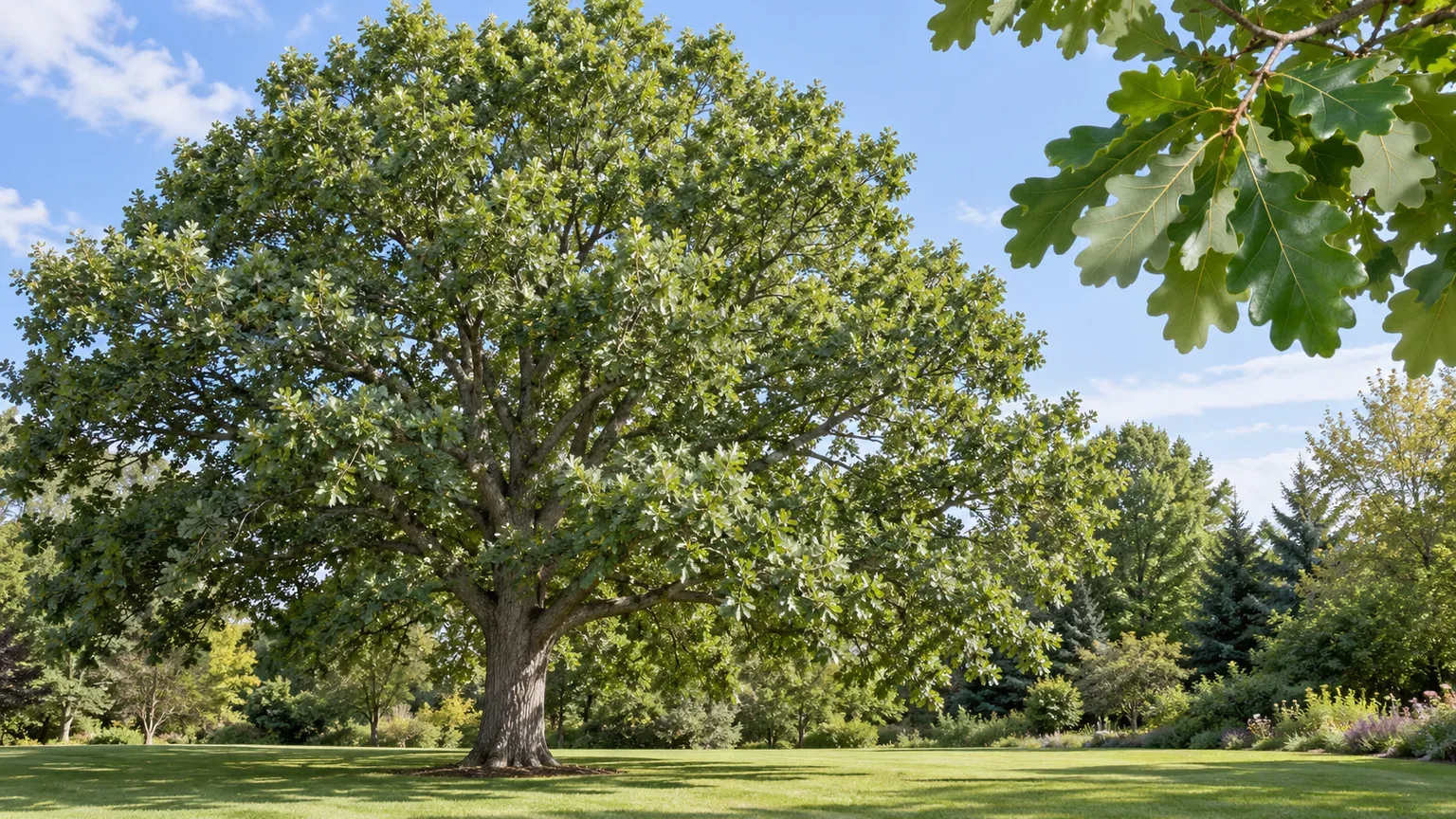
Swamp white oak (Quercus bicolor) is a long-lived North American shade tree for a large yard, park, or naturalized edge. It handles moist ground and occasional flooding better than many landscape oaks, but the name can mislead: it does not need to stand in a swamp, and its tolerance of wet soil does not make it a small-space or no-care tree. Choose it for room to develop a broad crown, sun, and soil that is not severely alkaline or crushed by construction.
For most homeowners, the decision comes down to three questions: can the site accommodate a canopy roughly 50 to 70 feet across, can you water the young tree during dry spells, and does the soil fit its preference for moist, usually acidic conditions? If all three answers are yes, swamp white oak can provide shade, fall interest, and acorns used by wildlife for generations. If the planting strip is narrow, sits beneath utility wires, or is surrounded by concrete and alkaline fill, choose a smaller or better-adapted tree.
Is Swamp White Oak Right for Your Yard?
This is a deciduous tree for people who want substantial, lasting shade rather than an instant ornamental accent. It suits larger residential lots, open lawns, rain-garden margins that are not continuously submerged, and properties replacing a mature ash or another large canopy tree. The tree is native across much of the eastern and central United States and southern Canada, including southern Wisconsin, where extension horticulturists describe it as adaptable to poorly drained and clay soils. (University of Wisconsin–Madison Horticulture, Oak Ridge National Laboratory Arboretum)
Its trade-offs are predictable. A wide crown shades a large area, the roots need an unpaved zone in which to spread, and mature trees drop acorns and leaves. Those are not defects, but they matter beside driveways, patios, pools, sidewalks, small gardens, and play areas. If you cannot picture the future canopy without it blocking a roof, utility line, or neighbor’s space, the correct care decision is to plant a different tree.
Nursery labels commonly describe landscape trees in the range of about 50 to 70 feet tall and similarly wide, while older specimens can become larger. Published figures vary because tree size depends on age, climate, soil, and whether a source describes a maintained landscape specimen or an exceptional tree. Dr. Michael Dirr’s species profile describes typical landscape trees around 50 to 60 feet with a similar or greater spread, while Ohio arboriculture references record taller champion trees. Plan for the larger crown rather than treating the smallest catalog number as a guarantee. (HMI Advantage, Dr. Michael Dirr, Ohio Chapter ISA)
Identify the Tree by Leaves, Bark, and Acorns
The “bicolor” in the botanical name points to a useful field mark: a dark green upper leaf surface above a noticeably paler, often grayish or silvery underside. Leaves are generally five to seven inches long with shallow, rounded lobes or teeth rather than deep cuts. The contrast shows up best when a breeze turns the canopy, and it helps separate swamp white oak from white oak (Q. alba), whose lobes are more deeply rounded.
Young branches and trunks can have peeling, pale gray-brown bark; with age, the trunk darkens and develops rough, scaly ridges. Acorns are borne on long, slender stalks, often in pairs. Those details are more reliable together than any one trait alone, since leaf shape varies among individual trees and leaves on vigorous shoots can look different from those on mature branches. Wisconsin Horticulture and Ohio’s ISA chapter describe the pale lower leaf surface and shallow-lobed foliage as notable identification features. (Wisconsin Horticulture, Ohio Chapter ISA)
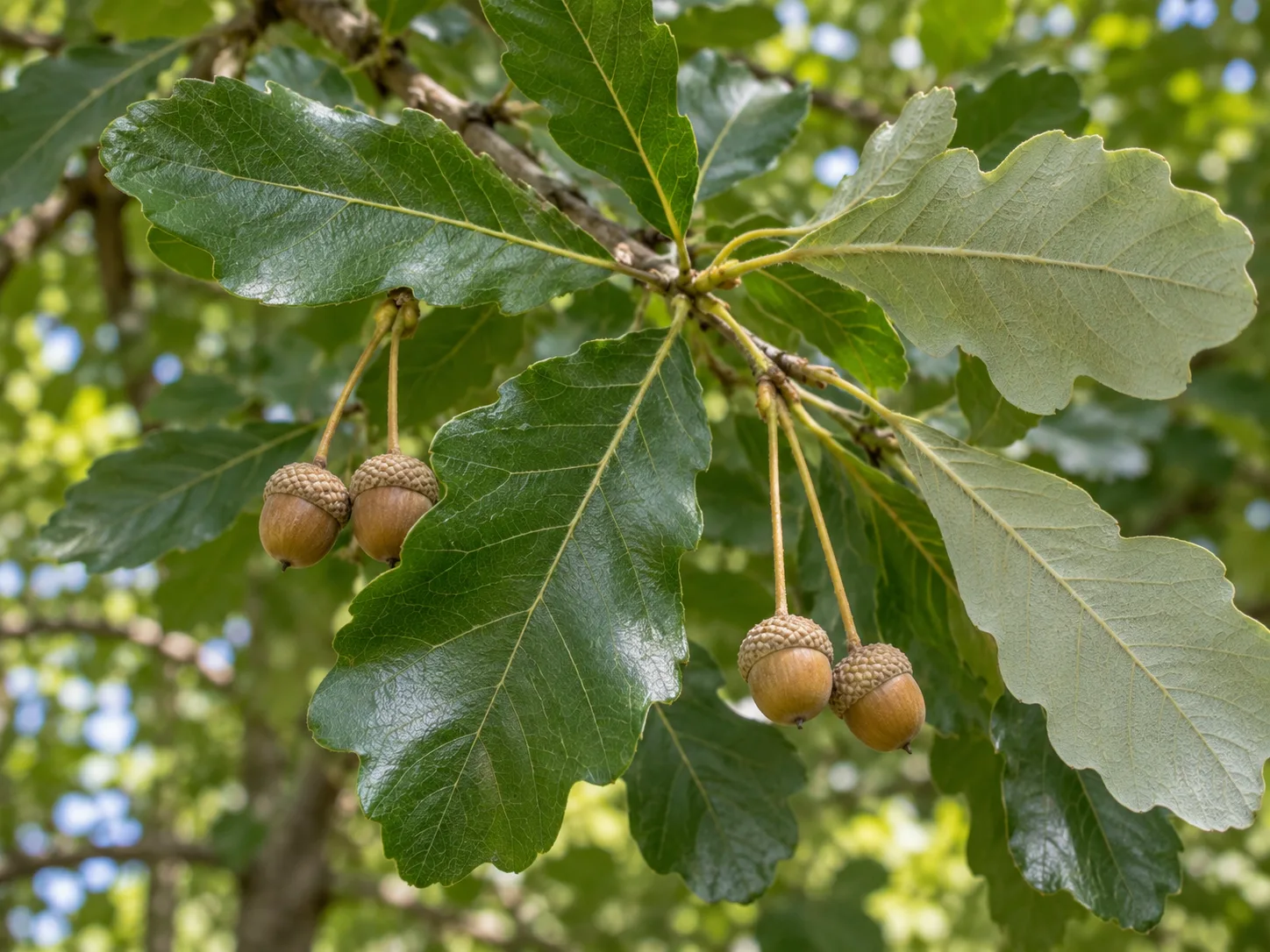
The pale leaf undersides and long acorn stalks are useful identification clues.
Growth Rate, Hardiness, and Lifespan
Swamp white oak is usually described as moderate-growing, though established trees can put on a foot or more of shoot growth in a favorable year. That is not a promise for a new transplant: a young tree often spends its first seasons building roots, and drought, shade, compaction, or high-pH soil can slow visible top growth. Avoid paying a premium for a claim that any young oak will grow at the same rate in every yard.
Regional horticulture sources commonly list it for USDA hardiness zones 4 through 8; Wisconsin Horticulture gives a lower boundary of 4a. Confirm the range for your region and the particular cultivar with a local nursery or extension service, especially near zone boundaries or in sites with unusual winter exposure. The species is long-lived, but “centuries” describes its potential in an appropriate setting, not a warranty for a tree planted in restricted, disturbed soil. (Penn State Extension, Wisconsin Horticulture)
Sun, Soil, Drainage, and pH
Give the tree full sun when possible. It can tolerate some partial shade, particularly while young or as an understory tree, but a canopy grown in strong light will generally be more balanced than one forced to stretch toward an opening. Avoid tucking it under a mature canopy if the goal is a broad shade tree.
Swamp white oak grows across a range of mineral soils, including clay, and is especially useful where the ground stays moist or drains slowly at certain times of year. It generally prefers moist, well-drained to wet soil with an acidic to near-neutral reaction. Penn State Extension describes the species as preferring moist to wet acidic soil while adapting to drier sites; Wisconsin Horticulture notes its tolerance of poorly drained and clay soils. That flexibility is about moisture and texture, not permission to ignore root-zone conditions. (Penn State Extension, Wisconsin Horticulture)
Soil pH deserves particular attention before planting near new construction, limestone, concrete, or calcareous fill. Dirr’s profile notes that swamp white oak prefers an acid soil reaction and describes foliage paling in a high-pH site; Penn State also flags soil compaction and salt as concerns. If nearby oaks show yellow leaves or the site has fresh fill, get a soil test before buying. Do not add lime, sulfur, peat, or fertilizer by guesswork. For a large tree, trying to acidify the entire future root zone may be impractical; a better species or a different location can be the more durable fix.
Wet Soil Is Not the Same as Any Wet Site
The species is a good candidate for a low spot that becomes saturated in spring or floods occasionally, but water tolerance has limits that depend on timing, depth, and duration. A tree that can survive periodic flooding is not automatically suited to a basin that remains underwater through the growing season, receives concentrated roof runoff, or has compacted soil with little oxygen. Watch the site after heavy rain and again during a dry spell; note how long water stands and whether the ground cracks or hardens in summer.
Do not confuse slow drainage with compacted construction fill. Some landscape accounts praise swamp white oak for urban tolerance, but Penn State lists compaction among its sensitivities. That difference matters: naturally heavy, moist soil may still support roots, while soil crushed by equipment or layered over buried debris can exclude the air and water roots need. If excavation equipment has worked the planting zone, assess and correct the soil structure before planting rather than expecting the species name to solve it.
Choose a Planting Site With Room Above and Below
Look up first. A mature swamp white oak is unsuitable beneath overhead power lines, and young trees can hide a future conflict for a decade or more. Look sideways at roofs, streets, patios, septic areas, neighboring property, and other trees; allow for a broad crown, falling acorns, and a root zone that may extend beyond the branch tips. Penn State Extension’s tree-planting guidance notes that roots can spread well beyond the crown, so the visible dripline is not a root barrier. (Penn State Extension, Planting Trees in Your Community Forest)
Check underground utilities before digging, and do not place a large oak where future trenching or paving is likely. A lawn can work if you can keep mower traffic and repeated soil compaction away from the trunk and major roots. A broad mulched area is usually easier on a young oak than turf growing directly to the bark. Where the available planting area is narrow, an upright cultivar may reduce branch spread, but it does not make a 40- to 50-foot tree appropriate beneath wires or beside a small foundation.
Plant a Swamp White Oak Without Burying the Roots
Plant in early spring or fall when the tree is dormant or weather is mild, the soil is workable, and the root ball can be kept moist. Avoid planting into frozen ground, saturated mud, or the hottest part of summer unless you can manage frequent monitoring and irrigation. Container-grown trees offer a longer planting window than bare-root stock, but the root ball still must not dry while you work.
Before the purchase, inspect the tree’s trunk and roots. Choose a straight, sound trunk with a clear dominant leader and no large wounds, dead branches, or tight forks. On a container tree, slide the pot off if the nursery permits and look for circling roots around the outside; a root mass that has formed a dense coil is a poor bargain because those roots can girdle the trunk later. A smaller tree with well-distributed roots usually establishes more reliably than an oversized specimen with damaged or congested roots.
Dig a broad planting hole, roughly two to three times the root ball’s width, but no deeper than the distance from the root flare to the bottom of the ball. Loosen the sides so roots can move into surrounding soil. Set the tree upright, spread or correct circling roots where practical, and backfill with the soil you removed; do not bury the hole in compost or create a rich, different-textured pocket that roots may hesitate to leave. Penn State’s planting guide likewise emphasizes a wide hole, correct depth, careful root-ball handling, and keeping roots moist before planting. (Penn State Extension, Planting Trees in Your Community Forest)
Set the Root Flare, Mulch, and Stake Correctly
Find the point where the trunk widens into the first main roots. That root flare should sit at or slightly above finished grade, not several inches underground. If the nursery soil covers it, brush soil away until you can see the upper structural roots before deciding how deep to dig; otherwise, the tree can settle too low and develop chronic moisture or bark problems at the trunk base.
Water the backfill to settle air pockets, then spread a two- to three-inch mulch layer over a generous circle. Keep mulch several inches away from the trunk so the bark stays dry and visible. A volcano of mulch piled against the trunk traps moisture and hides girdling roots; it does not help the tree hold water.
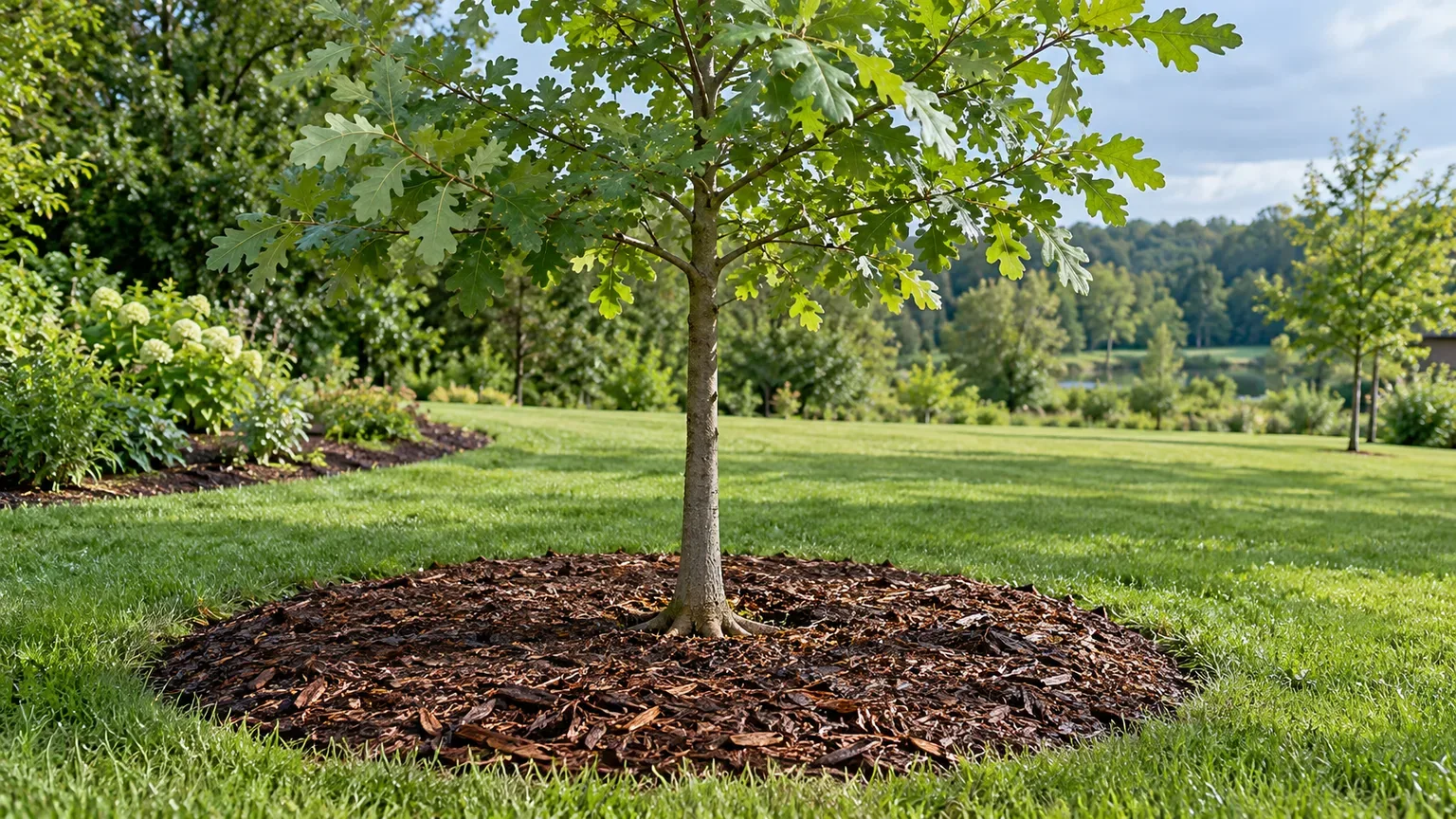
Set the root flare at grade and keep mulch off the trunk.
Stake only if the root ball rocks in wind or the site is exposed. Use loose, flexible ties low enough to let the trunk move slightly, and remove them after the tree can stand securely, usually within the first growing season. A tight stake left for years can rub the bark and weaken the trunk instead of supporting it.
Water Through Establishment, Then During Drought
A newly planted tree needs steady root-ball moisture while it establishes, particularly during its first two summers. Water slowly and deeply when rain has not kept the root zone moist; do not follow a rigid weekly schedule if the soil is already saturated. In clay, check the root ball and surrounding soil before irrigating, because the surface can look dry while the lower soil remains wet.
A useful check is to pull mulch aside and feel soil several inches below the surface near the edge of the root ball. If it is cool and damp, wait; if it is dry and crumbly, water slowly enough that moisture reaches the full root ball rather than running off the surface. A soaker hose or slow trickle around the root zone is more useful than brief daily sprinkling. Keep the mulch broad and refresh it as it thins, but do not let it touch the trunk.
After establishment, swamp white oak can tolerate some dry weather, but an extended summer drought can still stress it, particularly in sandy or paved sites. Water deeply during prolonged dry periods instead of giving small, frequent surface drinks. New leaves that wilt during a hot afternoon may recover by evening; persistent wilting, early browning, or dieback across the canopy calls for a closer check of soil moisture, root injury, and planting depth.
Fertilizer and Leaf-Litter Care
Do not fertilize a healthy tree simply because it is growing slowly. First check whether the tree is receiving enough sun, whether the root flare is buried, whether soil is compacted, and whether the root ball dries between rain events. A soil test can reveal a genuine nutrient deficiency and prevent adding nutrients that the tree does not need.
Leave sound fallen leaves beneath the canopy where they will not smother turf or clog drains. Leaf litter returns organic material to the soil and creates a more natural tree-root zone. If the leaves are diseased, collect them when local extension guidance recommends sanitation; otherwise, shredding a thick layer or moving it into a compost area is usually more useful than stripping every leaf from the yard and replacing it with fertilizer.
Keep lawn fertilizer and weed-control products away from the trunk and root zone unless the label and a soil test support their use. Excess nitrogen can drive tender shoot growth without fixing alkaline soil, root damage, or drought. It also encourages a maintenance cycle that a large native oak generally does not need.
Prune for a Strong, Safe Structure
Start structural pruning while the tree is young, when a small correction can prevent a large limb problem later. Keep one dominant leader, remove or reduce competing stems gradually, and correct branches that cross, rub, or form a narrow weak attachment. Do not remove a large portion of live crown in one session; the aim is a strong scaffold with room to grow, not a clipped shape.
For established trees, remove dead, damaged, or hazardous limbs and leave major reductions to an ISA Certified Arborist. Make proper cuts just outside the branch collar rather than flush to the trunk or leaving a long stub. Topping is especially damaging: it removes the natural crown, triggers weakly attached regrowth, and can create a more hazardous tree than the one you meant to manage.
Oaks require timing care because oak wilt fungi can spread through fresh wounds in some regions. Penn State advises pruning oaks in winter and avoiding the April-to-November period in Pennsylvania; local high-risk dates vary with climate and disease presence, so use local extension or arborist guidance rather than importing one state’s calendar. If a storm breaks a branch or creates an immediate hazard, safety takes precedence—contact an arborist and ask about proper wound management rather than leaving a dangerous limb in place. (Penn State Extension, Oak Trees of Pennsylvania, Penn State Extension, Oak Diseases)
Grow From Acorns or Choose Nursery Stock
For a predictable landscape tree, buy a locally grown seedling or young nursery tree with healthy roots and an identifiable cultivar label if you want a particular form. A nursery-grown tree saves time and lets you choose structure. Swamp white oak is easier to transplant than some oaks, but it is still a large, long-lived tree; moving an established specimen is not a practical substitute for choosing the site carefully.
Acorn propagation is inexpensive and rewarding, but seedlings vary genetically and may not resemble a named cultivar. The acorns of white-oak-group species germinate soon after they fall rather than waiting through a long winter dormancy. Dirr describes planting swamp white oak acorns soon after collection and protecting the containers from animals. (HMI Advantage, Dr. Michael Dirr)
A Practical Acorn-to-Seedling Method
Collect fresh, fully mature acorns soon after natural drop. Reject acorns with holes, cracks, mold, or a shriveled appearance; dry storage can quickly reduce viability. A sink test is only a rough screen, not proof that every sinking acorn will grow, so prioritize fresh, sound seed instead of relying on water alone.
Sow each acorn in a deep container with drainage, cover it with about an inch or two of loose potting mix, and keep the mix lightly moist, not waterlogged. Use a tall pot because oak seedlings develop a strong downward root early; a shallow tray encourages roots to bend or circle. Protect the pot from rodents, mark the species and collection date, and leave it outdoors in a sheltered place that experiences the local season. Move the seedling to its permanent location while it is still small enough to plant without bending the root.
Cultivars and Nursery Selection
Seed-grown trees differ in crown shape, branching, leaf appearance, and fall color. Named cultivars can offer more predictable traits, but they remain full-sized trees unless the cultivar description specifically says otherwise. “Improved branching” does not mean compact, and a narrow young form can broaden with age.
American Dream (‘JFS-KW12’) is described as having a broadly pyramidal young habit, glossy foliage, and improved resistance to powdery mildew and anthracnose. Beacon, also known as ‘Bonnie and Mike,’ is selected for a narrower, upright form; Dirr estimates a mature height around 40 to 50 feet and a spread around 10 to 15 feet. Those dimensions are cultivar estimates, not a substitute for the nursery’s current information or local performance. Ask for the botanical cultivar name, expected spread at maturity, and whether the tree was propagated true to type. (HMI Advantage, Dr. Michael Dirr, Ohio Chapter ISA)
Seasonal Care and Fall Cleanup
In spring, look for even bud break and a healthy flush of leaves rather than expecting a young oak to grow dramatically taller each season. Keep the mulch ring clear of turf, check for trunk damage from mowers or string trimmers, and water during dry spells. In summer, watch for prolonged wilt or early leaf browning; do not respond to every leaf spot with fungicide.
Fall brings acorns, changing leaf color, and leaf drop. The crown may turn yellow, bronze, or russet depending on weather and site, and individual trees may differ. Sweep or rake acorns from heavily used paths if they become a slipping hazard, but leave some under the canopy if wildlife use is part of why you planted the tree. In winter, the branch structure is easier to inspect and is often the safest time to schedule routine oak pruning where local guidance recommends dormant-season work.
Troubleshoot Yellow Leaves, Leaf Spots, and Oak Wilt
Many leaf marks on an oak look alarming without threatening the tree. Penn State Extension notes that oak anthracnose often affects young leaves during wet spring weather, while late-season leaf spots, blister, and powdery mildew usually cause limited harm to landscape trees. If the tree leafs out normally the following spring and the canopy remains vigorous, a spotty late-summer display is usually a reason to monitor, not to spray. (Penn State Extension, Oak Diseases)
Galls are another common sight. They are growths triggered by tiny insects or mites, not tumors that spread from branch to branch. Most are cosmetic; avoid pruning heavily or applying broad-spectrum insecticide because you see a gall. Photograph the affected leaves, note when symptoms appeared, and ask an extension office or arborist to identify a severe or recurring problem before treating.
When Yellow Leaves Point to High-pH Stress
If leaves turn yellow while the veins remain greener, especially across much of the canopy, consider iron chlorosis from alkaline soil—but do not diagnose it from color alone. Drought, waterlogged roots, root damage, poor planting depth, and nutrient imbalance can produce overlapping symptoms. Swamp white oak prefers acidic soil, and high pH can make iron less available even when the mineral is present.
Start with a soil test from the root zone and inspect the root flare, irrigation, and drainage. Avoid adding iron or acidifying amendments blindly: a treatment can fail if the real issue is damaged roots, and changing soil pH around a mature tree is difficult. If yellowing is widespread, the canopy is thinning, or branches are dying, get an arborist’s assessment and share the soil-test result rather than repeatedly applying fertilizer.
When Branch Wilt Needs Prompt Diagnosis
Oak wilt is a serious disease, but a single brown branch does not confirm it. Penn State describes oak-wilt symptoms as browning that often begins at leaf tips and margins, with leaves wilting and dropping while some green remains; symptoms can move through the crown. Drought, canker, root injury, and other diseases can resemble parts of that pattern, so diagnosis matters before cutting or moving firewood.
If several branches decline quickly during the growing season, contact your local extension service or an ISA Certified Arborist promptly. White oaks are generally less susceptible than red oaks, but swamp white oak is not immune. Avoid pruning in the local oak-wilt risk window, do not transport suspect oak wood without checking state guidance, and do not apply fungicide without professional diagnosis. (Penn State Extension, Oak Diseases, Penn State Extension, Oak Trees of Pennsylvania)
Conclusion
Swamp white oak is a strong choice when you have room for a broad canopy, sun, and soil that stays moist without being an unsuitable construction fill or permanently submerged basin. Its wet-soil adaptability, pale-backed leaves, wildlife value, and long life make it a useful native shade tree, but the site must match the tree—not the other way around.
Choose healthy nursery stock, expose the root flare, plant no deeper than the root ball, mulch without touching the trunk, and water according to soil moisture while roots establish. Leave fertilizer on the shelf unless a soil test calls for it, shape young branches gradually, and schedule oak pruning during the locally recommended dormant window. Those early choices matter more than a complicated maintenance routine.



