Why Are My Tomato Leaves Curling? 8 Causes and Fixes
Find out why tomato leaves curl upward or downward, how to tell harmless leaf roll from virus or chemical injury, and what to do next.
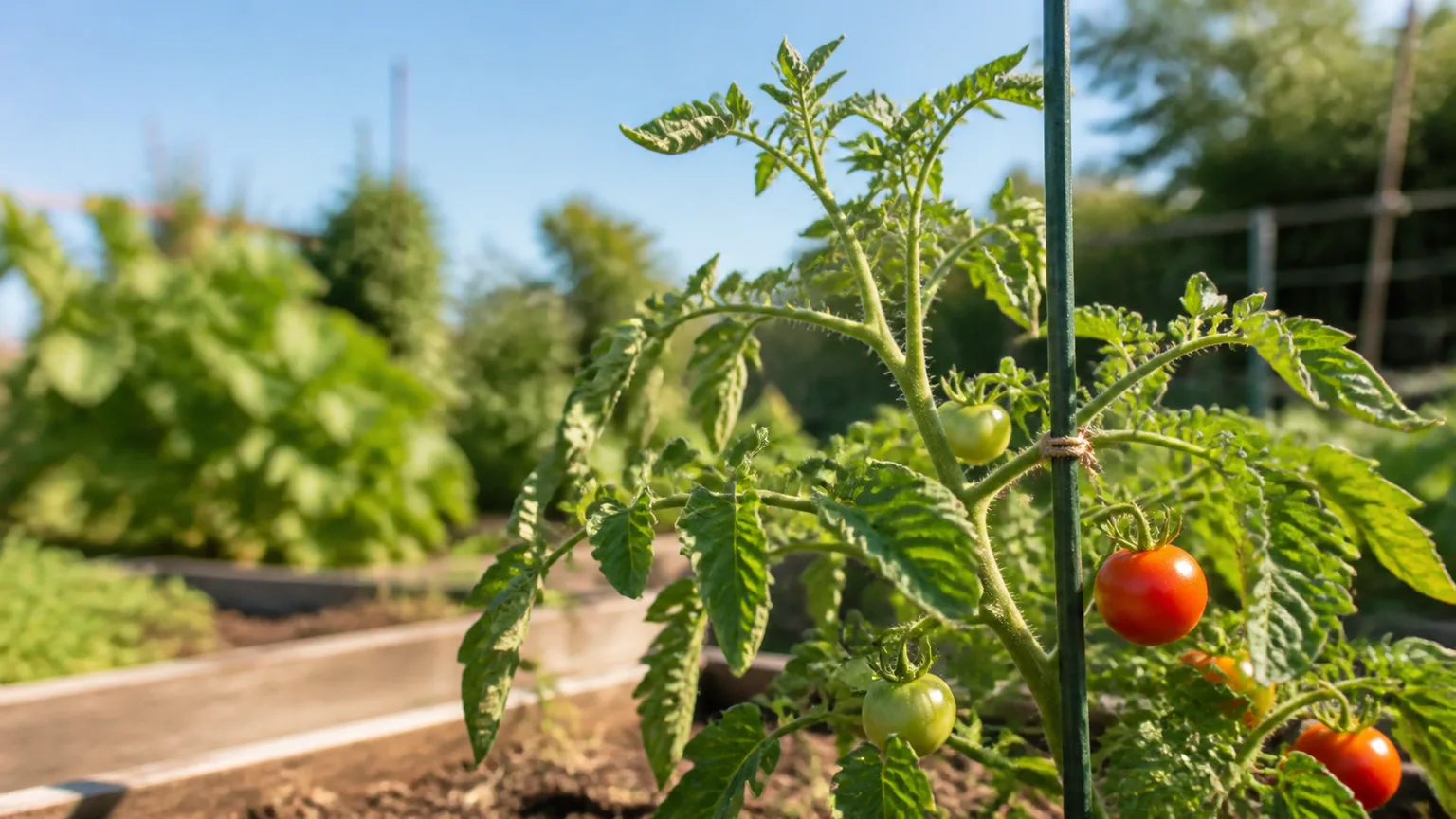
Tomato leaves curling is a symptom, not a diagnosis. The most common version is a temporary stress response: older leaves roll upward or inward, stay green, and relax when heat, wind, or inconsistent moisture settles. A different pattern—new leaves twisting downward, yellowing, shrinking, or staying distorted—raises the stakes because herbicide injury, mites, or a virus may be involved.
Do not start by stripping the plant or adding fertilizer. Photograph the whole plant, inspect the newest growth and the undersides of leaves, feel the soil several inches down, and think back to what changed in the last week. That sequence is more reliable than the direction of the curl alone.
Quick answer: curl is a symptom, not a diagnosis
Tomato leaves commonly curl because of heat, wind, drought, excess moisture, root damage, transplant stress, heavy pruning, excess nitrogen, herbicide exposure, viruses, or pests. Texas A&M AgriLife groups the problem into environmental, chemical, and biological causes, which is a useful way to avoid the common mistake of treating every curled leaf as a disease.
The first split is whether the plant is still growing normally. If the leaves are green, the stems are firm, flowers and fruit look normal, and the curl is worse in the afternoon but better by morning, environmental stress is more likely. If the newest leaves are the most affected and the plant is stunted, mottled, yellow-veined, bronzed, or producing deformed fruit, pause before treating and consider chemical injury, a virus, or a microscopic pest.
Start with direction, leaf age, and timing
Use this table as a triage tool, not as a substitute for diagnosis. Several problems overlap, and a plant can have more than one at once—for example, heat stress on top of roots damaged by soggy soil.
| What you see | Most useful first suspicion | First check |
|---|---|---|
| Older leaves roll upward, remain green, and improve overnight | Physiological leaf roll | Heat, wind, recent dry-down, or root disturbance |
| Leaves droop or curl downward while soil stays wet | Overwatering or root injury | Drainage, soil odor, and root condition |
| New growth twists, cups, or narrows after spraying nearby | Herbicide drift | Recent lawn, pasture, or garden-weed treatment |
| New leaves are small, yellow between veins, and the plant is stunted | Virus or severe chemical injury | Whiteflies, weeds, pattern across plants, and local diagnosis |
| Young leaves and flowers distort; growth may bronze or harden | Broad mites | A diagnostic lab or microscope; the mites may be invisible |
Look at new growth, not only the damaged leaves. Leaves that already curled may never become flat again, even after the plant recovers. Normal-looking new leaves are the better recovery signal.
1. Physiological leaf roll from heat, wind, or uneven water
Physiological leaf roll is the reassuring explanation behind many cases of tomato leaf curl. The plant reduces exposed leaf surface when its roots cannot keep up with water loss from hot sun, dry soil, or drying wind. Texas A&M has documented tomato leaves rolling during heat stress in the middle of the day, and the leaves may look rolled while the plant remains green and productive. (Texas A&M AgriLife: Why are my tomato leaves curling?)
This pattern often begins on older, lower leaves. The leaves can become slightly thick or leathery, but they do not usually show a spreading mosaic, sharply yellow margins, sticky residue, webbing, or severe stunting. A useful field clue is timing: if the curl is most obvious during the hottest part of the day and eases after sunset or after a stable watering routine returns, stress is more likely than a contagious disease.
The fix: stabilize conditions instead of chasing the leaves
Water slowly at the soil line when the root zone is drying, then let excess water drain away. The goal is even moisture through the active root zone—not a dry-to-wet cycle, a permanently saturated bed, or a fixed calendar schedule that ignores rainfall and container size.
Mulch the soil with a thin, even layer of organic material, leaving a small gap around the stem. Mulch slows evaporation and reduces soil splash, but it cannot compensate for a pot without drainage or a bed that stays waterlogged. In a container, move the plant away from a reflective wall or the hottest afternoon surface, and provide support so wind does not whip the foliage.
Do not cut off every curled leaf. Green leaves are still feeding the plant, and unnecessary defoliation creates another stress. Remove only tissue that is dead, clearly diseased, heavily infested, or blocking airflow in a way that you can correct with a light, selective trim.
2. Overwatering or damaged roots
Too much water can curl tomato leaves just as too little water can. The difference is in the root zone: an underwatered plant has dry soil and may recover after a thorough drink, while an overwatered plant may wilt or curl with wet soil because damaged roots cannot move water and oxygen normally.
Downward curl, soft stems, yellowing lower leaves, slow growth, algae or crust on the soil, and a sour smell make excess moisture more likely. Epic Gardening’s tomato guidance also warns that overwatering can produce downward curl and root-rot symptoms, while watering needs change with heat, wind, humidity, soil, and whether the tomato grows in a pot or in the ground. (Epic Gardening: 7 Signs You’re Overwatering Tomatoes)
Check the root zone before watering again
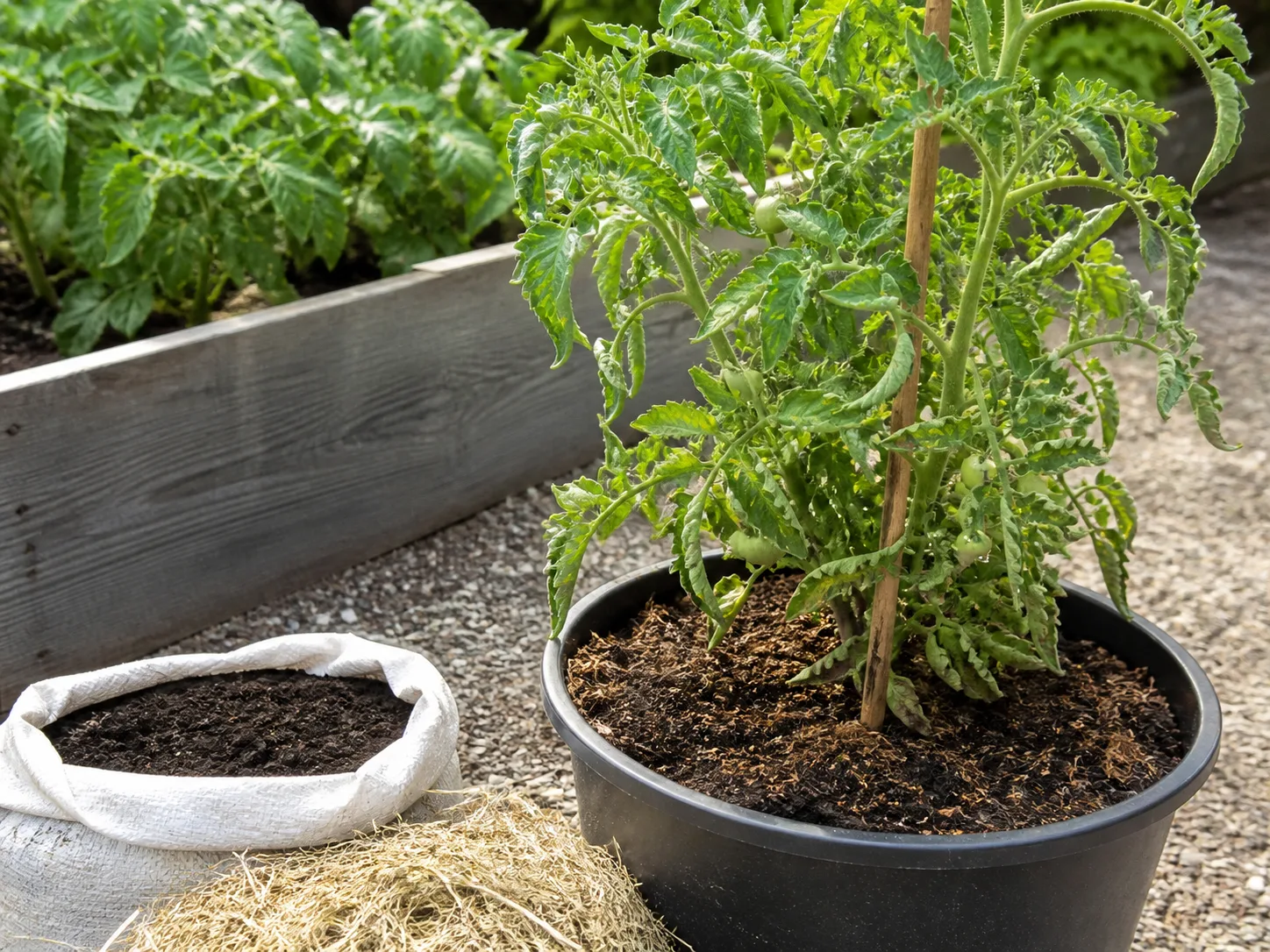
Push a finger, wooden skewer, or narrow trowel several inches into the soil near—but not against—the stem. If the soil is wet below a dry surface, do not water merely because the top looks dry. Check the container’s drainage holes, empty any saucer, and make sure a raised bed is not receiving runoff from a roof or low spot.
For a potted plant or a small transplant, slide the root ball out gently if the plant continues to wilt in wet mix. Healthy tomato roots are generally light-colored and firm; roots that are dark, soft, slimy, or foul-smelling have been damaged. Trim only roots that are clearly rotten with clean tools, repot into a well-draining mix, and expect temporary wilt after the disturbance.
For a large in-ground vine, do not dig it up as a first response. Let the bed drain, stop irrigation until the root zone begins to dry, and correct the drainage problem. Uprooting a mature tomato can destroy more functioning roots than the original wet spell did.
3. Transplant shock or cold stress
A tomato can curl after hardening off, transplanting, root disturbance, or a sudden change from sheltered nursery conditions to sun and wind. Cold soil and chilly nights slow root activity just when the leaves are losing water, so the top growth can look wilted, leathery, or curled even when the soil is not completely dry.
The timing is the main clue: the curl appears within days of planting or moving the plant, while the stems remain green and the newest leaves are not progressively shrinking or mottling. Container tomatoes can also react when their root ball becomes hot against pavement or cool after a cold rain.
Keep the root ball evenly moist but not saturated, protect a recent transplant from strong wind for a few days, and avoid adding fertilizer while it is visibly stressed. Do not repeatedly unpot and replant it to check whether it is recovering. Give it stable conditions and look for fresh, normally shaped growth over the next one to two weeks.
4. Over-pruning or sudden leaf loss
Tomato pruning is not automatically helpful. Removing a large amount of foliage at once can expose the plant to stronger sun and wind, reduce its water-use buffer, and leave developing fruit less protected. Epic Gardening notes that excessive pruning can contribute to leaf curl, yellowing, stunted growth, and lower production, while the right amount of pruning depends on whether the plant is determinate or indeterminate. (Epic Gardening: 11 Reasons Your Tomato Leaves Are Curling)
If curling began after you stripped suckers, removed many lower leaves, or cut back a bush tomato after flowering, stop pruning until the plant produces healthy replacement growth. Determinate tomatoes generally need much less pruning than vining indeterminate types. For either type, remove leaves touching soil or badly diseased tissue, but keep enough healthy canopy to shade the fruit and maintain normal water use.
Sunscald on exposed fruit, crispy leaf edges, or curl only on the newly exposed side of the plant supports a canopy-loss explanation. Restore support and shade through the hottest period if necessary; do not try to solve exposure stress with extra fertilizer.
5. Too much nitrogen or another soil imbalance
Curl is a poor reason to fertilize. Excess nitrogen can make tomato foliage unusually dark green, thick, soft, and abundant while flowers and fruit lag behind. The same lush growth may curl at the margins, but a similar-looking leaf can also result from heat or roots that are not functioning well.
Stop high-nitrogen feeding until you know what the soil contains. Do not try to balance one guessed deficiency with a second product. A tomato that is already stressed by wet roots, drought, or chemical injury will not be repaired by a fertilizer dose, and soluble salts can add another root problem in a container.
Use a soil test before adding fertilizer
A soil test is more useful than a leaf symptom chart when the problem is persistent, affects several plants in the same bed, or follows repeated applications of compost and fertilizer. Test the actual bed or container mix, follow the laboratory’s sampling instructions, and adjust only the nutrients the report identifies as low or excessive.
Purple color, general stunting, interveinal yellowing, and thick dark foliage point to different possibilities, but they are not proof of a single deficiency. If the plant is flowering and fruiting normally, leave it alone rather than trying to force a particular NPK ratio. Good tomato care is a sequence—light, drainage, water, and roots first; fertilizer second.
6. Herbicide drift or residue in compost
Herbicide injury deserves special attention because tomatoes are highly sensitive and the source may be outside your garden. Drift from a nearby lawn, field, ditch, or neighbor’s treatment can twist and cup new leaves, narrow the leaflets, split stems, and distort fruit. Texas A&M notes that physical spray drift can move yards, vapor from some products can travel much farther, and even relatively low wind can increase risk; 2,4-D and dicamba are common growth-regulator herbicides that can injure tomatoes. (Texas A&M AgriLife: Why are my tomato leaves curling?)
The pattern is often more important than the number of curled leaves. Herbicide damage favors new growth, may appear on multiple plants exposed to the same air flow, and persists as leaves continue to emerge. If symptoms began after a spray event, do not apply another chemical in an attempt to counteract it; follow the product label and contact your local extension service if the diagnosis matters for a crop or a neighbor’s application.
University of Maryland Extension treats herbicide injury on vegetables as a diagnostic problem because symptoms can overlap with disease and nutrient stress. (University of Maryland Extension: Herbicide Damage on Vegetables)
When manure or mulch is the clue
If the curl began after you added compost, manure, hay, straw, or grass clippings, consider persistent herbicide residue. Texas A&M AgriLife warns that some pasture herbicides, including aminopyralid, can remain active in manure and compost and injure sensitive vegetables long after the original forage was treated. The same source recommends treating contaminated soil as a real input problem rather than assuming heat or watering caused it.
Stop using the material and note which bed received it. In a container or small raised bed, replacing the affected mix is often more dependable than trying to dilute it. In a large bed, contact an extension office before adding activated charcoal, biochar, or more compost; those amendments may reduce injury in some situations but are not a universal home-garden reset.
7. Tomato viruses
Viruses are less common than ordinary stress, but they matter because there is no simple spray that returns infected foliage to normal. Virus suspicion rises when the youngest leaves are the smallest or most distorted, growth is stunted, color is mottled or yellow between veins, flowers drop, or fruit production changes. Multiple viruses can produce overlapping leaf symptoms, so a photograph and a local diagnostic service are more useful than naming one from curl alone.
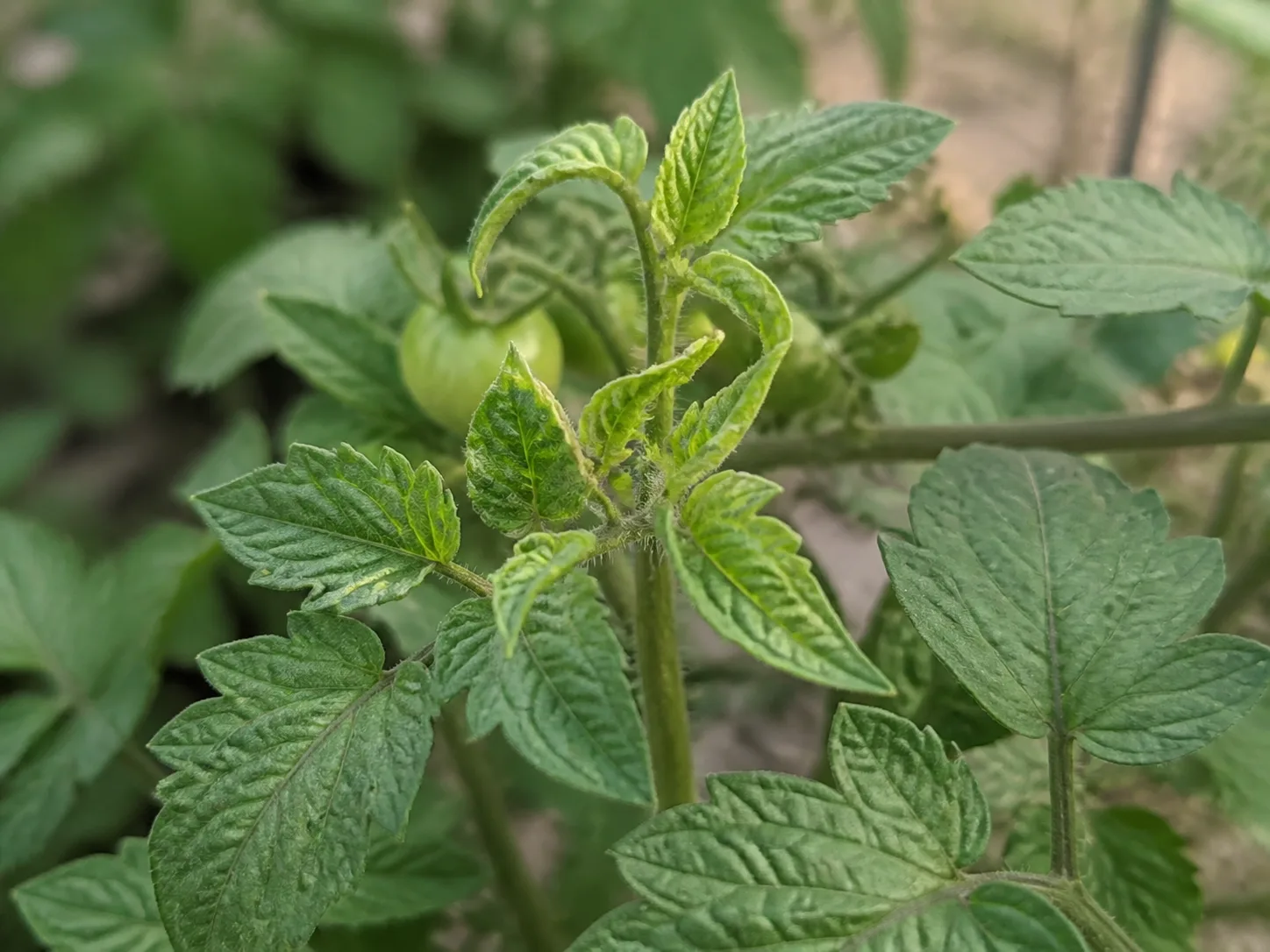
Keep a plant with mild green physiological roll in place. If a plant has persistent stunting and abnormal new growth, isolate it from handling and remove it only after considering the pattern across the bed and the cost of a wrong diagnosis. Bag suspect material rather than adding it to home compost, and clean hands and tools before working on neighboring tomatoes.
Tomato yellow leaf curl virus
Tomato yellow leaf curl virus, or TYLCV, is associated with small leaves, yellowing between veins, upward and inward curl, shortened shoots, and stunting. Agriculture Victoria identifies silverleaf whitefly as the vector and notes that the virus can sharply reduce tomato yield even though fruit that forms may look unaffected. (Agriculture Victoria: Tomato yellow leaf curl virus)
That combination is unlike a plant whose older leaves roll during a hot afternoon but whose new growth remains full-sized and green. Check leaf undersides for whiteflies, inspect nearby weeds and nightshades, and ask your extension service about local virus pressure. Whitefly control is an integrated pest-management decision; use only products labeled for edible crops, follow the current label, and do not assume that killing visible adults will cure an already infected plant.
Mosaic and curly-top clues
Mosaic-type problems produce irregular light-and-dark green patterning, crinkling, small leaflets, or uneven growth rather than a clean, reversible roll. Curly-top symptoms may include thickened, twisted upper leaves, yellowing, purplish veins, and severe stunting; leafhoppers can spread the virus in some regions. Horticulture references describe mottling, crinkling, and abnormal growth as warning signs that deserve a disease diagnosis rather than a fertilizer experiment. (Fine Gardening: What’s Wrong with My Tomato Plants?)
If only one or two old leaves are curled and the plant is otherwise vigorous, a virus is not the first conclusion. If every new leaf is increasingly deformed, several plants show the same pattern, or fruit is also abnormal, stop moving between plants and get local guidance on removal, sanitation, and resistant cultivars for the next planting.
8. Broad mites and other pests
Broad mites are a classic reason a tomato’s newest leaves and flowers can become twisted, thickened, or severely distorted while the pest itself remains out of sight. Texas A&M AgriLife notes that broad mites feed on young tissues and inject toxins that distort growth; a microscope or diagnostic lab may be needed because a hand lens is not always enough. (Texas A&M AgriLife: Why are my tomato leaves curling?)
Do not diagnose broad mites from curl alone. Inspect buds and the undersides of the newest leaves, look for bronzing or russeting, compare new growth with older leaves, and check whether the plant came from a greenhouse or nursery with other stressed plants. Whiteflies, aphids, and spider mites can also contribute to curl directly or spread viruses, but they leave different clues such as honeydew, cast skins, stippling, webbing, or visible insects.
If mites are suspected, isolate the container and avoid moving it through the garden. Remove severely damaged tissue, photograph the plant, and ask an extension diagnostic service or knowledgeable nursery professional before buying a miticide. Any pesticide, horticultural oil, or insecticidal soap must be labeled for tomatoes and the target pest; test a small area, protect pollinators, and observe the harvest interval on the label.
A 48-hour recovery plan
When the cause is unclear, use a short observation window rather than applying several remedies at once. Each change should answer a question, and the plant’s next new leaf is more informative than the leaf that already curled.
- Photograph before touching the plant. Take one whole-plant image and close-ups of old leaves, new growth, the underside of a leaf, the stem, and any fruit. Include a neighboring plant if it shows the same symptom.
- Record the trigger. Note the last watering, rainfall, heat or wind event, transplant, pruning, fertilizer, compost, mulch, and any lawn or weed-control spray within range.
- Check the root zone. Feel several inches down, confirm that water can drain, and smell the mix. Do not water a wet plant just because the leaves look limp.
- Pause aggressive inputs. Stop fertilizer, foliar sprays, and major pruning until you have a stronger clue. Green leaves can stay; remove only dead, diseased, or heavily infested tissue.
- Correct the obvious stressor. Water a genuinely dry plant slowly, let a saturated bed drain, add temporary wind protection, or stop using a suspect compost. Do not make all four changes at once.
- Read the new growth. Normal-sized green leaves after conditions stabilize support an environmental cause. Continued twisting, yellowing, mottling, bronzing, or stunting calls for an extension diagnosis.
This plan also prevents a common failure mode: watering a wilted overwatered tomato, fertilizing a chemically injured tomato, or spraying a virus. If the plant is valuable, the crop is commercial, or symptoms are spreading fast, send a clear sample or image to a plant diagnostic laboratory instead of waiting for certainty from a web article.
Prevention that reduces repeat curl
Prevention is mostly about reducing abrupt changes. Grow tomatoes in well-drained soil with enough sun, keep irrigation consistent with the weather, and use support before a tall vine becomes tangled. Water at the soil line, mulch without burying the stem, and leave enough space for air to move through the canopy.
Water, mulch, support, and sanitation
Check the soil before each irrigation rather than using a rigid schedule. Deep, slow watering is usually more useful than shallow daily sprinkling, but containers and hot windy sites dry faster than a mulched in-ground bed. Adjust for rain, and repair drainage before increasing water.
Use clean, mature compost from a source that can tell you what herbicides were used on hay or pasture. Do not assume a pile is safe because it is old or hot. Rotate tomato-family crops when practical, remove diseased debris from the garden, and clean pruners between plants when disease is a possibility.
Keep pruning conservative and match it to the variety. Stake or cage the plant early, inspect new nursery plants before they join the bed, and look at leaf undersides during routine harvests. Fine Gardening’s tomato troubleshooting guidance likewise puts weed control, soil-level watering, airflow, and prompt removal of clearly diseased material ahead of quick-fix sprays. (Fine Gardening: What’s Wrong with My Tomato Plants?)
Conclusion
Most tomato leaves that curl are reacting to a change in water balance, heat, wind, roots, or handling—not announcing that the plant is doomed. Start with the simplest high-value clues: which leaves are affected, which way they curl, whether the plant recovers overnight, and whether the newest growth remains normal.
If new leaves keep twisting, yellowing, shrinking, bronzing, or showing a mosaic pattern, stop guessing. Herbicide drift, contaminated compost, broad mites, and viruses require different responses, and a local extension diagnostic service can save you from removing a healthy plant or spraying the wrong product. Stabilize the root zone, keep green foliage working, and let the next flush of growth tell you whether the plant is actually recovering.



