What Not to Plant Near Lettuce
Fennel, brassicas, summer squash, and parsley do not all create the same risk. Get practical spacing, timing, and better companion choices for lettuce.

The word never makes companion planting sound simpler than it is. Fennel is the plant I would separate from lettuce first, but brassicas, summer squash, and parsley create very different levels of risk. In a small garden, knowing the difference can save you from moving a perfectly harmless herb while a sprawling squash quietly smothers the salad row.
The most useful question is not “Are these plants friends?” It is: Will this neighbor steal the light, water, root space, harvest window, or pest-management attention that lettuce needs? West Virginia University Extension describes companion planting as a useful starting point, while also cautioning that results vary by place and that the practice is not an exact science. That is the right lens for the four common pairings below. WVU Extension’s companion-planting guide
The Short Answer: One True No and Three Conditional Separations
If you have only one spare corner and need a quick decision, put fennel there—or grow it in a separate container. Keep summer squash away from lettuce unless you have a generous amount of room and a plan for the leaves. Brassicas such as broccoli, cabbage, kale, cauliflower, and Brussels sprouts can share a bed with lettuce when spacing and harvest timing are deliberate. Parsley is the least convincing “never” pairing; a nearby parsley plant is not a reliable explanation for lettuce that suddenly bolts.
| Neighbor | What can go wrong | Best practical move |
|---|---|---|
| Fennel | Possible growth inhibition, self-sowing, tall mature growth, and a difficult-to-measure interaction zone | Use a separate bed, large container, or far edge of the garden |
| Brassicas | Similar cool-season schedule, overlapping water and fertility needs, and a crowded pest-scanning zone | Share space only with mature spacing; harvest lettuce early |
| Summer squash | Broad leaves and thirsty roots can cover lettuce and make access difficult | Put squash in its own 3- to 4-foot planting area or outside the lettuce bed |
| Parsley | Usually a space, shade, or timing issue—not a proven universal bolting trigger | Keep it at the edge and diagnose heat and moisture first |
Lettuce is a cool-season crop that grows best when it can make leaves quickly before hot weather. Utah State University Extension recommends fertile, well-drained soil, steady moisture, and final spacing commonly around 8 to 12 inches between plants, with 12 to 18 inches between rows for head lettuce. A companion that fits those conditions can work; one that changes them is the real problem. USU Extension’s lettuce guide
How to Judge a Bad Lettuce Neighbor
Before pulling a plant, run four tests. They are more dependable than a chart because they measure the actual garden in front of you: the season, the root zone, the mature canopy, and the pest or disease pattern.
Season and Temperature Are the First Test
Lettuce likes cool conditions, but “cool-season crop” does not mean it wants a permanently shaded, wet corner. Seeds germinate best in a moderate temperature range, and hot weather slows growth, worsens flavor, and encourages premature flowering. USU Extension notes that temperatures above about 80°F can reduce germination and that heat can make lettuce bitter; its advice also emphasizes avoiding water or fertilizer stress.
That timing changes how a pairing performs. A trellised pea crop can be a useful source of late shade for a spring or early-summer lettuce row, but the same structure may block the weaker autumn sun if it remains in place into fall. A broccoli transplant beside baby lettuce can work in a spring bed if the lettuce is cut before the broccoli’s leaves expand. The same planting may be too crowded if both crops are expected to remain until full maturity.
Bolting is especially easy to misread. The plant sends up a flower stalk and its leaves may become bitter, but the trigger is often a combination of heat, long days, drought, root disturbance, or simply an aging plant. Do not assume a nearby herb released a harmful chemical until you have checked the thermometer, soil moisture, and planting date.
NC State Extension Gardener describes leaf lettuce as a quick crop, with some types ready from seed in roughly 40 to 50 days under suitable conditions. That short harvest window is a design advantage: use it to place lettuce in the gaps around a slower crop, then clear the space before the larger plant needs it. NC State’s lettuce growing guidance
Root Zone and Fertility Are the Second
Lettuce has a relatively shallow root system, so it benefits from soil that stays evenly moist near the surface. It does not compete well with weeds or with a vigorous plant whose roots occupy the same thin layer while its leaves intercept the sun. A companion does not need to be chemically hostile to reduce a lettuce harvest; it only needs to be faster, bigger, or hungrier in the same bed.
This is why the label heavy feeder is not enough by itself. A fertile bed can support two crops, but the extra compost or fertilizer does not solve a canopy that lies over the lettuce or a plant whose roots make the surface dry between waterings. Fertilize from a soil test or the crop’s instructions, then water the whole bed deeply enough for its roots without keeping lettuce crowns constantly wet.
Root depth can help. Radishes, carrots, and beets can occupy a different shape of soil than lettuce, especially when they are planted in separate bands and thinned properly. The benefit disappears if every seed is broadcast into one dense mat that makes weeding, watering, and harvesting impossible.
Crop-Family Pests Are Not All the Same
Putting two crops together because they share a season can also put their pests within easy reach, but the phrase “same pests” needs precision. USU lists aphids, slugs, and flea beetles among lettuce problems. UC Statewide Integrated Pest Management guidance, by contrast, explains that cabbage aphids feed on plants in the Brassicaceae family, including cabbage, broccoli, and related weeds. They are not a universal pest of every leafy green.
The practical overlap is more often generalist pests, wet conditions, or the gardener’s attention. Slugs can chew lettuce and young brassica leaves. Aphids may occur on more than one crop, but the species and host range differ. A bed packed with lettuce and brassicas can also hide damage under overlapping leaves, so inspect the undersides twice a week when plants are young.
Diversity may help interrupt a pest’s movement or provide habitat for beneficial insects, but it is not a pesticide. Row cover, sanitation, crop rotation, hand removal, and regular scouting remain more reliable control layers. UC IPM’s cabbage-aphid guidance
Fennel: The One to Isolate First
Fennel is the clearest answer to the “what not to plant near lettuce” question because it combines a widely reported growth-inhibition concern with a strong, tall, persistent growth habit. That does not mean every fennel plant will kill every nearby lettuce plant. It does mean the experiment is hard to control in a small bed, and there is little reason to take the risk when fennel is easy to give its own space.
Why Fennel Deserves Its Own Corner
Fennel is not one uniform garden plant. Common fennel is grown for fronds and seeds, while Florence fennel is grown for a swollen edible base. Utah State University Extension describes both types as full-sun plants that prefer well-drained soil and regular moisture. Florence fennel is commonly spaced 8 to 12 inches apart after thinning, with rows about 18 inches apart, and common fennel can become a substantial plant.
That size matters before allelopathy enters the conversation. A tall common fennel can shade low lettuce, shed seed into paths and beds, and make it hard to reach the lettuce for harvest. Florence fennel and lettuce may also be planted in the same cool-season window, so they can compete at the exact moment the lettuce needs rapid, uninterrupted growth. USU Extension’s fennel guide
Fennel is also a poor candidate for a tiny mixed row because you cannot tell from one disappointing lettuce crop which factor mattered: shade, dry soil, root disturbance, crowding, or a chemical interaction. Extension companion charts commonly place fennel among plants to separate, but the same guidance says companion planting varies by location and should be tested over time rather than treated as a guarantee.
My rule is simple: if you want fennel, isolate it; if you want a dense salad bed, do not use fennel as its neighbor. A large container is particularly useful because it limits root-zone overlap and makes self-sown seedlings easier to remove. Cut flower heads before they drop seed if you do not want fennel appearing in the lettuce bed next year.
How Far to Separate Fennel From Lettuce
There is no single, research-backed distance that guarantees lettuce will be unaffected by fennel in every soil and climate. For a cautious home-garden layout, place fennel in a separate raised bed, at the far end of a long plot, or in a container. If the plants must occupy the same garden, use at least the practical two- to-three-row separation suggested by WVU Extension for negative companion relationships, then increase the buffer if the fennel is tall, self-sowing, or casting afternoon shade.
Keep the lettuce on the sunny side of the garden and the fennel where its height will not shade the crop during the lettuce harvest window. Remove volunteer fennel seedlings promptly. This arrangement is more useful than trying to sprinkle a few lettuce plants around the fennel and hoping the roots stay in separate worlds.
If your lettuce is already growing beside fennel, do not panic or destroy both plants. Harvest the lettuce young, move or containerize the fennel if it is still small, and check whether the soil is drying or the leaves are shaded. You can then compare a separated lettuce succession with the original row rather than relying on a single anecdote.
Brassicas: Same Season, Different Crops, Shared Management Problems
Broccoli, cabbage, cauliflower, kale, Brussels sprouts, collards, and mustard greens are brassicas, while lettuce belongs to a different plant family. That distinction makes the competitor warning too absolute: brassicas and lettuce are not automatically incompatible, and the pairing can be productive when lettuce is treated as a fast crop between larger transplants.
The reason to be cautious is management. Both groups prefer cool weather, fertile soil, and consistent moisture. A lettuce plant that is 8 inches from a young broccoli transplant may look perfectly spaced in April, then become crowded when the brassica’s outer leaves widen. The same bed can also demand frequent scouting for slugs, aphids, flea beetles, and caterpillars, even though not every pest moves between both crops.
UC IPM’s cabbage-aphid guidance is a useful correction to the broad “shared pests” claim: cabbage aphids specialize in brassicas. That makes crop-family rotation and removal of brassica leftovers especially important for the brassica side of the bed, while lettuce still needs its own inspection for aphids and slugs. Keeping a brassica and lettuce together does not create a new disease by magic, but a crowded, damp canopy gives you fewer good options once damage starts.
When Brassicas and Lettuce Can Share a Bed
Use lettuce as an early harvest layer, not as a permanent understory. Transplant the broccoli or cabbage at its recommended mature spacing, then sow leaf lettuce in an open gap only if you can harvest it before the brassica canopy closes. For head lettuce, follow the packet and a spacing range near 8 to 12 inches; for baby leaf, use a denser sowing only when you have a clear cutting plan.
Keep the rows distinct instead of mixing seeds so densely that you cannot thin them. A narrow band of leaf lettuce on the bed’s sunny edge, a separate brassica row behind it, and a path-side strip of chives is easier to water and scout than a single confetti-like planting. Remove old brassica leaves and crop debris after harvest, and rotate brassica beds when possible.
If brassica leaves begin shading the lettuce before you have harvested it, cut the lettuce rather than feeding it extra fertilizer. More nitrogen may produce soft, crowded foliage while doing nothing about lost light or airflow. If the lettuce is meant for a fall crop, plant a fresh succession after the brassica has been cleared instead of trying to keep a tired spring planting alive through summer.
Summer Squash: A Space and Water Conflict
Summer squash and zucchini are not bad neighbors because they release a special substance that targets lettuce. They are bad neighbors in many small beds because their mature footprint is easy to underestimate. Even a bush-type plant needs room for broad leaves, a clear path for harvesting, and enough airflow to reduce disease pressure.
West Virginia University Extension describes summer squash as a warm-season annual that prefers full sun. Its guidance recommends planting mounds about 3 to 4 feet apart, thinning to one or two plants, and leaving extra room for airflow. Those dimensions explain why a squash seedling can be a fine-looking lettuce companion in May and a solid wall across the lettuce row a few weeks later. WVU Extension’s summer-squash guide
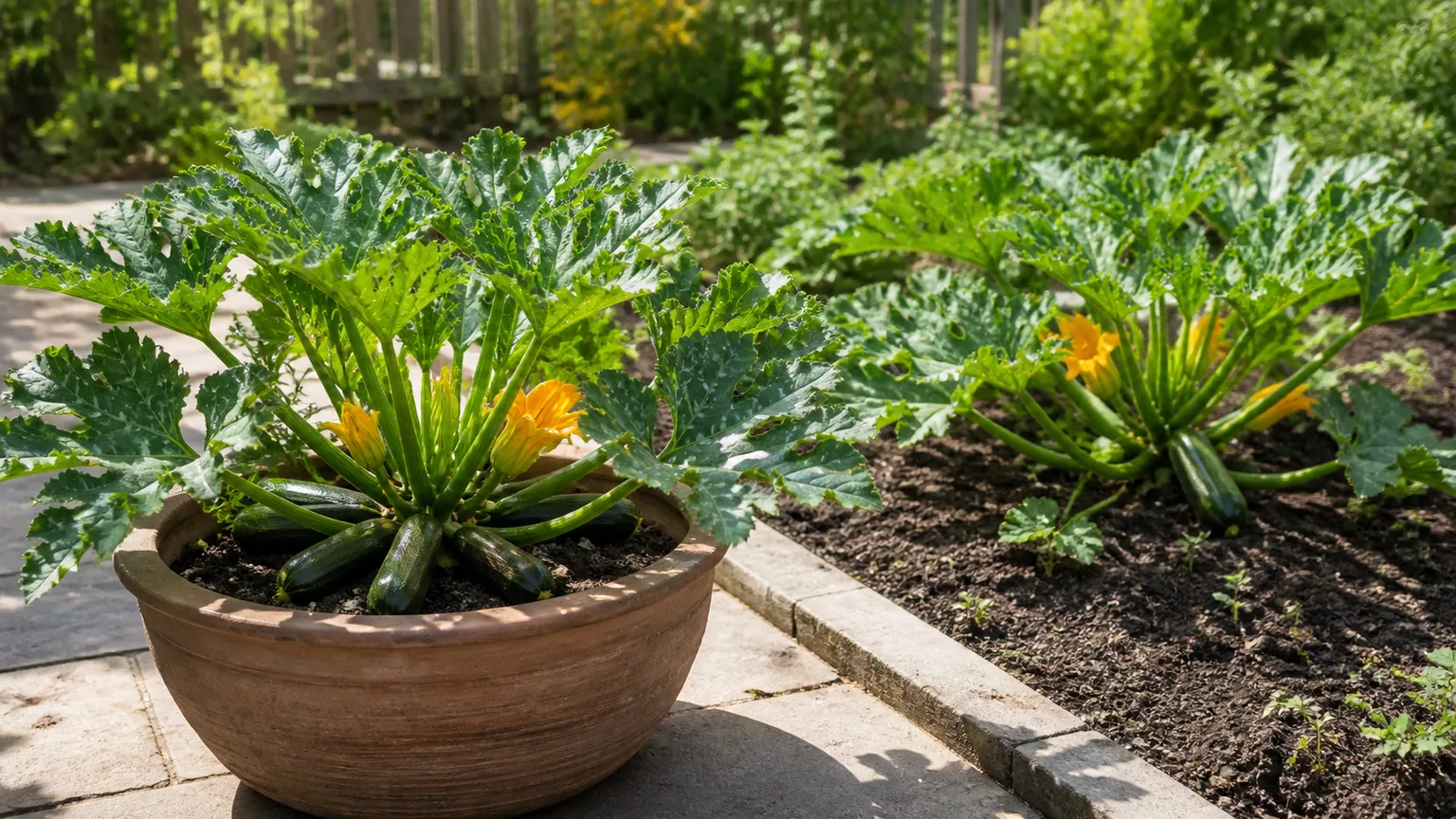
Water is the second conflict. Lettuce needs steady moisture near the surface, while fruiting squash needs enough water to maintain leaves and set fruit during hot weather. If both crops share a narrow bed, the gardener may either keep the lettuce too wet or let the lettuce dry while trying to satisfy the squash. The squash’s leaves can also hide the lettuce from a hose, drip line, or quick pest inspection.
Make the Pairing Work If Space Is Tight
The easiest solution is to give squash its own planting area outside the lettuce bed. A patio container or a corner of the in-ground garden works if the container is large enough and the plant is not allowed to sprawl across the salad row. Bush types are more realistic for small gardens, but check the cultivar’s mature width; “bush” does not mean miniature.
If you must share one bed, plant lettuce on the north or uphill side only if that placement still gets enough light, and keep the squash at the edge where its leaves can be redirected outward. Do not plant lettuce inside the squash’s expected footprint. Use drip or soaker irrigation so you can water the root zones without wetting a dense canopy, and keep a path open for daily squash harvests.
Trellising is not a universal fix. Some vining cucurbits can be trained with strong support, but many bush summer squashes are not designed to climb, and heavy fruit can pull on a weak structure. If the variety is not suited to vertical training, choose separation over an improvised trellis that collapses onto the lettuce.
Parsley: Treat the “Bolting” Warning Carefully
Parsley is the least convincing plant on this list as a universal lettuce enemy. The claim that parsley roots make lettuce bolt is repeated in companion-planting lore, but it is not a useful diagnosis on its own. A lettuce plant that bolts beside parsley may simply have encountered hot days, long daylight, inconsistent moisture, root disturbance, or an over-mature variety.
There is a practical reason to keep parsley from crowding a lettuce row: parsley can become a leafy, upright herb that competes for light at the edge of a small bed, and it may stay in place after the lettuce season ends. But that is a space-management issue, not proof that parsley chemically forces every lettuce plant to flower.
Epic Gardening’s practical lettuce companion guidance includes taller herbs such as parsley as potential shade for tender greens in hot weather, while also acknowledging that some companion-planting benefits remain debated. That is a more useful interpretation than an absolute ban. Grow parsley at the bed edge, harvest it regularly, and keep it from leaning over the lettuce crown.
If the lettuce begins to stretch or send up a stalk, check the soil one inch down, review the recent high temperatures, and look for root damage. Harvest outer leaves immediately, provide temporary afternoon shade in a hot climate, and sow a heat-tolerant or slow-bolting lettuce succession. Remove parsley only if it is actually blocking light or access. Epic Gardening’s lettuce companion guide
Better Lettuce Companions That Earn Their Space
The best lettuce companions are not necessarily the plants with the most dramatic claims attached to them. They are crops that match lettuce’s season, occupy a different shape of space, finish on a useful schedule, or make the bed easier to inspect and harvest.
Alliums and Quick Roots
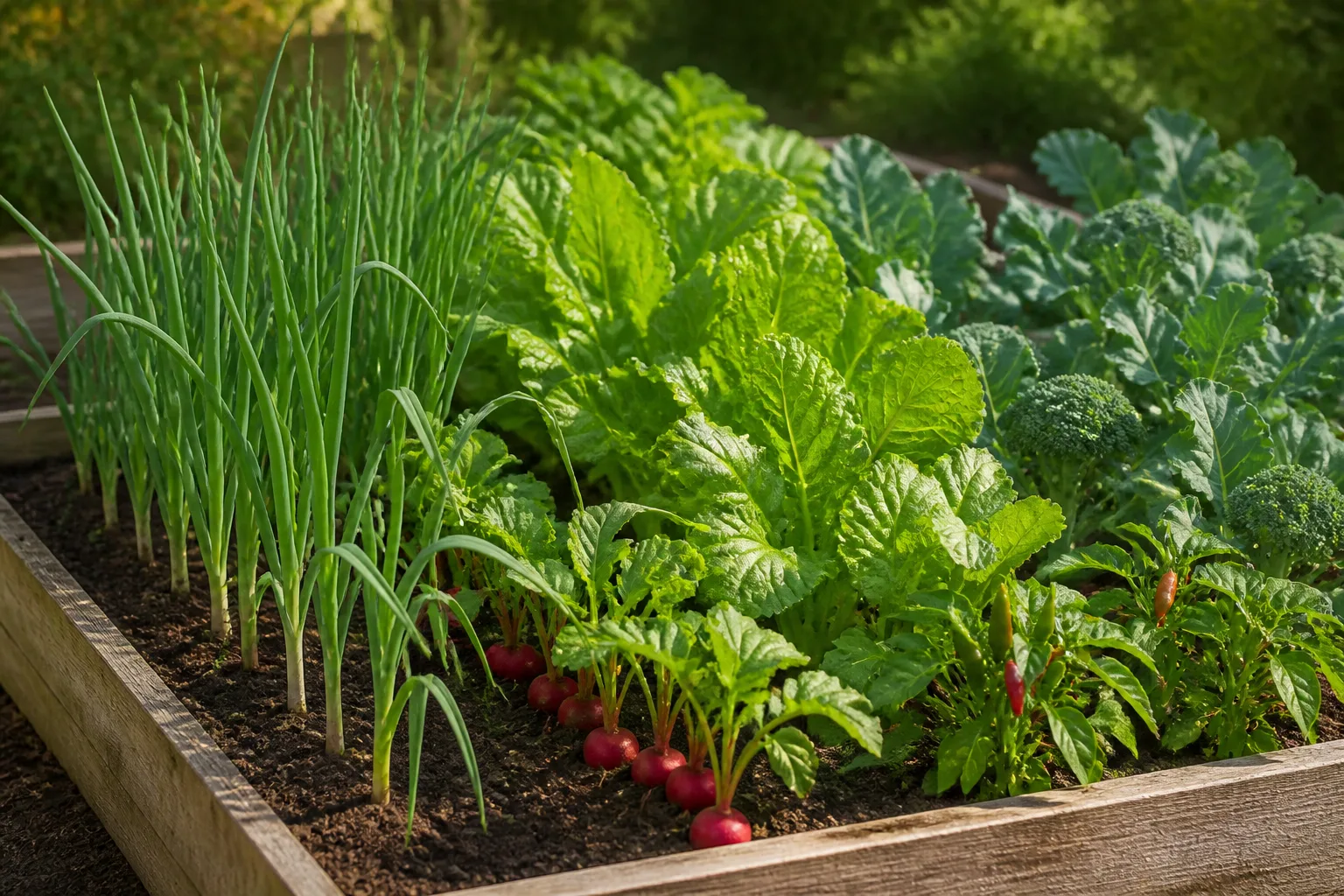
Chives, onions, and garlic are practical neighbors because their upright leaves use less horizontal room than a squash plant and their care can overlap with a cool-season lettuce bed. Do not promise that their scent will repel every aphid. Instead, use alliums as one part of a diverse layout and continue checking lettuce leaves.
Radishes are especially useful between lettuce successions. They germinate quickly, can mark a row, and are harvested before a head lettuce plant reaches full width. Carrots and beets can also share a bed when each crop is sown in its own band and thinned. The root crop does not magically improve the lettuce, but it can make the square footage more productive without placing another large canopy directly over the greens.
WVU Extension lists carrots, radishes, strawberries, cucumber, and onions among lettuce companions. Epic Gardening similarly highlights root crops and alliums as useful choices, particularly when the gardener matches the plants to the season and harvest window. Use these lists as candidates, then reject any pairing whose mature size or water needs do not fit your bed.
Taller Crops and Useful Shade
In hot weather, some shade can keep lettuce leaves cooler and slow the slide toward bitterness and bolting. The useful word is some. Lettuce still needs enough light for growth, and a dense wall that blocks air or traps moisture is not a companion benefit.
Use a trellis, tomato cage, or tall crop on the side that gives afternoon protection without shading the lettuce all day. WVU Extension describes interplanting smaller cool-season crops such as lettuce between larger, slow-growing vegetables so the larger canopy can provide shade later. That works best when the lettuce is planted early and harvested before the tall crop becomes dominant.
Put tall plants where their shadows move away from the lettuce during the main harvest period. Watch the bed rather than obeying a rigid compass rule: fences, trees, slopes, and latitude change the shadow pattern. If the shaded lettuce stops growing, turns pale, or remains wet after watering, the shade has become a liability.
A Practical Planting Plan for a Small Bed
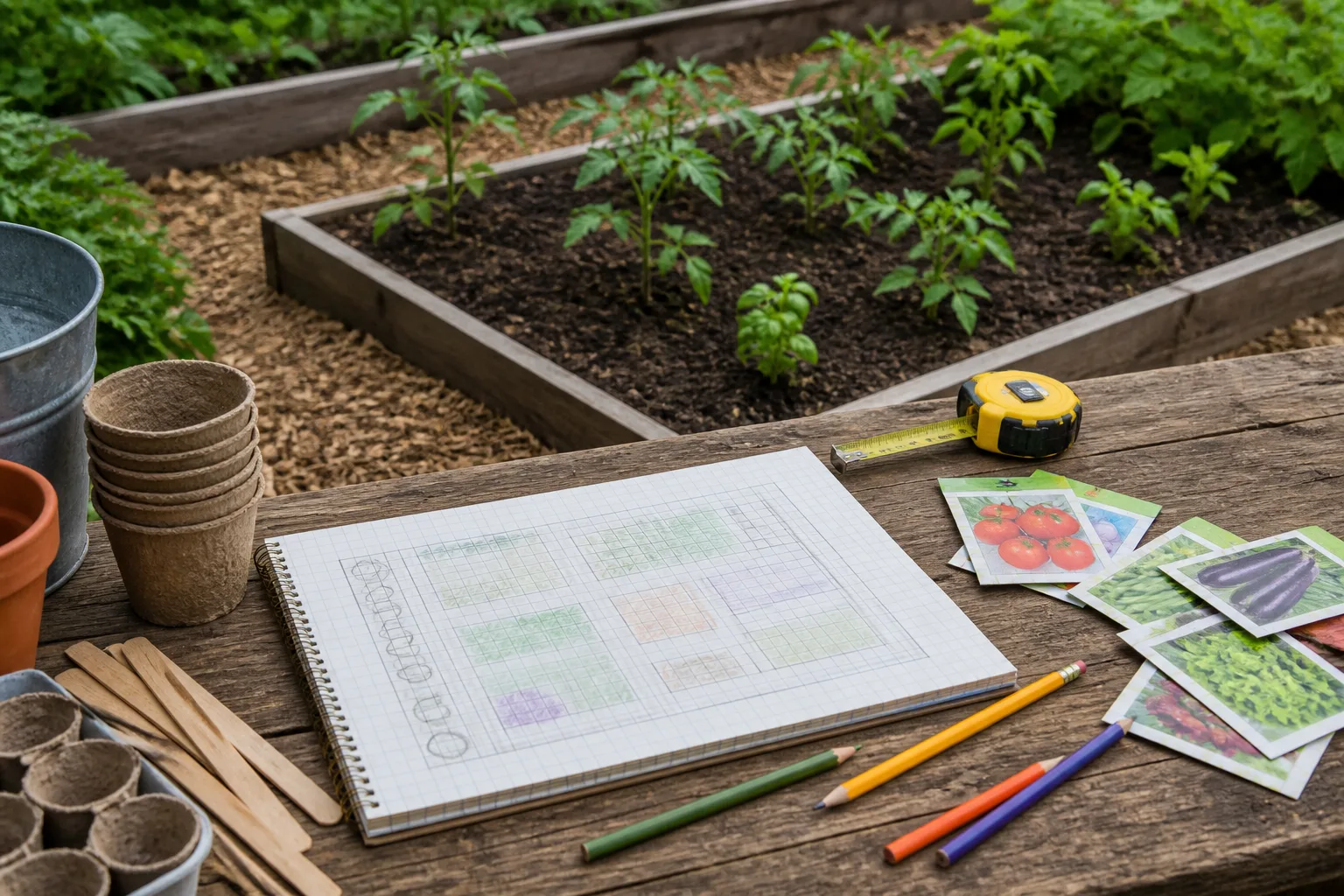
For a 4-by-8-foot bed, start with the lettuce rather than the companion chart. Draw the mature footprint of the main crop, mark the path side, and reserve a clear strip for irrigation and harvest. The goal is not to fit four companion plants into every opening; it is to make the harvest sequence easy.
For a spring bed, place one row of head lettuce or two bands of leaf lettuce on the sunny side. Keep 8 to 12 inches between head plants or use the seed packet’s guidance for the variety. Add a narrow radish row beside the lettuce, then harvest the radishes before the lettuce needs the room. Put chives or onions along the edge rather than in the center of the lettuce crowns.
If you are growing broccoli or cabbage, give those plants their full mature spacing first. Add baby lettuce only in the gaps that can be cleared within a few weeks. Keep fennel out of this bed. Reserve summer squash for a separate corner or container, with roughly a 3- to 4-foot planting area for a bush type and more for a vining type.
For a summer lettuce attempt, use a heat-tolerant variety, steady irrigation, and temporary afternoon shade. A tall trellis on the west side can help, but do not place an expanding squash plant in front of it. For fall lettuce, clear the spring bed, remove crop debris, refresh the surface with mature compost if needed, and sow a new succession instead of nursing spring lettuce through the hottest part of the year.
If Lettuce Is Already Planted Beside Them
You usually do not need to pull a whole bed because a companion chart says the pairing is wrong. Diagnose the symptom first, then change the factor that is actually limiting the lettuce.
If the lettuce is shaded, redirect a squash leaf, remove a lower obstructing leaf when appropriate, or move the smaller plant before its roots are disturbed further. If the soil is drying quickly, add a thin organic mulch that does not touch the crown and switch to slow, soil-level watering. If the surface stays wet, improve spacing and airflow instead of adding more water.
If the lettuce has holes, inspect at dusk for slugs and check the undersides of leaves for aphids. If the neighboring brassica has a visible aphid colony, remove heavily infested leaves or plants according to local extension guidance and keep scouting both crops. Do not spray an edible crop with a homemade mixture or an unregistered pesticide simply because the plants are close together; follow the product label and local recommendations.
If the lettuce is bolting, harvest what is still good and start a new sowing. Temporary shade can slow heat stress, but it cannot turn an over-mature spring variety back into a cool-season seedling. Note the date, variety, recent temperatures, watering pattern, and neighboring plants in a garden log. That record will tell you more next season than a universal “never” rule.
Conclusion
The safest answer to what not to plant near lettuce is fennel: isolate it in its own bed or container. Brassicas are a conditional pairing that can work when lettuce is harvested early and the bed stays open. Summer squash needs physical separation because its mature leaves and water demand overwhelm small salad rows. Parsley deserves a lighter warning; if lettuce bolts beside it, investigate heat, daylight, drought, and plant age before blaming the herb.
Build the bed around mature size, harvest timing, light, and access. Add alliums, radishes, carrots, or beets where they genuinely fit, then keep scouting because companion planting supports good garden management—it does not replace it.