Do Citronella Candles Work? Repellents to Try Instead
Citronella candles may help in calm air, but they are not a yard-wide solution. Compare fans, EPA-registered repellents, Bti, traps, and source control.

If a citronella candle is your entire mosquito plan, it is unlikely to deliver the calm, bite-free evening you want. Citronella candles can provide a modest, localized repellent effect in still air, especially close to the flame, but the scent disperses quickly outdoors and the candle does not remove eggs, larvae, or adult mosquitoes from your yard.
That does not make a candle useless. It can be a pleasant extra layer on a small, sheltered table. The mistake is asking it to protect an open lawn, compensate for a clogged gutter, or replace a proven repellent on your skin. The most reliable approach is to match the tool to the job: airflow and a spatial repellent for a patio, an EPA-registered skin repellent for your body, and source reduction for the yard itself.
The Quick Answer: Useful Accent, Weak Mosquito Strategy
Do citronella candles work? Sometimes, but not consistently enough to count as stand-alone mosquito control. NC State Extension describes citronella candles as most useful when there is relatively little air movement; the American Mosquito Control Association says their mild effect is not significantly better than the protection from other candles that produce smoke (NC State Extension; American Mosquito Control Association).
The practical translation is simple. A candle may reduce landings in a small, protected zone for as long as it is burning, but it does not create a measured, permanent “mosquito-free radius.” Wind, the number and species of mosquitoes, nearby vegetation, and the location of the breeding sites can overwhelm the scent before it reaches you.
If your goal is a dinner for two on a screened porch, keep the candle if you enjoy the light and smell. If your goal is to protect a large deck, stop bites during gardening, or lower mosquito pressure after rain, put your money and effort into a fan, personal repellent, water management, or a properly labeled product instead.
How Citronella Candles Affect Mosquito Behavior
Citronella oil is distilled from grasses and contains compounds including citronellol, citronellal, and geraniol. The National Pesticide Information Center explains that citronella repels rather than kills insects, apparently by masking scents that help them locate a host (NPIC’s citronella fact sheet). A candle adds heat and smoke, but it also releases a small, fluctuating amount of volatile oil into a large, moving outdoor space.
What a Candle Can and Cannot Do
A candle can make the immediate area around a tabletop less attractive while the air is calm. That benefit is spatial and temporary: it depends on the candle being lit, the oil being released, and the repellent plume remaining near the people you are trying to protect.
It cannot kill the mosquitoes developing in a flowerpot saucer. It cannot keep a day-biting Aedes mosquito from approaching someone who walks ten feet away to refill a drink. It cannot protect exposed ankles on a walk across the lawn, and it does not prevent mosquito-borne disease by itself.
Read the label before assuming that a product is just a scented candle. Some outdoor devices use synthetic pyrethroid actives such as allethrin or metofluthrin rather than citronella. That can make a spatial device more effective than a plain scented candle, but it also means you need to follow its label, keep it away from children and pets, respect ventilation instructions, and use it only outdoors if the label says so.
Why Wind, Layout, and Species Change the Result
Mosquito control is a geometry problem as much as a product problem. A candle on the upwind side of a small table may place its odor near the people seated there; the same candle on a breezy deck may lose its plume before it crosses the table. Dense shrubs can provide cool resting sites a few steps away, while a nearby gutter or saucer can keep supplying new adults.
Timing matters too. Many mosquitoes are most active around dawn and dusk, but Aedes aegypti and Aedes albopictus often bite during the day, particularly in shade. UGA Extension notes that container-breeding Aedes can develop in tires, buckets, planters, and similar small habitats, so a family that sees daytime biters should inspect its own containers rather than assume an evening candle will solve the problem (UGA Cooperative Extension).
Match the Tool to the Problem You Actually Have
Before buying another repellent, decide whether you are protecting a person, a seating zone, or the property. Those are different jobs with different success measures.
| Your goal | Best first layer | Where citronella candles fit | Main limitation |
|---|---|---|---|
| Fewer bites at one patio table | Fan aimed across the seating area, plus a labeled spatial repellent if needed | Optional calm-air accent | Wind and open sides disperse the scent |
| Protection while gardening or walking | EPA-registered skin repellent and protective clothing | Does not travel with you | Candle only protects its immediate zone |
| Fewer mosquitoes over days and weeks | Remove water, improve drainage, manage unavoidable water | No meaningful population effect | Adults can fly in from neighbors or natural habitat |
| A large yard with recurring pressure | Integrated plan and, if warranted, a licensed professional | Small-area add-on only | No single consumer device covers every species and habitat |
Need Fewer Bites at a Patio Table
Start with moving air. Mosquitoes are weak fliers, and both UGA Extension and AMCA identify a fan as a useful low-tech way to disrupt flight around a deck or patio. Aim the fan across lower legs and the table edge rather than straight at faces; the goal is a steady cross-current that makes landing difficult and disperses some of the carbon-dioxide plume mosquitoes use to find people.
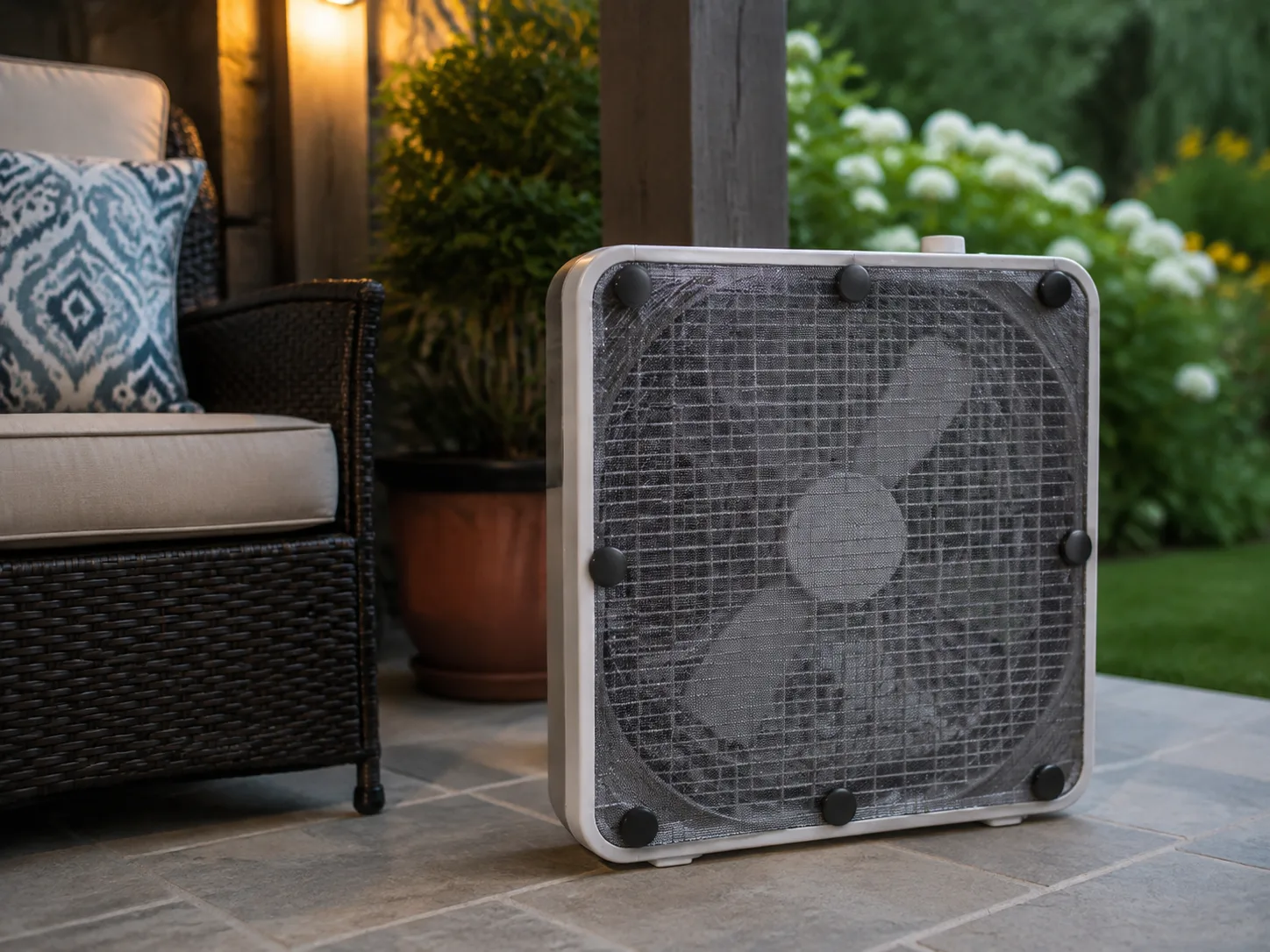
Add a spatial repellent only when the area is within the product’s labeled coverage and the air is calm enough for it to work. A lantern or repellent device may outperform a plain citronella candle, but the protection stops at the edge of the zone. You still need skin repellent if you leave the patio or if mosquitoes are landing on body parts outside the airflow.
For personal protection while gardening or walking, use an EPA-registered product labeled for skin. The CDC lists DEET, picaridin, IR3535, oil of lemon eucalyptus (OLE), para-menthane-3,8-diol (PMD), and 2-undecanone among the active ingredients in proven EPA-registered repellents (CDC mosquito-bite prevention). Look for an EPA Reg. No. and follow that specific product’s directions; concentration and formulation affect how long protection lasts.
Loose, long sleeves and pants add a physical barrier, especially when the fabric is not tight against the skin. Permethrin-treated clothing can provide another layer, but permethrin products for clothing must not be applied directly to skin. Screens, closed doors, and air conditioning reduce indoor exposure when mosquitoes are getting inside.
To reduce mosquitoes across the yard, begin with breeding habitat, not adult-killing hardware. A yard mosquito is often the final stage of a problem that started in a saucer, clogged gutter, tarp fold, toy, tire, tree hole, or low spot. The CDC recommends emptying and scrubbing, turning over, covering, or discarding water-holding items at least weekly and after conditions that refill them (CDC mosquito-bite prevention).
That step is more durable than burning a candle because it removes the next generation before it can fly. It also helps even when the mosquitoes biting you originated in a neighbor’s yard, because every container you remove is one less local source feeding the pressure around your home.
A Seven-Step Mosquito-Control Plan for Your Yard
Work through this sequence in order. It prioritizes the interventions that stop new mosquitoes, then adds layers for the adults already present.
Step 1: Find Every Small Water-Holding Container
Walk the property after rain and look at ground level. Inspect flowerpot saucers, watering cans, wheelbarrows, children’s toys, buckets, tires, boat covers, grill covers, clogged drains, birdbaths, pet bowls, pool covers, and the folds of tarps. Check under shrubs and behind sheds where containers can stay damp and out of sight.
Do not dismiss a small amount of water because it looks dirty or shallow. UGA Extension lists artificial containers and drainage systems as mosquito habitats, and its life-cycle guidance shows how quickly warm conditions can move larvae toward adulthood. A bottle-cap-sized puddle is worth removing when it is repeated across dozens of containers.

Step 2: Empty, Scrub, Cover, or Repair It
Tip containers completely, then scrub their inner walls rather than merely adding fresh water. Some mosquito eggs can remain attached above the waterline and hatch when the container refills. Store buckets and wheelbarrows upside down, cover rain barrels with a tight screen or lid, clear gutters, and fix outdoor faucets that create puddles.
Refresh birdbaths on a regular schedule and brush the basin. For pet bowls, provide fresh water for the animal while preventing the bowl from becoming a neglected outdoor nursery. If a saucer is not needed, remove it; if it is needed to protect a surface, empty it after watering and do not leave a reservoir sitting under the pot.
Drainage problems need a different fix from container problems. Fill shallow depressions only after confirming that doing so will not send water toward a foundation, improve the grade where appropriate, and get professional advice before installing a French drain or dry well near utilities or neighboring property.
Step 3: Treat Water You Cannot Remove
Some water features must remain: ornamental ponds, rain barrels, livestock troughs, and certain large birdbaths. First use a tight cover, circulation, or a managed fish population when those options fit the feature. For stagnant water that cannot be removed, a labeled larvicide containing Bacillus thuringiensis israelensis (Bti) can be appropriate.
Bti targets mosquito larvae, not adult mosquitoes, so it is a prevention tool rather than an instant bite remedy. UGA Extension describes Bti products as safe and effective when used in the correct larval habitat, but the label is the final authority for water volume, treatment interval, fish or wildlife compatibility, and whether the product may be used in a particular feature. Never use a random pesticide or household cleaner in a pond, birdbath, or rain barrel.
Water plants deserve attention too. Bromeliad leaf cups, hollow stems, and other plant structures can hold water. Empty or flush them as the label or local extension guidance recommends, and avoid treating a plant’s water reservoir with an off-label product.
Step 4: Make the Seating Area Hard to Land In
Place a box, pedestal, or oscillating fan so air crosses the area where people sit. Close doors behind you, repair screen holes, and remove dense, damp clutter right next to the seating zone. Mosquitoes often rest in cool vegetation during the day, so opening airflow around the patio can help even when it does not change the total number in the neighborhood.
This is the moment when a citronella candle can make sense as an extra layer. Put it on a stable, heat-safe surface where the flame cannot contact leaves, fabric, or a child’s reach. Keep it away from the fan’s strongest stream if the airflow immediately blows the flame or scented plume away, and never leave an open flame unattended.
Repellents That Usually Beat a Citronella Candle
The better option depends on whether the repellent is for skin, clothing, a small spatial zone, or the yard. “Natural” and “chemical” are not useful performance categories by themselves; the active ingredient, formulation, registration, label, and use site matter more.
DEET, Picaridin, IR3535, and OLE/PMD
DEET remains a dependable choice for mosquitoes and ticks when you need strong, predictable personal protection. Picaridin is often preferred by people who dislike DEET’s feel or odor, while IR3535 is another labeled option. The CDC also lists OLE/PMD and 2-undecanone, but product availability, age restrictions, and protection time vary.
NC State Extension notes that products containing picaridin can perform comparably to DEET products of similar concentration, and that OLE means a tested, registered ingredient—not a bottle of undiluted essential oil. This distinction is important: pure lemon eucalyptus essential oil is not the same thing as an EPA-registered OLE repellent, and a citronella essential-oil blend is not automatically validated for skin protection.
Use the smallest amount needed to cover exposed skin. Do not spray beneath clothing, into the face, or onto irritated skin. Apply sunscreen first and repellent second. Wash treated skin after coming indoors and wash treated clothing before wearing it again when the label calls for it. Our guide to the best bug repellents compares these categories in more detail, including the difference between yard sprays and skin products.
For children, pets, and sensitive skin, children should not apply repellent themselves. An adult should put the product on their own hands before applying it to a child’s face, and repellent should not go on a child’s hands, eyes, mouth, cuts, or irritated skin. The CDC specifically says not to use OLE or PMD on children under 3 years old and recommends following the product label for every age and formulation (CDC mosquito-bite prevention).
NPIC notes that citronella oil can mildly irritate skin and eyes and can cause allergic reactions in some people after frequent or prolonged exposure. “Plant-based” does not mean harmless when concentrated. Keep oils, candles, and refills away from pets and children, and contact a veterinarian or poison-control service if a child or animal ingests a product or develops a concerning reaction.
Do not apply a yard insecticide to skin, even if its label says it repels mosquitoes from lawns. Do not put permethrin intended for clothing on skin. If a product is not labeled for the body, it belongs somewhere else—or not in your plan at all.
Do Mosquito-Repelling Plants Really Help?
Plants can contribute atmosphere, fragrance, and habitat, but a potted herb is not a perimeter shield. NC State Extension reports that plants marketed as mosquito repellents have not reliably supported outdoor repellency claims in their intact-plant form. The concentrated oils can have repellent properties when formulated and applied correctly; the living plant releases far less of that oil into a large yard.
Lavender, rosemary, lemongrass, basil, mint, marigolds, and citronella grass are useful around a patio when you like growing them and can meet their light and moisture needs. Brush or crush a leaf and the smell becomes stronger for a moment, but that is not a substitute for skin repellent. Mint can spread aggressively, citronella grass is frost-tender in many climates, and lavender dislikes persistently wet soil, so choose plants for the site first.
Place fragrant pots at the edge of a seating area rather than scattered across the lawn. For a practical placement approach, Farmers’ Almanac suggests using strongly scented herbs along patio edges while acknowledging that one plant is not a force field. Combine plants with water removal and airflow, and judge success by fewer landings where you sit—not by the assumption that the entire yard has changed. Our guide to mosquito-repelling plants covers placement and the limitations of plant-based claims.

Gimmicks and Partial Solutions to Use Carefully
Some tools are not worthless; they are simply asked to do more than they can. Treat the following as narrow, conditional layers rather than replacements for source reduction and personal protection.
Bug Zappers, Ultrasonic Devices, and Traps
Black-light bug zappers kill flying insects that contact the grid, but AMCA cites controlled studies in which mosquitoes made up a small share of the catch and yards with zappers did not show a meaningful reduction in mosquito numbers. The devices can also kill many non-target insects. Keep them away from pollinator beds and do not place one beside the table where people are trying to avoid insects.
Ultrasonic devices have an even weaker case. AMCA reports that studies have not demonstrated a reliable repellency effect, so a sound-emitting keychain or plug-in should not replace a fan, repellent, screens, or water management.
Attractant traps are more plausible because they can capture adult females, but they require maintenance and their results depend on species, lure, wind, placement, breeding pressure, and time. Put an outdoor trap between the likely source and the seating area, not beside your chair, and empty or service it as directed. The best mosquito traps guide explains when a trap is worth adding and why it cannot solve larvae in a gutter.
Yard Sprays and Automatic Misting Systems
Yard sprays are insecticides, not personal repellents. They may reduce adult mosquitoes temporarily on labeled vegetation or exterior surfaces, but rain, new adults, neighboring habitat, and resistance shorten the practical benefit. They can also affect non-target insects if applied broadly or at the wrong time. In its hands-on yard-repellent testing, Better Homes & Gardens likewise separated longer-lasting sprays from small-area candles and heat-based lanterns rather than treating them as interchangeable tools.
If you use a consumer product, read the entire label before mixing or spraying. Confirm that mosquitoes and the intended site are listed, observe re-entry intervals for people and pets, protect water, avoid spraying blooming plants visited by pollinators, and never increase the rate because mosquitoes are numerous. For larger or recurring problems, a licensed applicator who uses surveillance and integrated mosquito management is more accountable than a set-and-forget misting schedule.
EPA’s mosquito-control guidance warns that automatic residential misting systems deserve careful scrutiny; a marketing claim is not a substitute for a registered product label or local public-health advice (EPA mosquito-control guidance). Check local rules before any treatment, especially near ponds, wetlands, vegetable gardens, or shared property.
A Practical Plan for Tonight and This Week
If guests are arriving tonight, start with the tools that work immediately. Run a fan across the seating area, put on an EPA-registered skin repellent, wear loose long sleeves and pants, close nearby doors, and light a citronella candle only as a calm-air supplement. Do not spend the afternoon spraying every shrub unless you have read the label, confirmed the site, and can honor the re-entry instructions.
Tomorrow, walk the property with a bucket and a scrub brush. Empty and clean saucers, toys, buckets, gutters, and birdbaths; turn over containers; repair screens; and look for puddles that remain after irrigation. If the same low spot refills, fix the drainage rather than repeating a temporary adult spray.
Each week during mosquito season, repeat the water audit after rain and check the shaded edges of patios, decks, sheds, and fences. If bites continue despite removing local water, use a trap as a monitored supplement, ask neighbors to remove containers, contact your local mosquito-control district, and pay attention to public-health alerts. A persistent problem can be regional or neighborhood-wide, and no candle can compensate for that scale.
For more ideas that fit a lower-chemical yard, see natural outdoor mosquito deterrents and what mosquito-repelling scents can—and cannot—do. The useful principle is the same in both: prevent breeding first, then protect the people who are actually outside.
Conclusion
Citronella candles can help a little in a small, sheltered area, but they are an accent, not a mosquito-control strategy. If you want fewer bites at a patio, add moving air and use a properly labeled spatial repellent when conditions suit it. If you need protection on your body, choose an EPA-registered skin repellent and follow its age and application directions. If you want fewer mosquitoes over time, remove standing water, manage water you must keep, and address drainage and dense resting cover.
That layered approach costs less frustration than buying one more candle and hoping the yard changes. Use the flame for ambiance if you enjoy it; use water removal, airflow, and evidence-backed repellents for the work.