Grass Turning Yellow: 4 Checks to Make First
Learn why grass turns yellow and how to read the pattern, test sprinkler coverage, inspect soil, and spot pests or disease before choosing a fix.
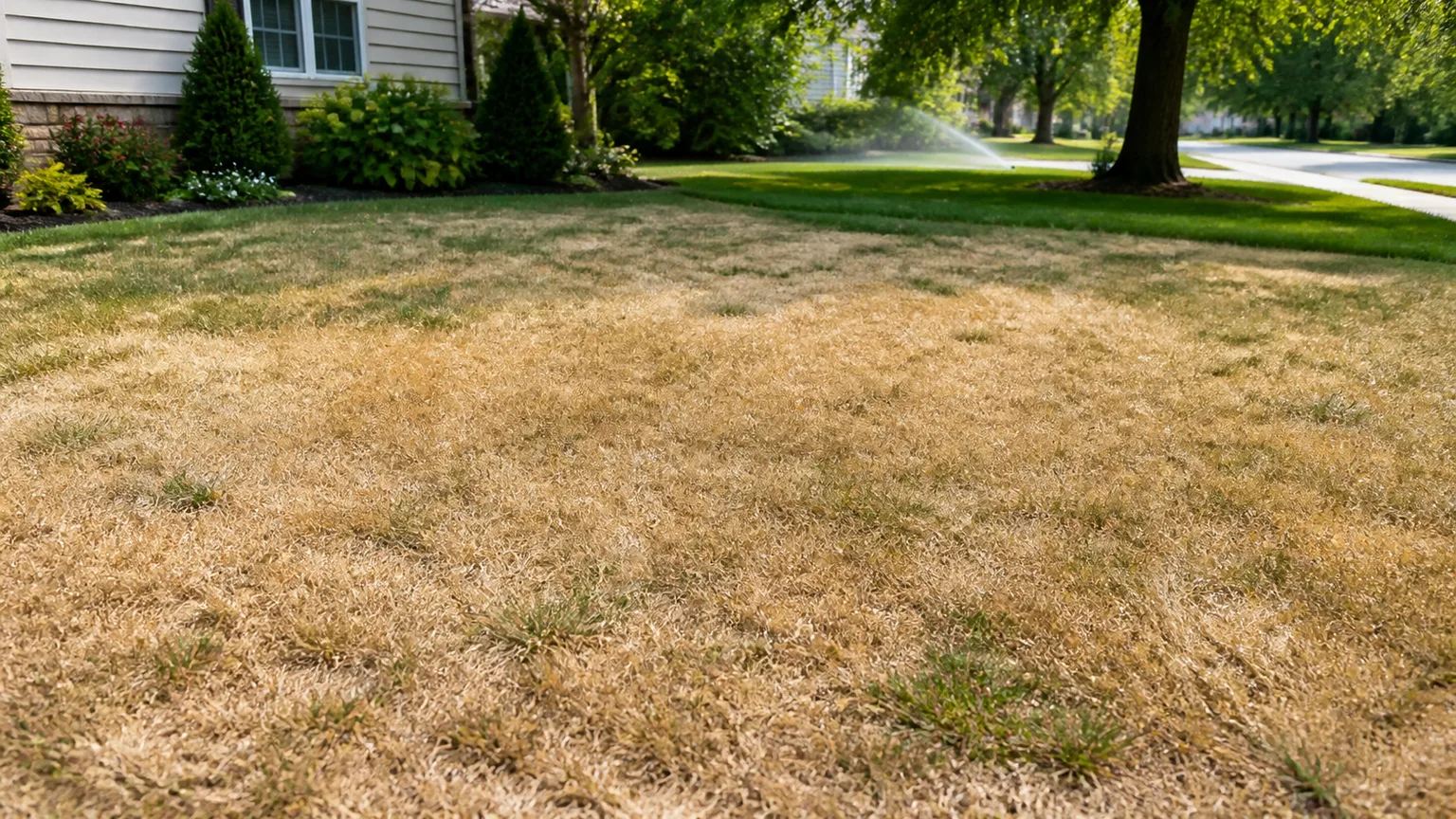
Yellow grass is a symptom, not a diagnosis. The same pale color can come from dry roots, roots sitting in airless soil, a scalped lawn, a nutrient shortage, fertilizer injury, seasonal dormancy, pests, or disease.
That is why adding fertilizer is a poor first move. Start with the pattern and the soil, then check the four big levers: water and drainage, mowing and heat, nutrients and fertilizer history, and soil pH and compaction. Those checks usually tell you whether the lawn needs water, less water, better mowing, a soil test, or a closer pest-and-disease inspection.
Read the Yellow Pattern Before You Treat It
Walk the lawn before you touch the sprinkler or spreader. The shape, location, texture, and speed of change are more useful than the color by itself.
| What you see | What it suggests | First check |
|---|---|---|
| The whole lawn is pale and growth is slow | Nitrogen shortage, low light, drought stress, or seasonal change | Recent feeding, soil moisture, grass type, and mowing height |
| Crisp yellow or tan grass on sunny edges | Underwatering, heat stress, or chinch bugs | Soil depth, sprinkler coverage, and the boundary of the patch |
| Soft yellow grass in low spots | Excess water, poor drainage, or disease pressure | Standing water, runoff, thatch, and how long the leaves stay wet |
| Yellow patches with a greener outer edge | A concentrated fertilizer or urine injury is possible | Recent applications and the shape of the patch |
| Irregular patches keep expanding | Insects, disease, or a continuing irrigation problem | Inspect the edge between healthy and damaged turf |
| Orange dust, leaf spots, rings, or mushrooms appear | Disease is more likely than a simple nutrient shortage | Leaf blades, weather, drainage, and grass species |
These are clues, not proof. A hot, sunny patch can be drought-stressed and then become more vulnerable to insects; a wet patch can have both poor drainage and disease. Treat the pattern as a way to choose the next test, not as permission to apply a product immediately.
The LawnStarter guide to yellow grass makes the same useful distinction: spots, all-over yellowing, and rings point toward different groups of causes. Give yourself a day or two of observations if the damage is not spreading rapidly, and take a photo from the same position so you can compare the patch instead of relying on memory.
Do a 10-Minute Lawn Triage
You can learn a surprising amount without a soil kit or a pesticide. Use this short sequence before deciding what the lawn needs.
- Check the recent weather. Note heat, rain, frost, unusually cloudy days, and whether the lawn was watered before the yellowing appeared.
- Check the ground. Push a screwdriver or trowel into healthy turf and yellow turf. Hard, dry soil points toward drought or compaction; wet soil that stays soft points toward drainage or overwatering.
- Check the sprinkler. Look for a clogged head, a tilted nozzle, a broken line, overspray onto pavement, or a dry strip along the edge of the irrigation pattern.
- Check the mowing history. Ask whether the grass was allowed to grow tall, cut very low, mowed while wet, or cut with a dull blade.
- Check the product history. Record fertilizer, weed control, iron, and insecticide applications, including where the spreader started and stopped.
- Check the roots and crown. Gently part the blades at the soil line. Living turf crowns are firm and connected to roots; dead, loose turf lifts easily or pulls away in mats.
If the entire lawn changed color after a cold snap, heat wave, or first hard frost, do not compare it with a deep-green lawn of a different grass species. If one section changed after a treatment or irrigation repair, focus on the boundary between changed and unchanged turf.
Check Water, Drainage, and Root Oxygen
Water stress is the first thing many people suspect, and sometimes they are right. But too little water and too much water can both make grass yellow. Roots need moisture and air; a dry root zone cannot supply the leaves, while saturated soil pushes air out of the pore spaces and leaves roots short of oxygen.
Tell Underwatering From Overwatering
Underwatered turf often looks dull, bluish-green, yellow, or tan. Footprints and mower tracks may remain visible because the leaves do not spring back. The soil is dry below the surface, and the worst areas are commonly near sunny pavement, slopes, sandy spots, or sprinkler gaps.
Overwatered turf may look soft, weak, or pale rather than crisp. You may find puddles, runoff, algae, moss, a sour smell, shallow roots, or patches that stay damp long after the rest of the lawn has dried. Low areas and heavy clay soil show the problem first. Repeated shallow watering can also produce a lawn that wilts quickly because its roots stay near the surface.
Do not water on a calendar just because the grass is yellow. The Gardening Know How watering guide recommends checking soil moisture and using footprints or a screwdriver as stress clues. It also explains that a lawn’s water requirement changes with grass type, climate, and soil texture.
An inch of water per week is not a universal prescription. NC State Extension uses about 1 inch per week for actively growing St. Augustinegrass, with sandy soils often needing smaller amounts more frequently. A fescue lawn in a different climate, a shaded lawn, and a lawn under local water restrictions may need a different schedule. Use a local extension calendar and the soil’s condition to adjust the target.
If the soil is saturated, pause routine irrigation and find the reason: a leak, poor grading, compacted traffic lane, blocked drain, or heavy soil. If the soil is dry, water slowly enough that it soaks in rather than running down the sidewalk. Split a long irrigation cycle into two shorter cycles when runoff starts before the root zone is wet.
Measure Sprinkler Output Instead of Guessing
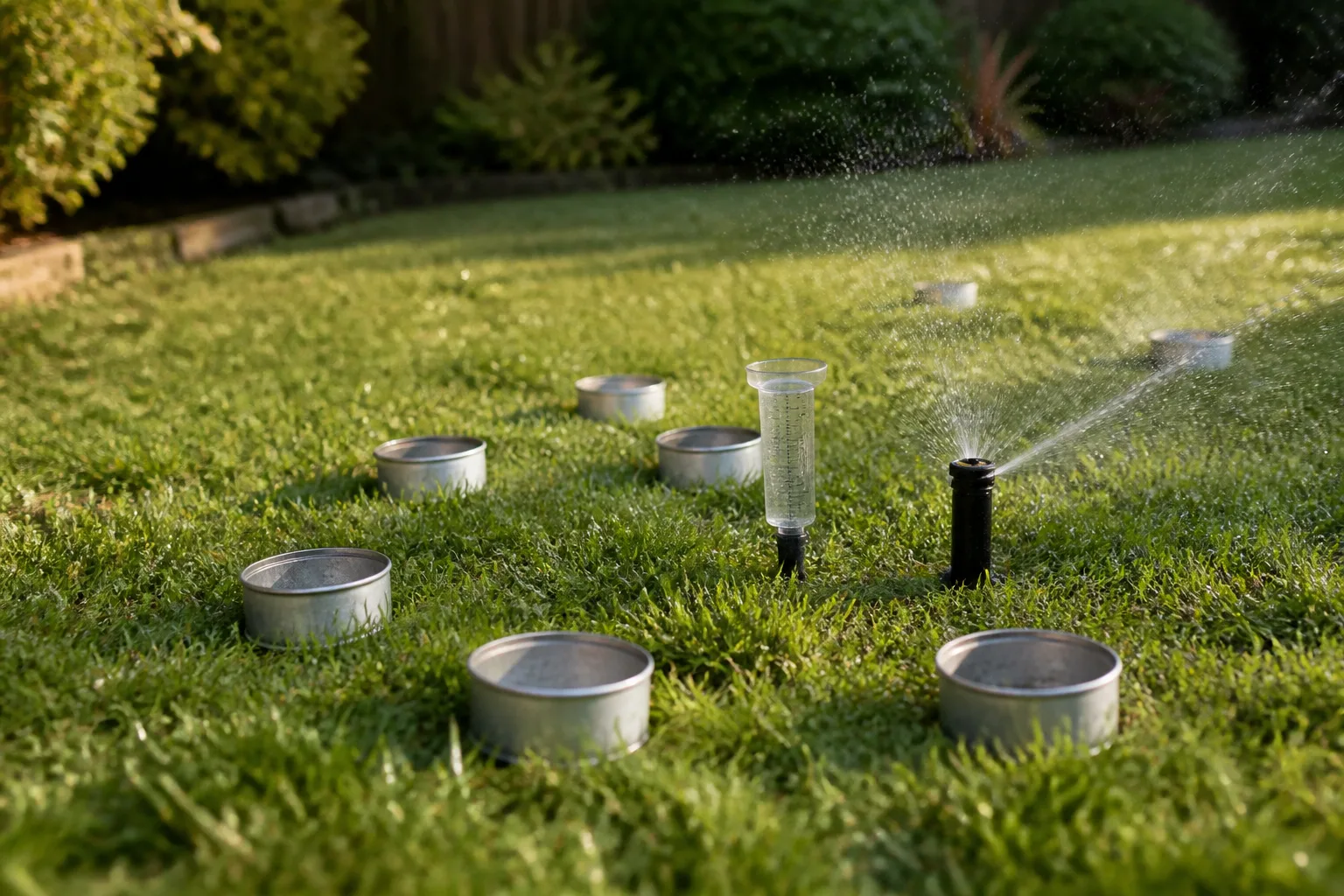
A sprinkler can run for the same number of minutes in every zone and still apply very different amounts of water. Test it with several straight-sided cans, tuna cans, or catch cups.
Place the containers across the zone—near the head, in the middle, at the far edge, and near any yellow strip. Run the system for a measured period, then compare the depth in each container. If one cup is nearly empty and another is overflowing, the problem is coverage uniformity, not simply a shortage of total run time.
Move or clean the head, repair a broken nozzle, or adjust the zone before increasing the schedule. Water in the early morning when practical so the lawn has time to dry, but do not keep irrigating through rain or leave an already saturated lawn wet just because morning has arrived.
Check Mowing, Heat, and Sun Stress
A lawn can turn yellow after a perfectly ordinary mowing if the cut removes too much leaf tissue. Grass stores much of its photosynthetic surface in the blades; cutting far below the appropriate height exposes older, paler tissue and leaves the plant with less leaf area to recover.
Look for Scalping and Uneven Cutting
Scalped turf is unusually short, yellow or straw-colored, and often follows the contours of a bump or a mower pass. The change may appear right after mowing, especially when the lawn was overgrown and the mower deck was lowered. A dull blade can shred the tips, leaving a gray or tan cast that looks like disease.
Raise the mower to the correct height for the grass species, keep the blade sharp, and mow often enough that you remove no more than about one-third of the leaf blade at a time. NC State’s St. Augustinegrass guidance notes that a higher mowing height is generally more tolerant of shade and drought; other grasses have their own height ranges, so use a local turf guide rather than copying a neighbor’s setting.
Do not mow wet, heat-stressed turf simply to make the lawn look even. Wet clippings can clump, tires can compact the soil, and a stressed lawn has less ability to replace the leaf area removed. If only the freshly cut lower blades look yellow but new growth remains firm and green, give the lawn time to grow back before treating it as a nutrient problem.
Heat can also make a healthy lawn lose color temporarily. Warm-season grasses and cool-season grasses have different active-growth windows, and either can pause under severe heat or drought. Shade from a new tree, a building, or a fence can make one section paler than the rest even when water and fertilizer are adequate.
Check Fertilizer and Nutrient Availability
Nitrogen is involved in chlorophyll and vigorous leaf growth, so a genuinely nitrogen-short lawn may be pale and slow-growing. But “yellow means nitrogen” is not a safe diagnosis. Nitrogen can be present but unavailable because of pH, shallow roots, cold soil, or drought, and too much fertilizer can injure the same grass you are trying to green up.
Separate Nitrogen Deficiency From Fertilizer Burn
Think about distribution and timing. A uniform, gradual paling across the lawn with weak growth may fit a nutrient shortage or a grass that is not actively growing. Stripes that match spreader passes, sharply defined spill zones, or crispy patches that appear soon after feeding fit fertilizer or salt injury more closely.
The Oklahoma State University soil-test guide explains that nitrogen is mobile and can move through soil with rainfall or irrigation. It also cautions that phosphorus and potassium should not be added automatically every time a lawn is fed. A complete fertilizer applied year after year can build nutrients the turf does not need and send excess into runoff.
If a recent application may have burned the lawn, do not add more fertilizer, iron, or weed control to “balance it out.” Follow the product label and local water rules. A measured, appropriate irrigation may help move soluble salts through the root zone when the soil is well drained, but flooding a compacted or waterlogged lawn can compound the injury and carry nutrients off the property.
Keep the fertilizer bag. The N-P-K numbers show the percentage of nitrogen, phosphate, and potash by weight, but they do not tell you what your lawn needs. Virginia Cooperative Extension’s warm-season turf guidance ties fertilizer programs to grass type, soil-test results, timing, and the proportion of slow-release nitrogen. That is a better basis for a schedule than a fixed number of applications for every lawn.
Know When Iron or Another Nutrient Is the Clue
Iron is a common source of confusion because grass can look yellow when iron is unavailable even though the soil contains iron. High pH can make iron less accessible, and root stress can prevent the turf from using nutrients that are present.
Look at new growth and the whole plant, not just one blade. A pale lawn with poor growth can have a different problem from new leaves that emerge yellow while older leaves remain greener. Do not use an iron product as a harmless test; iron salts can stain hardscape and may injure turf if mixed or applied incorrectly.
If the lawn is repeatedly yellow despite reasonable watering and mowing, obtain a soil test before adding lime, sulfur, iron, phosphorus, or a “green-up” blend. The University of Minnesota Soil Testing Laboratory’s interpretation guide explains that a report is useful only when it is interpreted for the crop or turf being grown. Follow the lab’s sampling and amendment recommendations rather than trying to correct a number in isolation.
Check Soil pH and Compaction
Soil pH is not a score for “good” or “bad” soil. It changes the chemical environment around the roots and affects whether nutrients are available. A lawn can yellow even when a nutrient is present if pH or poor root conditions keep the roots from accessing it.
Compaction creates a second version of the same problem. Pressed soil has fewer air-filled pores, limits root growth, slows infiltration, and encourages runoff. The result can be both drought stress on the surface and excess water sitting in shallow depressions.
Take a Soil Sample That Can Answer the Question
Do not test only the most yellow patch and assume the result represents the whole lawn. Take separate samples when the soil, turf type, slope, or management history changes. Avoid unusual areas such as compost piles, fertilizer spills, pet spots, and freshly amended beds unless you are specifically testing them.
Use a clean tool, remove surface debris and thatch, take several small samples from the root zone, and mix the representative soil according to the laboratory’s directions. The exact depth and quantity vary by lab and turf type. A lab report can provide pH and available phosphorus and potassium, plus an interpretation of what to apply; it is more useful than a color-changing strip with no lawn-specific recommendation.
Do not add lime because a neighbor’s lawn needs it. Lime raises pH, and applying it to already alkaline soil can make iron and other micronutrients less available. The same caution applies to sulfur and high-phosphorus products: change the soil only when a test and local recommendation justify the change.
Improve Compaction Without Aerating Mud
A screwdriver that stops abruptly in a dry, hard lane is a clue, not a complete diagnosis. Confirm it by looking for repeated foot traffic, tire tracks, puddling, runoff, shallow roots, and turf that is thinest where people or equipment pass.
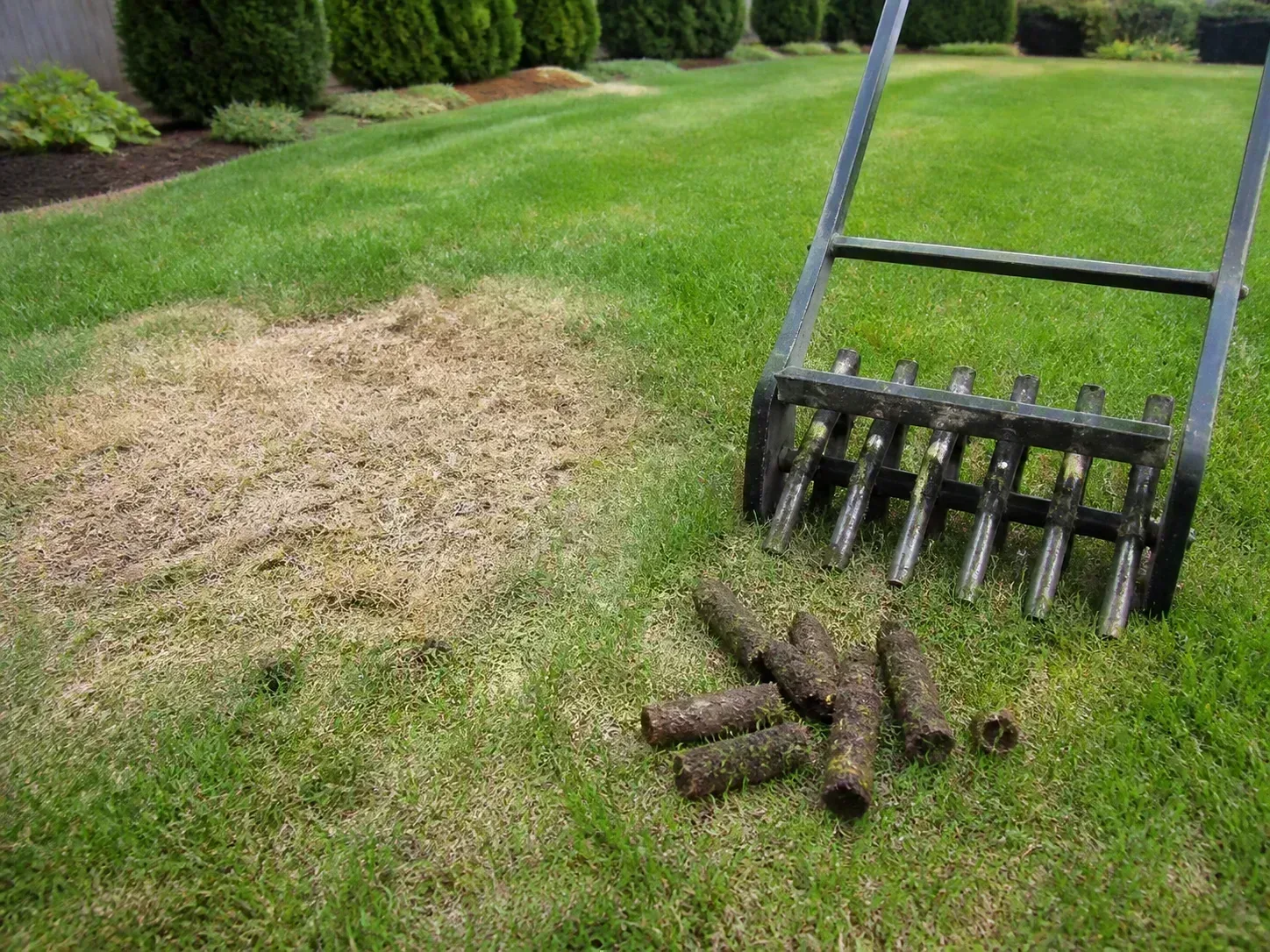
Core aeration can help heavy clay or heavily trafficked turf, but timing and soil moisture matter. NC State Extension recommends aerating when the grass is actively growing and able to recover. Soil should be moist enough for cores to pull cleanly, not so wet that equipment smears the surface into a denser layer.
After aeration, correct the cause as well as the symptom. Redirect foot traffic, repair grading or drainage, avoid driving on saturated turf, and adjust irrigation so water reaches the roots rather than pooling. Aeration will not fix a broken sprinkler, an unsuitable grass for deep shade, or a disease that is being kept wet by overwatering.
Do the Patches Suggest Pests or Disease?
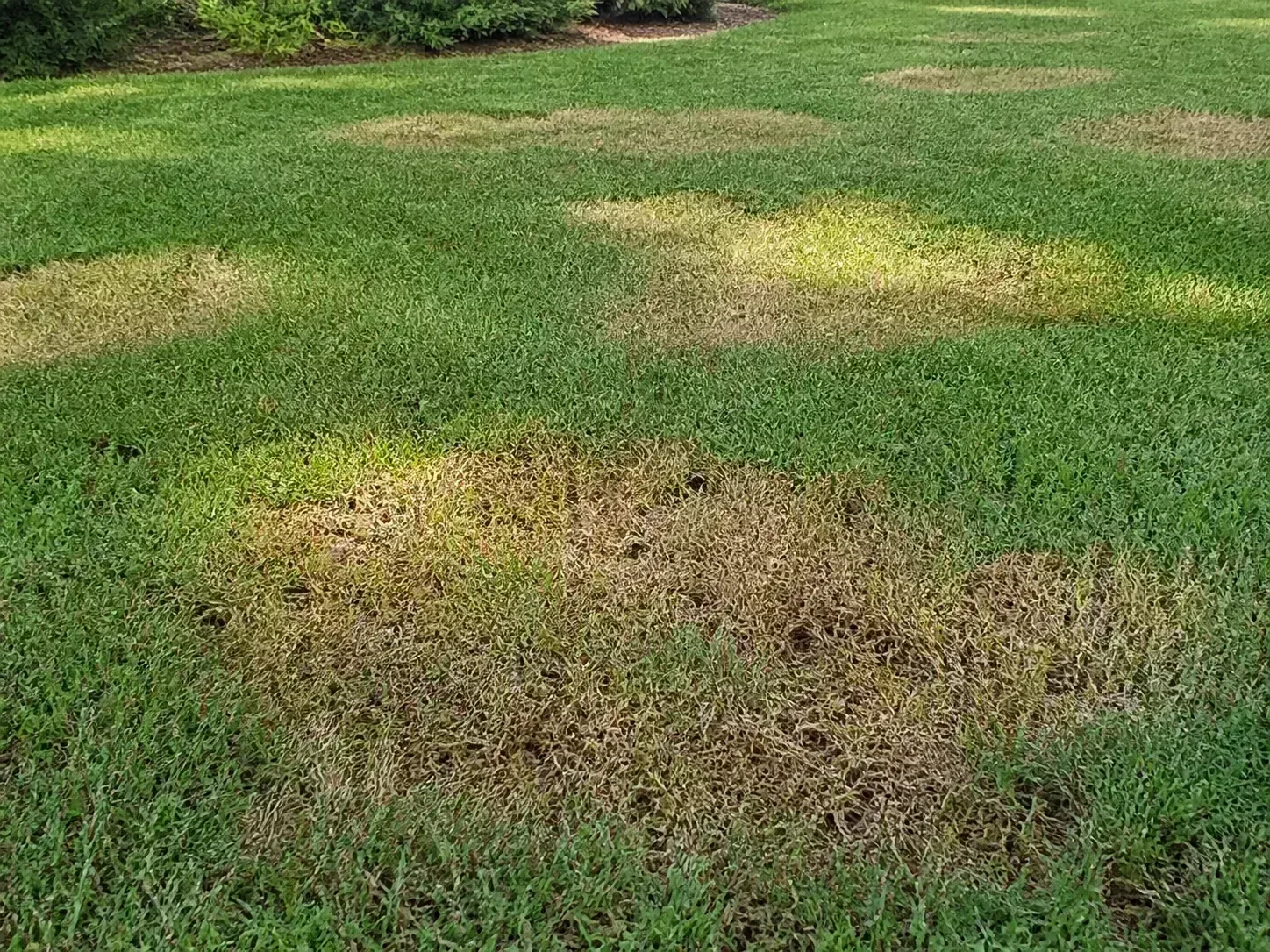
When yellowing is localized, expanding, or accompanied by leaf marks, inspect the turf at the transition between green and yellow. The center may be too damaged to show the original clue; the edge often has the insects, lesions, or living-but-stressed blades you need to see.
Check for Chinch Bugs, Grubs, and Localized Injury
Chinch bugs are especially worth checking in hot, sunny, water-stressed turf, particularly St. Augustinegrass. The Missouri Botanical Garden describes irregular yellow patches that can begin in heat- and drought-stressed locations, including south-facing slopes and areas near pavement.
Look for a patch that starts small and keeps moving outward even after sensible irrigation. Part the grass at the soil line and inspect the boundary for tiny insects or nymphs. For St. Augustinegrass, NC State Extension describes a simple float test: push a can with both ends removed into the turf, fill it with water, and watch what floats to the surface. Do not transfer a threshold from one grass species or region to another; use local extension guidance before treating.
Grubs produce a different set of clues. Birds, skunks, or other animals digging repeatedly, turf that lifts like a loose carpet, and weakened roots can justify a grub check. Do not apply a preventive insecticide simply because one patch is yellow. Identify the pest, confirm that it is causing the damage, and follow the product label if control is actually needed.
Recognize Disease Patterns Before Using a Fungicide
Disease becomes more plausible when yellowing follows prolonged wet weather, poor drainage, heavy thatch, or long periods of leaf wetness. Orange powder on leaves can point toward rust; circular or expanding patches can occur with several diseases; and St. Augustinegrass can develop large patch under conditions that include cool, wet weather, poor drainage, overirrigation, excessive nitrogen, and low mowing.
Those clues overlap. A ring is not a diagnosis, and a fungicide that does not match the disease wastes money and can disrupt the lawn’s wider biology. Photograph the patch, note the grass species and weather, and send a sample or images to a county extension office, turf diagnostic service, or qualified lawn professional when the damage is spreading.
Correct the conditions that favor disease while you investigate: stop unnecessary irrigation, improve drainage, mow at the appropriate height with a clean sharp blade, and remove heavy clumps of wet leaves or grass. Do not scalp or heavily fertilize a stressed lawn in an attempt to force a quick color change.
Use Grass Type and Season as a Reality Check
Color expectations vary. Warm-season grasses commonly slow down or go dormant in cool weather; cool-season grasses can lose color in heat and drought. A lawn may be yellow-green during a normal transition while still having healthy crowns and roots.
The Gardening Know How overview of yellowing grass notes that grass type, season, dormancy, mowing, watering, compaction, nutrients, pests, and disease can all produce similar color changes. That broad list is useful because it prevents a narrow nitrogen-only diagnosis.
Compare the lawn with the same species in a similar exposure, not with a different turf in a different neighborhood. Consider shade, reflected heat from pavement, new sod, winter color, and whether the grass is actively growing. If the crowns are alive and the color change matches the season, recovery may require time and appropriate conditions rather than a product.
Follow a Simple One-Week Recovery Plan
Once you have checked the pattern, make one change at a time so you can tell what helped.
Today: Photograph the lawn, mark the yellow area, inspect the soil at several points, and write down recent fertilizer, weed-control, and irrigation events. Check the sprinkler heads and look at the edge of the damaged patch.
Over the next two or three days: Measure irrigation with catch cups if the soil is dry, or pause irrigation if the soil is saturated. Mow only when the grass is dry and growing, raise the deck if the lawn was scalped, and remove clumps that are smothering the surface.
This week: Submit a representative soil sample if the problem is chronic or unexplained. Do not apply lime, iron, a complete fertilizer, or a fungicide while waiting unless a local recommendation or product label gives you a specific, justified reason.
After the next growth cycle: Recheck color, new growth, soil moisture, and patch size. A water or mowing problem should stop worsening once the root-zone condition improves. A patch that keeps expanding, lifts easily, shows insects or lesions, or develops bare soil deserves an extension diagnosis or professional inspection.
Call for help sooner when a fertilizer or herbicide spill occurred, runoff is entering a drain or waterway, a new sod installation is failing, the lawn is rapidly dying, or you cannot identify the grass species. A local expert can match the diagnosis and treatment to the turf, climate, label rules, and water restrictions instead of giving you a generic green-up recipe.
Conclusion
When grass turns yellow, begin with evidence rather than fertilizer. Read the pattern, test the soil moisture and sprinkler coverage, review mowing and heat stress, then use fertilizer history, soil pH, and compaction to narrow the cause.
If the patches spread or show insects, lesions, rings, or persistent wetness, move from routine care to a pest or disease inspection. Yellow turf can recover when its crowns are alive, but recovery depends on correcting the actual stress. A short diagnostic pause is usually faster, cheaper, and safer than treating every yellow lawn as a nitrogen shortage.



