How To Tell When California Jujubes Are Ready To Harvest
Use skin color, firmness, and a taste test to time California jujube harvests. See how to pick in stages and handle fruit for fresh eating or drying.
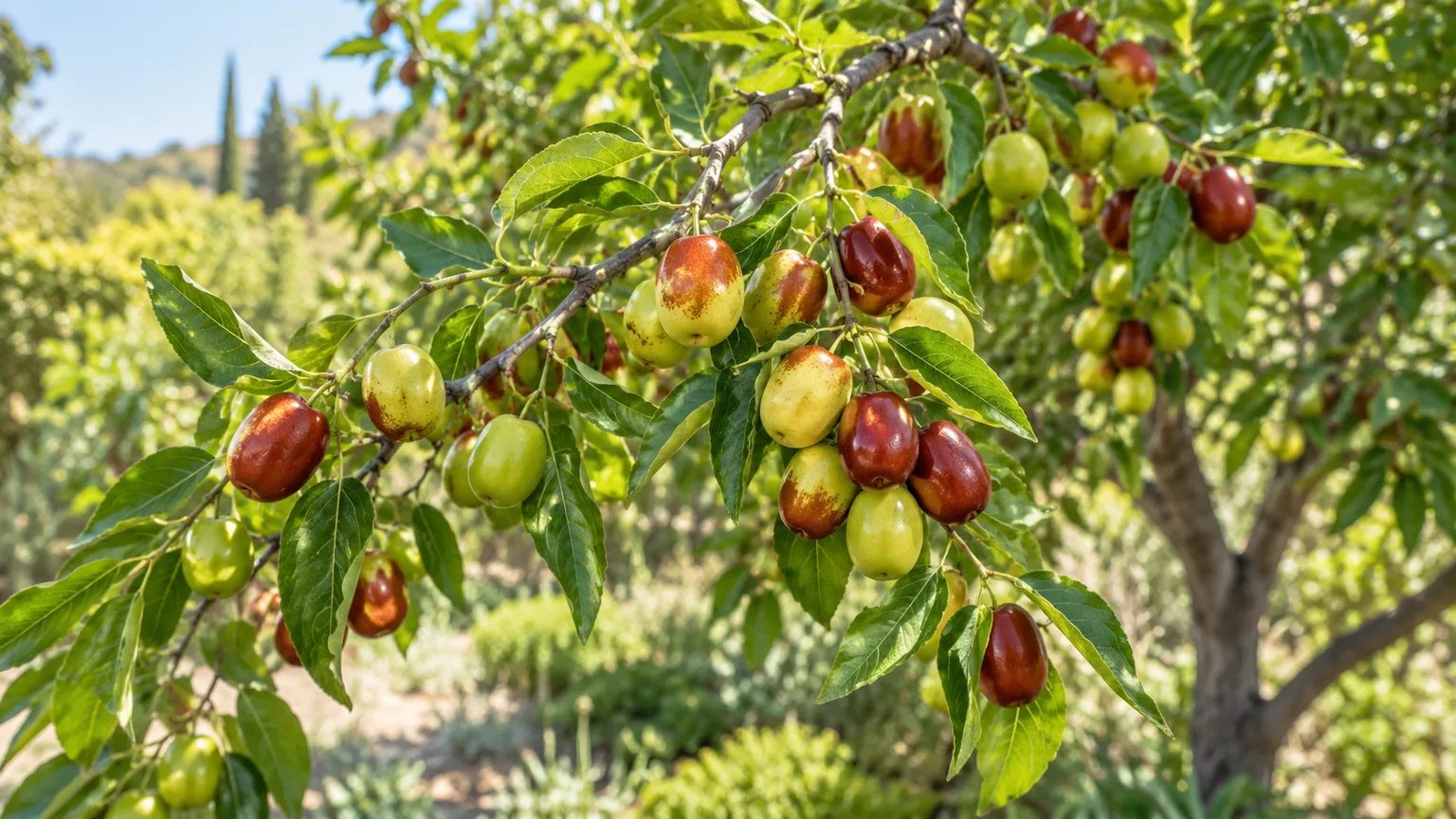
Quick answer: look for color, firmness, and taste
A jujube is usually ready for fresh eating when its green skin has begun changing toward yellow-green with mahogany or reddish-brown patches, and the fruit is still firm. Taste a few from the same tree before picking a large bowl: sweetness and texture vary among cultivars, and some are enjoyable while still partly green. For drying, leave fruit longer until it is fully colored and begins to lose moisture or wrinkle on the tree. Early green fruit picked too soon generally will not become properly ripe indoors. The University of Kentucky Cooperative Extension profile describes this progression and recommends picking fresh fruit after brown color first appears but before wrinkling begins.
There is no single California date or color that fits every jujube. Use the fruit’s stage and your intended use together: color tells you where ripening is, firmness helps distinguish crisp from soft fruit, and a small taste test tells you whether that cultivar has reached the flavor you want.
California harvest timing depends on cultivar and place
Jujube harvest is a period, not a statewide weekend. California includes coastal gardens, hot inland valleys, foothill orchards, and desert edges, while named cultivars mature at different times. The California Rare Fruit Growers’ cultivar notes, based on Southern California, place early ‘Li’ in mid-August and some later selections much farther into fall. Those dates are useful examples from one region, not a promise for every California tree. A cooler coastal site, a high-elevation garden, or a different cultivar can shift the window.
Use a calendar only to remind yourself to start checking. New Mexico State University’s cultivar trials track both maturation dates and maturation order because varieties differ; Texas A&M AgriLife also identifies weather and cultivar as harvest factors. Start inspecting when fruit has reached its normal size and color begins to shift, then repeat the check every few days. A note with your own first-color and best-taste dates will be more useful next year than copying a date from another county.
Why jujubes on one tree ripen in waves
Fruit on a jujube tree does not necessarily ripen together. Different cultivars can mature in different orders, and fruit on the same tree can reach the usable stage at different times. The Kentucky extension profile recommends frequent picking every few days over a month or more; California Rare Fruit Growers likewise describes a non-simultaneous crop that can be picked over several weeks. That staggered pattern is why a single sweep often leaves early fruit overripe and later fruit too green.
Plan for several short visits instead of waiting until the whole canopy looks uniformly brown. On each visit, pick fruit that suits the day’s purpose and leave firm, greener fruit attached. You may also find ripe fruit tucked inside shaded foliage after sun-exposed fruit has colored. If the crop is large, begin with the easiest-to-reach branches and label a few representative clusters so you can compare how quickly the tree changes through the season.
Learn the main jujube color stages
A useful color sequence is green, yellow or whitish green, yellow-green with mahogany mottling, then reddish-brown or fully red. Fruit eventually softens and wrinkles as it loses water. These are stages, not rigid quality grades: cultivars can differ in shape, color, sweetness, and the point when they taste best. The California Rare Fruit Growers description and the Kentucky extension profile both outline this progression, while Texas A&M AgriLife notes that some cultivars can taste sweet before full maroon color.
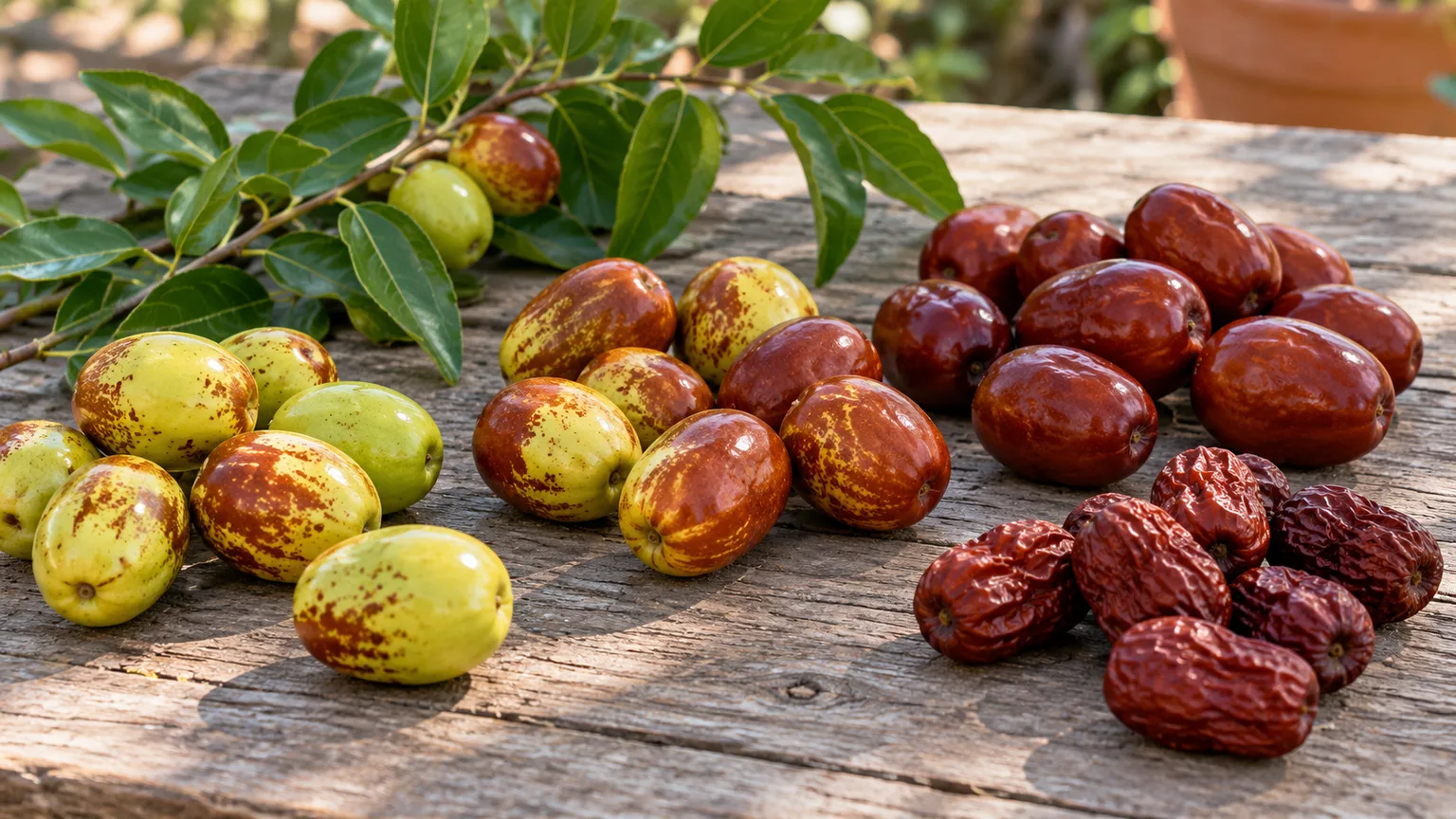
Think of the sequence as a way to narrow the decision. Green means “check again” for most cultivars; a first brown patch means “taste one”; mostly colored fruit is a stronger candidate for full maturity; wrinkling signals that crisp fresh texture is passing. A sample from your own tree resolves differences better than treating any single color word as universal.
Green fruit: usually leave it on the tree
Green jujubes are usually immature for fresh harvest, even if they are already full-sized. Kentucky Extension reports that fruit picked green does not ripen satisfactorily off the tree. California Rare Fruit Growers gives the same caution. Leaving green fruit attached allows it to continue changing in color and flavor, so resist picking a whole crop just because the fruits look large or a calendar says the season has started.
There is a cultivar exception to the idea that every green jujube tastes unripe. Texas A&M AgriLife says some varieties become sweet while still green, though most taste better after the skin turns maroon or reddish maroon; green fruit is generally crunchier. This is a reason to test one or two early samples, not to assume that any green fruit is ready. If the sample is bland, sharply astringent, or watery, leave the rest on the tree and reassess in a few days.
Yellow-green fruit: test before picking
Yellow-green is a transition stage. It can be a good point to taste a fruit, especially if you prefer a crisp bite, but it does not guarantee sweetness in every cultivar. The Kentucky profile notes that fruit harvested at yellow-green is noticeably less sweet than fruit allowed to ripen further. California Rare Fruit Growers says many people prefer jujubes in the interval between yellow-green and full red, when they are crisp and sweet. Together, these descriptions show why a sample matters: this stage can be pleasant for one variety and too early for another.
Pick a representative fruit from a sunlit branch and one from a more sheltered part of the canopy. If both have an agreeable sweetness and firm flesh, you can harvest selected fruit at that stage. If one is watery or lacks flavor, wait and compare again. Keep a few fruit on the tree after the first tasting, because a small color shift can change sweetness and softness over the next several days.
Mahogany mottling: the first useful harvest signal
Mahogany freckles or patches are often the first visible sign that a green jujube is moving into a useful fresh-eating stage. The Kentucky profile describes the transition from green to yellow or whitish green, followed by mahogany-colored spots, then reddish-brown fruit. California Rare Fruit Growers similarly notes that mahogany spots appear as fruit ripens further. When you see the first mottling, taste before harvesting heavily; some gardeners prefer this crisp stage, while others wait for more color and sweetness.
This is also a good point to begin regular picking rounds. The Gardening Know How guide uses dark brown and firm fruit as a general harvest cue, while an orchard grower writing for The Arbor Gate described some cultivars as best around half-brown and still crisp. Those practical observations do not establish one rule for every cultivar, but they reinforce the value of sampling fruit at more than one color stage. If the first mottled fruit tastes good, pick those and leave the rest to progress.
Reddish-brown fruit: mature, but not one-size-fits-all
Reddish-brown or maroon skin is a strong sign that many jujubes are approaching full maturity. Kentucky Extension describes fully ripened fruit as reddish-brown, while California Rare Fruit Growers describes fully mature fruit as entirely red. Texas A&M AgriLife says most cultivars taste better when the peel moves from green toward maroon or reddish maroon. Because the precise shade differs among varieties, use the word “mature” as a range and confirm it with firmness and taste.
For fresh eating, you may still want fruit before it becomes soft or wrinkled. Let a sample tell you whether the cultivar’s flavor peaks when it is partly mottled or more fully colored. If the flesh is pleasantly sweet and remains firm, harvest that fruit now. If it is still crisp but not sweet enough for your taste, leave it attached and try again soon. A fully colored fruit is not automatically spoiled; it simply may be moving toward a softer, more mature texture than some people prefer.
Wrinkled fruit: a drying stage, not a crisp one
As jujubes remain on the tree after full color, they can lose moisture, soften, and wrinkle. This is a normal route to a tree-dried fruit, not necessarily a sign that the crop has failed. Kentucky Extension recommends fully mature fruit for drying and notes that fruit begins to wrinkle as it softens and loses moisture. California Rare Fruit Growers also describes shriveling under dry conditions. If you want crisp fruit, harvest before this stage; if you want a drier, date-like texture, allow selected fruit to remain longer and check them often.
Drying on the tree is not equally suitable in every setting. The Gardening Know How source says fruit can be left until it fully dries, while Grow Organic’s harvest guidance advises harvesting promptly in humid conditions rather than leaving fruit outdoors to wrinkle. Those suggestions point to a practical limit: moisture and weather affect how predictable tree-drying will be. Remove fruit that is damaged, moldy, or unpleasant rather than assuming every wrinkled jujube is good to eat. When uncertain, harvest sound fruit and finish drying it under clean, controlled conditions.
Use firmness and taste to confirm color
Color is easy to see, but texture and flavor make the decision more personal. A fruit that is firm and crisp may be ideal for fresh eating even when it has not reached the darkest shade. A softer, fully colored fruit may taste sweeter to you, but can be past the crisp stage. The Texas A&M AgriLife harvest guidance explicitly connects maturity to cultivar, weather, and personal preference, and notes that fruit is usually crunchier when green than when maroon.
Taste a small sample from one cultivar at two stages if you are unsure. Cut or bite the fruit and notice whether it is sweet enough, pleasantly crisp, and free of a dry or mealy texture. Do not judge the whole tree by one fruit from a single exposed branch. When you find the point you like, write down the skin appearance and texture alongside the date. A simple note such as “first mahogany patches, still firm, sweet-tart” creates a useful reference for the next picking round.
Choose the harvest stage for fresh eating or drying
Decide how you plan to use the fruit before you pick. For crisp fresh eating, many growers prefer fruit that has started to color but is still firm. California Rare Fruit Growers says the fruit is crisp and sweet between yellow-green and full red; Kentucky Extension gives a similar fresh-use window after the first brown appears and before wrinkling. For drying, wait until fruit is fully mature and allow it to lose more moisture, either on the tree when conditions suit or after picking.
Cultivar also affects the best use. Texas A&M AgriLife describes ‘Li’ as a crisp, apple-like fruit at maturity and notes that cultivars such as ‘Lang’ are widely grown in Texas; New Mexico State University reports that growers select cultivars for fresh eating, drying, and other uses. Do not assume a variety name guarantees the same result in every climate, but use the label as a prompt to ask the nursery or local grower which stage suits it. A mixed harvest can include firm fruit for snacking and later fruit for drying.
Read heat and weather as context, not a calendar
Warmth and cultivar influence when a crop reaches a useful stage, but a hot spell is not a reliable harvest signal by itself. The Arbor Gate’s Bill Adams described a Texas season when extreme heat affected some cultivars’ fresh-eating quality and led him to pick selected fruit around half-brown before shriveling. That is a firsthand orchard example, not a California forecast. Use it as a reminder that a tree’s fruit condition can change with the season and variety, and keep checking fruit as the weather shifts.
In California, the practical response is to observe your own trees rather than transfer a date from an inland orchard or another state. If fruits are changing quickly, shorten the interval between checks. If they remain green and firm, give them more time. Avoid a hard calendar rule like “pick all fruit in August”: even California Rare Fruit Growers’ cultivar schedule is specifically based on Southern California. Record your local first-color and peak-taste dates so your next season starts with better timing.
Return for several short picking passes
A staged crop is easier to manage when you make frequent, small harvests. Kentucky Extension recommends checking every few days over a month or more, and California Rare Fruit Growers says fruit from one tree can be picked for several weeks. During an active ripening period, check at least twice a week; if fruit is coloring rapidly or you are seeing softening, shorten that interval. The exact rhythm is a practical routine, not a cultivar-independent biological schedule.
Before filling a basket, inspect fruit from more than one branch and more than one exposure. Sun-facing fruit may color sooner than fruit deeper inside the canopy, and a tree’s ripening can be uneven. The cultivar trials reported by New Mexico State University researchers track maturation dates and order precisely because selections differ. That finding supports checking the whole tree instead of relying on its most colorful branch.
Use a repeatable route: look at an outer sunny branch, a shaded interior branch, and a lower or higher cluster you can reach safely. Compare skin color, firmness, and taste. If the fruit differs, harvest only the ready clusters. Do not climb or pull hard on branches to reach a few fruits; use a stable ladder only when you can work safely, or leave high fruit for another pass. If the tree is compact or you are planning a small-yard planting, the site’s dwarf fruit tree guide also discusses jujube size and cultivar trade-offs.
On each pass, pick fruit that meets your chosen standard and leave greener, firm fruit attached. Keep separate containers if you are collecting crisp fresh fruit and fully mature fruit for drying. A short walk-through also reveals whether birds or mammals are taking fruit before you can harvest. If loss is becoming a problem, see LeafyPixels’ guides to protecting fruit trees from birds and keeping squirrels out of fruit trees for humane barriers and observation tips.
Pick gently and protect the branch and fruit
Jujube branches may have spines, so wear gloves and long sleeves when reaching through the canopy. Support a fruit lightly as you detach it, and do not yank a cluster or bend a fruiting branch sharply. Gardening Know How recommends cutting the stem rather than pulling, a useful approach when fruit does not separate cleanly. Clean snips can reduce tugging, especially when you are working near other developing fruit. Keep tools clean and avoid placing harvested fruit in a deep pile where lower layers can be bruised.
Work from the outer canopy inward and keep your free hand away from thorns. If branches are tangled, make a note to address tree shape during an appropriate pruning period rather than cutting limbs in the middle of harvest. LeafyPixels’ guide to pruning fruit trees covers timing and structure separately. A harvest basket with a shallow layer helps keep the fruit visible, so you can sort out split, insect-damaged, or over-soft fruit before it is mixed with sound jujubes.
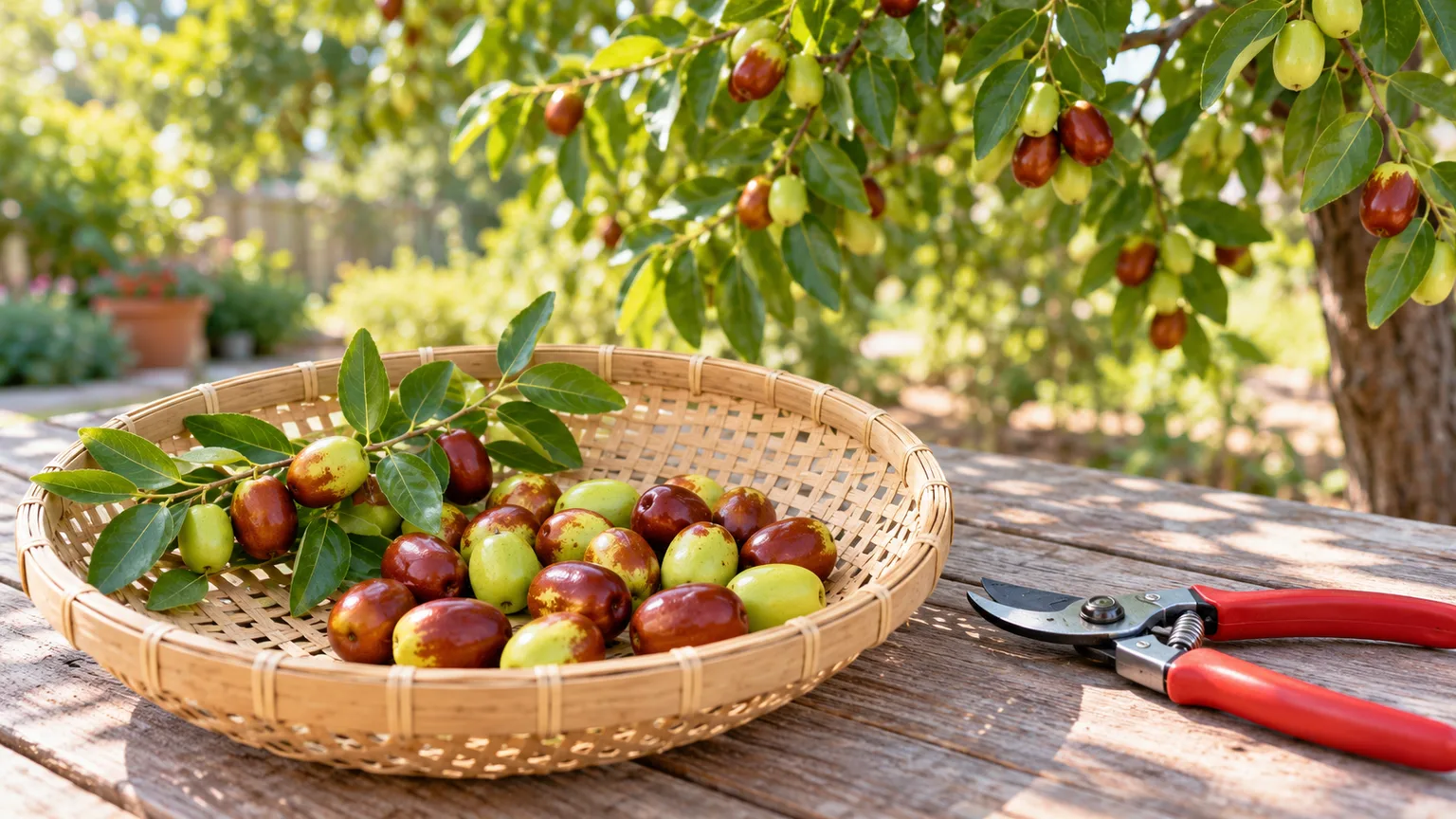
Sort, cool, and use the harvest promptly
After each picking pass, separate firm fruit for fresh eating from fully colored fruit intended for drying. Remove leaves and obvious debris, then inspect for cracks, bruises, soft spots, or signs of decay. The Kentucky extension profile says fresh storage varies from about a week to a month depending on temperature and relative humidity, so storage life is not a fixed promise. For the best texture, handle fruit gently and plan to eat, refrigerate, cook, or dry it without leaving a warm basket on the counter for days.
If you are gathering a larger amount, keep a small label with the cultivar, picking date, and stage. That will help you compare how long each type keeps and how its flavor changes. Do not store damaged fruit with sound fruit, and follow safe produce handling practices for washing and drying before use. If you are unsure whether small fruit or weak growth reflects nutrition rather than harvest timing, avoid guessing with fertilizer; the site’s fruit-tree fertilizing guide explains how to assess a tree before feeding.
What to do with fruit that falls or stays green
A fallen jujube can be ripe, overripe, damaged, or simply knocked loose. Check it rather than putting it straight into the eating bowl: look for clean skin, an agreeable smell, firm-enough flesh for your purpose, and no mold or insect injury. Fruit that is badly bruised or has begun to decay should be discarded. Fallen fruit is also a useful signal to inspect nearby branches for other mature fruit, but it does not mean the entire tree is ready.
If fruit stays green, first confirm its cultivar and compare its development over several days. Some varieties can be sweet while green, but most are better after color advances, and green fruit picked early will not reliably finish ripening indoors. The tree may also be carrying a later-maturing selection or growing in a cooler site. Use a local nursery, extension office, or grower familiar with your cultivar if the crop repeatedly fails to mature before the season ends. Next year, track the first color change and full-taste date instead of relying on fruit size alone.
Common mistakes when harvesting jujubes
The most common mistake is treating full brown color as the only correct harvest point. It can be a useful maturity cue, but some cultivars are enjoyable while partly colored and crisp; others taste better when more fully maroon. A second mistake is picking green fruit in bulk and expecting it to sweeten on the counter. Extension guidance warns that early green fruit does not ripen satisfactorily off the tree, although later stages may continue to ripen at room temperature.
Other avoidable errors include waiting for every fruit to color, because ripening is staggered; leaving fresh-eating fruit until it softens and wrinkles; assuming a California date from one region applies statewide; and using fruit size as the main maturity test. Another mistake is pulling hard on a branch when a stem resists. Pick selectively, taste before scaling up, and return after a few days. Jujube harvest becomes much less mysterious when you treat the tree as a sequence of samples rather than one all-or-nothing crop.
A practical California jujube picking checklist
Before going out, decide whether today’s goal is crisp fruit, sweeter fully colored fruit, or fruit for drying. Then use this quick routine:
- Look for the cultivar’s normal shape and a clear shift away from plain green.
- Sample a yellow-green or mottled fruit before harvesting a large quantity.
- Check firmness and taste; choose the stage you enjoy for fresh eating.
- Pick fully colored fruit for drying, and monitor fruit left to dry on the tree.
- Inspect several branches because ripening can be uneven.
- Return every few days while new fruit reaches the harvest stage.
- Keep a note of cultivar, date, skin color, texture, and taste.
These steps are deliberately simple. A few tasting notes from your own garden will quickly become more specific than a general month range. If you have more than one cultivar, label the harvest separately so you can learn which tree is early, which lasts later, and which stage gives you the best eating quality.
Conclusion
For most California jujubes, the clearest fresh-harvest signal is fruit that has moved beyond plain green, developed some yellow-green and mahogany or reddish-brown color, and still feels firm. Taste samples from your actual tree because cultivar, local conditions, and personal preference change the best picking stage. Harvest crisp fruit before it wrinkles; leave fully mature fruit longer when you want a drying crop, and return every few days rather than waiting for the whole tree to color at once.
Make one note of the date, color, texture, and flavor you liked. That small record turns next season’s harvest from guesswork into a local schedule built for your cultivar and California growing conditions.