Wild Strawberry Ground Cover: Shade, Care, and Spread
Learn how wild strawberry works as ground cover: choose the right shade, plant at the correct depth, water through establishment, and manage runners.
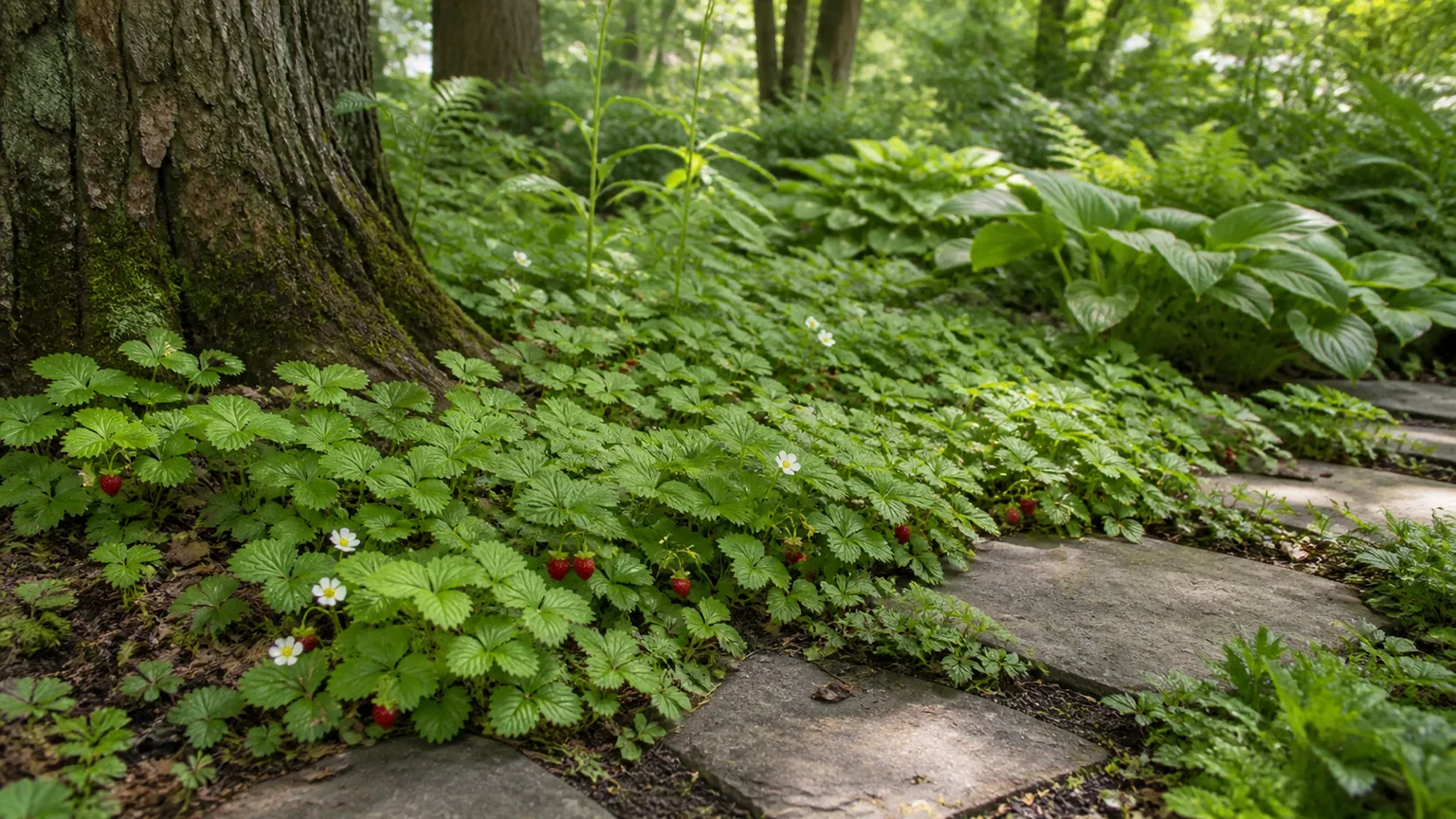
Woodland strawberry (Fragaria vesca) earns its place in a garden for a reason that has little to do with its tiny berries: it can knit together the low layer beneath trees, shrubs, and taller perennials while still offering white flowers and edible red fruit. Its three-part leaves stay attractive for much of the year in mild climates, and its short stature lets a path, stone, or taller plant remain visible.
It is also easy to oversell. Woodland strawberry is not a no-water plant, a guaranteed year-round carpet, or a structural fix for a steep eroding slope. It spreads by stolons and can be a thoughtful ground cover when you give it a defined edge; in a small bed, the same habit can become extra maintenance. The right question is not simply “Will it grow in shade?” It is “Will this exact combination of light, moisture, climate, and boundary make the plant useful?”
Is Woodland Strawberry Right for Your Site?
The short answer is yes if you have filtered light or gentle sun, soil that can hold some moisture without staying saturated, and room for a low plant to travel. It is a weaker choice for a dark, dry site beneath thirsty tree roots, a constantly wet bed, or a place where you cannot check the edges during the growing season.
The Royal Horticultural Society describes F. vesca as a spreading perennial with three-part toothed leaves, white flowers in late spring, and small red fruit. Its plant profile recommends fertile, moist but well-drained soil, notes tolerance of partial shade, and lists it as suitable for ground cover and containers. Those details explain the appeal, but they also give you the first filter: shade is acceptable; stagnant wetness is not, and deep shade will reduce fruiting. (RHS plant profile)
Identify the Plant Before You Buy
Common names are unusually slippery here. “Wild strawberry,” “woodland strawberry,” and “alpine strawberry” are often used for Fragaria vesca or for selected garden forms of it. A nursery plant sold under one of those names may be a compact clumper, a runner-producing form, or a cultivated selection that behaves differently from a local wild population.
The Native Plant Trust’s Go Botany account is especially useful because it records both a native subspecies, Fragaria vesca ssp. americana, and a non-native subspecies, F. vesca ssp. vesca, in New England. It also documents the plant’s stolons and rhizomes and distinguishes it from Virginia strawberry (Fragaria virginiana) by leaflet and tooth characteristics. In other words, “woodland strawberry” does not automatically mean one uniform plant or a native plant everywhere in North America. (Native Plant Trust Go Botany)
Read the scientific name on the tag, ask whether the plant produces runners, and check your local native-plant or conservation guidance if native status matters to your project. Do not rely on a photograph or a common name when you are collecting from the wild, planning a restoration planting, or trying to avoid a lookalike.
Shade Keeps Foliage, but Light Drives Fruit
Woodland strawberry is a better shade candidate than large-fruited garden strawberries, but “tolerates shade” is not the same as “fruits well in full shade.” In filtered light or bright open shade, you can expect a useful carpet of leaves and at least some flowers. As light falls, flowering and fruit production usually become the first things to give way.
For the most berries, give it morning sun, dappled light, or several hours of direct sun with protection from punishing afternoon heat. A site under a high, limbed-up tree may work beautifully; dense evergreen shade at the base of a dry tree may not. If your real priority is foliage beneath a dark canopy, choose a plant adapted to that exposure instead of planting strawberries and judging success by an impossible fruiting target.
What Creates Its Year-Round Garden Interest
The phrase “year-round color” needs a climate qualifier. In a mild winter, the foliage can behave as semi-evergreen; in colder or exposed gardens, it may slow, discolor, or go dormant. The plant still returns as a perennial when its roots and crown are healthy, but a dormant patch is not a bright green carpet in January.
Follow the Seasonal Cycle Instead of Expecting Constant Color
Spring is when new leaves and white flowers make the patch look freshest. Summer brings the small red berries, though the harvest is usually intermittent rather than the heavy flush associated with commercial strawberries. A handful of plants can provide a pleasant garden snack, but the wildlife may reach the fruit before you do.
As temperatures rise, growth may slow. Some alpine-strawberry growers report that plants pause in extreme heat and resume when conditions moderate; that is a survival response, not automatic proof of drought. Epic Gardening describes F. vesca as a perennial that can go dormant and return the following spring, while its care guidance emphasizes keeping the shallow root zone from drying completely. (Epic Gardening’s alpine-strawberry guide)
In fall and winter, foliage may stay present in a mild, sheltered garden or retreat in a cold one. Remove only damaged or diseased leaves and let healthy foliage protect the crown. If you want strong winter color in a climate where F. vesca regularly dies back, pair it with a genuinely winter-structured plant rather than demanding that one ground cover do every seasonal job.
Design the Groundcover Bed Before Planting
A successful patch is designed around its edges. Woodland strawberry looks natural under taller plants, beside stepping stones, or along a woodland path because the low rosettes soften hard lines without hiding the whole structure. The same runners can move into a lawn, an adjacent perennial, or a narrow path if you treat the plant as stationary bedding instead of a spreading perennial.
Choose a Moisture-Appropriate Edge and Spacing
Give new plants roughly 12 to 18 inches apart as a practical starting range, then adjust for the selection’s mature spread and how quickly you want the soil covered. The RHS lists a maximum spread of about 0.5–1 meter for its plant profile, while Calscape lists a larger potential width for its regional material. The point is not to make a perfect grid; it is to leave enough air and access that you can weed, water, and remove unwanted runners before the planting becomes a solid tangle. (RHS plant profile; Calscape woodland strawberry profile)
Place the strawberry at the transition between taller shade plants and an open path, not directly against a trunk and not in the deepest root competition. Under a tree, improve the planting hole only modestly with finished compost if the soil is poor; do not build a rich, water-holding pocket that stays wet while the surrounding soil dries. Keep moisture-loving companions on their own irrigation zone when possible.
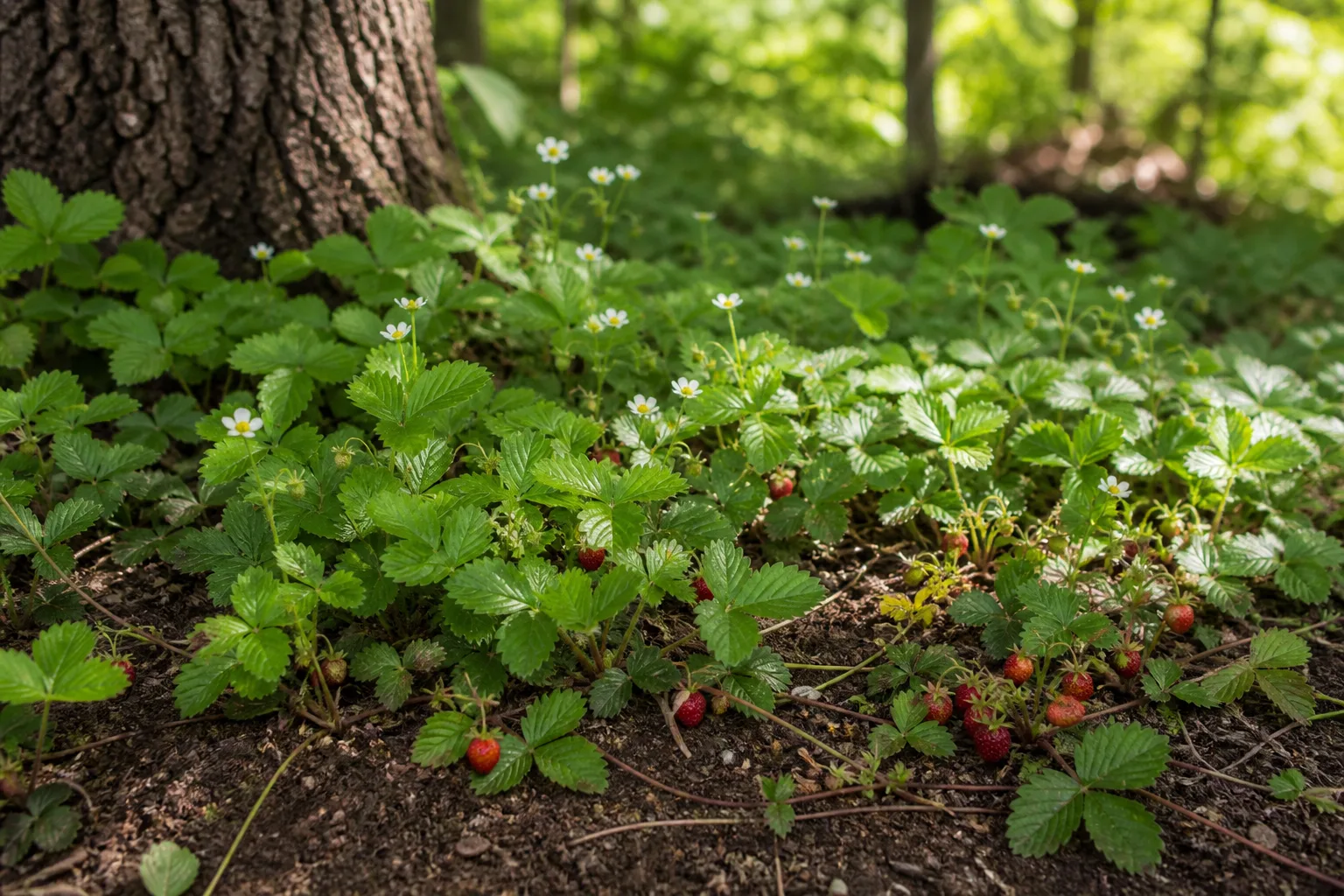
Use It Along Paths and Slopes With Limits
The plant is well suited to path edges, gaps between stepping stones, and gentle slopes where its low foliage can cover exposed soil and reduce splash. A living mat can also make a slope look finished while taller shrubs hold the upper structure. But a strawberry patch is not a substitute for contouring, deep-rooted structural plants, drainage work, or erosion-control fabric on a steep bank.
On a slope, watch where water collects after a storm. A plant that likes moisture can still fail if runoff scours the crown, while a dry upper slope may need temporary irrigation for its first season. Start with a small test area; if soil is moving, fix the water and soil problem before expanding the planting.
Establish a Dense Patch Without Losing the Crown
Ground cover becomes low maintenance only after it has roots strong enough to compete. The establishment phase is where most of the work happens: remove perennial weeds, plant correctly, water through dry spells, and avoid burying the center of the rosette. A thin patch is often not a sign that the plant is inherently poor; it is a sign that it was planted into competition or allowed to dry repeatedly before it rooted out.
Plant at the Right Time and Depth
Potted plants can be installed in spring after the soil is workable, or in late summer to early fall where the ground stays open long enough for roots to establish before winter. The RHS recommends spring, late summer, or early autumn for strawberries generally, while its F. vesca profile recommends spring seed sowing at about 13–18°C. (RHS strawberry-growing guide)
If starting from seed, sow on the surface of a fine, free-draining medium and cover only lightly. The seeds are small and slow to emerge. Savvy Gardening recommends late-winter sowing under grow lights, with warm, moist conditions and patience through several weeks of germination; Lovely Greens likewise advises a very light covering and notes that seedlings can take up to a month to appear. Transplants are the better route when your priority is quick groundcover rather than the enjoyment and economy of seed starting. (Savvy Gardening’s alpine-strawberry guide; Lovely Greens’ alpine-strawberry guide)
For a potted plant, loosen only circling roots, set the crown—the short central stem where leaves meet—level with the soil surface, and firm the soil around the roots. A buried crown stays damp and can rot; a crown set high dries out and exposes roots. Water once to settle the root zone, then check the soil rather than following a calendar.
Water the First Season, Then Read the Soil
Keep new plants evenly moist while roots move into the surrounding soil. “Evenly moist” does not mean puddled: water deeply enough to wet the root zone, then allow the surface to begin drying before watering again. In a fast-draining sandy bed or beneath a tree that intercepts rain, checks may be frequent. In heavy soil or cool shade, the interval will be longer.
Water at soil level in the morning when possible. Wet foliage and fruit that stay damp in crowded conditions are more vulnerable to fungal problems, while shallow roots can suffer if water only wets the top dusting of soil. Once the patch is established, a leaf-compost mulch can reduce evaporation and competition, but leave a visible gap around every crown.
Keep Woodland Strawberry Healthy Through Heat and Winter
The low-maintenance promise depends on managing extremes rather than feeding the plant constantly. Woodland strawberry is forgiving about ordinary garden variation, but heat, drought, saturated soil, and crowding all turn a simple groundcover into a problem patch.
Mulch, Feed Lightly, and Clean Up Selectively
Use a thin layer of finished compost or leaf mold to improve the soil surface and suppress early weeds. Do not pile heavy mulch over the rosettes, and do not use fertilizer as a substitute for light. In a fertile bed, excessive nitrogen can make soft leafy growth while increasing crowding and reducing the tidy, fruiting habit you wanted.
If growth is weak after you have corrected light and moisture, a restrained spring feeding may help, but follow the product label and avoid pushing a plant that is naturally small. Harvest ripe berries promptly and remove fruit that is collapsing or moldy. Keep the patch open enough for air movement and clear out dead leaves that are smothering the crown; leave healthy foliage in place to protect the plant going into cold weather.
During extreme summer heat, check soil moisture at the root zone and provide temporary shade if plants are newly planted in a hot exposed site. Do not respond to a heat pause by watering constantly. If the soil is already wet and leaves are limp, inspect the crown and roots for rot instead of adding more water.
Manage Runners So the Carpet Stays Intentional
The most important maintenance fact is also the most useful design feature: F. vesca can spread by above-ground stolons, commonly called runners, and some related alpine selections are more clumping or runnerless. The RHS recommends removing excess runners from its F. vesca profile, while the Native Plant Trust records stolons and rhizomes as part of the plant’s growth form. Treat the plant you bought as an individual selection, not as a guarantee about every plant sold under “alpine strawberry.”
Divide, Transplant, or Remove New Plantlets
When a runner has formed a rooted daughter plant, you can leave it in place to close a gap, lift and transplant it in early spring, or sever and remove it if it is crossing a path. Move only well-rooted plantlets, water them into their new position, and give them the same establishment care as a purchased plug. The runner photograph below shows the useful moment to make that decision: the daughter has its own small rosette and is no longer just a floating stem.
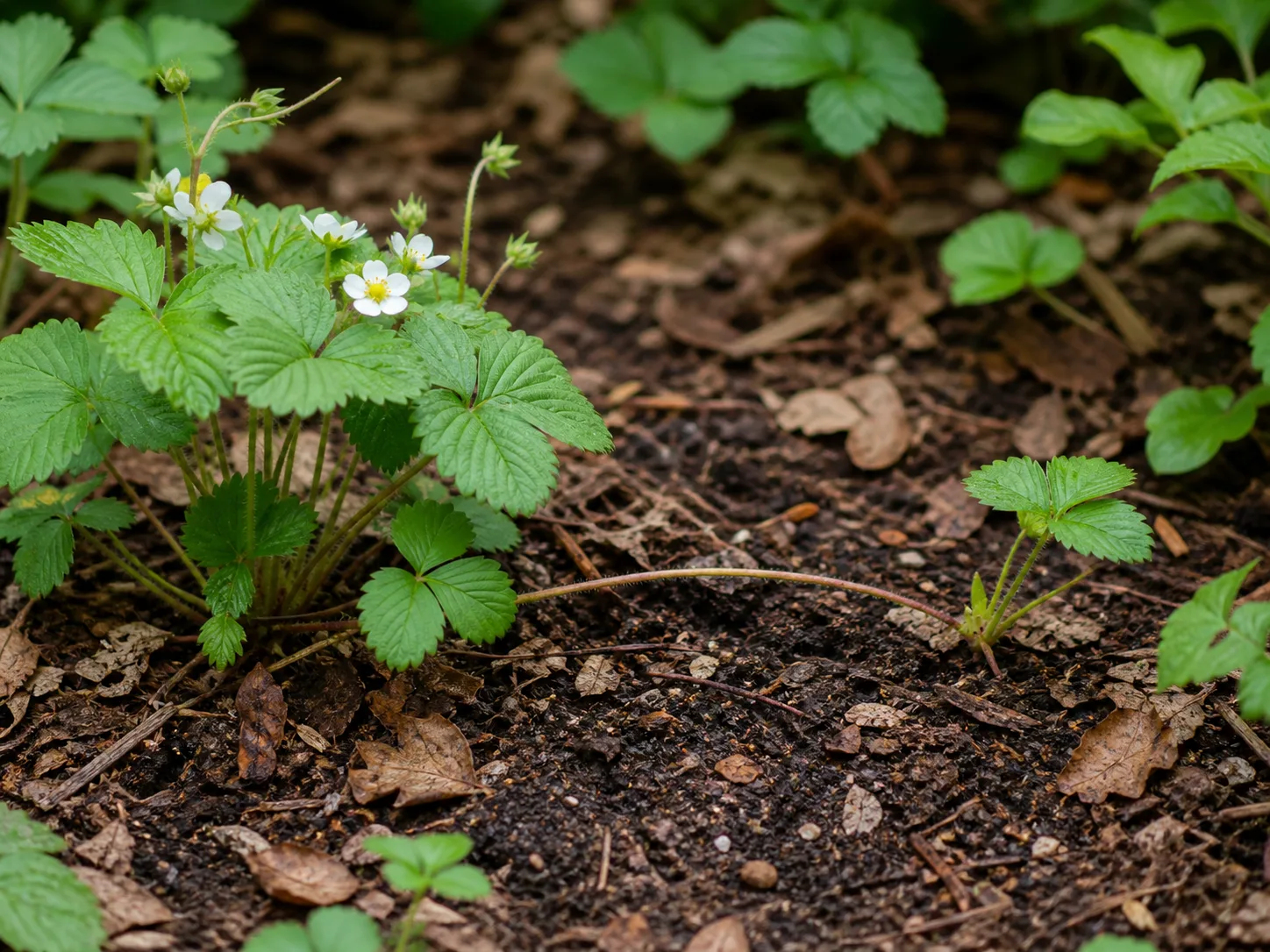
For a defined border, edge the patch once or twice during the growing season and remove runners before they root. For a naturalized woodland area, let a few plantlets settle while keeping a clear strip along paths and lawns. A deep edging barrier is not always necessary, but a visible boundary and an occasional inspection are. If your garden cannot accommodate that small amount of management, choose a naturally clumping ground cover.
Troubleshoot Weak Growth, Rot, and Missing Fruit
Diagnose the site before diagnosing the plant. A strawberry that looks sparse under a dense evergreen may need more usable light; one that collapses in wet soil may have root or crown trouble; one that has leaves but no berries may simply be too shaded or too young. Changing fertilizer first often hides the actual cause.
Separate Light, Moisture, Pest, and Pollination Problems
Use this order of checks:
- Look at light. Is the patch receiving filtered daylight, morning sun, or only deep darkness? More light generally improves flowers and fruit, while heavy shade can leave healthy-looking foliage with little harvest.
- Feel the soil below the surface. Dry soil explains wilt in a new planting; saturated soil, a sour smell, or a soft crown points toward drainage and rot risk.
- Inspect the undersides of leaves and the fruit. Aphids, slugs, mites, birds, and gray mold can all reduce the useful harvest even when the foliage looks acceptable. RHS lists aphids, slugs, red spider mite, vine weevil, strawberry viruses, root rot, and gray mold among potential problems for F. vesca. (RHS plant profile)
- Check flowers before blaming nutrition. A plant cannot fruit where there are few flowers, and fruit set can be reduced by insufficient pollinator activity or frost damage. Keep the planting open, avoid unnecessary insecticide use, and provide other flowering plants nearby.
- Check the identity. If the fruit, leaves, or growth habit do not match the tag, pause before eating or propagating it. Native Plant Trust’s comparison with F. virginiana is a reminder that two strawberry species can look close enough to confuse a casual inspection.
The easiest correction is usually the smallest one: move a container to brighter light, thin a crowded patch, redirect water away from the crown, remove rotten fruit, or transplant a runner into better soil. If the site itself is wrong, replace the plant rather than trying to fertilize it into tolerating conditions it does not like.
Choose a Different Native Groundcover When the Site Demands It
Woodland strawberry is a versatile choice, not the universal answer to shade. On the West Coast, redwood sorrel (Oxalis oregana) may better match a moist, deeply shaded woodland understory. In a compact, mound-forming planting where runners are unwelcome, crevice alumroot (Heuchera micrantha) offers a different leaf shape and a more stationary habit. Both options are regional recommendations, not interchangeable nationwide substitutes; match the plant to your local climate, soil, wildlife goals, and native-plant guidance.
Use hostas, ferns, or other shade plants only when their mature size and moisture needs fit the bed. The most reliable groundcover is the one that survives the actual site without constant rescue. If you want edible fruit, accept the runner maintenance. If you want a motionless green carpet in deep shade, choose a clumping plant. If you need to stop soil from moving on a steep slope, solve the slope first and treat groundcover as one supporting layer.
Conclusion
Wild strawberry can be one of the best ground covers for a bright woodland edge because it combines a low habit, white flowers, small edible berries, and a spreading growth form that can close exposed soil without hiding everything around it. It is most successful in filtered light to sun, fertile soil that drains, and a bed where first-season watering and runner control are realistic.
Plant it with the crown at soil level, start 12–18 inches apart, protect the shallow roots from repeated drying, and expect less fruit in deep shade or extreme heat. Let runners fill planned gaps, remove them from paths, and treat winter color as climate-dependent rather than guaranteed. With those limits understood, Fragaria vesca becomes more than an unexpected alternative to hostas: it becomes a useful, edible, pollinator-friendly layer in a garden designed around how the plant actually grows.