Alocasia Regal Shield Care Guide: Light, Humidity, Soil
Alocasia odora × reginula 'Regal Shield'
Alocasia Regal Shield (Alocasia odora × reginula 'Regal Shield') care: bright indirect light, 60–75% humidity, chunky aroid mix, corm-safe watering, hybrid vigor, and dormancy.
Alocasia Regal Shield Care Guide: Light, Humidity, Soil
Start with wateringThe most common care mistake for Alocasia Regal ShieldWatering guide →Alocasia Regal Shield care essentials
Light
bright indirect light
Water
Water when the top 2–3 cm of soil is dry; reduce sharply in winter dormancy. Avoid overwatering — the corm rots fast in wet mix.
Soil
Chunky, well-draining aroid mix with perlite and orchid bark; never use dense peat-heavy mix alone.
Humidity
60–75%
Temperature
18–26°C (65–80°F)
Fertilizer
Stop fertilizing, reduce watering to roughly every 3–5 weeks (just enough to keep the corm from desiccating), and keep the pot warm with bright indirect light.
About Alocasia Regal Shield
Alocasia Regal Shield is native to Hybrid (Alocasia odora × Alocasia reginula), typically reaches 90–150 cm tall indoors; shield leaves to 45 cm indoors, with moderate to vigorous in active growth growth. Alocasia Regal Shield has a upright growth habit and part of the Araceae family. It is also known as Elephant Ear Regal Shield, Regal Shield Alocasia, and Jewel Alocasia.
| Detail | Information |
|---|---|
| Also known as | Elephant Ear Regal Shield, Regal Shield Alocasia, Jewel Alocasia |
| Native region | Hybrid (Alocasia odora × Alocasia reginula) |
| Mature size | 90–150 cm tall indoors; shield leaves to 45 cm |
| Growth rate | Moderate to vigorous in active growth |
| Growth habit | Upright |
| Scientific name | Alocasia odora × reginula 'Regal Shield' |
| Family | Araceae |
Alocasia Regal Shield Care Guide: Light, Humidity, Soil
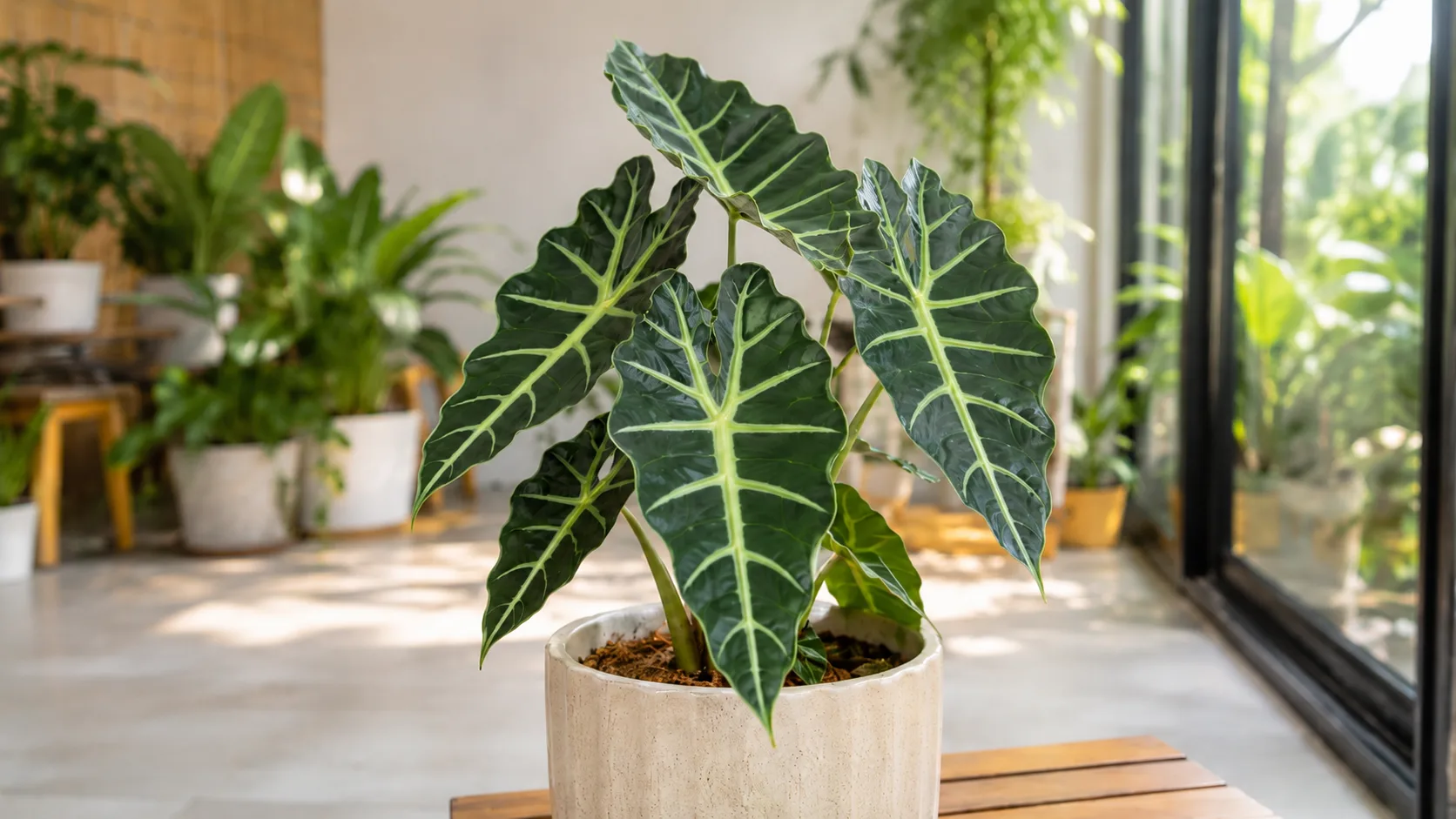
Alocasia Regal Shield is not a beginner houseplant, but it is also not impossibly difficult. It sits in a specific middle zone: demanding about humidity, very particular about wet feet, and absolutely stunning when you get the basics right. The leaves are the giveaway — large shield-shaped blades with dark green surfaces, strong veining, and purple-flushed petioles and undersides inherited from its compact parent. Get light, watering, humidity, and soil matched to a tropical understory, and the plant rewards you with a slow but steady stream of new spears. Get any one of those badly wrong, and the same plant will sulk for months. This guide walks through everything that actually matters for Alocasia odora × reginula ‘Regal Shield’, with specific numbers, primary sources, and the failure modes I see most often.
Species profile: Alocasia odora × reginula ‘Regal Shield’
Alocasia Regal Shield — also sold as Elephant Ear Regal Shield — is a hybrid cultivar between upright Alocasia odora and compact Alocasia reginula (the species behind Alocasia Black Velvet). Indoors it typically reaches 90–150 cm tall with moderate growth when light, humidity, and drainage align. Like all alocasias, it grows from an underground corm that stores energy through seasonal slowdowns — see the dormancy section below before assuming leaf drop means the plant is dead.
What makes Regal Shield different from other alocasias
Regal Shield is often grouped with “jewel” alocasias because of its dark coloring, but it behaves more like a vigorous floor alocasia than a tiny velvet species. The Royal Horticultural Society’s general alocasia guide notes that large species such as A. odora can reach about 1.5 m (5 ft) indoors, while compact types suit smaller humid spots — Regal Shield splits the difference, inheriting odora’s upright stature and reginula’s purple-backed foliage.
Hybrid background: odora vigor meets reginula color
Alocasia odora is an upright shield-leaf species in the Araceae family grown for bold tropical structure. Alocasia reginula is a slow, compact Borneo species with nearly black velvety leaves. ‘Regal Shield’ combines odora’s size and growth rate with reginula’s purple petioles and leaf reverses. NC State Extension describes the genus as tuberous perennials from tropical Asia that prefer shaded sites with slightly acidic, moist, well-drained, humus-rich soil — that combination of moisture and drainage is the core indoor challenge for this hybrid.
Regal Shield vs Black Velvet, Odora, and Polly
Alocasia Black Velvet (A. reginula) is the compact parent — slower, smaller, velvet-textured, and even less forgiving of dry air. Regal Shield is larger, glossier, and usually replaces leaves faster when humidity stays above 60%. Pure Alocasia odora grows taller with plain green shields and no purple flush; it shares the same corm logic but needs more floor space. Alocasia Polly (A. × amazonica hybrid) has glossy wavy-margined leaves without the purple-backed shield look. All are toxic and want chunky mix, but Regal Shield’s larger leaf surface makes dry air and wet roots especially punishing — treat it as a humidity-sensitive floor plant, not a windowsill curiosity.
Light: bright, indirect, and stable
Regal Shield is an understorey plant, and it wants the light conditions an understorey plant would expect. Bright, indirect light is the target: strong enough to read a book in the leaf shadows at midday, but not direct sun on the leaves themselves. The Royal Horticultural Society’s general alocasia guide makes the same point: bright but not direct light, with strong sun risking scorch.
Direct sun on a Regal Shield shows up fast as bleached patches, brown crisp edges on the sun-facing side, or sudden leaf collapse after a move. Too little light shows up slower as long, weak petioles, smaller new leaves, and a plant that holds only one or two leaves at a time instead of the fan of four to six a healthy plant should carry. An east-facing window with morning sun, a north-facing window with bright ambient light, or a west window with a sheer curtain is usually the safest placement. Rotate the pot a quarter turn each week to keep growth symmetrical.
If you are using grow lights, full-spectrum LED panels at 30–60 cm above the canopy for 10–12 hours a day are a good starting point. For placement specifics and foot-candle targets, see the Alocasia Regal Shield light guide.
Best window placement for shield leaves
Most home growers find a happy medium around 10,000–15,000 lux — roughly one to two metres back from a bright east window or directly in front of a bright north window. Shield leaves photosynthesize efficiently in filtered light, but they will not maintain tight internodes or strong purple coloration in dim corners. A bathroom with frosted glass and a skylight can outperform a south-facing living room corner that feels bright to your eyes but delivers under 2,000 lux at the pot.
Alocasia Regal Shield watering guide: when the top 2–3 cm is dry
The single most common cause of death for Alocasia ‘Regal Shield’ is overwatering on Alocasia Regal Shield. The Missouri Botanical Garden Plant Finder describes the genus as preferring consistently moist, organically rich, well-drained soils — moist, not saturated, in mix that drains fast enough for oxygen to reach fine roots. Convergent grower advice: water when the top 2–3 cm of the mix is dry, water thoroughly, and never let the pot sit in runoff.
The right way to water is to test the actual pot, not the calendar. Stick a finger, chopstick, or moisture meter to the second knuckle. If the top 2–3 cm of mix is dry and the deeper mix is just approaching dry, water. If the deeper mix is still damp, wait. When you do water, soak the entire root ball until water runs from the drainage holes, then empty the saucer or cachepot.
Underwatering is more recoverable than overwatering. A Regal Shield that has dried out a little will show curled leaves and crispy edges, and a thorough soak usually brings it back. A Regal Shield that has been sitting in a wet, anaerobic mix for weeks will have mushy, dark, smelly roots, and the recovery is much harder.
Pot weight and chopstick checks
Pot weight is faster than any moisture meter once you learn it. Lift the pot immediately after a thorough watering and remember the weight. By the time the pot feels distinctly light and the top of the mix is dry to the touch, the plant is ready for water. A chopstick pushed to the bottom of the pot and left for 30 seconds tells the same story: dry stick means water; damp stick with dark mix clinging means wait.
Humidity and temperature: 60–75% RH and 18–26 °C
Humidity is the variable that most often separates a Regal Shield that thrives from one that merely survives. The target is 60–75% relative humidity, which is well above what most heated or air-conditioned homes provide in winter (typically 30–50%). A bathroom with bright natural light is a natural fit for this plant if the light is right (NC State Extension).
Temperature should sit between 18 and 26 °C (65–80 °F) during active growth. Regal Shield will tolerate a slow drift down to around 13 °C (55 °F) without dying, but prolonged exposure to those temperatures is the most reliable way to trigger dormancy, and below about 10 °C (50 °F) you risk permanent damage. The Royal Horticultural Society’s alocasia guide gives the same temperature floor: above 10 °C in winter, well above 16 °C during the active growing season, and never in a cold draught.
The two indoor locations that cause the most problems are the windowsill in winter (cold glass plus cold draught) and the spot directly under an AC vent in summer (cold dry air blown across the leaves).
Why misting alone is not a humidity fix
Misting raises the relative humidity around the leaf for a few minutes at most, and it leaves the leaf surface wet, which can invite fungal spotting on large shield leaves. A humidifier is the most reliable solution; misting is not. Grouping plants together, placing the pot on a pebble tray above the water line, and growing the plant in a glass cabinet or terrarium are all measurable improvements. If you use a humidifier, run it on a hygrometer rather than a fixed setting; overshooting 85% RH in a poorly ventilated room creates its own fungal risks.
Soil mix: chunky, airy, and slightly acidic
Alocasia hybrids in cultivation root best in well-drained, airy media that never stay logged. Standard houseplant potting mix is too dense on its own; it compacts within months and is the single fastest path to root rot on Alocasia Regal Shield. Most specialist growers and university extension services converge on the same recipe: a chunky, airy aroid mix built around equal parts of an organic component, a drainage component, and a bark component.
The target pH is mildly acidic, around 5.5–6.5. Most peat-free or coco-coir-based mixes sit inside that range naturally.
A reliable 1:1:1 aroid recipe
A simple, well-documented mix is 1 part coco coir (or peat-free houseplant compost), 1 part perlite, and 1 part orchid bark, by volume. The coco coir holds a thin film of moisture around the roots without staying soggy; the perlite creates air pockets; the orchid bark gives larger pores that let water run through fast. For Regal Shield-specific mix tuning and wrong-soil warning signs, see the Alocasia Regal Shield soil guide.
Do not add fine sand to “improve drainage” — it fills air gaps and makes the mix worse. Do not use garden soil, and do not use a peat-heavy tropical mix on its own; pure peat holds too much water and suffocates the slow Regal Shield root system.
Fertilizer, Alocasia Regal Shield repotting guide, and long-term root health
Alocasia ‘Regal Shield’ is a modest feeder. A balanced water-soluble houseplant fertilizer at one-quarter to one-half of the label rate, applied every four to six weeks during active growth (spring through early autumn), is plenty. Always apply fertilizer to already-moist soil so the solution can move through the root zone without burning fine root hairs.
Pause feeding during dormancy, for the first month after repotting, and any time the plant is recovering from a pest or root issue. Feeding a plant that is not actively using nutrients just adds salt to the mix — a common cause of brown tips on Alocasia Regal Shield.
Repot every one to two years, or whenever the pot dries much faster than it used to, roots circle the drainage holes, or water runs straight through without soaking in. Go up only one pot size at a time (about 2 cm of additional diameter). A pot that is too large holds too much water for the root system to use, which is the most common cause of root rot after repotting. The best time is at the start of the active growing season.
Propagation: division and corm harvesting
Alocasia ‘Regal Shield’ cannot be propagated from leaf or stem cuttings. The two reliable methods are division of offsets from the mother plant and corm propagation of the small bulb-like storage organs that develop around the root system. Both methods are best done in spring or early summer when the plant is in active growth.
For division: unpot the parent plant, shake off loose mix, and gently tease the root ball apart. Each division needs at least one growth point and some roots. Pot each division into fresh, pre-moistened aroid mix, keep it in Alocasia Regal Shield light guide conditions, and maintain humidity above 60% until you see new growth. Do not fertilize for the first month.
For corm propagation: unpot the plant and feel through the mix near the root mass for small, firm, marble-to-pea-sized corms. Place each healthy corm on moist sphagnum moss in a sealed clear container at 24–27 °C (75–80 °F) in bright indirect light. Roots usually appear in two to four weeks. Do not harvest every corm from a single plant — the mother plant relies on them as a water and energy reserve through dormancy. Full step-by-step detail lives in the Alocasia Regal Shield propagation guide.
Dormancy: why your plant suddenly drops all its leaves
In late autumn or winter, with shorter days and cooler nights, a perfectly healthy Regal Shield can drop every leaf, leaving a pot of bare mix with a corm below the surface. This is dormancy, not death — the same behaviour corm-based alocasias use when light and temperature fall below growth thresholds. Shorter photoperiod and sustained temperatures below about 13 °C (55 °F) are the most reliable dormancy triggers even in heated homes.
During dormancy, stop fertilizing, reduce watering to barely enough to keep the corm from desiccating (typically once every three to five weeks), and keep the plant in a warm, stable spot with bright indirect light. Resist the temptation to repot, divide, or “rescue” the plant by overwatering. New growth usually appears in spring when temperatures and daylength both rise. If new growth does not appear by mid-spring, gently unpot the plant and check that the corm is still firm; if it is, repot, water lightly, and keep waiting.
Common problems: yellow leaves, spider mites, root rot
Most Regal Shield problems are environmental, not mysterious. The diagnostic order matters: check moisture first, then light, then pests.
Yellow leaves are the most common complaint. A single older leaf yellowing while new growth looks healthy is normal — Regal Shield holds only a small fan of leaves at a time. Widespread yellowing is almost always overwatering or a mix that holds too much moisture. Less common causes include low light, mineral-heavy tap water, and pests. See yellow leaves on Alocasia Regal Shield for the full diagnostic path.
Brown leaf tips and edges almost always point to low humidity, salt buildup, or hard tap water. Flushing the pot with plain, low-mineral water every few months moves salts through.
Spider mites are the most common pest in dry indoor air. Look for fine webbing on leaf undersides and stippled upper surfaces. Isolate the plant, rinse foliage thoroughly, and apply insecticidal soap or dilute neem oil at five-day intervals for two to three rounds while raising humidity above 60%. See spider mites on Alocasia Regal Shield for treatment detail.
Root rot is almost always caused by overwatering, a dense mix, or a pot without drainage. Early signs are yellowing leaves, soft stems at the base, and a sour smell from the mix. Unpot, trim mushy roots, and repot into fresh, dry, chunky mix.
Toxicity to pets and people
Every part of Alocasia odora × reginula ‘Regal Shield’ is toxic to cats, dogs, horses, and humans if chewed or ingested. The toxic principle is insoluble calcium oxalate, in the form of needle-like raphide crystals. The ASPCA’s toxic plant database lists Alocasia spp. as toxic to dogs, cats, and horses, with clinical signs including oral irritation, pain and swelling of the mouth, excessive drooling, vomiting, and difficulty swallowing.
If a pet or child has chewed on a Regal Shield, call the ASPCA Animal Poison Control Center at (888) 426-4435 or your veterinarian immediately. Do not induce vomiting unless specifically instructed.
For households with cats, dogs, or small children, place the plant out of reach or choose a non-toxic alternative. The RHS general alocasia guide recommends wearing gloves when handling alocasias because the sap can irritate skin.
Buying tips and the first 30 days at home
A healthy Regal Shield in a nursery or online listing should have firm, glossy shield leaves with clear veining and purple-flushed petioles, no visible webbing or sticky residue on the undersides, and a pot of mix that does not smell sour. A small amount of cosmetic damage on an older leaf is normal; a plant with collapsed crowns, mushy petioles, or yellow new growth is not. Specialist aroid growers and reputable houseplant lines are generally safer bets than generic big-box listings for correctly labelled hybrids.
In the first 30 days, do not repot, do not fertilize, and do not propagate. Quarantine the plant away from other houseplants for at least two weeks in case it arrived with spider mites or mealybugs. Watch the pot dry-down carefully to learn the rhythm of your specific container. If the plant drops a leaf in the first week or two, that is usually a stress response, not a care failure. Move only one variable at a time: light first, then watering, then humidity, then fertilizer.
Conclusion
Alocasia odora × reginula ‘Regal Shield’ rewards growers who treat watering, humidity, and dormancy as one system. Keep the corm firm, the mix airy, and winter care conservative — and Regal Shield will push new spears when conditions improve. The most important habits are the boring ones: lift the pot, check roots annually, accept winter leaf drop, and never overwater a dormant corm.
When to use this page vs other Alocasia Regal Shield guides
- Alocasia Regal Shield overview — Canonical hub for this species; care topics and problems branch from here.
- Alocasia Regal Shield problems — Symptom-first path when you already know something is wrong.
- Alocasia Regal Shield watering — Deep dive when moisture rhythm is the only issue.
- Alocasia Regal Shield light — Placement, windows, and grow lights in detail.
Related Alocasia Regal Shield guides
- Alocasia Regal Shield watering
- Alocasia Regal Shield light
- Alocasia Regal Shield soil
- Alocasia Regal Shield propagation
- Alocasia Regal Shield fertilizer
- Alocasia Regal Shield repotting
- Alocasia Regal Shield pruning
- Root rot on Alocasia Regal Shield
- Spider mites on Alocasia Regal Shield
- Yellow leaves on Alocasia Regal Shield
- Brown tips on Alocasia Regal Shield
- Overwatering on Alocasia Regal Shield
How to care for Alocasia Regal Shield?
How much light does Alocasia Regal Shield need?
bright indirect light
- bright indirect light - bright indirect light.
When should you water Alocasia Regal Shield?
Water when the top 2–3 cm of soil is dry; reduce sharply in winter dormancy. Avoid overwatering — the corm rots fast in wet mix.
- Finger or chopstick to 2–3 cm depth; lift pot to gauge weight - Water when the top 2–3 cm of soil is dry; reduce sharply in winter dormancy.
- Drain excess water - Water when the top 2–3 cm of soil is dry; reduce sharply in winter dormancy.
What soil works best for Alocasia Regal Shield?
Chunky, well-draining aroid mix with perlite and orchid bark; never use dense peat-heavy mix alone.
- perlite - Chunky, well-draining aroid mix with perlite and orchid bark; never use dense peat-heavy mix alone.
- orchid bark - Chunky, well-draining aroid mix with perlite and orchid bark; never use dense peat-heavy mix alone.
- peat-free potting mix - Chunky, well-draining aroid mix with perlite and orchid bark; never use dense peat-heavy mix alone.
Grower notes for Alocasia Regal Shield
Dormancy and the corm
Alocasia Regal Shield may drop all leaves in winter while the underground corm stays alive. Reduce watering to every 3–5 weeks, stop fertilizer, and wait for spring growth — do not discard a pot that looks empty.
Hybrid vigor from odora × reginula
Regal Shield inherits upright size from Alocasia odora and the purple-flushed undersides of compact Alocasia reginula (Black Velvet). It grows taller and faster than jewel alocasias like Black Velvet or Frydek when humidity stays above 60%, but it still rots quickly in dense or oversize pots — do not treat it like a tough floor philodendron.
What matters most with Alocasia Regal Shield
Alocasia Regal Shield is easiest to grow when you judge the whole plant: new growth, root-zone moisture, light exposure, and how quickly the pot dries after watering. The care checkpoint is bright indirect light paired with chunky aroid mix. Large shield leaves transpire heavily — humidity and drainage matter more than a fixed weekly watering day.
Best placement in a real home
Alocasia Regal Shield belongs where bright indirect light is realistic for most of the day. Water when the top 2–3 cm of soil is dry; reduce sharply in winter when dormancy is likely. Humidity target: 60–75%. Temperature comfort zone: 18–26°C (65–80°F). A bright bathroom or grouped plant corner often works better than a dry living-room shelf.
Before you buy this plant
Choose Alocasia Regal Shield with firm new growth, large shield-shaped leaves with purple-flushed petioles and undersides, clean leaf surfaces, and soil that does not smell sour. Be cautious if you see collapsed crowns, mushy petioles, or a pot that stays wet in poor light. Also sold as Elephant Ear Regal Shield — verify the hybrid shield leaf, not a mislabeled Polly or plain odora.
First month after bringing it home
Do not repot Alocasia Regal Shield on day one unless the mix is failing or pests are obvious. Quarantine it, learn how fast the pot dries, and keep care boring while it adjusts. If a leaf drops in week one, the corm below may still be fine — resist overwatering an empty-looking pot.
Is it pet safe?
Alocasia Regal Shield is toxic to cats and dogs and humans.
Contains insoluble calcium oxalate crystals causing oral irritation, drooling, and vomiting if ingested.
Watering Alocasia Regal Shield
For Alocasia Regal Shield, finger or chopstick to 2–3 cm depth; lift pot to gauge weight and water every 7–10 days in summer; every 2–4 weeks in winter. Reduce watering 60–70% in autumn/winter when dormancy is likely; keep corm from drying out.
| Detail | Information |
|---|---|
| How often | Every 7–10 days in summer; every 2–4 weeks in winter |
| How to check | Finger or chopstick to 2–3 cm depth; lift pot to gauge weight |
| Seasonal changes | Reduce watering 60–70% in autumn/winter when dormancy is likely; keep corm from drying out |
Signs of overwatering
- yellow leaves
- mushy petioles
- soggy soil
- root rot
Signs of underwatering
- drooping leaves
- dry crispy edges
- slow growth
Soil & potting for Alocasia Regal Shield
Use a mix of perlite, orchid bark, peat-free potting mix, coarse sand for Alocasia Regal Shield. Fast-draining; corm must never sit in saturated soil. Target soil pH around 5.5–6.5. Repot every 1–2 years, ideally in spring.
| Detail | Information |
|---|---|
| Recommended mix | perlite, orchid bark, peat-free potting mix, coarse sand |
| Drainage | Fast-draining; corm must never sit in saturated soil |
| Soil pH | 5.5–6.5 |
| Repotting frequency | Every 1–2 years |
| Best season to repot | Spring |
Signs it needs repotting
- roots circling pot
- rapid soil drying
- stunted growth
Humidity & temperature for Alocasia Regal Shield
Alocasia Regal Shield prefers 60–75%, though normal home humidity is usually fine. Keep temperatures around 18–26°C (65–80°F).
| Detail | Information |
|---|---|
| Humidity | 60–75% - normal home humidity is fine. |
| Ideal temperature | 18–26°C (65–80°F) |
Fertilizer & pruning for Alocasia Regal Shield
Use stop fertilizing, reduce watering to roughly every 3–5 weeks (just enough to keep the corm from desiccating), and keep the pot warm with bright indirect light. for Alocasia Regal Shield.
| Detail | Information |
|---|---|
| Fertilizer type | Stop fertilizing, reduce watering to roughly every 3–5 weeks (just enough to keep the corm from desiccating), and keep the pot warm with bright indirect light. |
Common problems on Alocasia Regal Shield
Yellow Leaves
MediumLikely cause: Common on this plant type; confirm with recent watering, light, and root checks.
Quick fix: Inspect the plant and correct the most likely care stressor before stacking treatments.
Full fix guide →Brown Tips
MediumLikely cause: Common on this plant type; confirm with recent watering, light, and root checks.
Quick fix: Inspect the plant and correct the most likely care stressor before stacking treatments.
Full fix guide →Root Rot
MediumLikely cause: Common on this plant type; confirm with recent watering, light, and root checks.
Quick fix: Inspect the plant and correct the most likely care stressor before stacking treatments.
Full fix guide →Overwatering
MediumLikely cause: Common on this plant type; confirm with recent watering, light, and root checks.
Quick fix: Inspect the plant and correct the most likely care stressor before stacking treatments.
Full fix guide →Underwatering
MediumLikely cause: Common on this plant type; confirm with recent watering, light, and root checks.
Quick fix: Inspect the plant and correct the most likely care stressor before stacking treatments.
Full fix guide →Spider Mites
MediumLikely cause: Common on this plant type; confirm with recent watering, light, and root checks.
Quick fix: Inspect the plant and correct the most likely care stressor before stacking treatments.
Full fix guide →Mealybugs
MediumLikely cause: Common on this plant type; confirm with recent watering, light, and root checks.
Quick fix: Inspect the plant and correct the most likely care stressor before stacking treatments.
Full fix guide →Aphids
MediumLikely cause: Common on this plant type; confirm with recent watering, light, and root checks.
Quick fix: Inspect the plant and correct the most likely care stressor before stacking treatments.
Full fix guide →Leggy Growth
MediumLikely cause: Common on this plant type; confirm with recent watering, light, and root checks.
Quick fix: Inspect the plant and correct the most likely care stressor before stacking treatments.
Full fix guide →Slow Growth
MediumLikely cause: Common on this plant type; confirm with recent watering, light, and root checks.
Quick fix: Inspect the plant and correct the most likely care stressor before stacking treatments.
Full fix guide →Wilting
MediumLikely cause: Common on this plant type; confirm with recent watering, light, and root checks.
Quick fix: Inspect the plant and correct the most likely care stressor before stacking treatments.
Full fix guide →Drooping Leaves
MediumLikely cause: Common on this plant type; confirm with recent watering, light, and root checks.
Quick fix: Inspect the plant and correct the most likely care stressor before stacking treatments.
Full fix guide →Low Humidity
MediumLikely cause: Common on this plant type; confirm with recent watering, light, and root checks.
Quick fix: Inspect the plant and correct the most likely care stressor before stacking treatments.
Full fix guide →Not Enough Light
MediumLikely cause: Common on this plant type; confirm with recent watering, light, and root checks.
Quick fix: Inspect the plant and correct the most likely care stressor before stacking treatments.
Full fix guide →Fungus Gnats
MediumLikely cause: Common on this plant type; confirm with recent watering, light, and root checks.
Quick fix: Inspect the plant and correct the most likely care stressor before stacking treatments.
Full fix guide →Mold on Soil
MediumLikely cause: Common on this plant type; confirm with recent watering, light, and root checks.
Quick fix: Inspect the plant and correct the most likely care stressor before stacking treatments.
Full fix guide →Curling Leaves
MediumLikely cause: Common curling leaves pattern on Alocasia Regal Shield under indoor care stress.
Quick fix: Inspect roots, watering, light, and pests; adjust one variable and monitor new growth.
Full fix guide →Brown Leaves
MediumLikely cause: Common brown leaves pattern on Alocasia Regal Shield under indoor care stress.
Quick fix: Inspect roots, watering, light, and pests; adjust one variable and monitor new growth.
Full fix guide →Black Spots
MediumLikely cause: Common black spots pattern on Alocasia Regal Shield under indoor care stress.
Quick fix: Inspect roots, watering, light, and pests; adjust one variable and monitor new growth.
Full fix guide →Holes in Leaves
MediumLikely cause: Common holes in leaves pattern on Alocasia Regal Shield under indoor care stress.
Quick fix: Inspect roots, watering, light, and pests; adjust one variable and monitor new growth.
Full fix guide →Pale Leaves
MediumLikely cause: Common pale leaves pattern on Alocasia Regal Shield under indoor care stress.
Quick fix: Inspect roots, watering, light, and pests; adjust one variable and monitor new growth.
Full fix guide →Distorted Leaves
MediumLikely cause: Common distorted leaves pattern on Alocasia Regal Shield under indoor care stress.
Quick fix: Inspect roots, watering, light, and pests; adjust one variable and monitor new growth.
Full fix guide →Scale Insects
MediumLikely cause: Common scale insects pattern on Alocasia Regal Shield under indoor care stress.
Quick fix: Inspect roots, watering, light, and pests; adjust one variable and monitor new growth.
Full fix guide →Thrips
MediumLikely cause: Common thrips pattern on Alocasia Regal Shield under indoor care stress.
Quick fix: Inspect roots, watering, light, and pests; adjust one variable and monitor new growth.
Full fix guide →Whiteflies
MediumLikely cause: Common whiteflies pattern on Alocasia Regal Shield under indoor care stress.
Quick fix: Inspect roots, watering, light, and pests; adjust one variable and monitor new growth.
Full fix guide →Leaf Miners
MediumLikely cause: Common leaf miners pattern on Alocasia Regal Shield under indoor care stress.
Quick fix: Inspect roots, watering, light, and pests; adjust one variable and monitor new growth.
Full fix guide →Caterpillars
MediumLikely cause: Common caterpillars pattern on Alocasia Regal Shield under indoor care stress.
Quick fix: Inspect roots, watering, light, and pests; adjust one variable and monitor new growth.
Full fix guide →Nitrogen Deficiency
MediumLikely cause: Common nitrogen deficiency pattern on Alocasia Regal Shield under indoor care stress.
Quick fix: Inspect roots, watering, light, and pests; adjust one variable and monitor new growth.
Full fix guide →Iron Deficiency
MediumLikely cause: Common iron deficiency pattern on Alocasia Regal Shield under indoor care stress.
Quick fix: Inspect roots, watering, light, and pests; adjust one variable and monitor new growth.
Full fix guide →Magnesium Deficiency
MediumLikely cause: Common magnesium deficiency pattern on Alocasia Regal Shield under indoor care stress.
Quick fix: Inspect roots, watering, light, and pests; adjust one variable and monitor new growth.
Full fix guide →Potassium Deficiency
MediumLikely cause: Common potassium deficiency pattern on Alocasia Regal Shield under indoor care stress.
Quick fix: Inspect roots, watering, light, and pests; adjust one variable and monitor new growth.
Full fix guide →Calcium Deficiency
MediumLikely cause: Common calcium deficiency pattern on Alocasia Regal Shield under indoor care stress.
Quick fix: Inspect roots, watering, light, and pests; adjust one variable and monitor new growth.
Full fix guide →