Magnesium Deficiency on Barrel Cactus: Causes, Checks &
Quick answer
Magnesium deficiency on barrel cactus shows as pale yellow-green bands along older lower rib valleys while spine rows and the crown often stay darker blue-green. First step: confirm the pattern is on mature lower rib skin—not soft translucent tissue from overwatering or pale new crown growth from iron deficiency.
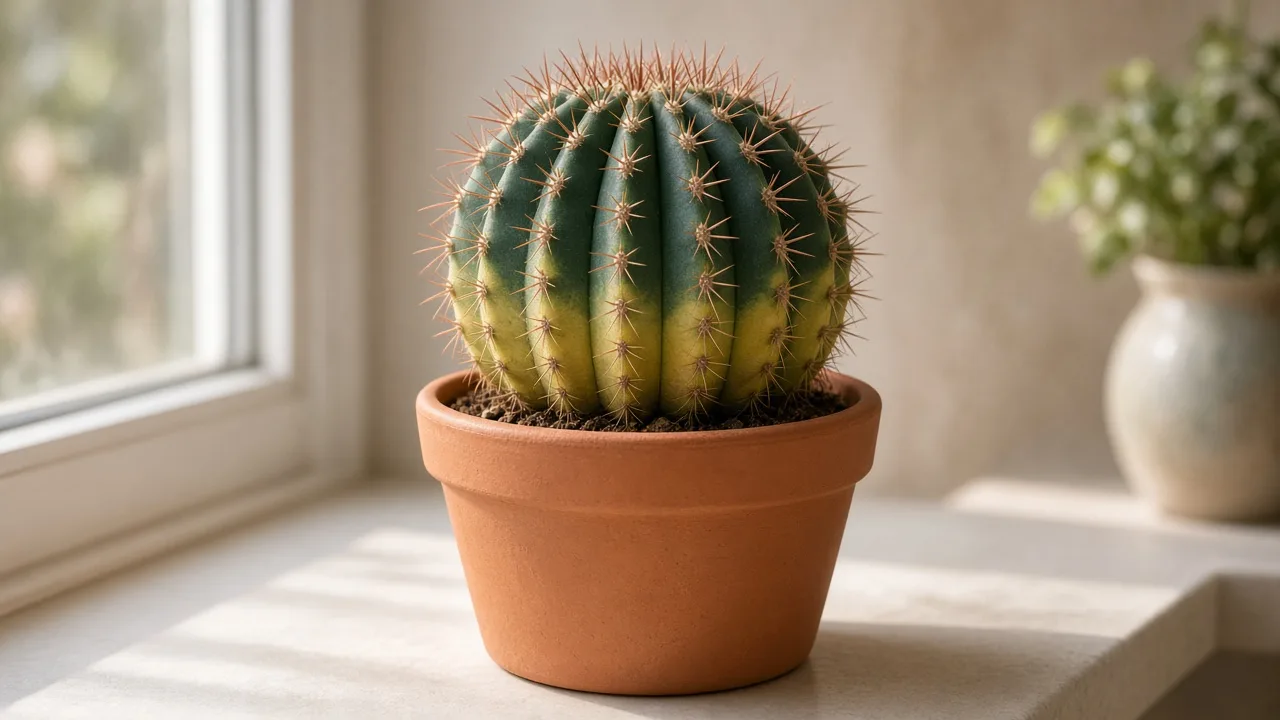
Magnesium Deficiency on Barrel Cactus: Causes, Checks & Fixes
This guide covers magnesium deficiency on Barrel Cactus. See also the general Magnesium Deficiency guide, watering, and light pages for this plant.
Magnesium Deficiency on Barrel Cactus: Causes, Checks & Fixes
Quick answer
Magnesium deficiency on barrel cactus (Ferocactus spp.) shows as pale yellow-green bands along older lower rib valleys while spine rows, areole bases, and the crown often stay relatively dark blue-green. Magnesium is mobile within plant tissues and deficiency symptoms appear first on lower or older foliage—on this leafless cactus, that translates to mature rib skin closest to the soil line, not the active crown areole ring.
See our magnesium deficiency guide. On Ferocactus, inspect the oldest lower rib sections between spine rows—pale valley banding there is classic magnesium before iron deficiency, which hits new crown tissue with green spine bases, or nitrogen deficiency, which dulls the whole barrel.
First step: confirm pale rib-valley banding on mature lower ribs, not soft translucent tissue at the base or pale new crown growth.
When to use this page vs other Barrel Cactus guides
| Pattern | Read next |
|---|---|
| Pale bands in lower rib valleys, crown still blue-green | Magnesium deficiency (this page) |
| Pale new crown areole ring with green spine bases | Iron deficiency |
| Whole barrel dull olive-gray, thin ribs | Nitrogen deficiency |
| Distorted or corky new crown spines | Calcium deficiency |
| Soft base, wet soil, translucent lower ribs | Root rot or overwatering |
| Slight rib contraction after long drought | Underwatering |
| Brown scorched skin after sudden sun move | Sunburn |
| No growth for years in a dim room | Not enough light or slow growth |
What magnesium deficiency looks like on barrel cactus
Healthy Ferocactus carries well-defined ribs covered with sharp spines emerging from areoles, with blue-green to olive stem skin photosynthesizing along each rib face. Magnesium sits at the center of the chlorophyll molecule, and when soil reserves run low the plant strips magnesium from older tissue to fund new crown growth.
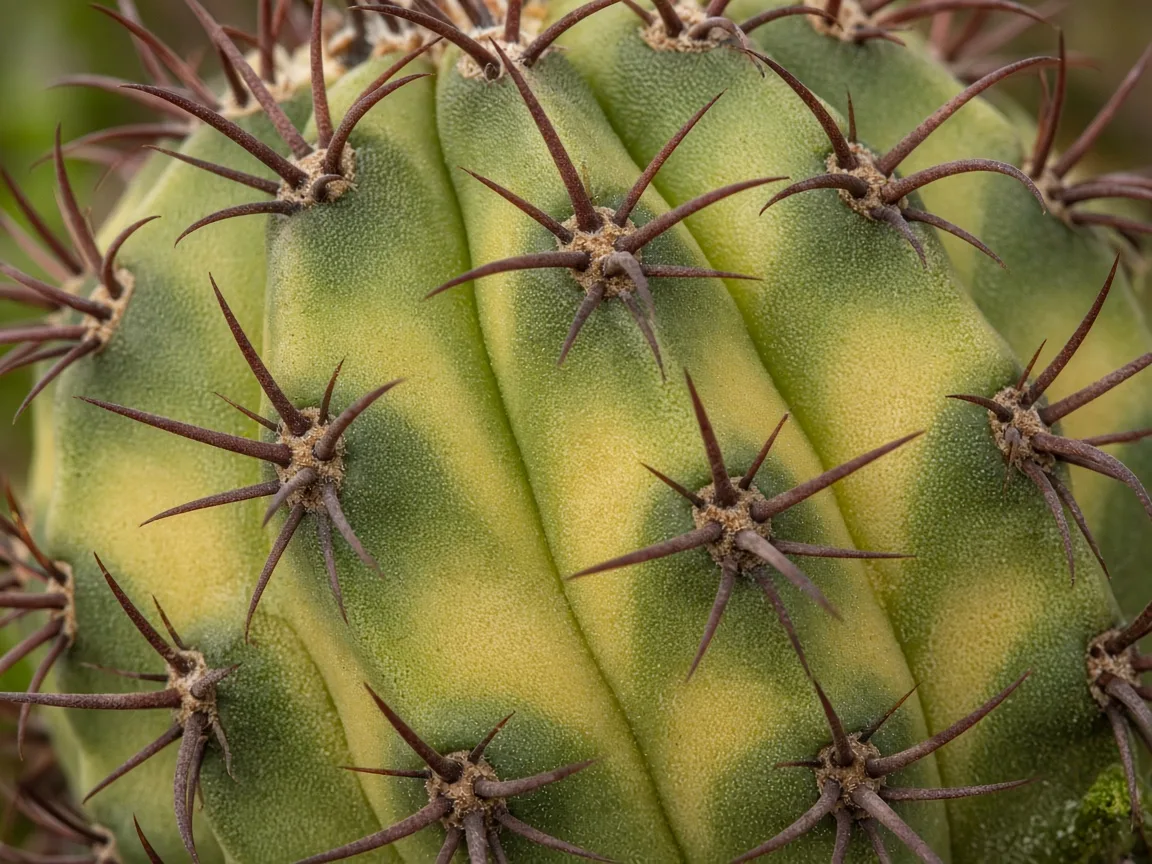
Pale yellow-green bands in the valleys between spine rows on a lower Ferocactus rib—areole bases stay relatively dark green while the rib skin between them loses color.
Typical signs:
- Pale yellow-green or olive bands in rib valleys between spine rows on the oldest lower sections of the barrel
- Spine bases and areole tissue stay relatively darker green along each rib crest—cactus equivalent of interveinal chlorosis
- Upper crown and newest rib rings may look normal in early stages while lower body shows banding
- Firm ribs and base unlike soft translucent tissue from overwatering
- Slow upward spread over months as magnesium relocates from old to new rib tissue
- Normal spine density—spines do not fall off or distort the way calcium deficiency can cork the crown
Not magnesium deficiency:
- Pale new crown areole ring with green spine bases—iron deficiency (iron symptoms occur on youngest or uppermost tissue)
- Uniform dull olive-gray across the whole barrel without valley banding—nitrogen deficiency or pale leaves pattern on related stress
- Translucent soft lower ribs on persistently wet soil—overwatering or root rot
- Slight rib contraction and dull skin after months without water—underwatering
- Brown scorched patches after light change—sunburn
- White cottony clusters in areoles—mealybugs
RHS notes interveinal chlorosis from manganese, iron, or magnesium deficiency, with manganese and magnesium symptoms tending to start on older tissue. On barrel cactus, read that pattern on rib valleys rather than leaf blades.
Why barrel cactus gets magnesium deficiency
Barrel cactus is a slow-growing desert succulent built for rocky, mineral-rich soils and full sun. Each rib face photosynthesizes year-round indoors, but magnesium demand spikes when the crown pushes new spine rings during warm active growth. Very light feeding, potassium-heavy bloom formulas, leached gritty mix, or blocked uptake from wet roots limits magnesium—and shows on mature lower rib skin while the crown still looks acceptable.
Barrel cactus-specific causes:
- Years without any fertilizer — Ferocactus needs little feed, but a specimen in the same depleted cactus mix for three or more years can exhaust available magnesium even when ribs look plump. See the barrel cactus fertilizer guide for conservative feeding rhythm.
- Potassium-heavy bloom fertilizer without micronutrients — Owners chasing crown flowers sometimes use high-K formulas that drive expansion while magnesium in the root zone depletes.
- Leached mineral mix — Deep soak-and-dry watering through fast-draining pumice and grit drains magnesium faster than owners replace it with complete feed.
- Blocked uptake from overwatering — Chronic saturation limits absorption even when magnesium is present; see overwatering before drenches.
- Low light reducing photosynthetic demand signals — A barrel cactus in a dim room grows so slowly that pale rib banding may go unnoticed for years; overlap with not enough light and slow growth.
- Inconsistent dry-down cycles — Roots alternate between saturated mix and bone-dry dormancy in an oversized pot. Follow the watering guide dry-skewer check before assuming a nutrient gap.
- Off-season feeding confusion — Fertilizer applied during cool winter dormancy when metabolism is slow builds salts without correcting rib chlorosis; true deficiency correction happens during warm active growth.
Do not diagnose magnesium deficiency on sour wet soil with a soft base—that is root failure until you confirm firm ribs and appropriate dry-down.
Rib valley banding vs crown iron chlorosis
Ferocactus has no leaves—chlorosis reads on rib skin between spine rows. Magnesium deficiency produces pale valleys on older lower ribs while spine bases along each crest stay greener. Iron deficiency shows interveinal chlorosis on the youngest or uppermost tissue first—on barrel cactus that means the newest crown areole ring looks pale with relatively green spine bases, not the lower body.
That location split is the fastest home diagnosis on a leafless cactus. Pale lower valleys with a blue-green crown points to magnesium. Pale crown with firm lower ribs points to iron. Whole-barrel dulling without a valley pattern points to nitrogen.
Judge severity by how many rib sections show banding: one pale lower rib face after a long dry winter differs from pale banding climbing halfway up the barrel on stable summer care.
Firm rib and dry-skewer check before feeding
Barrel cactus stores water in thick ribbed tissue. Before any magnesium correction, press the lowest ribs near the soil line gently with a gloved hand—the spines are sharp.
Firm, plump ribs with a dry skewer through the full pot depth support a measured Epsom drench or quarter-strength complete cactus feed during active growth. Soft, translucent, or sunken tissue at the base on wet mix means root rot or overwatering—not a nutrient label problem. Correct drainage and dry-down per the watering guide before any feed on soggy roots.
This rib-firmness gate would be nonsense on a fern frond or pothos vine—it is essential on Ferocactus because Epsom drenches on rotting tissue accelerate collapse.
Summer growth window vs winter dormancy gaps
Ferocactus metabolism tracks heat and light. Harvest to Table notes feeding only during spring and summer active growth and withholding fertilizer during winter dormancy. Magnesium correction only works when the plant is actively transpiring and taking up water—feeding a cool dormant barrel in winter does not fix spring rib banding and risks salt stress on idle roots.
When new crown spine rings resume in late spring, magnesium demand rises as chlorophyll rebuilds along expanding rib tissue. Growers who skipped complete fertilizer through the prior summer and then push heavy potassium bloom fertilizer in May sometimes see pale lower ribs—the potassium drives crown activity faster than available magnesium can support photosynthesis on older rib faces.
Closing the gap means quarter- to half-strength complete cactus fertilizer once or twice during active growth per the fertilizer guide, or one measured Epsom salt drench at 1 tablespoon per gallon on already-moist mix—not more nitrogen to force a greener barrel the chlorophyll molecule cannot sustain.
Lookalike symptoms
| Pattern | Check | Likely cause |
|---|---|---|
| Pale valleys on older lower ribs | New vs old tissue | Magnesium deficiency (this page) |
| Pale new crown areole ring | Upper vs lower body | Iron deficiency |
| Whole barrel dull olive-gray | Overall color | Nitrogen deficiency |
| Crooked or corky new crown spines | Crown distortion | Calcium deficiency |
| Soft base, wet soil, translucent ribs | Base firmness | Root rot |
| Rib shrinkage, dull skin, bone-dry pot | Dry-down history | Underwatering |
| Brown scorched skin after sun move | Recent placement | Sunburn |
| White webbing between spines | Magnifier | Spider mites |
How to confirm
- New vs old tissue — Pale rib valleys confined to the oldest lower sections while the crown stays blue-green strongly suggests magnesium.
- Base health — Firm ribs and dry skewer through the pot vs soft mushy tissue at soil line.
- Fertilizer history — Years without complete feed, or potassium-heavy bloom formula without micronutrients.
- Watering rhythm — Chronic wet mix blocking uptake vs appropriate soak-and-dry cycles per the watering guide.
- Light intensity — Dim room slowing growth so banding went unnoticed; check light placement.
- Crown comparison — Pale crown with green spine bases points to iron; pale lower valleys with normal crown points to magnesium.
- Season — Symptoms appearing during warm active growth with a firm base fit deficiency better than winter rib shrinkage alone.
First fix for barrel cactus
One quarter- to half-strength dose of complete cactus fertilizer containing magnesium and micronutrients on already-moist mix after a normal dry-down watering—or one Epsom salt drench at 1 tablespoon per gallon applied to moist gritty mix—only after confirming firm ribs, full sun or strong grow light, warm active growth, and no soft base rot.
Do not repot, relocate to blazing sun, and triple-feed a recently moved barrel cactus the same week. Stabilize watering per the barrel cactus watering guide first—dry skewer through the full pot depth before the next soak, empty cachepot standing water after each watering.
Magnesium is mobile and readily translocated from older tissue to young developing tissues—one measured correction during active growth lets the crown keep pulling magnesium while lower rib color slowly stabilizes on new seasonal growth.
Step-by-step recovery
- Rule out rot by feeling the base and checking soil moisture—treat confirmed root rot before fertilizer.
- Move gradually into stronger light if not enough light is slowing photosynthesis and masking recovery.
- Apply quarter- to half-strength complete cactus feed once on moist mix during active growth, or one Epsom drench at the rate above; repeat once more at four to six weeks if the next crown flush responds per the fertilizer guide.
- Maintain consistent dry-down cycles—uptake fails when roots alternate between saturated and desiccated in heavy decorative pots.
- Repot into fresh mineral cactus mix if roots fill the pot and rib banding persists after two measured feeds on firm ribs—see barrel cactus repotting.
- Monitor the next one or two crown spine rings—pale rib valleys already set rarely return to full blue-green; recovery shows on cleaner upper rib color and normal new areole growth.
- Flush white salt crust at the pot rim before resuming feeding if buildup blocks uptake.
Recovery timeline
Pale bands on older rib skin rarely return to full blue-green once the stem tissue has hardened. The next one or two growing seasons after corrected complete feeding, stronger light, and stable watering usually show cleaner upper rib color and normal crown spine rings on a firm barrel—much slower than fast-growing succulents because Ferocactus adds only millimeters of height per year indoors.
Severe base damage from chronic overwatering may delay recovery a full growing season or more. If pale banding climbs most of the barrel despite complete feed and stable summer care, inspect roots for rot before repeating fertilizer or repotting again.
Mistakes to avoid
- Do not confuse sun-scorched rib skin with magnesium valley banding—review recent light changes first.
- Do not heavy-feed a barrel cactus on wet soil or during cool winter dormancy.
- Do not use Epsom salt as a substitute for complete fertilizer long term—magnesium alone does not replace nitrogen, potassium, or iron.
- Do not expect hardened pale rib valleys to fully re-green—judge the next crown flush and upper rib tone.
- Do not stack repotting, sun relocation, and full-strength feed the same week on a stressed plant.
- Do not diagnose magnesium on a soft base—fix overwatering first.
Prevention
- Feed lightly with diluted cactus fertilizer including magnesium and micronutrients during active warm-season growth per the barrel cactus fertilizer guide—NC State recommends cactus-specific fertilizer only during the growing season.
- Choose complete formulas over potassium-only bloom boosters for year-round rib health.
- Maintain consistent dry-down rhythm per the watering guide.
- Keep the plant in full sun or strong supplemental light so photosynthesis uses available magnesium efficiently.
- Refresh depleted mineral mix every three to four years when roots crowd the pot.
- Inspect lower ribs monthly during late spring and summer—early valley banding is easier to correct than a half-pale barrel.
- Pause all fertilizer during cool winter rest and resume only when new crown growth returns.
Related Barrel Cactus guides
- Barrel Cactus overview
- Barrel Cactus fertilizer
- Barrel Cactus watering
- Barrel Cactus light
- Barrel Cactus soil
- Iron deficiency
- Calcium deficiency
- Barrel Cactus problems hub
- All plant symptoms
Conclusion
Pale yellow-green bands in the valleys between spine rows on older lower Ferocactus ribs point to magnesium uptake failure on mature photosynthetic stem tissue—confirm the lower-body vs crown pattern, rule out soft base rot and iron chlorosis at the crown, stabilize dry-down watering and rib firmness, apply one measured complete feed or Epsom drench during warm active growth, and judge recovery by cleaner upper rib color and the next crown spine ring.
Related tool
Use the Fertilizer Dilution Calculator to narrow causes for magnesium deficiency on this plant before changing multiple variables at once.