Nitrogen Deficiency on Barrel Cactus: Causes, Checks & Fixes
Quick answer
Nitrogen deficiency on barrel cactus (*Ferocactus* spp.) shows as a dull washed-out green-gray body, thinner-looking lower ribs, stunted crown areole flushes, and slow warm-season growth while the base stays firm. First step: confirm even color loss on older lower rib tissue—not crown-specific distortion, interveinal banding, or soft base rot—then check years without complete fertilizer in leached mineral mix.
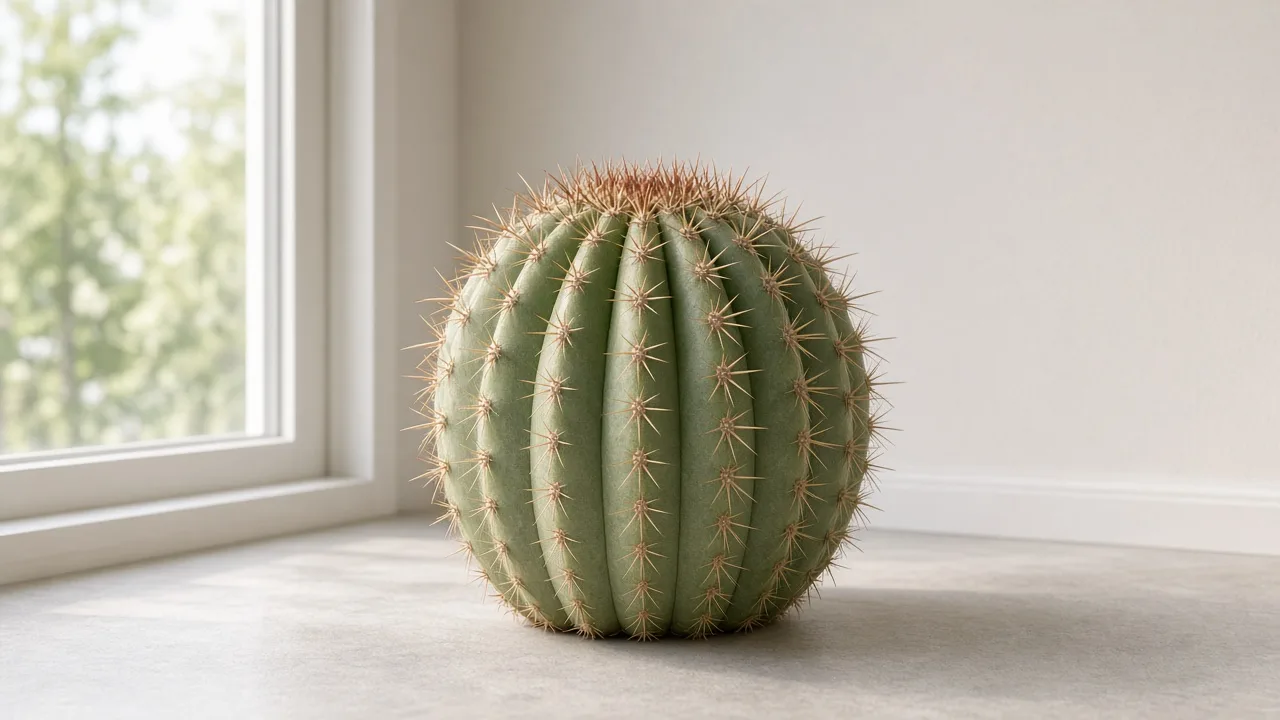
Nitrogen Deficiency on Barrel Cactus: Causes, Checks & Fixes
This guide covers nitrogen deficiency on Barrel Cactus. See also the general Nitrogen Deficiency guide, watering, and light pages for this plant.
Nitrogen Deficiency on Barrel Cactus: Causes, Checks & Fixes
Quick answer
Nitrogen deficiency on barrel cactus (Ferocactus spp.) shows as a dull washed-out green-gray body, thinner-looking lower ribs, stunted crown areole flushes, and slow warm-season growth while the base stays firm. Nitrogen is mobile in plants, so deficiency symptoms show up first on the lower leaves as a general yellowing—on a leafless barrel, that mobile-nutrient pattern translates to even color loss on older lower rib tissue while the crown may stay slightly greener, unlike calcium deficiency (distorted crown spines) or iron deficiency (pale new crown tissue with greener veins).
See our nitrogen deficiency guide for general mobile-nutrient mechanics. On barrel cactus, inspect the lowest mature ribs and spine rows during active summer growth—uniform washout there, with undersized crown areole rings and no flowers on a mature specimen, is classic nitrogen starvation before low-light pale leaves or wet-root failure.
First step: confirm even dull pale color on older lower rib tissue—not crown distortion, interveinal banding, or soft base rot—then check years without complete fertilizer in leached mineral mix.
When to use this page vs other Barrel Cactus guides
| Pattern | Read next |
|---|---|
| Uniform dull pale lower and mid ribs, stunted crown flushes | Nitrogen deficiency (this page) |
| Distorted or corky new crown spines and areoles | Calcium deficiency |
| Yellow between veins on older rib tissue | Magnesium deficiency |
| Pale new crown tissue with greener veins | Iron deficiency |
| Brown scorched skin after sudden sun move | Sunburn |
| Soft base, wet soil, translucent lower ribs | Root rot or overwatering |
| Slight rib contraction and dull skin after long drought | Underwatering |
| No growth for years in a dim room | Not enough light or slow growth |
What nitrogen deficiency looks like on barrel cactus
Healthy Ferocactus carries well-defined ribs covered with sharp spines emerging from areoles, with plump rib tissue in deep green, blue-green, or gray-green tones and new spine clusters forming in a ring at the crown during summer. Nitrogen stress breaks that pattern on older lower rib tissue first, then spreads upward over months as the plant strips chlorophyll from mature skin to fund crown growth.
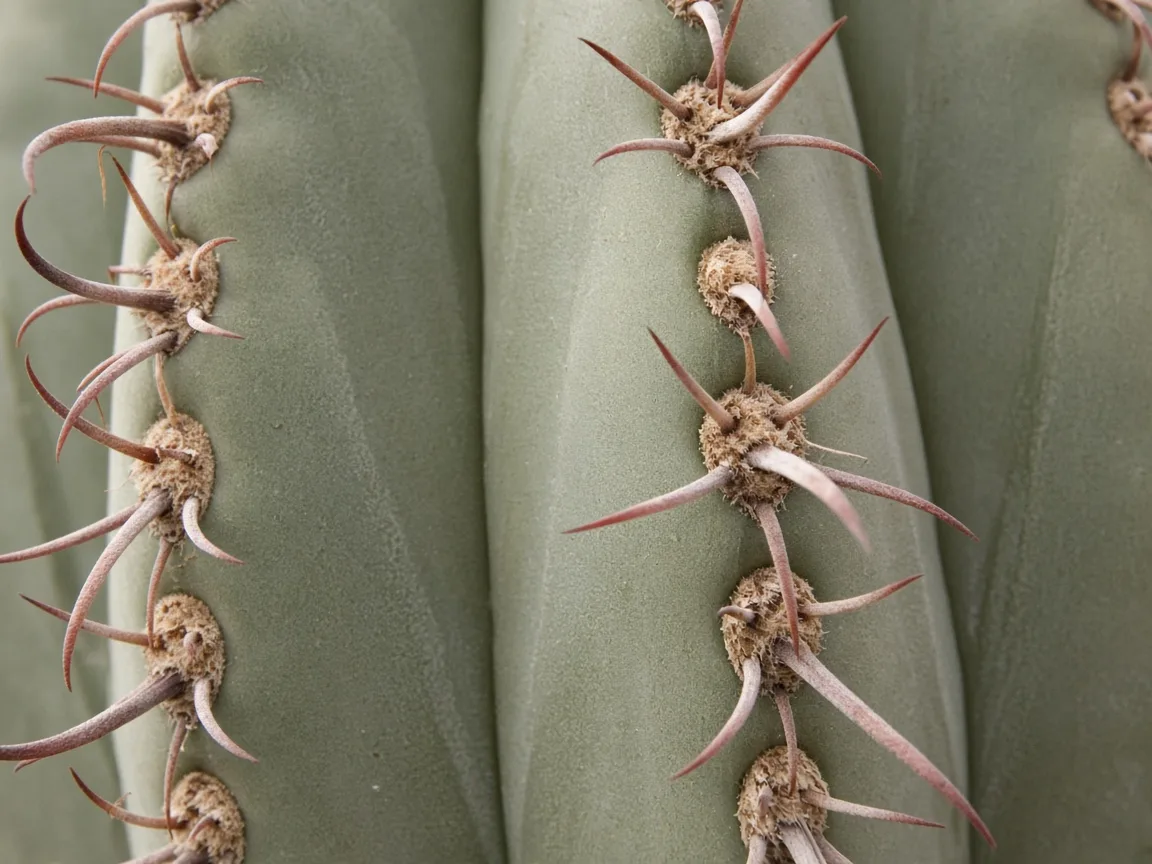
Dull pale green-gray chlorosis on lower Ferocactus rib skin—uniform washout without crown-specific distortion or interveinal banding.
Typical signs:
- Uniform dull pale green-gray on the lowest and mid-barrel ribs—the whole rib surface loses color evenly, not in vein bands
- Progressive washout upward over seasons as nitrogen is pulled from older rib tissue toward the active crown
- Thinner-looking ribs and slightly sunken skin between spine rows on the lower body compared with a healthy plump barrel
- Stunted or undersized crown areole flushes—new spine rings at the top stay small despite warm weather and firm ribs
- No crown flowers on a mature barrel that otherwise receives full sun—NC State notes inadequate sunlight or lack of nutrients can prevent flowering on barrel cactus
- Firm base and ribs with normal dry-down when roots are healthy; soft mushy tissue at soil line suggests overwatering instead
- Crown still slightly greener in early deficiency—the mobile-nutrient pattern mirrors lower-leaf chlorosis on leafy plants
Not nitrogen deficiency:
- Crooked, corky, or distorted new crown spine clusters—calcium deficiency
- Yellow tissue between darker green veins on rib skin—magnesium deficiency
- Pale newest crown areole tissue with greener veins—iron deficiency
- Uniform washed-out color across the whole barrel in a dim room—not enough light before assuming starvation
- Slight rib shrinkage and dull skin after months without any water—underwatering
- Translucent soft lower ribs on persistently wet soil—root rot
UC IPM notes slow growth and uniform yellowing of older leaves as the first symptoms of nitrogen deficiency. On a slow-growing Ferocactus, that pattern is easiest to read on lower mature ribs during warm active months when the barrel should be pushing a new crown areole ring.
Reading lower rib color vs crown areole rings
Barrel cactus has no leaves—so the mobile-nutrient read depends on rib age and position on the barrel body. Nitrogen is retranslocated from older tissue to younger growing points, which on Ferocactus means lower ribs sacrifice chlorophyll first while the crown areole ring still tries to expand.
Walk the barrel from base to crown:
- Lowest mature ribs near the soil line — Uniform dull pale green-gray here with slightly greener tissue higher up fits nitrogen deficiency.
- Mid-barrel ribs — Progressive washout climbing upward over one or two growing seasons confirms ongoing nitrogen hunger.
- Crown areole ring — Still relatively greener in early deficiency; undersized new spine clusters despite warm weather confirm the plant is starving crown growth.
- Spine row pattern — Even color loss across entire rib surfaces differs from localized sun-scorch patches or pest damage between individual spines.
This bottom-up rib read is barrel-cactus-specific because the whole photosynthetic surface is stem skin organized in vertical ribs—the geometry differs from rosette succulents, columnar euphorbs with ridge leaves, or leafy houseplants where you inspect individual blades.
Rib plumpness and dull skin on the barrel body
Healthy indoor Ferocactus ribs look plump and firm, with skin taut between spine rows. Nitrogen supports chlorophyll and protein formation in plant tissue—when reserves run low, ribs can look slightly sunken or thin even before dramatic yellowing appears.
Compare rib depth on the lower third of the barrel against reference photos of the same species at similar size. A barrel that has not gained measurable height or rib expansion for two warm seasons while ribs look progressively flatter and duller often needs nitrogen review—not more water to “plump” the body.
Firm, plump lower ribs with only one slightly lighter rib on an otherwise deep-colored barrel may be normal slow aging. Worry when most lower and mid ribs wash out together during active summer growth and crown flushes stay undersized.
Do not confuse rib shrinkage from long drought with nitrogen deficiency—underwatering causes temporary contraction that resolves after one proper soak-and-dry cycle on firm roots, while nitrogen washout persists through correct watering.
Why barrel cactus gets nitrogen deficiency
Barrel cactus is a slow-growing desert succulent built for rocky, mineral-rich soils and full sun. Nitrogen is found in chlorophyll, amino acids, and proteins—when soil reserves run low, the plant dismantles chlorophyll in older lower rib tissue and redirects nitrogen to the crown areole ring.
Barrel cactus-specific causes:
- Never fed or skipped years — Owners treat Ferocactus as “no fertilizer needed” while a barrel sits in the same pot for multiple seasons. See the barrel cactus fertilizer guide for conservative feeding rhythm.
- Leaching soaks in fast-draining mix — Each thorough watering through gritty cactus mix flushes nitrogen from finite container soil. NC State fertilizing guidance notes nitrogen chlorosis develops when older foliage cannot access enough nitrogen from depleted soil.
- Low-light metabolism — A barrel in a dim room uses less nitrogen and grows slowly, but chronic not enough light can mimic pale washout. Fix light before assuming hunger.
- Depleted mineral mix — Pumice and coarse sand that started airy break down over three to four years. Roots stay alive but nitrogen availability drops until you refresh mix per repotting guidance.
- Root stress blocking uptake — NC State notes overwatering or poor drainage causes rot on barrel cactus, and chronic overwatering limits nitrogen transport regardless of what is in the fertilizer bottle.
- Winter feeding confusion — Harvest to Table recommends feeding Ferocactus during spring and summer active growth and withholding fertilizer during winter dormancy. Fertilizer applied during cool dormancy when metabolism is slow does not fix spring washout and risks salt stress on idle roots.
- Excess phosphorus or potassium without nitrogen — Bloom-focused low-nitrogen cactus formulas help prevent weak growth but, used alone for years on depleted mix, can leave the barrel nitrogen-starved while crown flushes stall.
Summer growth window and feeding rhythm
Ferocactus metabolism tracks heat and light. NC State recommends fertilizing barrel cactus only during the growing season with a product designed for cacti or succulents. Nitrogen correction only works when the plant is actively transpiring and taking up water—feeding a cool dormant barrel in winter does not fix summer rib washout.
When new crown growth resumes in late spring, nitrogen demand spikes at the areole ring. Growers who skipped any complete fertilizer through the prior summer and then wonder why a mature barrel fails to flower often have nitrogen hunger, not a mysterious “refusal to bloom.”
Closing the gap means quarter- to half-strength complete cactus fertilizer once or twice during active growth per the fertilizer guide—not heavy nitrogen to force a wider crown on a dim, stressed specimen.
Dry-skewer leaching in mineral cactus mix
Barrel cactus watering follows a soak-and-dry rhythm—soak thoroughly only after the pot is dry from top to bottom per the watering guide. That discipline keeps roots healthy but continuously leaches soluble nitrogen from container mix.
Before assuming deficiency, run the dry-skewer check through the full pot depth and confirm the base ribs feel firm. Pale ribs on bone-dry mix with slight contraction may be underwatering. Pale ribs on wet mix with a soft base are uptake failure from root rot—adding fertilizer will not help until drainage and dry-down are corrected.
If ribs stay firm, the skewer reads dry on schedule, light is strong, and washout persists after two or more warm seasons without any feed, nitrogen deficiency is likely.
Lookalike symptoms
| Pattern | Check | Likely cause |
|---|---|---|
| Uniform dull pale lower and mid ribs | Even washout, thin ribs | Nitrogen deficiency (this page) |
| Crooked or corky new crown spines | New vs old tissue | Calcium deficiency |
| Interveinal yellow on rib skin | Vein pattern | Magnesium deficiency |
| Pale new crown with green veins | Crown only | Iron deficiency |
| Brown scorched skin patch | Recent sun move | Sunburn |
| Soft base, wet soil | Base firmness | Root rot |
| Rib shrinkage, bone-dry pot | Dry-down history | Underwatering |
| No growth, dim room, etiolation | Light level | Not enough light |
How to confirm
- Older vs newer rib tissue — Even dull pale color on lowest mature ribs with greener crown tissue in early stages strongly suggests nitrogen.
- Base health — Firm ribs and dry skewer through the pot vs soft mushy tissue at soil line.
- Feeding history — Years without any complete cactus fertilizer in the same leached mineral mix.
- Light intensity — Full sun or strong grow light so the plant can use nitrogen for crown growth per the light guide.
- Watering rhythm — Consistent dry-down cycles vs chronic wet soil blocking uptake.
- Crown flush size — Two or more undersized areole rings in a row on stable summer care points to starvation, not one cool-season pause.
- Flowering — Mature size, firm ribs, full sun, and no crown blooms for multiple summers despite prior flowering fits chronic nitrogen hunger.
- Season — Symptoms appearing during warm active growth with a firm base fit deficiency better than winter shrinkage alone.
First fix for barrel cactus
One quarter- to half-strength dose of complete cactus fertilizer on already-moist mix after a normal dry-down watering—only after confirming firm ribs, full sun or strong grow light, warm active growth, and no soft base rot.
Do not repot, relocate to blazing sun, and triple-feed a recently moved barrel cactus the same week. Stabilize watering per the barrel cactus watering guide first—dry skewer through the full pot depth before the next soak, empty cachepot standing water after each watering.
If light is weak, move gradually into stronger exposure per the light guide before feeding—a pale barrel in a dim room may need photons more than nitrogen.
Step-by-step recovery
- Rule out rot by feeling the base and checking soil moisture—treat confirmed root rot before fertilizer.
- Move gradually into stronger light if not enough light is slowing metabolism and mimicking washout.
- Apply quarter- to half-strength complete cactus feed once on moist mix during active growth; repeat once more at four to six weeks if the next crown flush responds per the fertilizer guide.
- Maintain consistent dry-down cycles—uptake fails when roots alternate between saturated and desiccated in heavy decorative pots.
- Repot into fresh mineral cactus mix if roots fill the pot and rib washout persists after two measured feeds on firm ribs—see barrel cactus repotting.
- Monitor the next one or two crown areole flushes—dull lower rib skin rarely re-greens; recovery shows on plumper new spine rings and deeper crown color.
- Flush white salt crust at the pot rim before resuming feeding if buildup blocks uptake.
Recovery timeline
Dull lower rib tissue rarely returns to deep blue-green or bright green once chlorophyll is stripped on slow-growing cactus skin. The next one or two crown areole flushes after corrected complete feeding, stronger light, and stable watering usually look plumper and greener within one to two growing seasons on a firm barrel—much slower than fast-growing succulents because Ferocactus adds only millimeters of height per year indoors.
Severe base damage from chronic overwatering may delay recovery a full growing season or more. If successive crown flushes stay stunted despite complete feed and stable summer care, inspect roots for rot before repeating fertilizer or repotting again.
Mistakes to avoid
- Do not confuse low-light washout with nitrogen hunger—review light before feeding a dim barrel.
- Do not heavy-feed a barrel cactus on wet soil or during cool winter dormancy.
- Do not expect dull lower rib skin to re-green—judge the next crown areole flush.
- Do not stack repotting, sun relocation, and full-strength feed the same week on a stressed plant.
- Do not skip feeding for years then dump concentrated bloom fertilizer on a pale specimen—that path leads to salt burn, not faster crown recovery.
- Do not use high-nitrogen houseplant fertilizer on desert cactus—weak elongated growth and salt stress follow.
Prevention
- Feed lightly with diluted complete cactus fertilizer during active warm-season growth per the barrel cactus fertilizer guide—NC State recommends cactus-specific fertilizer only during the growing season.
- Refresh depleted mineral mix every three to four years when roots crowd the pot.
- Maintain consistent dry-down rhythm per the watering guide.
- Keep the plant in full sun or strong supplemental light so metabolism uses applied nitrogen.
- Inspect lower ribs monthly during late spring and summer—early washout is easier to correct than a permanently thin pale barrel.
- Pause all fertilizer during cool winter rest and resume only when new crown growth returns.
Related Barrel Cactus guides
- Barrel Cactus overview
- Barrel Cactus fertilizer
- Barrel Cactus watering
- Barrel Cactus light
- Barrel Cactus soil
- Pale leaves
- Slow growth
- Barrel Cactus problems hub
- All plant symptoms
Conclusion
A dull washed-out barrel body with thin-looking lower ribs and stunted crown areole flushes points to nitrogen starvation in leached container mix—confirm the even lower-rib washout pattern, rule out soft base rot and low light, stabilize dry-down watering and rib firmness, apply one measured complete cactus feed during warm active growth, and judge recovery by the next crown spine ring.
Related tool
Use the Fertilizer Dilution Calculator to narrow causes for nitrogen deficiency on this plant before changing multiple variables at once.