Yellow Leaves on Betel Leaf: Wet Roots, Nutrients & Pattern
Quick answer
Yellow leaves on Betel Leaf (*Piper betle*) usually show on the lowest heart-shaped blades first when roots sit wet in shade, or on new tip leaves when iron or light fails—rarely as random spots. First step: note whether yellowing is on basal old leaves, the growing tip, or the whole vine on a heavy wet pot before you change watering or feed.
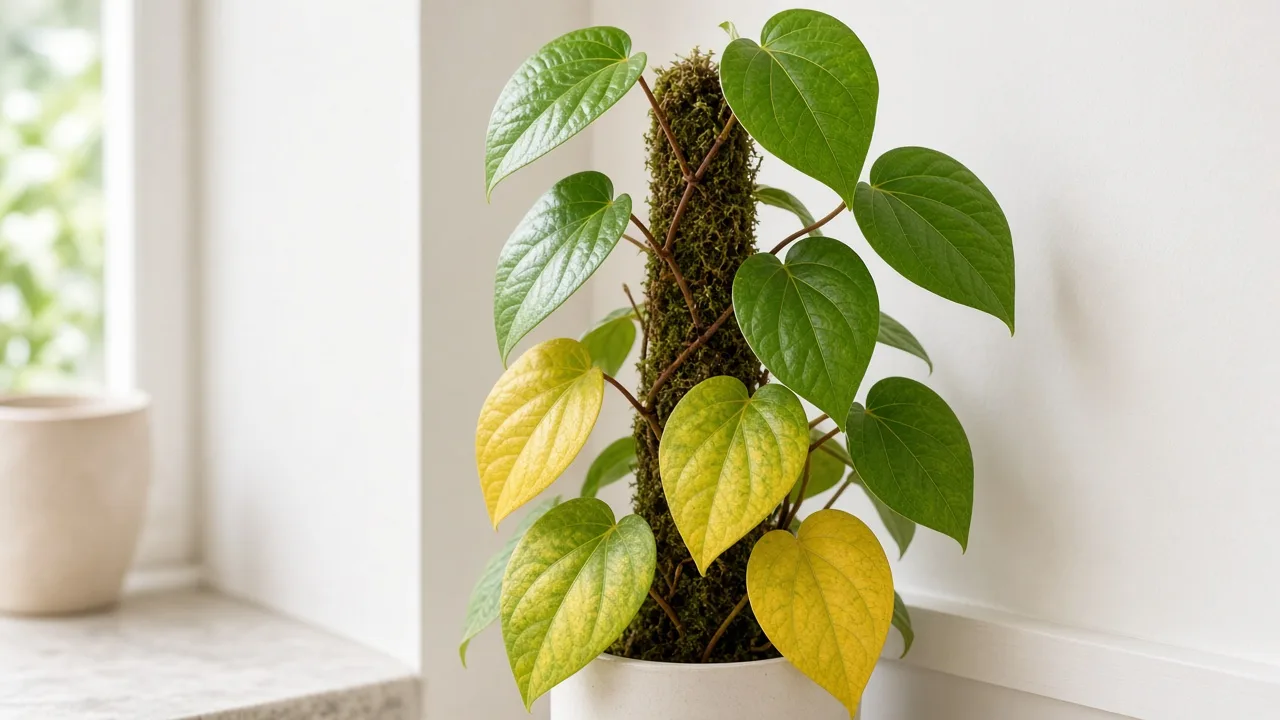
Yellow Leaves on Betel Leaf: Causes, Checks & Fixes
This guide covers yellow leaves on Betel Leaf. See also the general Yellow Leaves guide, watering, and light pages for this plant.
Yellow Leaves on Betel Leaf: Causes, Checks & Fixes
Quick answer
Yellow leaves on Betel Leaf (Piper betle, the paan vine) are a pattern symptom, not one disease. Healthy plants hold glossy heart-shaped green blades on a climbing stem; yellowing tells you where the vine is failing—basal old leaves on wet mix, new tip leaves in dim rooms, or the whole canopy when roots or nutrients collapse.
For how yellow foliage works on houseplants in general, see our yellow leaves guide. On Betel Leaf, the first fork is blade position: lowest hearts on a heavy wet pot (root stress), oldest leaves fading evenly in a leached container (nitrogen deficiency), or yellow new growth with green veins (iron deficiency).
First step: compare one yellow leaf at the basal coil near the pot with the newest heart at the climbing tip—then probe the top 2–5 cm of mix and press the collar at the soil line. Do not fertilize until you know which pattern you have.
When to use this page vs other Betel Leaf guides
| What you see | Read next |
|---|---|
| Yellow lowest leaves on heavy wet mix, limp petioles | Overwatering |
| Soft collar, sour smell, mushy roots | Root rot |
| Uniform yellow on oldest basal leaves, firm stems | Nitrogen deficiency |
| Yellow new leaves, green veins | Iron deficiency |
| Yellow between veins on old leaves | Magnesium deficiency |
| Washed-out green before clear yellow | Pale leaves |
| Long internodes, pale new growth in a dim corner | Not enough light |
| Yellow with brown scorched edges | Potassium deficiency |
What yellow leaves look like on Betel Leaf
Betel foliage is large, thin, heart-shaped, and glossy when healthy, with a reddish petiole. Yellowing rarely appears as a random middle-leaf spot; it follows vine architecture and care mistakes this species repeats indoors.
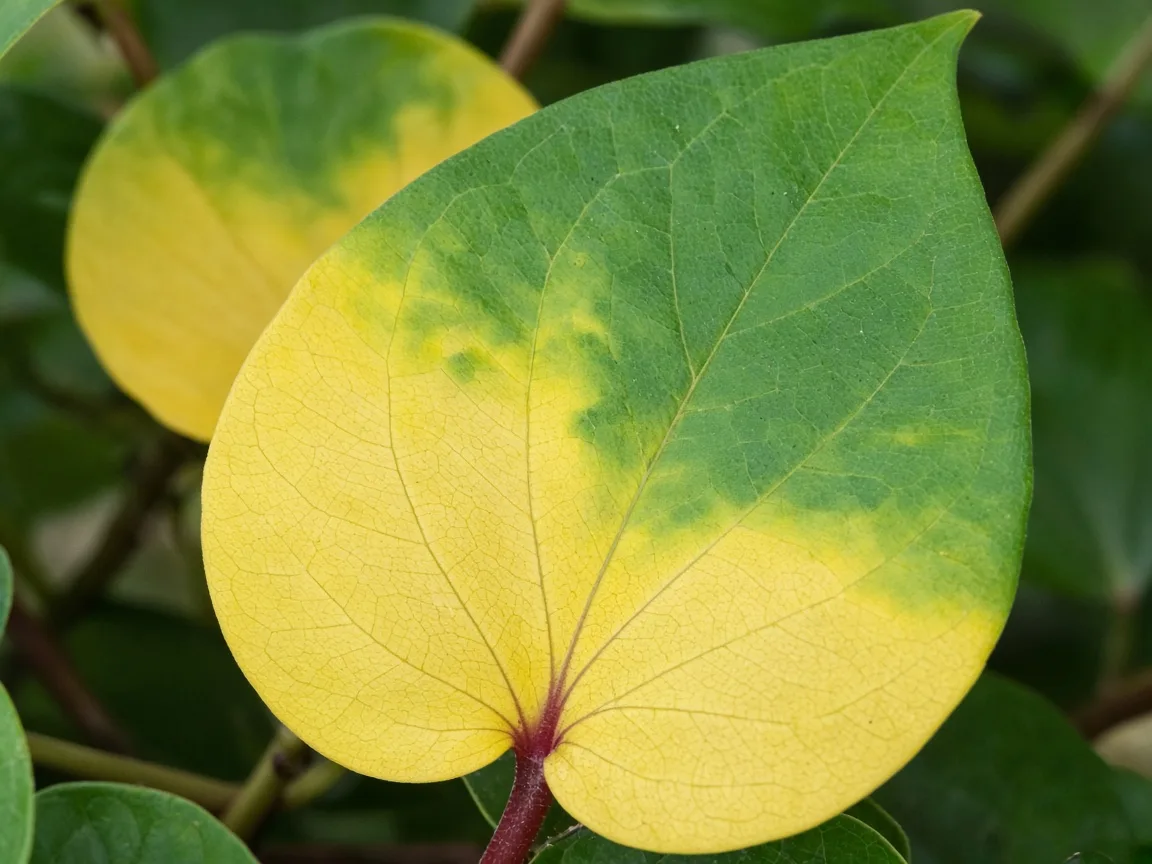
Yellowing from the petiole upward on a basal heart-shaped betel leaf—compare with the greener tip leaf on the same runner before you change watering.
Wet-root yellow (most common indoors):
- Lowest heart-shaped leaves turn yellow-green, then full yellow, while soil stays damp for many days
- Petioles stay limp; blades may look glossy but hang at a sharper angle
- Pot feels heavy when lifted; drainage holes may smell sour on organic mix
- Matches chronic wet mix reducing root function on a shade-loving vine that still needs drainage
Nitrogen yellow:
- Oldest leaves along the basal section of vine yellow evenly—veins and tissue fade together
- Yellow creeps upward over weeks; new tip leaves may stay greener but emerge smaller
- Nitrogen is mobile; deficiency shows on lower leaves first
- Roots firm; mix moisture rhythm otherwise normal—see nitrogen deficiency
Iron / pH yellow:
- Youngest hearts at the tip show yellow between green veins (interveinal chlorosis)
- Often follows months of alkaline tap water; betelvine does not tolerate alkaline soils
- Route to iron deficiency and review soil pH targets
Light-stress yellow:
- New growth yellows or stays chartreuse while lower leaves still look green
- Internodes stretch; vine leans toward glass—overlap not enough light and leggy growth
Normal basal turnover:
- One or two fully yellow hearts at the very bottom of an old runner, rest of vine glossy
- Common after a year on the same pole when field growers would lower and rejuvenate vines
Urgent collapse:
- Several leaves yellow within days, collar soft on wet mix—overlap Phytophthora wilt management on betelvine and root rot
Why Betel Leaf yellows in shaded pots
Piper betle is grown in cool humid shade with steady soil moisture in the field—regular moisture is essential. Container growers often copy “tropical = water often” without copying drainage trenches and airflow between beds. In a dim indoor corner, a peat-heavy pot dries slowly while the label still says water every few days.
That mismatch produces oxygen-starved roots even though leaves look thirsty. The vine sheds chlorophyll on lower leaves first because mobile nutrients and water move toward the growing tip—exactly the lower-leaf yellowing pattern extension services describe on overwatered plants.
Betel also does not tolerate saline or alkaline conditions in cultivation. Hard tap water plus depleted organic mix can yellow new leaves while roots still feel firm—different first fix than wet soil.
Reading yellow along the coiled basal vine
Field betel culture lowers long vines so fresh shoots sprout from nodes at ground level. Indoor vines on a short moss pole mimic the old basal section: leaves that spent months shaded by their own canopy yellow while the tip still climbs.
Use this betel-specific read:
- Yellow only on the lowest 30–60 cm of stem, tip still green → often light starvation on old tissue, nitrogen redistribution, or normal turnover—not automatic root death
- Yellow climbing steadily up the vine on firm stems in warm weather → nitrogen or magnesium—check months without feed
- Yellow lowers + wet mix + limp petioles → root stress—pause water before any feed
- Yellow at tip with green veins → iron/pH—do not dump nitrogen urea on the problem
If lower yellow leaves sit on coiled vine piled at the pot rim, gently lift the coil and check whether those nodes sit in stagnant moisture against the container edge—a common cachepot mistake on adventitious-rooting Piper vines.
Collar checks before you treat leaves
On betel, the collar—where the main stem meets the mix—is where Phytophthora wilt and root rot start on chronically wet organic soil. Leaves can stay partly green while the base fails.
First fix when lowers are yellow on wet mix: stop watering and press the collar with a clean finger. Firm corky tissue means move to dry-down and airflow per overwatering. Soft, dark, or water-soaked collar on damp mix means unpot the same day—see root rot. Do not spray leaves or fertilize until collar and moisture logic are clear.
Adventitious roots at buried nodes should look white and firm when you peek at the soil surface. Brown mush at nodes plus yellow hearts confirms root-zone failure, not a leaf spray deficiency.
How to confirm the cause
Work in this order so you change one variable at a time:
- Moisture: finger 2–5 cm deep; lift pot weight; sniff drain holes
- Collar: firm vs soft at soil line on wet vs dry mix
- Leaf age: basal oldest vs newest tip on the same runner
- Vein pattern: uniform fade vs interveinal yellow on new leaves
- Light: distance to bright filtered window; recent move from shade to scorch or vice versa
- Feed history: months in same leached compost without fertilizer in warm months
| Pattern | Most likely cause | First action |
|---|---|---|
| Yellow lowers, wet heavy pot, limp | Overwatering / root stress | Stop watering; collar check |
| Soft collar, sour wet mix | Root rot / Phytophthora risk | Unpot; trim mush; dry-down |
| Even yellow oldest leaves, firm stem | Nitrogen deficiency | Confirm warm active growth; measured feed |
| Yellow new leaves, green veins | Iron / alkaline water | Adjust water; chelated iron if confirmed |
| Yellow new growth, long internodes | Low light | Improve placement per light guide |
| One–two yellow bottom leaves only | Senescence / basal shade | Rejuvenate or accept; watch tip growth |
Step-by-step recovery
After your one first fix from the table:
Wet-root path: Let the top 2–5 cm dry before the next soak; empty saucers; improve airflow around the shaded pot. Judge success by firmer petioles and no new yellow blades within two weeks—not by old leaves re-greening.
Nutrient path: Only feed when roots are firm and mix is moist not soggy. Container plants lose nutrients to leaching—betel’s fast leafy growth in humid heat burns through nitrogen in small pots. One half-strength balanced feed after a proper dry-down beats repeated strong doses on stressed roots.
Iron path: Flush with lower-pH water; avoid chalky tap on acid-leaning mix. Correct new leaf colour over the next two node flushes, not overnight.
Light path: Move to bright filtered exposure—east window, dappled balcony, or sheer curtain—not midday scorch on thin hearts.
Rejuvenation path: When basal yellow is mostly old shaded tissue, trim back the coiled basal section to a firm node after the growing season, give the vine fresh support, and let tillers sprout the way lowering does in field culture—irrigate only after you see new shoot growth if you cut hard.
Recovery timeline
- Overwatering pause: limp yellow lowers often stabilize in 7–14 days if collar stays firm; new tip growth in 2–4 weeks
- Nitrogen feed: next two heart-shaped leaves at the tip should look larger and deeper green within 3–6 weeks in warm humid growth
- Iron correction: interveinal yellow on new leaves fades on subsequent flushes, not on blades already fully yellow
- Collar rot: weeks to months if salvageable; yellow leaves are the late signal—collar decides save vs cutting
Mistakes to avoid
- Fertilizing yellow vines on wet mix—salts stress roots that already lack oxygen
- Repotting, pruning, and pesticide on the same day—pick the dominant issue first
- Treating all yellow as nitrogen hunger—tip pattern with green veins is iron, not urea
- Ignoring the collar because upper leaves still look green
- Calendar watering in winter when TNAU warns against frequent irrigation when evaporation is slow
How to prevent yellow leaves
Align with betel’s rhythm: bright filtered light, even moisture via the 2–5 cm check per watering, 60–80% humidity, fertile soil with drainage, and light feeding in warm months. Extend trellis height before basal leaves live in permanent shade. Use rainwater or filtered water if tip leaves repeatedly show iron-type yellow. Inspect collar and drain holes when you see fungus gnats at the rim—a early wet-mix clue.
Related Betel Leaf guides
- Overview — paan vine habit and placement
- Problems hub — full symptom index
- Watering — dry-down rhythm after yellow lowers on wet mix
- Light — semi-shade vs scorch for heart-shaped leaves
- Fertilizer — when to feed without burning stressed roots
Related tool
Use the Plant Problem Diagnosis Tool to narrow causes for yellow leaves on this plant before changing multiple variables at once.