Overwatering on Betel Leaf: Causes, Checks & Fixes
Quick answer
Overwatering on Betel Leaf means the root zone stays saturated longer than this shade-loving Piper vine can handle—common in dim rooms, cachepots, or winter calendar watering. First step: stop watering, probe the top 2–5 cm, lift the pot, and feel the collar at the soil line before you add another soak.
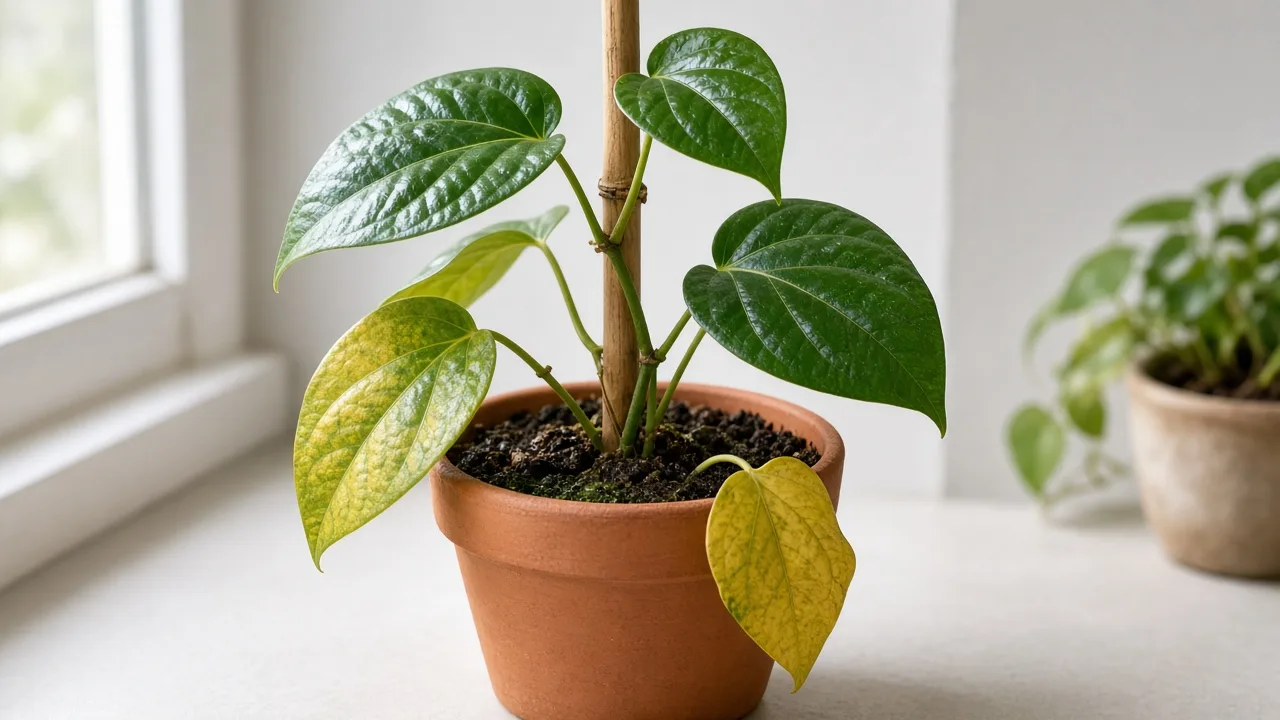
Overwatering on Betel Leaf: Causes, Checks & Fixes
This guide covers overwatering on Betel Leaf. See also the general Overwatering guide, watering, and light pages for this plant.
Overwatering on Betel Leaf: Causes, Checks & Fixes
Quick answer
Overwatering on Piper betle is not “this tropical vine loves water, so more is safer.” Betel Leaf wants regular soil moisture with drainage—but when the mix stays saturated in a shaded pot, roots lose oxygen and fail to move water upward. Heart-shaped paan leaves then hang limp while soil still feels wet, which owners often misread as thirst.
For how chronic wet mix damages roots in general, see our overwatering guide. On Betel Leaf, watch for a heavy cool pot under shade cloth, yellowing lower leaves on dark damp mix, fungus gnats at the rim, a sour smell at drain holes, and soft tissue at the collar where the vine meets the soil.
First step: stop watering and probe the top 2–5 cm while you lift the pot. If that layer is still cool and clinging, do not add water—move to collar checks and airflow before any soak.
When to use this page vs other Betel Leaf guides
- Drooping leaves — limp heart-shaped foliage from many causes; this page focuses on chronic wet mix and root-zone oxygen loss
- Wilting — rapid whole-vine collapse; use when turgor drops fast after cold nights or collar failure
- Underwatering — light pot, dry top 2–5 cm, dull firm leaves
- Root rot — mushy roots, advanced collar rot, salvage decisions
- Fungus gnats — flies at the pot rim when surface mix never dries
- Watering guide — long-term top-layer dry-down rhythm after the pot stabilizes
What overwatering looks like on Betel Leaf
On a healthy paan vine, glossy heart-shaped leaves hold a firm angle along climbing stems on a trellis or moss pole. Overwatering changes the lower canopy first, then the collar, while the mix stays wet.
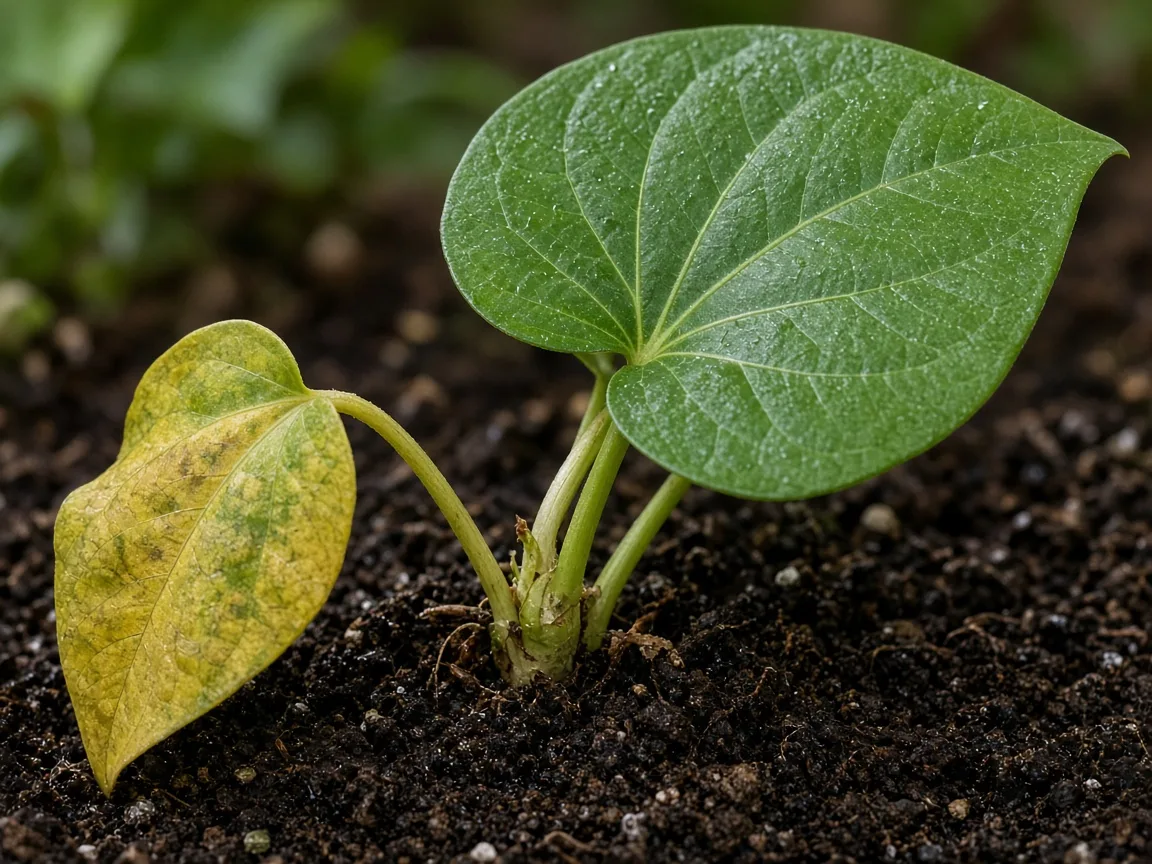
Overwatering on Betel Leaf—yellowing lower heart-shaped leaves and a dark damp soil surface while the petioles stay limp, not crisp from drought.
Early wet-soil stress shows dulling gloss on bottom leaves, slight yellowing at the leaf base, and limp petioles even though you watered recently. The pot feels heavy. Surface mix stays dark. You may notice small flies hovering at the pot rim where organic matter stays constantly moist.
Established overwatering brings clear yellow lower leaves, soft limp blades that do not recover after a day, and slowed new internode extension at the tip. Adventitious roots at buried nodes may brown. The collar—the stem base where the vine enters the mix—can feel spongy if rot is advancing.
Severe collar involvement overlaps field Phytophthora wilt on betelvine. TNAU lists integrated management for Phytophthora wilt, including avoiding frequent irrigation during winter. Home pots see the same anatomy: sudden lean, dark water-soaked collar tissue, and vine collapse while mix remains wet—route to root rot if roots are mushy.
What overwatering is not: crispy brown tips on a light dry pot (underwatering or low humidity); stippling with webbing (spider mites); greasy black leaf patches on wet foliage (black spots / Phytophthora leaf issues).
Why Betel Leaf is easy to overwater at home
Piper betle is a shade-loving climber that prefers moist, fertile, well-drained soil—not a succulent on a windowsill. Waterlogged, saline, and alkaline soils are unsuitable for cultivation. That combination confuses owners: the plant needs moisture, but only with oxygen at the roots.
Betelvine fields rely on drainage trenches between beds and careful irrigation timing. Container growers often skip that engineering—a peat-heavy nursery pot in filtered indoor shade can hold water for two weeks while labels still say “water every few days.”
Common setup mistakes on this species:
| Mistake | Why it hurts Betel Leaf |
|---|---|
| Calendar watering in a cool shaded room | Low transpiration keeps mix wet; roots suffocate |
| Decorative cachepot without draining runoff | Collar sits in stale water after every soak |
| Oversized pot “for growth” | Large wet reservoir around a small root ball |
| Daily moss-pole misting + frequent soil watering | Nodes and collar stay anaerobic while leaves look lush |
| Winter watering at summer frequency | TNAU warns against frequent irrigation in winter when evaporation is slow |
The shaded-pot evaporation trap
Betel Leaf belongs on an east balcony, under 40–50% shade cloth, or behind a sheer curtain—not in harsh midday sun. The trap is evaporation speed. In AC-cooled dim corners, a dense organic mix dries slowly even though the vine looks “tropical” and seems to want constant water.
Signs you are in the trap:
- Mix stays dark and cool while lower leaves yellow
- Pot weight barely changes between waterings
- Fungus gnats breed at the surface
- New tip growth stalls while older leaves droop
The fix is not blasting the vine with midday sun—it is matching water to how slowly this pot dries. Review the Betel Leaf watering guide for the top 2–5 cm dry-down check and pot-weight habit.
Reading the collar and adventitious roots
Field betelvine management focuses on the stem base because wilt and collar rot start where vines meet wet soil. Before you water a yellowing paan vine:
- Press the collar gently where the stem enters the mix. Firm tissue with yellow lowers is more recoverable than a soft, dark, collapsing base.
- Inspect adventitious roots on the moss pole or stake. Healthy aerial roots look pale and firm. Mushy brown roots at the soil line or on a constantly wet moss wrap signal trouble.
- Sniff drain holes. Soil too long without oxygen often smells sour or rotten—a strong cue to stop watering and inspect roots.
If the collar is firm and only lower leaves yellow, you are likely in early overwatering. If the collar is soft, treat overlap with root rot immediately.
Moss-pole and node moisture traps
Supported Betel Leaf often climbs a bamboo stake, trellis, or moss pole. Owners mist poles daily for humidity while also watering soil on schedule—a double wet zone at buried nodes.
Symptoms of a pole trap:
- Limp leaves on otherwise moist mix
- Brown mushy nodes where stems touch wet moss at the pot rim
- Algae or constant dampness on wrap at the collar height
Correction: Let the top 2–5 cm dry before the next soil soak, reduce pole soaking until the collar zone dries, and improve airflow at the pot mouth. See soil if the blend stays waterlogged despite careful watering.
How to confirm overwatering (not thirst or rot alone)
Work through these checks in order:
- Finger test at 2–5 cm depth — Cool, clinging soil days after watering confirms excess moisture; dusty dry crumbs point to underwatering.
- Pot weight — Heavy container + limp yellow lowers = wet-root stress; light pot + dull leaves = dry stress.
- Collar firmness — Soft collar on wet mix = escalate beyond this page.
- New growth — Absent or soft tip leaves on wet soil supports overwatering; firm new glossy leaves after a measured soak supports thirst correction.
- Pests and disease — Rule out curling leaves from mites when stippling appears; rule out brown leaves from sun scorch when only exposed blades burn.
| Pattern | Mix at 2–5 cm | Pot weight | Likely cause |
|---|---|---|---|
| Yellow lower leaves, limp gloss | Cool, damp | Heavy | Overwatering / early root stress |
| Limp leaves, dull color | Dry, crumbly | Light | Underwatering |
| Fast collapse, soft collar | Wet | Heavy | Root rot / Phytophthora |
| Tip burn, firm leaves | Evenly moist | Medium | Low humidity, not overwatering |
The first fix to try
Stop watering until the top 2–5 cm pass a dry finger test—then only water if the collar is still firm and the pot is not already saturated at depth.
That single pause prevents the classic mistake: pouring water because paan leaves look limp while roots are already failing in wet organic soil. Wilting with moist soil often means damaged roots cannot take up water—not a call for another soak.
After the pause, if the top layer dries and the collar stays firm:
- Move the pot slightly brighter filtered light or add airflow (fan, open balcony) so evaporation matches your watering habit—not full harsh sun.
- Empty saucers and cachepots; never let the root ball sit in standing runoff.
- Set folded paper towels under drain holes for a few hours if the mix is sodden at mid-depth (wick excess without repotting on day one).
Do not fertilize, repot, or hard-prune the whole vine on the same day you discover wet-root stress.
Step-by-step recovery
Mild overwatering (firm collar, yellow lowers only)
- Let the top 2–5 cm dry fully; water once thoroughly until runoff, then discard runoff within 30 minutes.
- Remove yellowed lower leaves only if they are mushy or invite gnats—cosmetic yellow may remain.
- Resume the watering rhythm when the top layer dries again, not on a fixed calendar.
Moderate stress (persistent gnats, sour smell, slow tip growth)
- Complete the dry-down above.
- Loosen the top 1–2 cm of compacted wet crust with a fork—do not disturb deep roots if the collar is still firm.
- Address fungus gnats with surface drying and traps; larvae need moist organic debris.
- If mix stays wet longer than a week in shade, plan a repot into airier blend after the vine stabilizes—not while collapsing.
Severe collar softening
Skip gentle dry-down alone. Inspect roots, trim mushy tissue, repot into fresh well-drained mix, and consider tip propagation from healthy nodes above the rot line. Periodically waterlogged soils favor Phytophthora root diseases—sterile tools and discarded old mix reduce spread.
Recovery timeline
| Stage | What improvement looks like | Typical timeframe |
|---|---|---|
| Early wet stress | Yellowing stops spreading; top 2–5 cm dry on schedule | 3–10 days after corrected watering |
| Root rebound | New glossy tip leaves; firm collar | 2–4 weeks in warm humid shade |
| Collar rot involved | Little new firm growth from tip | Weeks to not recoverable—see root rot page |
Lower yellow leaves rarely return to deep green. Judge success by new heart-shaped flush at the growing tip and a collar that stays firm when you press it.
Lookalike symptoms on Betel Leaf
| What you see | Wet or dry? | Next page |
|---|---|---|
| Limp leaves, heavy pot, yellow lowers | Wet | This page |
| Limp leaves, light pot, dry crumbs | Dry | Underwatering |
| Whole-vine flop after cold night | Variable | Wilting |
| Crispy brown tips, firm blades | Often moist mix | Brown tips / humidity |
| Greasy brown leaf patches | Wet foliage + wet soil | Black spots |
What not to do
- Watering because heart-shaped leaves look limp when the top 2–5 cm are still damp—the fastest path to root rot on shaded Betel Leaf.
- Moving a wet, yellowing vine to a darker corner “to rest”—low light slows evaporation further.
- Fertilizing to “green up” yellow leaves while roots are oxygen-starved.
- Repotting into an even larger decorative pot without fixing drainage.
- Soaking a moss pole daily while the soil profile never dries at the collar.
How to prevent overwatering next time
Water when the top 2–5 cm feel dry, then drain fully. In cool winter rooms, stretch the interval; on hot windy balconies, shorten it. Use the soil mix Betel Leaf needs—fertile loam with perlite or coarse sand, not heavy garden clay in an oversized tub.
Place the vine in bright filtered shade with humidity so leaves transpire without a permanently soggy root zone in a dim corner. Empty cachepots after monsoon storms. When field guidance says to avoid frequent winter irrigation, apply the same logic to indoor pots that dry slowly.
When to worry
Escalate immediately if:
- The collar softens or smells sour while mix stays wet
- Yellowing climbs rapidly up the vine
- Stems collapse at the soil line after cool wet weather
- Most roots are brown and mushy on inspection
If the collar has collapsed, focus on healthy tip cuttings rather than saving the original specimen.
Betel Leaf care cross-check
- Watering — Calendar watering in shade is the top cause; use pot weight + finger depth.
- Pot and cachepot — Standing runoff is a silent overwatering machine.
- Light — Very dim corners slow drying; see overview.
- Support — Wet moss at nodes mimics soil overwatering at the collar.
- Problems hub — Browse all Betel Leaf problems if symptoms mix.
Related Betel Leaf guides
- Betel Leaf overview — placement, humidity, and growth habit for the paan vine
- Betel Leaf watering — top 2–5 cm dry-down and soak-drain routine
- Betel Leaf soil — drainage and organic mix when pots stay wet too long
- Drooping leaves — limp foliage with wet-vs-dry routing
- Root rot — mushy roots and collar salvage
- Fungus gnats — flies when surface mix never dries
- Yellow leaves — nutrient and stress patterns beyond wet soil
- Betel Leaf problems — full problem list for this species
Conclusion
Overwatering on Betel Leaf is a timing and drainage problem on a moisture-loving shade vine, not proof the plant hates water. Stop the next soak when the top 2–5 cm are still damp, confirm the collar is firm, and match irrigation to how slowly your shaded pot actually dries. Recovery shows up in new glossy heart-shaped leaves at the tip—not in every yellow lower blade turning green overnight.
Related tool
Use the Root Rot Risk Checker to narrow causes for overwatering on this plant before changing multiple variables at once.