Low Humidity on Betel Leaf: Paan Vine RH Checks
Quick answer
Low humidity on Betel Leaf shows as crispy brown margins on thin glossy paan-vine leaves while soil may still feel moist. First step: hang a hygrometer within 30 cm of the canopy and move the pot out of AC or heater airflow before you change watering.
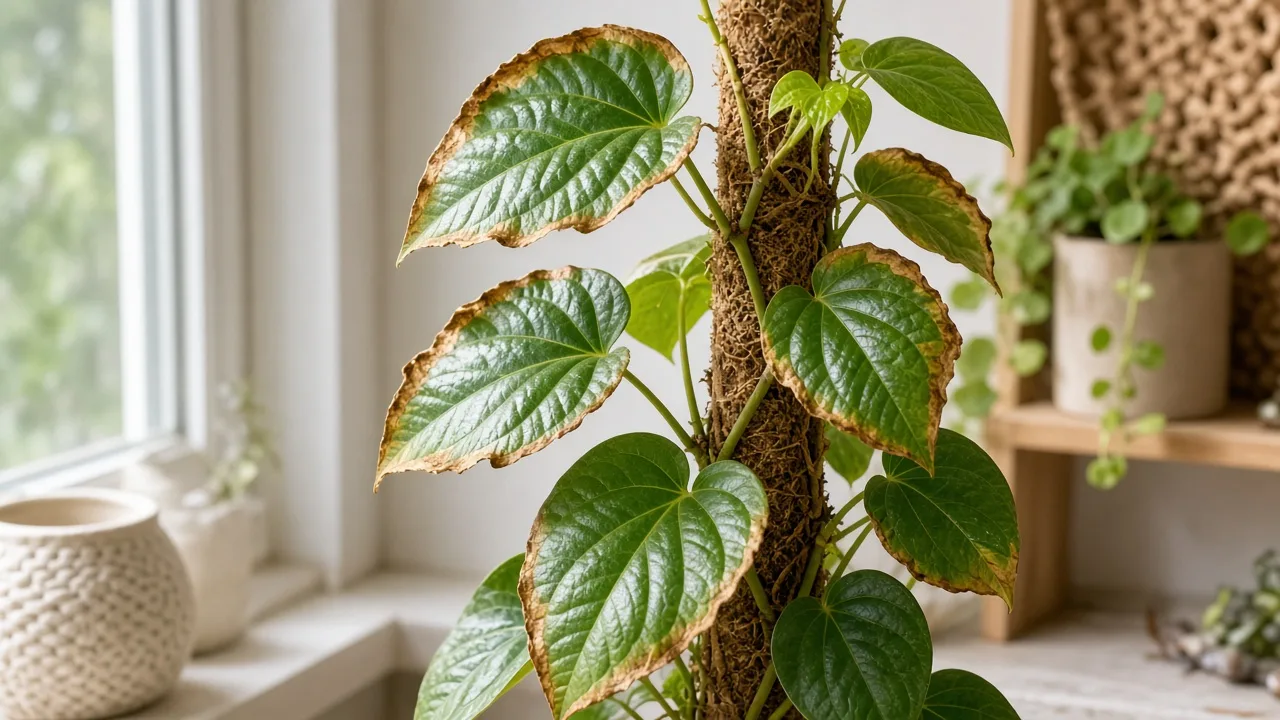
Low Humidity on Betel Leaf: Causes, Checks & Fixes
This guide covers low humidity on Betel Leaf. See also the general Low Humidity guide, watering, and light pages for this plant.
Low Humidity on Betel Leaf: Causes, Checks & Fixes
Quick answer
Low humidity on Betel Leaf (Piper betle, paan vine) means indoor air is drier than this shade-loving tropical climber evolved for. For how dry air crisp leaf edges on houseplants in general, see our low humidity hub. On a paan vine, the first damage is usually papery brown margins on thin, glossy heart-shaped blades—often while the finger test at 2–5 cm still reads appropriately moist, not bone-dry.
Cultivation references describe betel as a plant of humid tropical climates that prefers moist, well-drained soil in shade. TNAU betelvine guidance stresses a cool humid climate with considerable humidity and a regular supply of moisture in well-drained soil. Apartments with AC, winter heat, or a pot on a sunny, dry windowsill routinely fall short of that.
First step: hang a hygrometer within 30 cm of the climbing canopy and move the pot out of direct AC or heater airflow. Read RH for 24 hours before you water more, mist constantly, or repot.
When to use this page vs other Betel Leaf guides
| Pattern | Read next |
|---|---|
| Narrow tan band at tips only | Brown tips |
| Light pot, dusty-dry upper mix, limp dull leaves | Underwatering |
| Yellow leaves, heavy wet pot, soft collar | Overwatering or root rot |
| Bleached or crisp sun-facing side after a move | Light / scorch |
| Stippling, webbing, dusty undersides | Spider mites |
| Upward curl on new blades without pests | Curling leaves |
What low humidity looks like on Betel Leaf
Unlike thick succulents, Piper betle carries thin, aromatic, heart-shaped leaves on a fast-climbing vine. The wavy margin is the farthest tissue from the roots, so it desiccates first when relative humidity (RH) drops—the same scorch mechanism MOBOT describes when foliage loses water faster than roots can replace it.
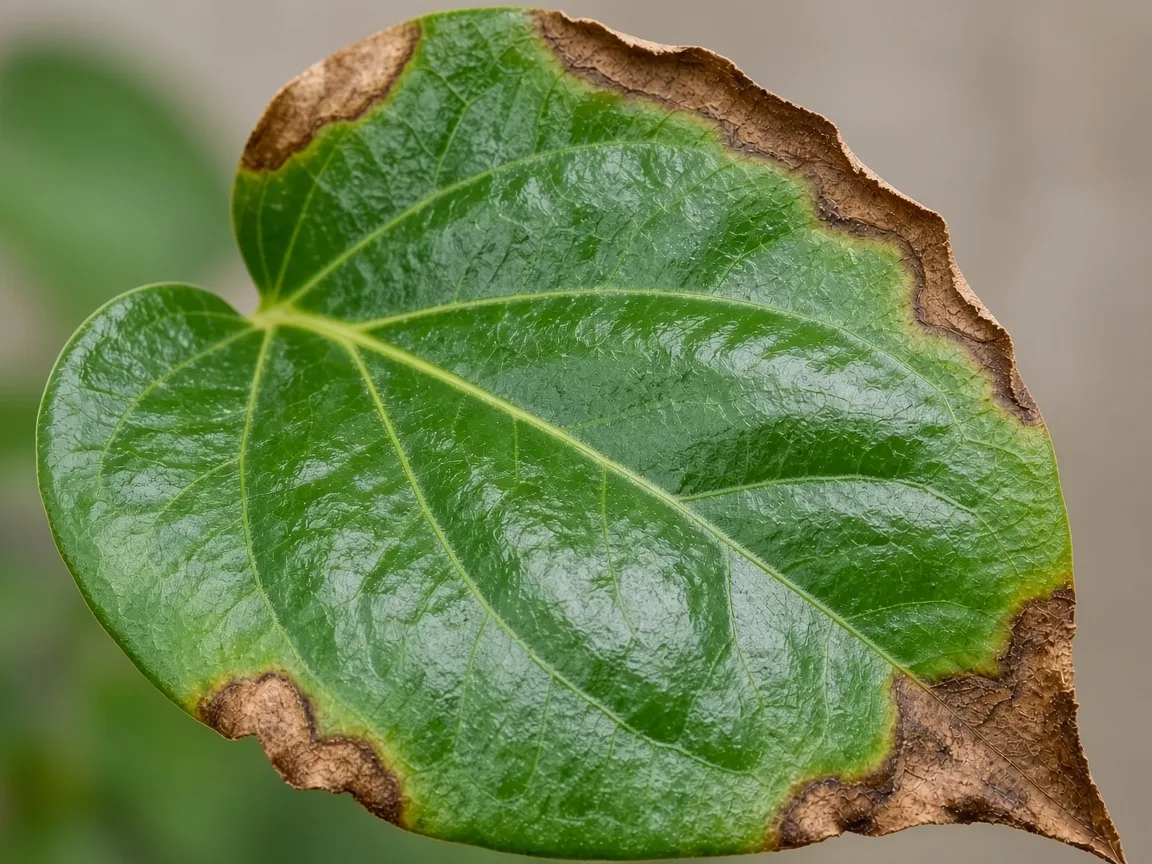
Dry tan margins on a glossy Betel Leaf blade—dead edge tissue will not re-green; watch the next node for a clean leaf flush.
Typical dry-air pattern:
- Brown or tan papery margins along the wavy edge, sometimes spreading inward as a dry band
- Glossy green center still firm while edges crisp—soil may feel normally moist at depth
- Worst damage on the exposed side facing a heat register, AC vent, or dry winter window
- Older outer leaves show first; the vine may still push new nodes if stems stay firm
- Slight upward cupping on young heart-shaped blades in very dry, bright microclimates
What is not low humidity alone:
- Uniform wilt with a light pot and dusty-dry mix → underwatering
- Yellowing with soft stems on constantly wet mix → overwatering
- Bronze stippling plus fine webbing on undersides → spider mites—often worsened by the same dry heat
Why a paan vine fails in dry indoor air
Betel Leaf is not a “set it and forget it” houseplant like many drought-tolerant species. Useful Tropical Plants notes it thrives under per-humid forest conditions with high relative humidity, ample soil moisture, shade, and wind protection. That biology clashes with three common home setups:
Air-conditioned or heated rooms. Central HVAC often holds 25–40% RH in winter or summer cooling season—far below the 60–80% target in the Betel Leaf overview. The thermostat can read comfortable while the microclimate beside a floor register is much drier.
Dry window ledges. A pot on bright glass gains light the vine needs but loses water from leaves faster than roots pull it up—especially when placement was recently moved from filtered shade to harsh afternoon sun through dry air.
Greenhouse-to-apartment shock. Nursery paan vines leave humid bench conditions. Continued margin browning on new heart-shaped leaves after the first week means the new room air is too dry—not that the plant needs calendar watering on a wet schedule.
Moss poles, adventitious roots, and canopy humidity
Betel Leaf is a climbing Piper: it produces adventitious roots along nodes that cling to bamboo, trellis, or a moist support. In betelvine fields, vines are trained on canes under shade structures that trap humid air. Indoors, if the support and the air around the upper nodes stay dry, those roots shrivel and the canopy transpires even faster—slowing extension even when the pot mix is wet.
That is why this problem page is not interchangeable with a snake plant guide: you are managing RH at climbing height, not just soil in a rosette pot. A humidifier on the floor may read 55% at ankle height while the top leaves beside a vent still sit in the 30s. Measure beside the leaves you are trying to save.
How to confirm low humidity (not thirst or pests)
Work through this order before repotting or feeding:
- Hygrometer at canopy height — Log RH for 24 hours within 30 cm of the leaves. Sustained readings below about 50% with margin browning strongly support dry-air stress. UConn’s home-garden humidity guidance notes drying leaf edges when humidity-loving plants sit in dry heated air.
- Vent and draft scan — Feel for hot or cold dry blasts at foliage level from AC, heat registers, or drafty glass. Note whether damage is worst on one side.
- Watering finger test — Check 2–5 cm depth. Dusty-dry with a light pot → underwatering or combined drought and dry air. Moist with margin-only browning → humidity or localized heat, not thirst.
- Pest cross-check — Hold a white paper under a leaf and tap. Specks that move, stippling, or webbing → spider mites. UC IPM notes spider mites are common on houseplants and increase when plants are drought-stressed or dusty—dry rooms invite both problems.
- Timing — Symptoms that spike when heating or AC first runs fit environmental RH. Sudden collapse with soft stems on wet mix is a different emergency—see wilting and root checks.
Lookalike table
| What you see | Likely cause | Differentiating check |
|---|---|---|
| Even margin browning, no stippling | Low humidity | RH below 50% at canopy; moist soil OK |
| Light pot, dry 2–5 cm, limp leaves | Underwatering | Recovers after thorough soak |
| Yellow lower leaves, wet heavy pot | Overwatering | Sour smell; soft collar |
| Stippling, webbing, moving specks | Spider mites | Tap test; dry heat history |
| Sun-facing bleach or crisp patch | Light scorch | Follows brighter placement |
| Tips only, not full margin | Often brown tips | Narrow distal band; same RH fixes |
First fix for Betel Leaf
Move the vine out of the driest microclimate—AC blast, heater register path, or baking window ledge—before any other change.
Practical steps:
- Shift the pot at least 1 m (3 ft) from floor registers and direct ceiling AC vents when possible
- Pull back from afternoon sun through dry winter glass, or add sheer curtain plus humidity buffer
- Hang the hygrometer beside the top leaves, not on the opposite wall
- Rotate once: if one side is more crisp, that side was in the dry stream
Do not compensate for dry air by keeping soil soggy—waterlogged mix invites Phytophthora-style collar issues on betelvine. Fix air first; keep the existing dry-down rhythm unless the finger test proves thirst.
Step-by-step recovery after placement
Once airflow is fixed, raise RH in order of reliability:
- Cool-mist humidifier running near the vine (not pointing directly into soil 24/7)—aim for 60–70% at canopy for several days, then maintain 55%+ if your room allows
- Plant grouping — Paired pots transpire together; useful on humid balconies, less so alone in a dry bedroom
- Pebble tray under the pot (pot above water line) for a modest boost—refill daily; not a substitute for a humidifier in a 30% RH room
- Brief morning mist on surrounding air only if you have good airflow; constant wet foliage in dim corners worsens leaf spot risk
If mites are confirmed, treat per the spider mite guide after you improve RH—humidity alone does not clear an active infestation.
Trim fully dead margin tissue for appearance once new growth looks stable; it will not re-green.
Recovery timeline and success markers
| Phase | What to expect |
|---|---|
| Days 1–3 | No further spread of brown margins after relocation; hygrometer shows higher RH at canopy |
| Week 1–2 | Firm stems; smallest new leaves hold green edges longer before hardening |
| Weeks 3–4 | A full heart-shaped leaf opens with intact wavy margin—your proof RH and watering align |
| Ongoing | Older crisped blades remain tan; judge by new nodes and glossy flush, not old scars |
If margins keep advancing on new leaves while RH stays above 55% and soil moisture is correct, inspect roots and drainage before fertilizing—see root rot and the problems hub.
Mistakes that make Betel Leaf worse
- Overwatering because brown edges “look thirsty” while RH is the real issue
- Misting leaves nightly in low light without airflow—invites fungal spotting on Piper foliage
- Humidifier on the floor while the climbing top still sits in a vent stream
- Ignoring spider mites when stippling appears in the same dry corner
- Repotting and pruning heavily the same week you add a humidifier—stack one stressor at a time
How to prevent dry air damage next time
Match watering to 2–5 cm dry-down, use rich draining soil on a support, keep filtered light without baking the canopy, and plan winter humidity before heaters run. Betelvine field practice assumes regular moisture with good drainage in humid air—your indoor goal is the same pairing, not soggy roots in a dry room.
Scout leaf undersides weekly in dry seasons. Quarantine new vines until RH near your display spot is stable.
Conclusion
Low humidity on Betel Leaf is edge stress on thin shade-vine foliage, not a mysterious disease. Piper betle tells you the room is too dry when heart-shaped margins crisp while stems stay firm and mix moisture may still look fine. Measure RH beside the climbing canopy, escape vent drafts, humidify deliberately, and read the next glossy leaf—not the old tan edges—for whether you fixed it.
Related Betel Leaf guides
- Betel Leaf overview — placement, RH targets, and cluster map
- Betel Leaf watering — finger test and seasonal rhythm
- Betel Leaf light — filtered shade vs harsh sun
- Betel Leaf soil — moisture retention without waterlogging
- Brown tips on Betel Leaf — when only the distal tip crisps
- Underwatering on Betel Leaf — drought vs dry air
- Spider mites on Betel Leaf — dry-room pest flare-ups
- Betel Leaf problems hub — all common issues on this species
Related tool
Use the Humidity Calculator to narrow causes for low humidity on this plant before changing multiple variables at once.