Black Spots on Betel Leaf: Causes, Checks & Fixes
Quick answer
On Betel Leaf, round black spots with yellow halos usually mean anthracnose (Colletotrichum piperis) in humid, still air—not generic houseplant stress. First step: remove the wettest spotted leaves with clean shears, stop wetting foliage when you water, and improve airflow around the climbing vine before any spray.
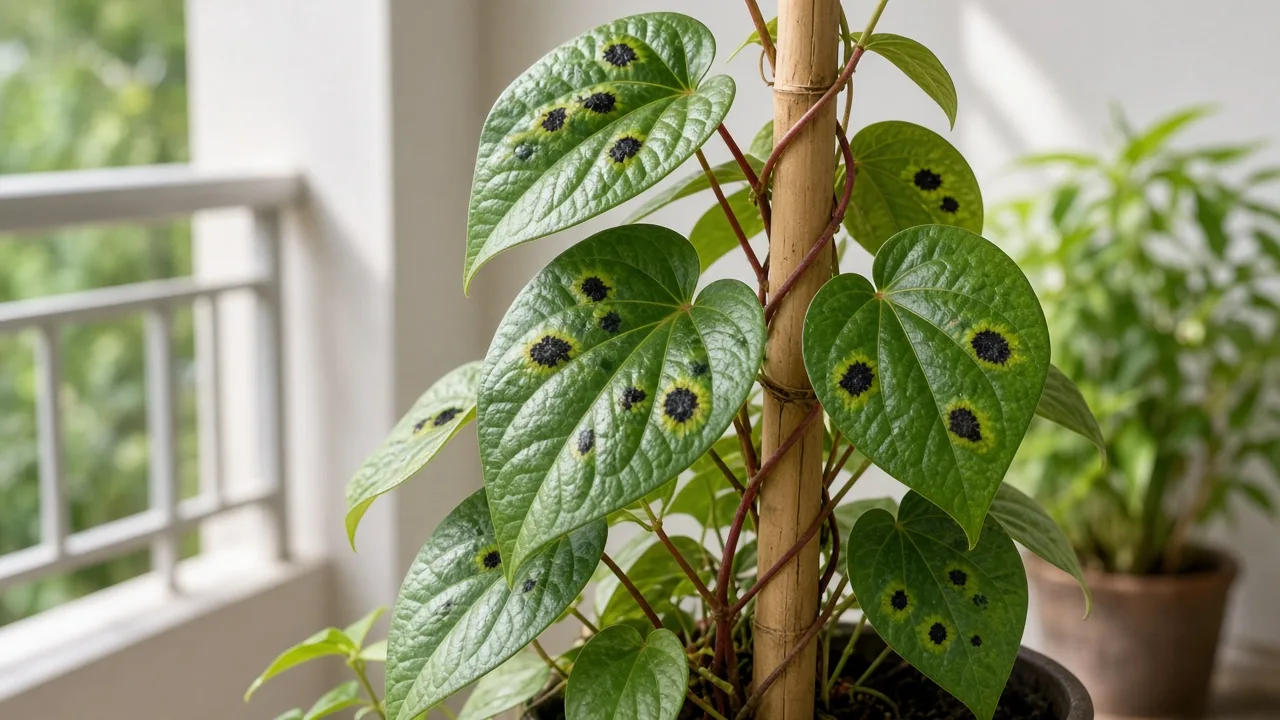
Black Spots on Betel Leaf: Causes, Checks & Fixes
This guide covers black spots on Betel Leaf. See also the general Black Spots guide, watering, and light pages for this plant.
Black Spots on Betel Leaf: Causes, Checks & Fixes
Quick answer
Black spots on Betel Leaf (Piper betle)—the glossy heart-shaped paan vine—most often mean anthracnose leaf spot (Colletotrichum piperis) when you see small round black lesions with yellow halos on otherwise green blades. For general black-spot mechanics on houseplants, see our black spots guide. On this shade-loving climber, the pattern usually appears after leaves stay wet in humid, poorly ventilated corners—the same microclimate that keeps paan leaves tender also favors fungal splash.
First step: remove the most heavily spotted leaves with clean shears, then water the soil only and open airflow around the vine. Do not mist foliage or stack fungicide, repot, and heavy prune on the same day.
Betel Leaf needs bright filtered light and steady moisture without waterlogged mix. When damp leaves, weak airflow, and crowded placement overlap, leaf spot and Phytophthora-style rot both worsen—inspect the pattern before treating.
When to use this page vs other Betel Leaf guides
- Holes in leaves — chewing damage or leaf miners, not circular necrotic spots
- Brown leaves — wide marginal browning from sun, drought, or salt stress
- Yellow leaves — whole-blade yellowing from roots, nitrogen, or collar rot
- Wilting — soft vine collapse when roots or stem are failing, not isolated spots
- Overwatering — chronically wet mix that sets up Phytophthora leaf rot
- Mold on soil — surface fuzz when mix never dries, often paired with gnats
- Spider mites — fine stippling and webbing, not expanding black circles
What black spots look like on Betel Leaf
Healthy paan vines carry glossy, deeply veined heart-shaped leaves on reddish petioles climbing a stake or trellis. Black-spot problems break that look in predictable ways on Piper betle.
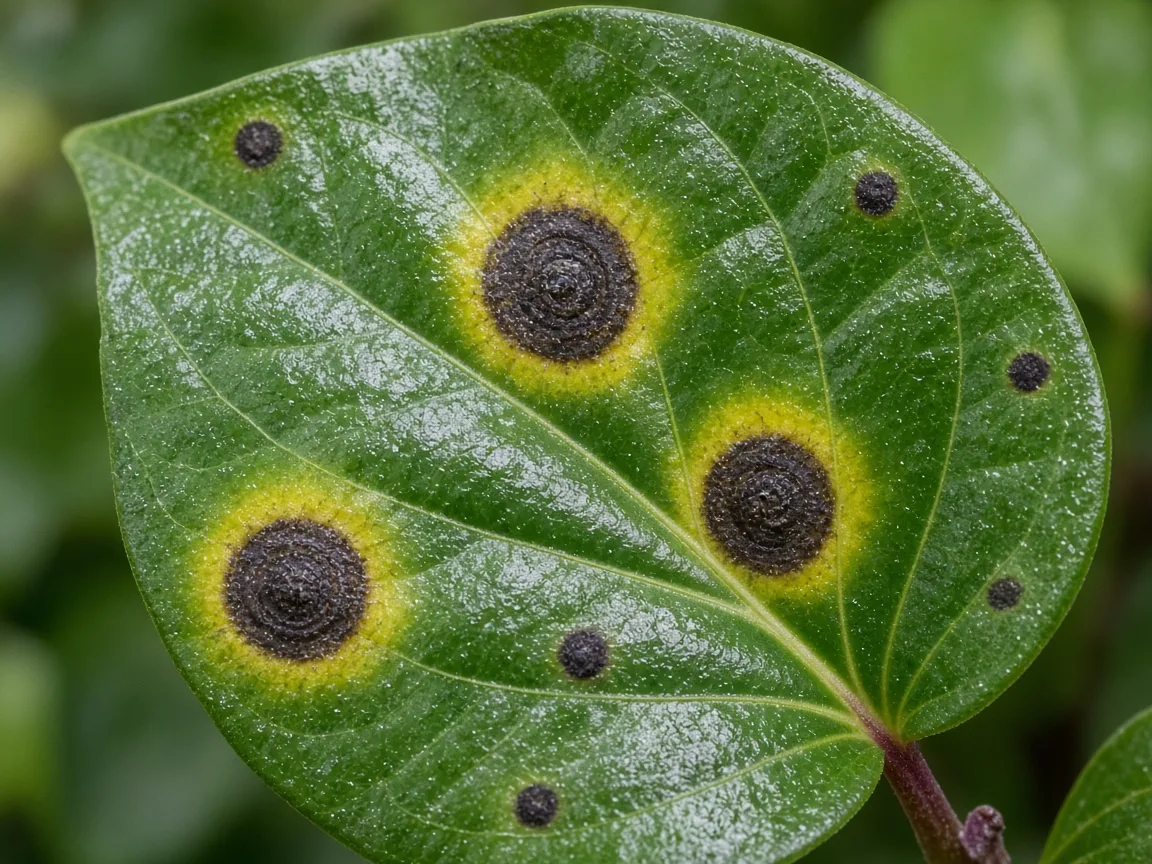
Anthracnose on paan leaves often shows concentric black rings with a yellow halo—compare with healthy tissue on the same vine.
Anthracnose (most common black-spot pattern)
Field records on betelvine describe small black circular spots that enlarge to about 2 cm, turn concentric, and sit inside a yellow halo before the leaf pales and dries. On container vines you usually see:
- Dry, round to oval black centers with a yellow ring on upper leaf surfaces
- Concentric ring pattern as spots age—not a uniform wash across the whole blade
- Pale yellowing around heavy infections before the leaf drops
- Stem lesions in advanced cases: black circular patches at nodes that can girdle young shoots
This matches classic fungal leaf spot behavior: spores germinate on wet leaf tissue and create expanding necrotic lesions.
Phytophthora leaf rot (water-soaked, not dry rings)
Betelvine in humid shade houses also suffers Phytophthora leaf rot, which looks different from anthracnose:
- Water-soaked brown patches starting at leaf margins or near the soil line
- Greasy, soft edges rather than dry black rings with halos
- Spots that merge quickly when mix stays saturated and nights are cool
- Often paired with overwatering signs—sour smell, fungus gnats, collar softening
If the pot has been wet for weeks and spots feel soft, treat moisture and roots first—not anthracnose sprays alone.
Bacterial leaf spot (angular, water-soaked specks)
Xanthomonas-type bacterial spot on betelvine starts as tiny brown water-soaked specks with yellow halos that enlarge into angular necrotic patches between veins. Indoors this is less common than anthracnose but worth separating:
- Angular, vein-bound lesions instead of round concentric rings
- Soft, water-soaked margins that collapse faster than dry fungal spots
- Black streaks on lower stem nodes when infection moves off the leaf
Sun scorch and mechanical marks (not disease)
Betel Leaf belongs in semi-shade—not harsh midday sun. Flat black or brown patches on the sun-facing side of one or two upper leaves, without yellow halos or concentric rings, are usually scorch from sudden exposure to west or south glass. A single torn leaf with one dry black edge from handling is cosmetic—not a reason to spray.
Why humid paan-vine setups get black spots
Piper betle evolved as a humid, shaded understory climber grown in high-moisture baroj-style structures across South and Southeast Asia. Indoors you recreate part of that environment—warm room, pebble tray, frequent watering—which keeps leaves glossy but also extends the hours leaf surfaces stay wet.
Three betel-specific factors drive spotting:
- Broad glossy blades hold mist and splash. Overhead watering or evening misting lets spores germinate on leaves that never dry before night.
- Vines climb tight against stakes. Inner leaves against a moss pole or bamboo stay shaded and stagnant—the perfect niche for Colletotrichum piperis conidia splashed from infected debris below.
- Fast flush of new nodes. Betel Leaf extends quickly in warm humid weather. Soft new leaves are the first tissue colonized when airflow lags behind growth.
Chronic wet mix without drainage adds Phytophthora pressure at the same time—not because black spots always mean root rot, but because the same over-wet culture grows both problems.
How to confirm the cause
Work through these checks in order:
- Spot texture — Dry black ring with yellow halo = anthracnose likely. Soft water-soaked brown = Phytophthora or bacterial.
- Location on the vine — Spots scattered on mid-canopy leaves in a humid corner = fungal splash. Marginal rot on lowest leaves touching wet soil = Phytophthora leaf rot.
- Leaf underside at nodes — Confirm scale or aphids are not leaving sticky residue that mimics spreading lesions.
- Soil moisture at 2–5 cm — Match the finger-test rhythm: if mix stays wet 5+ days, root stress weakens leaves even when spots look purely fungal.
- Recent care changes — New grow light, moved to direct sun, or switched to misting? Scorch and bacterial splash both follow sudden shifts.
- New growth test — After sanitation and dry leaves, the next two node flushes should open without new spots if your fix matched the cause.
First fix for Betel Leaf
Remove the wettest, most heavily spotted leaves with sterilized shears, bag them, and stop wetting foliage when you water.
That single step cuts inoculum and dries the leaf surface—the two levers that matter most on paan vines before any product.
- Water at the soil line only, early in the day, per the betel watering guide
- Space the vine away from walls and other plants; run a fan on low if humidity stays above 70%
- Pick up fallen leaves from the pot surface—they harbor Colletotrichum spores
- Do not mist until new growth stays clean for two weeks
Wait 10–14 days and judge the next two leaves at the growing tip. If fresh black rings still appear, move to targeted treatment—not before.
Step-by-step recovery
After the first fix:
- Sanitize tools between cuts with rubbing alcohol; betel vines bruise easily at nodes.
- Thin crowded inner leaves against the stake so air reaches glossy blades.
- Adjust watering to pot weight — Betel mix should stay moist but never soggy; empty cachepot water within 30 minutes.
- Raise light without scorch — Move to bright filtered east light or 40–50% shade if the vine was in deep gloom (weak light slows recovery but does not cause concentric rings).
- Optional biological support — In commercial betel culture, Trichoderma and Bordeaux mixture are used against leaf spot; indoors, confirm any product is safe for edible foliage and follow label rates.
- Escalate only if new spots persist — A copper or sulfur fungicide labeled for leaf spot on herbs may be appropriate when environmental correction fails; never harvest leaves within the label withholding period.
If stems show black girdling lesions or the collar softens, shift to the root rot workflow—anthracnose leaf sprays will not save a failing base.
Recovery timeline
Expect cleaner new leaves within two to four weeks once foliage stays dry and spotted debris is gone. The next two node flushes should open without fresh halos before you call the problem controlled.
Old black centers do not green up—success is measured on new glossy heart-shaped leaves climbing the support. Severely spotted blades can be trimmed after the vine stabilizes.
If soft water-soaked rot spreads on wet soil despite dry leaves, inspect roots within a week. Phytophthora can move from leaf to collar faster than anthracnose alone.
Lookalike symptoms
| What you see | Likely cause | Where to go |
|---|---|---|
| Round dry black spots with yellow halos, concentric rings | Anthracnose (Colletotrichum piperis) | This page |
| Greasy brown patches from leaf edge, wet mix | Phytophthora leaf rot | Overwatering, root rot |
| Angular water-soaked specks between veins | Bacterial leaf spot | Black spots hub — bacterial branch |
| Flat black patch on sun-facing leaf only | Sun scorch | Betel light guide |
| Chewed irregular holes | Caterpillars or miners | Holes in leaves |
| Fine stippling, webbing | Spider mites | Spider mites |
Mistakes to avoid
Do not mist a spotted paan vine to “boost humidity”—Betel Leaf wants humid air, not wet leaves. Use a pebble tray or humidifier instead of foliar water.
Do not apply heavy fungicide on every spotted leaf before removing debris and fixing airflow. Fungicides protect new tissue; they do not erase old necrotic centers.
Do not confuse healthy red petioles with disease—Piper betle naturally has reddish stems; worry when black raised rings girdle nodes.
Do not harvest spotted leaves for chewing while treating with chemicals not labeled for edible crops.
Do not repot on day one unless mix is sour or roots are brown—transplant stress on a diseased vine spreads spotting before recovery.
Betel Leaf care cross-check
Black spots rarely exist in isolation on this species:
- Watering — Water when the top 2–5 cm dries; soggy mix feeds Phytophthora alongside leaf pathogens.
- Soil — Fertile, well-draining loam with perlite; waterlogged organic mix is a leaf-rot trap.
- Light — Filtered light or partial shade; harsh sun causes black patches that mimic disease.
- Humidity — Target 60–80% air moisture without wetting blades; low humidity browns tips but does not create concentric rings.
- Fertilizer — Hold feed until new growth is clean for two weeks; fertilizer on stressed vines burns roots when uptake is weak.
How to prevent black spots on Betel Leaf
Water soil early so incidental splash dries before evening. Keep inner leaves thinned against trellises each month during fast summer growth.
Quarantine new paan cuttings until two clean flushes pass—field betel culture shows leaf spot incidence peaks in warm humid months when vines crowd together.
Rotate the pot weekly so one side of the vine is not permanently pressed against a damp wall. Sanitize shears when trimming betel pruning cuts.
Avoid overhead irrigation habits copied from outdoor baroj beds; container vines need root-zone moisture, not foliar showers.
When to worry
Isolated spots on one older leaf after a humid week are manageable. Act within days when:
- New leaves open already spotted for two flushes running
- Stem nodes blacken and soften at the collar
- More than one-third of leaves show merging lesions
- Water-soaked rot spreads on saturated mix despite dry foliage
- Whole vine wilts while soil is wet—see wilting and root inspection
At that stage, salvage healthy tip cuttings above clean nodes before the base fails.
Related Betel Leaf guides
- Betel Leaf overview — species baseline and care hub
- Betel Leaf problems — full symptom index for this vine
- Watering — dry-down checks that prevent Phytophthora leaf rot
- Light — filtered placement that avoids scorch mimics
- Soil — drainage mix for moist-but-not-soggy roots
- Root rot — when collar softening follows wet culture
- Overwatering — saturated mix that pairs with leaf rot
Related tool
Use the Plant Problem Diagnosis Tool to narrow causes for black spots on this plant before changing multiple variables at once.