Nitrogen Deficiency on Betel Leaf: Causes, Checks & Fixes
Quick answer
Nitrogen deficiency on Betel Leaf shows as uniform pale yellow-green on the oldest heart-shaped leaves along the basal part of the vine, with smaller or lighter new blades at the growing tip while stems stay firm. First step: confirm the pattern during active warm-season flush—not winter stall or soggy roots—then check months without feed in a leached compost-rich pot before fertilizing.
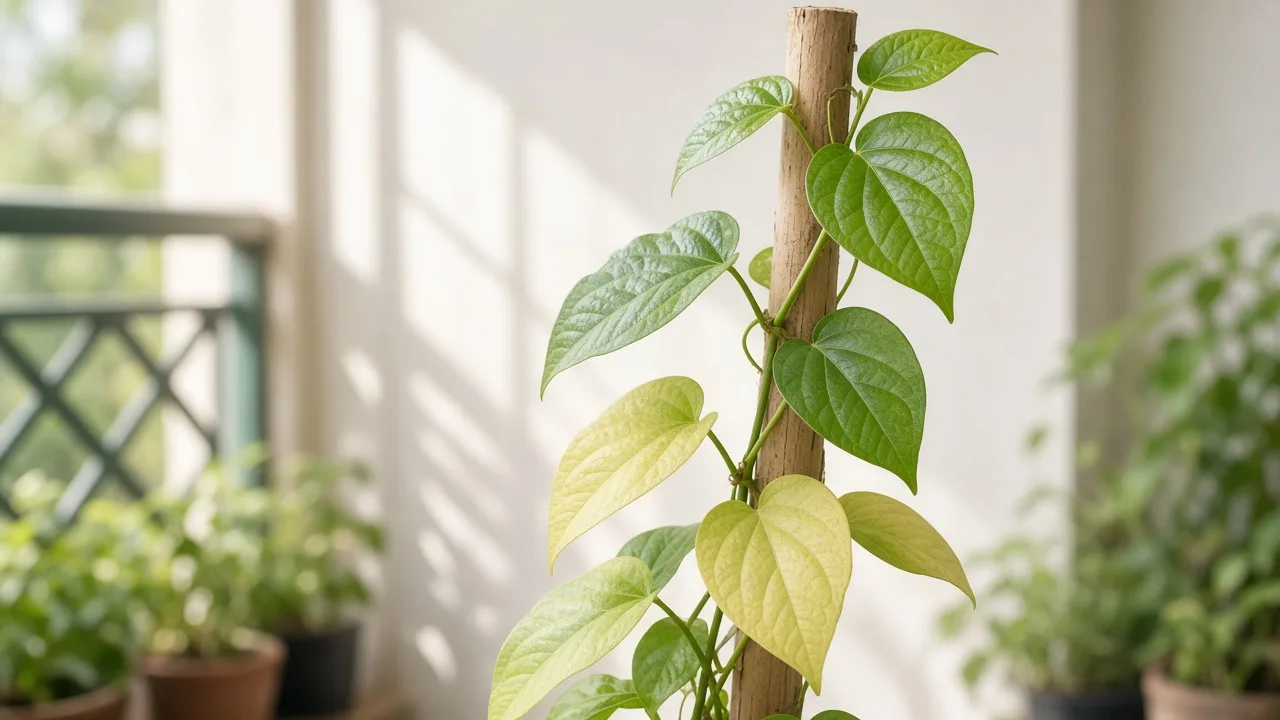
Nitrogen Deficiency on Betel Leaf: Causes, Checks & Fixes
This guide covers nitrogen deficiency on Betel Leaf. See also the general Nitrogen Deficiency guide, watering, and light pages for this plant.
Nitrogen Deficiency on Betel Leaf: Causes, Checks & Fixes
Quick answer
Nitrogen deficiency on Piper betle (Betel Leaf, paan vine) shows as uniform pale yellow-green on the oldest heart-shaped leaves along the basal coiled section of the vine, with smaller or lighter new blades at the growing tip and slowed warm-season extension while nodes and stems stay firm. Nitrogen is mobile in plants, so deficiency symptoms show up first on the lower leaves as a general yellowing—veins and tissue fade together, unlike magnesium deficiency (interveinal banding on old leaves) or iron deficiency (green veins on new tip leaves).
See our nitrogen deficiency guide for general mobile-nutrient mechanics. On Betel Leaf, inspect the lowest mature heart-shaped blades on the section of vine nearest the pot and support—even washout there, with the tip still pushing smaller new leaves, is classic nitrogen starvation before wet-root failure or low-light pale leaves.
First step: confirm uniform pale color on the oldest basal leaves—not interveinal chlorosis, new-tip green veins, or cool-season growth stall—then check firm nodes and months without balanced fertilizer in leached compost-rich mix.
When to use this page vs other Betel Leaf guides
| Pattern | Read next |
|---|---|
| Uniform pale oldest basal leaves, smaller tip blades | Nitrogen deficiency (this page) |
| Yellow between veins on oldest leaves | Magnesium deficiency |
| Yellow new tip leaves with green veins | Iron deficiency |
| Brown scorched margins on mature leaves | Potassium deficiency |
| Washed-out green across the whole vine, long internodes | Pale leaves or not enough light |
| Yellowing with soft stems on constantly wet mix | Overwatering or root rot |
| General yellowing without a clear nutrient pattern | Yellow leaves |
| Stalled nodes despite good light and moisture | Slow growth |
What nitrogen deficiency looks like on Betel Leaf
Healthy Betel Leaf holds glossy, heart-shaped green leaves on a climbing vine trained to a stake, trellis, or moss pole. Nitrogen stress breaks that pattern on mature foliage on the lower, older part of the stem, not with a vein-retained banding pattern.
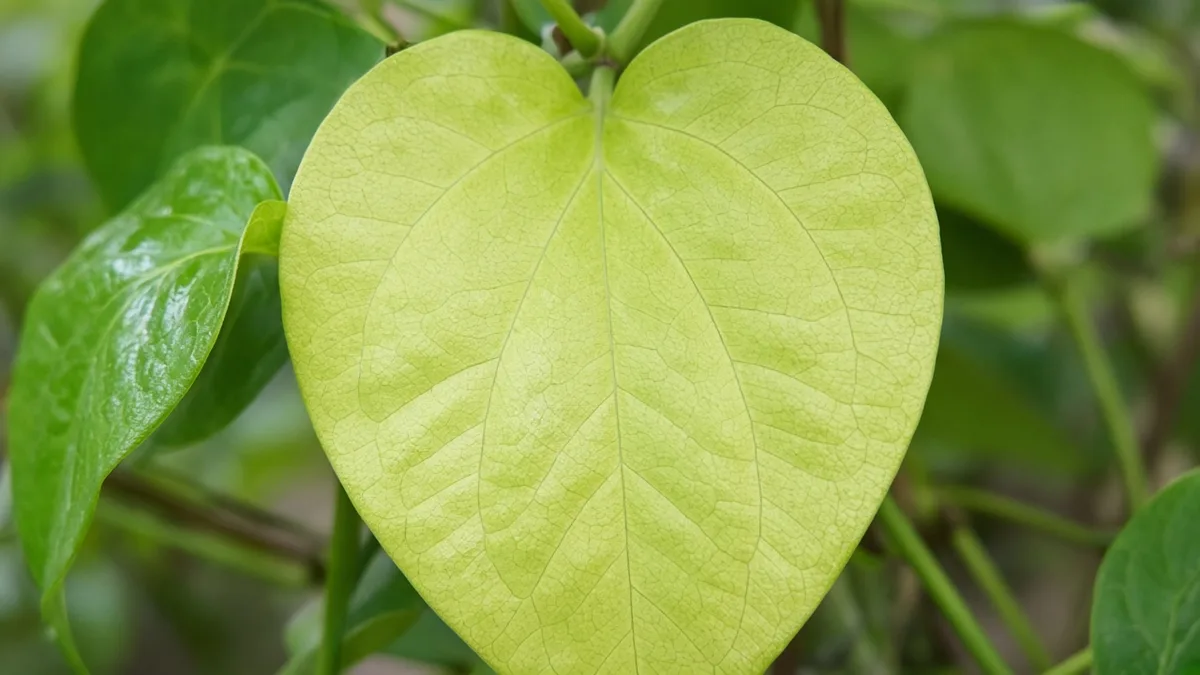
Oldest basal Betel Leaf blade with uniform pale yellow-green chlorosis—veins and tissue faded together, unlike interveinal magnesium banding.
Typical signs:
- Uniform pale yellow-green on the oldest heart-shaped leaves along the basal vine—veins and tissue lose color together
- Progressive climb toward younger leaves over weeks as the plant strips nitrogen from old tissue to fund tip growth
- Smaller or thinner new leaves at the vine tip and shorter internodes between nodes during warm active flush
- Firm nodes and stems when roots are healthy; soft collar rot on sour wet mix suggests overwatering instead
- Reduced leaf size on new flushes on a vine that should be extending quickly in humid filtered light
Not nitrogen deficiency:
- Yellow tissue between dark green veins on oldest leaves—magnesium deficiency (magnesium deficiency initially develops on lower or older foliage with interveinal chlorosis)
- Yellow new tip leaves with dark green veins—iron deficiency
- Seasonal stall and occasional yellow drop when nights cool and growth pauses—normal winter rhythm, not hunger; resume diagnosis only after spring flush returns
- Uniform washed-out green across the whole vine with long bare internodes—not enough light or leggy growth before assuming starvation
- All leaves yellow at once on persistently wet soil—overwatering or root rot
- One old basal leaf only while the tip pushes full-size green blades—normal aging on yellow leaves
UC IPM notes slow growth and uniform yellowing of older leaves as the first symptoms of nitrogen deficiency. On a fast-climbing paan vine, that lower-canopy washout is easiest to read on the lowest mature heart-shaped blade on each basal branch during warm months when the plant should be actively extending nodes.
Why Betel Leaf gets nitrogen deficiency
Betel Leaf is a shade-loving Piperaceae climber grown for continuous leafy flush on a support. Nitrogen is a core component of chlorophyll and proteins—when soil reserves run low, the vine dismantles chlorophyll in older basal tissue and redirects nitrogen to the growing tip and new nodes.
Commercial betelvine is nitrogen-responsive: TNAU recommends 150 kg N per hectare per year split through neem cake and urea in field beds. Home pots cannot use hectare rates, but the biology is the same—a leaf crop in cool humid conditions with regular soil moisture burns through nitrogen when nodes keep forming.
Betel Leaf–specific causes:
- Never fed or skipped warm-season feeds — Owners keep moisture perfect but forget dilute fertilizer while the vine sits in the same tub for multiple seasons. See the Betel Leaf fertilizer guide for container-safe timing.
- Leached compost-rich mix — Each thorough soak per the Betel Leaf watering guide flushes soluble nitrogen through drainage holes faster than owners replace it in fertile organic soil.
- Heavy leaf harvest — Repeated picking of large basal leaves removes nitrogen the plant would otherwise recycle into new flush.
- Winter pause without spring restart — Correct cool-season holds are necessary, but some growers never resume measured feed when monsoon flush returns.
- Blocked uptake from wet roots — Chronic saturation in a cachepot prevents absorption even when nitrogen is present; see overwatering before feeding waterlogged vines.
- Alkaline or saline stress — Betelvine does not tolerate saline and alkaline conditions, which can lock out nutrients even when fertilizer is present.
Do not diagnose nitrogen deficiency on sour wet soil with soft stems at the collar—that is root failure until you confirm mostly firm roots and appropriate dry-down.
Basal nodes and the coiled lower vine
The diagnostic fork on paan vine is which leaves pale along the stem, not just that some leaves look yellow.
Betel Leaf is often trained upward, then lowered and coiled at the base each spring in field practice so fresh tillers sprout from buried nodes. In pots, the same idea applies: the oldest functional leaves sit on the lowest nodes near the pot rim and support stake. Nitrogen starvation shows there first—uniform pale heart-shaped blades on the bottom one or two nodes, while the tip may still climb.
Run your fingers down the stem from the growing tip: if color improves steadily toward the top but the lowest node pair is uniformly lime, nitrogen is a strong suspect. If every leaf on the vine is equally washed out and internodes stretch, shift to not enough light before feeding. This node-walk along a coiled basal vine is meaningless on a rosette succulent—it is central on Betel Leaf.
Monsoon flush vs winter stall
Betel Leaf pushes fastest in warm, humid filtered light—roughly March through October across much of India. During that window, pale basal leaves plus undersized tip blades support nitrogen deficiency.
From about November through February, many balcony vines stall extension even when watered. Lower leaves may yellow and drop as growth slows; that seasonal fade is not nitrogen deficiency—even if older leaves yellow first. Nitrogen starvation shows during active node flush when nights stay mild, new heart-shaped leaves should be opening regularly, and the plant is on your normal watering rhythm.
Feeding a cold-stalled vine in a dry heated room builds salts without uptake. Wait for consistent spring tip growth, then diagnose pale basal color again.
Leaching in compost-rich container mix
The trap on Betel Leaf is the well-watered tub on a humid balcony while nitrogen silently leaches out of compost-heavy mix.
Leaching in organic pots: Each thorough drink flushes nitrate through drainage holes. Years of flushing without balanced fertilizer—or with micronutrient-only drenches—leaves uniform pale basal leaves while nodes still feel firm.
Moisture-retentive illusion: Top 2–5 cm may dry on schedule while a root mass in two-year-old coco-compost starves below. Even washout on lower canopy leaves with firm stems and normal watering rhythm often means depleted nitrogen, not thirst—compare with underwatering, which dulls the whole vine and pulls soil from the pot edge without a progressive lower-to-upper pale wave.
RHS notes nitrogen deficiency causes pale yellow leaves on older foliage first and that the nutrient is easily washed out of compost by watering—especially relevant for container paan vines that never receive field-scale neem cake manuring.
Lookalike symptoms
| Pattern | Check | Likely cause |
|---|---|---|
| Uniform pale oldest basal leaves | Feed history, mix age | Nitrogen deficiency (this page) |
| Interveinal yellow on oldest leaves | Vein pattern | Magnesium deficiency |
| New tip leaves yellow, green veins | Wet mix, pH | Iron deficiency |
| Edge scorch on old leaves | Feed type | Potassium deficiency |
| All yellow, wet heavy pot | Stem softness | Overwatering |
| One lower leaf only | Tip green and full size | Normal aging—yellow leaves |
| Washed-out uniform green, long internodes | Light hours | Pale leaves or not enough light |
| Stalled nodes, no pale pattern | Humidity, pests | Slow growth |
How to confirm
- Color pattern on lowest mature heart-shaped leaves — Uniform pale yellow-green including veins, not interveinal banding.
- Magnesium vs nitrogen split — Green veins with yellow between them on old leaves point to magnesium; even washout points here.
- Iron vs nitrogen split — New-tip green veins point to iron; oldest-basal-blade uniform pale points here.
- New leaf size at the vine tip — Smaller tip blades and short internodes support starvation when basal leaves pale first.
- Season and temperature — Active warm flush, not cool-season stall alone.
- Fertilizer label and timing — Complete balanced feed vs months without any application during growing season.
- Node and collar check — Firm nodes and healthy roots support nitrogen fixes; soft mush needs drainage first.
- Moisture cross-check — Wet core in a sealed cachepot rules out simple starvation until roots recover.
First fix for Betel Leaf
One half-strength dose of balanced liquid fertilizer on already-moist mix—only after confirming firm nodes, warm active flush, and uniform pale color on the oldest basal heart-shaped leaves.
Water normally first so roots are hydrated, then apply diluted feed until a small amount drains from the bottom per the Betel Leaf fertilizer guide. UC IPM cautions that poor drainage, compaction, and too much irrigation can mimic nitrogen deficiency because roots cannot absorb nutrients—do not feed a paan vine sitting in saturated mix at the collar.
Do not feed a waterlogged plant, a specimen you repotted within the last month, or a vine with active pest damage on new tip growth. Fix the limiting stress first, then apply one measured nitrogen correction during the growing season.
Step-by-step recovery
- Apply one half-strength complete balanced feed on moist mix during warm active growth; bloom-only low-nitrogen formulas alone may not supply enough nitrogen for foliage recovery.
- Flush salts if white crust rings the pot rim—leach with plain water before stacking more fertilizer; brown tips may overlap with brown tips from salt or dry air.
- Adjust watering so the pot dries appropriately between drinks per Betel Leaf watering—uptake fails in chronic wet mix.
- Repeat measured feed once after four to six weeks if basal chlorosis spreads but nodes stay firm—do not feed weekly at full strength on this vine.
- Repot into fresh compost-rich mix if roots circle the pot and pale basal leaves persist after two measured treatments—see Betel Leaf repotting.
- Remove fully yellow basal leaves only when they pull away easily; do not strip half the canopy at once on a young vine.
- Monitor the next two node flushes for larger heart-shaped blades and deeper green color at the tip.
Recovery timeline
Correct nitrogen on healthy roots shows larger, greener new tip leaves within three to six weeks during active warm growth—faster than woody trees but slower than a single pothos runner because Betel Leaf renews leaves in node flushes. Older chlorotic basal blades rarely return to full deep glossy green; the vine slowly replaces them as it climbs.
Full lower-canopy refresh on a mature trained vine may take one growing season. Judge success by deeper green color and normal leaf width on fresh tip growth, not by old pale blades darkening again. If three successive tip flushes stay small and pale after two measured treatments with firm nodes, reassess light, iron lockout, and overlapping slow growth causes.
Mistakes to avoid
- Fertilizer before drainage — Feeding waterlogged collar tissue worsens stress and will not fix chlorosis.
- Confusing iron, magnesium, and nitrogen — Leaf position and vein patterns tell them apart; read the lookalike table before drenches.
- Feeding during winter stall — Winter salts without uptake risk tip burn on a vine that is not growing.
- Repot + feed + hard prune same week — Stack one change at a time on a stressed paan vine.
- Expecting old basal leaves to re-green — Judge recovery by fresh tip growth size and color.
- Overfeeding after pale leaves appear — Full-strength repeated doses on stressed roots cause burn; measured half-strength once is the first fix.
- Diagnosing nitrogen on dim, washed-out vines — Not enough light fades the whole plant; fix filtered bright placement before assuming starvation.
Prevention
- Feed lightly with complete balanced liquid fertilizer during active growth per the Betel Leaf fertilizer guide—pair occasional liquids with thin compost or neem-cake top-dress in warm months, not hectare field rates.
- Refresh depleted compost-rich mix every one to two years when roots crowd the pot.
- Match feed frequency to growth rate—a humid east balcony vine in monsoon flush depletes nitrogen faster than a cool winter windowsill specimen.
- Track whether oldest basal heart-shaped leaves wash out uniformly before tip blades shrink; early pale lower leaves are easier to correct than a fully stunted vine framework.
- Pause feeding in cool months when extension stops, then resume only after consistent spring flush.
Related Betel Leaf guides
- Betel Leaf overview — species baseline and care hub
- Betel Leaf fertilizer — warm-season feed timing and dilution
- Betel Leaf watering — moisture rhythm that pairs with nutrient uptake
- Betel Leaf soil — fertile mix that holds nutrients without waterlogging
- Betel Leaf light — filtered light that drives growth and feed demand
- Betel Leaf problems — full symptom index for this species
- Magnesium deficiency — when older leaves band between veins
- Iron deficiency — when new tip leaves yellow with green veins
- Pale leaves — light-first diagnosis when color shifts broadly
- Yellow leaves — moisture and aging when yellowing is widespread
Conclusion
Uniform pale yellow-green on the oldest basal Betel Leaf heart-shaped blades, with smaller new tip leaves during warm active flush, is a nitrogen signal—confirm the pattern is not interveinal or new-tip chlorosis, rule out soft wet collar rot and cool-season stall, then apply one measured balanced feed on moist mix.
Related tool
Use the Fertilizer Dilution Calculator to narrow causes for nitrogen deficiency on this plant before changing multiple variables at once.