Potassium Deficiency on Betel Leaf: Old Leaf Margins & Weak
Quick answer
Potassium deficiency on Betel Leaf shows as yellow or brown scorch along the margins of older heart-shaped leaves lower on the climbing stem, sometimes with weak petioles or limp lower blades, while newer glossy leaves near the vine tip stay greener. First step: confirm margin burn on multiple old leaves—not tip-only crisp from dry air—and review whether you have fed a complete fertilizer through the growing season.
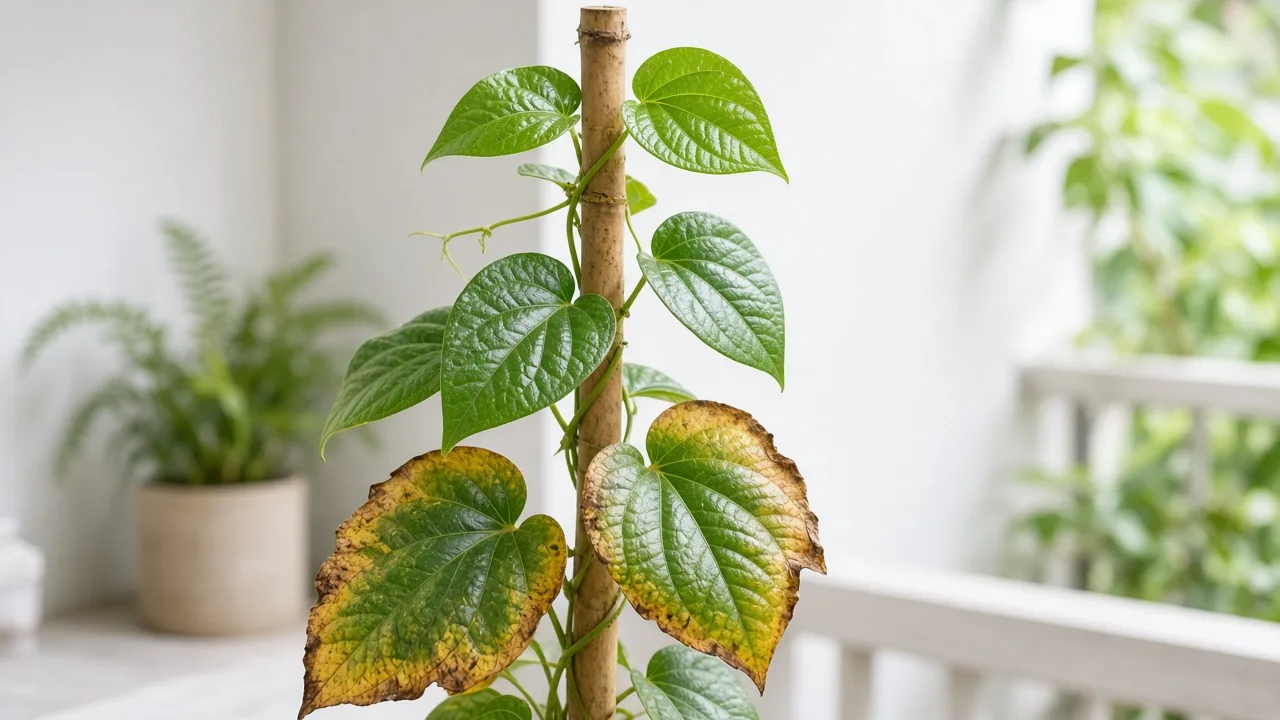
Potassium Deficiency on Betel Leaf: Causes, Checks & Fixes
This guide covers potassium deficiency on Betel Leaf. See also the general Potassium Deficiency guide, watering, and light pages for this plant.
Potassium Deficiency on Betel Leaf: Causes, Checks & Fixes
Quick answer
Potassium deficiency on Betel Leaf (Piper betle) shows as yellow or brown scorch along the margins of older heart-shaped leaves lower on the climbing stem, sometimes with limp lower blades or weak petioles, while newer glossy leaves near the vine tip stay greener. Potassium is mobile within plants—when soil reserves run low, the paan vine pulls potassium from old tissue to support new nodes at the growth tip. Older leaves show chlorosis with browning of tips, scorching of margins, and brown spots near the margins in classic potassium shortage. For universal nutrient mechanics, see our potassium deficiency guide. On Betel Leaf, inspect the outer edges of heart-shaped leaves three to six nodes below the tip—margin burn there differs from brown tips on mature foliage from dry air and from calcium deficiency on the newest cupped tip leaf.
First step: confirm marginal scorch on multiple older leaves lower on the vine, then check fertilizer completeness and whether the mix has gone saline or alkaline before adding feed.
When to use this page vs other Betel Leaf guides
| Pattern | Read next |
|---|---|
| Old leaf margins yellow then scorched, tip leaves still glossy | Potassium deficiency (this page) |
| Crispy distal tips on mature leaves, dry air | Brown tips |
| Uniform pale lower old leaves | Nitrogen deficiency |
| Yellow between veins on older foliage | Magnesium deficiency |
| Cupped or necrotic new tip heart-shaped leaf | Calcium deficiency |
| Soft collar, sour mix, wilt after watering | Root rot or overwatering |
| General yellowing workup | Yellow leaves |
What potassium deficiency looks like on Betel Leaf
Betel Leaf produces glossy heart-shaped leaves in sequence along a climbing vine trained on a moss pole, bamboo stake, or trellis. Potassium stress shows on older blades farther down the stem, not on the newest unfurling leaf at the tip first.
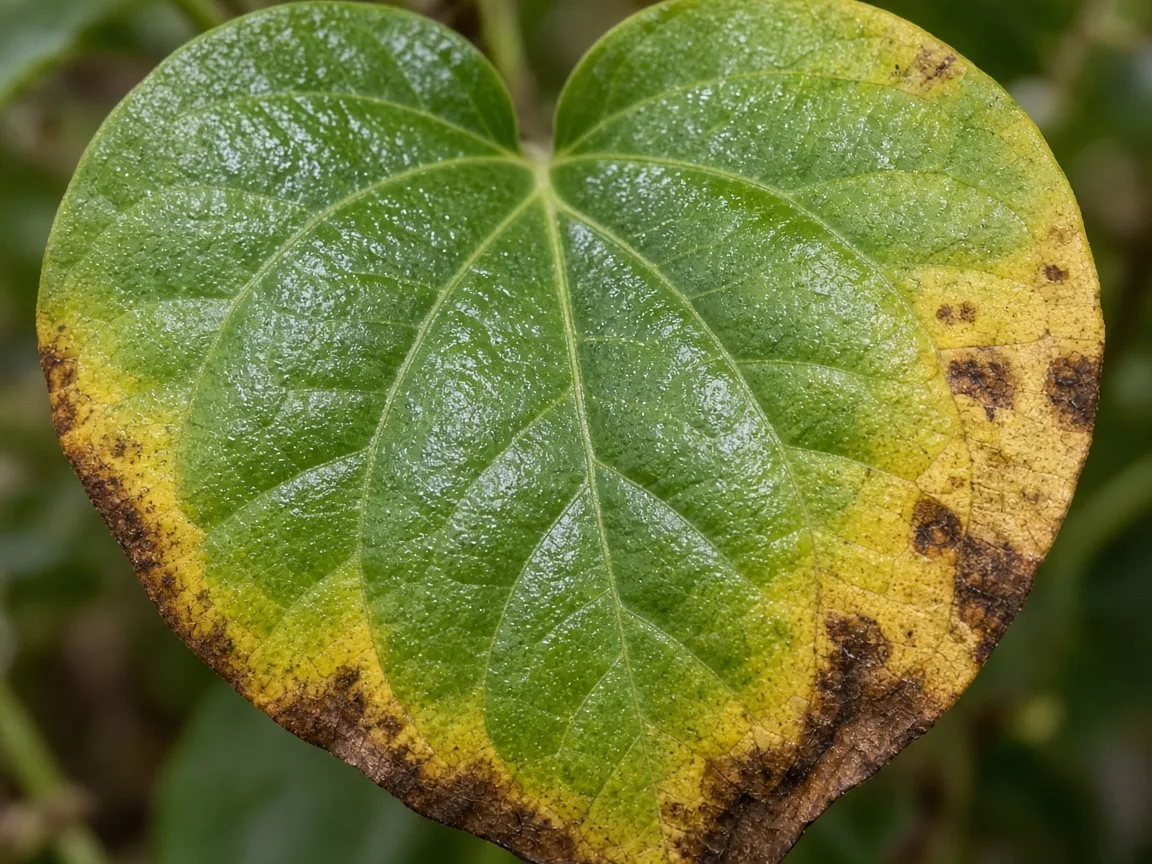
Yellow-tan scorch along the outer margin of an older heart-shaped paan leaf—the center may stay green while the edge browns, a mobile potassium pattern on a Piperaceae climber.
Typical signs:
- Yellow or tan band along the outer margin of older heart-shaped leaves on lower nodes—the scorch often starts at the edge and creeps inward while the midrib area stays greener longer (marginal browning on broadleaves is a hallmark potassium pattern)
- Small necrotic brown spots near the margin on the same old leaves, not isolated fungal dots with yellow halos
- Newer glossy leaves within a few nodes of the tip stay relatively green for weeks while multiple lower leaves show the same edge burn
- Limp or droopy lower leaves despite moist mix when potassium can no longer support water regulation in the blade—unlike firm underwatering wilt that perks up after a thorough drink
- Weak petioles on scorched lower leaves that hang at a sharper angle than healthy glossy foliage on the same vine
- Scorched margins persist when soil is evenly moist—unlike midday thirst crisp that tracks dry top 2–5 cm per the watering guide
Not potassium deficiency:
- Crispy distal tips only on open mature leaves with low canopy humidity—brown tips or low humidity
- Whole-leaf pale washout on lower foliage—nitrogen deficiency
- Interveinal yellowing with green veins on older leaves—magnesium deficiency
- Distorted newest heart-shaped leaf at the vine tip—calcium deficiency
- Marginal burn within days of a full-strength fertilizer dose on dry mix—salt injury; flush before diagnosing shortage
- Soft collar and sour-smelling mix—overwatering blocking uptake
Why Betel Leaf gets potassium deficiency
Betelvine is a heavy leaf crop in field culture—continuous harvest removes potassium from the system. Container paan vines on balconies face the same math on a smaller scale when owners pick leaves for use or trim without replacing nutrients.
Betel-specific causes:
- Nitrogen-heavy feeding without potassium balance — Field betelvine manuring includes muriate of potash as part of the NPK program. Home growers who use nitrogen-biased feeds or compost only may push glossy new nodes while old margins scorch.
- Leaching through moist, compost-rich pots — Betel Leaf needs regular soil moisture with considerable humidity. Frequent thorough watering per the watering guide flushes mobile potassium through drainage holes faster than slow houseplants lose it.
- Saline or alkaline conditions — TNAU notes betelvine does not tolerate saline and alkaline conditions. Hard water, cement-pot mineral drift, or salty balcony runoff can limit potassium uptake even when fertilizer is present.
- Depleted mix in the same pot for years — Organic-rich soil that once held nutrients may be structurally fine but potassium-poor after repeated leaf flush without complete feed.
- Root stress limiting uptake — Potassium deficiency in containers often reflects restricted uptake, not only empty soil. Waterlogged roots on soggy mix, collar rot, or nematode stress on betelvine cannot absorb potassium already in the pot.
Sequential leaves on the paan vine: where to look first
Unlike a rosette houseplant, Betel Leaf stacks heart-shaped leaves by node as the vine climbs. Potassium deficiency is a down-the-stem pattern: the lowest leaves on a long runner show margin scorch first, then the band of damage moves upward as the plant sacrifices more old tissue.
When diagnosing, mark one stem and compare the oldest harvestable leaf against the leaf just below the growth tip. Potassium-poor vines keep a glossy green tip while three to five lower heart-shaped blades share the same yellow margin. That age gradient is your strongest home clue—stronger than a single spotted leaf from black spots disease.
Leaf picking, flush growth, and potassium export
Growers who harvest or trim lower glossy leaves for kitchen use export potassium with every blade. Betel Leaf can push steady new nodes in warm humid filtered light while the pot quietly depletes—especially in monsoon-active growth when you water often but forget complete fertilizer.
If you pick leaves weekly during summer, treat potassium like water: replace it on a schedule through the fertilizer guide, not only when margins already scorch.
Moss poles, adventitious roots, and weak lower petioles
Betel Leaf clings with adventitious roots at nodes on a moist support. Potassium shortage does not start at those anchor points—it starts on older leaf blades whose petioles may weaken and droop while nodes stay firm. If lower leaves hang limp with scorched margins but the vine tip still extends, potassium depletion is more likely than wilting from Phytophthora collar rot—unless the collar is soft and mix smells sour.
A dehydrated moss pole slows tip growth but rarely causes margin-only scorch on several lower heart-shaped leaves at once.
Lookalike symptoms
| Pattern | Check | Likely cause |
|---|---|---|
| Old margins yellow → brown scorch, tip leaves green | Multiple lower nodes | Potassium deficiency (this page) |
| Tip-only crisp on mature leaves | Hygrometer low | Brown tips |
| Pale whole lower leaves | Not margin-focused | Nitrogen deficiency |
| Interveinal yellow, green veins | Older leaves | Magnesium deficiency |
| New tip leaf cupped | Older leaves normal | Calcium deficiency |
| Sour soil, soft collar | Wet heavy pot | Overwatering |
How to confirm
- Age pattern — Margin scorch on several older heart-shaped leaves lower on the stem; tip foliage still relatively glossy.
- Margin vs tip — Outer edge burn and necrotic spots near margins, not only distal tip crisp from dry air.
- Moisture context — Scorched margins while top 2–5 cm is appropriately moist points to potassium, not underwatering.
- Fertilizer label — Potassium (K) listed; not nitrogen-only products through a heavy leaf season.
- Water chemistry — White crust, alkaline tap, or recent hard-water shift on a plant that prefers slightly acidic soil for nutrient uptake.
- Root and collar — Firm nodes vs mushy collar on sour mix.
- Feeding history — Weeks of growth without complete balanced feed at half strength during spring–summer active flush.
First fix for Betel Leaf
One half-strength application of complete balanced liquid fertilizer containing potassium—after confirming firm nodes, even moisture (not waterlogged), and that you are not seeing tip-only crisp from dry air alone.
Apply to moist soil after a normal watering, never to bone-dry mix. Per the Betel Leaf fertilizer guide. Do not repot, hard-prune, and feed on the same day.
Step-by-step recovery
- Feed complete balanced fertilizer every two to four weeks through active growth at half label strength.
- Flush accumulated salts if white crust rings the pot; then resume half-strength feed on moist soil only.
- Keep mix evenly moist without waterlogging—see watering for the 2–5 cm finger test.
- Raise canopy humidity toward 60–80% if air is very dry so leaves are not doubly stressed.
- Correct overwatering or collar rot before repeated feeding if roots are damaged.
- Repot into fresh soil only if roots circle the pot and scorch persists after two corrected feeds.
- Monitor the next heart-shaped leaves opening from the tip—not the old blades that already scorched.
Recovery timeline
Three to six weeks for clean margins on new heart-shaped leaves. Old scorched edges do not re-green. Judge success when:
- Burn stops spreading to additional lower leaves within one to two weeks
- The next vine flush opens with intact glossy margins
- Lower petioles firm up on new growth even if old blades stay blemished
Mistakes to avoid
- Treating every crispy edge as humidity — Check margin pattern on older nodes before only misting.
- Nitrogen-only boosts on a leaf crop — Fast vine extension without potassium replacement worsens margin scorch.
- Full-strength feed on stressed roots — Fix waterlogging and collar health first.
- Expecting old scorched margins to heal — Watch the tip flush, not damaged lower blades.
- Ignoring alkaline or salty water on a crop that does not tolerate saline and alkaline conditions.
- Stacking repot, prune, and fertilizer on the same day after symptoms appear.
Prevention
- Use complete balanced fertilizer at half strength during active growth.
- Replace potassium lost to frequent watering and leaf harvest—not only nitrogen for size.
- Flush salts seasonally in containers; avoid heavy urea without balancing K.
- Maintain slightly acidic, fertile loam per the soil guide.
- Keep filtered light and high humidity stable so stress does not mask uptake problems.
- Refresh depleted mix when roots fill the pot and dry-down becomes very fast.
Related Betel Leaf guides
Conclusion
Yellow scorched margins on older heart-shaped leaves lower on a Betel Leaf vine—while the tip stays glossy—signal potassium depletion or blocked uptake on this moisture-loving Piperaceae climber. Confirm the down-the-stem margin pattern, rule out humidity tip crisp and alkaline water stress, then apply one complete half-strength feed on moist soil and judge the next leaf flush.
Related tool
Use the Fertilizer Dilution Calculator to narrow causes for potassium deficiency on this plant before changing multiple variables at once.