Coconut Tree Fertilizer Guide: Palm Special NPK
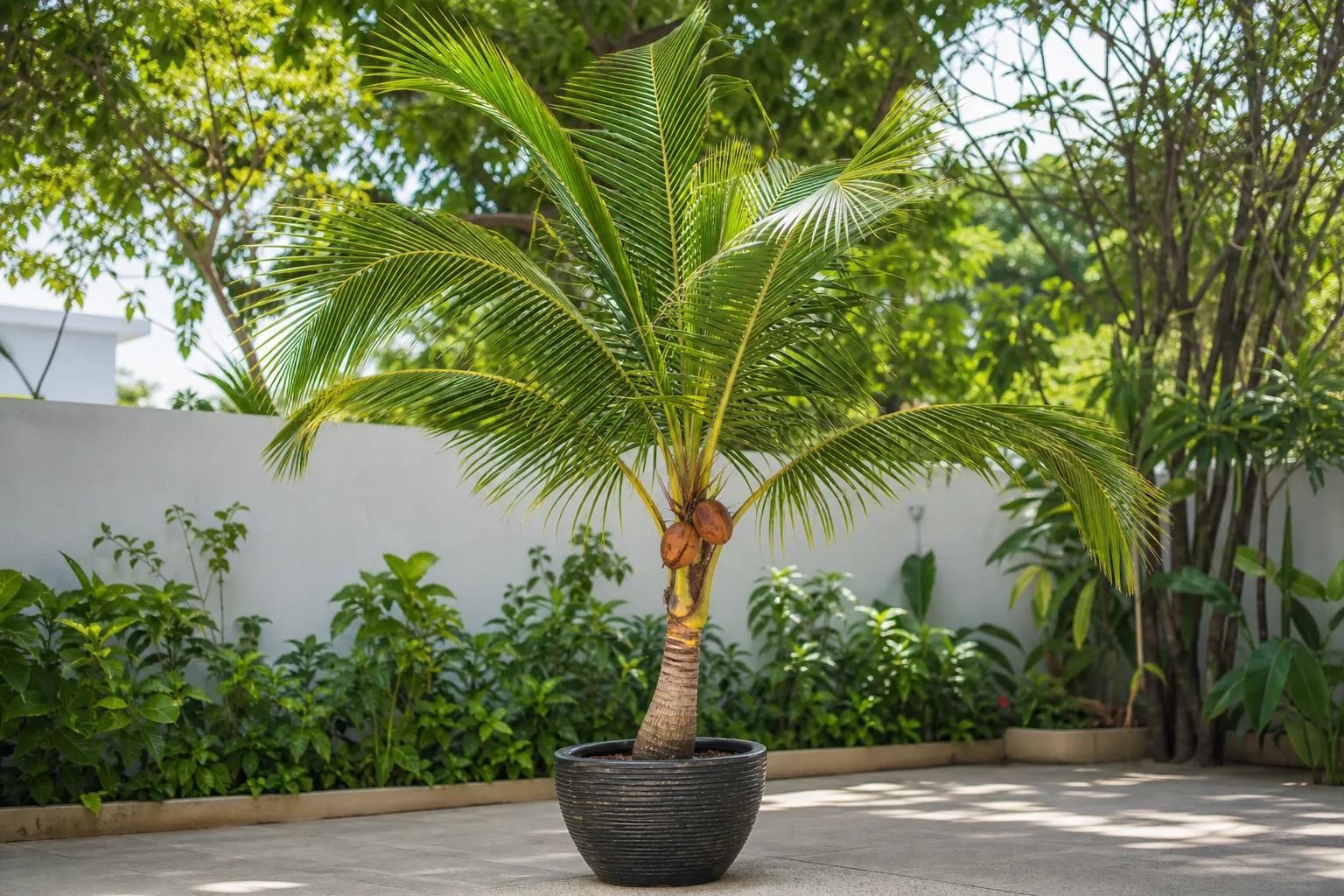
Coconut Tree Fertilizer Guide: Palm Special NPK
Coconut Tree Fertilizer Guide: Palm Special NPK
A pale or spotted coconut frond is not always a cue to pour on more feed. Cocos nucifera can look hungry when roots are waterlogged, light is weak, the mix is compacted, or a disease is starting—and fertilizer cannot fix those problems. Feed only when the palm is actively growing, the root zone drains, and Coconut Tree watering and Coconut Tree light are already in a workable range.
This guide is for landscape and terrace growers in frost-free tropical and subtropical climates, including much of coastal and inland India where coconut is common. Indoor pots are covered as short-term foliage specimens. Orchard kilogram rates for plantation blocks do not belong in a balcony tub.
The quick answer: what to feed coconut tree
For outdoor coconut palms, UF/IFAS recommends a palm-specific fertilizer—often sold as “Palm Special”—applied three to four times per year from spring through fall because coconut is prone to nutrient deficiencies. Prefer a controlled-release analysis near 8-2-12 +4Mg (or 8-0-12 +4Mg) with micronutrients, where nitrogen, potassium, and magnesium are slow-release and micronutrients are mostly soluble (UF/IFAS coconut palm care; UF/IFAS landscape palm fertilization).
For a young container coconut, use a complete controlled-release or dilute liquid palm/foliage fertilizer at the label’s container rate (or slightly below), and keep magnesium available in the mix. Do not dump landscape pounds of granular palm food into a small pot. Pause feeding when growth stalls in cool weather, the mix stays soggy, or the palm is recovering from transplant.
Why coconut fertilizer differs from generic houseplant feeding
Coconut is a large, single-trunk coastal palm with a high demand for potassium relative to many houseplants. In sandy or highly leached soils, potassium deficiency is one of the most common palm nutritional disorders worldwide, and Cocos nucifera shows classic translucent yellow-orange spotting on older leaflets as an early sign (UF/IFAS potassium deficiency in palms).
Generic “balanced” 10-10-10 or high-nitrogen lawn food pushes soft growth without enough potassium and magnesium to support it. UF/IFAS warns that high-N turf fertilizers applied even tens of feet from a palm can induce or worsen potassium deficiency as palm roots forage widely under the canopy (palm nutrition overview). That is why coconut feeding is about the right ratio and release form, not simply “more NPK.”
Missouri Botanical Garden describes best growth in moderately fertile, humusy, moist, well-drained soil in full sun—fertile enough to support a tropical palm, not a constant heavy salt load (Missouri Botanical Garden Cocos nucifera). Pair feeding with a free-draining Coconut Tree soil mix so nutrients stay available without drowning roots.
Best fertilizer type for coconut tree
Choose products labeled for palms when you can. The goal outdoors is a maintenance blend that keeps nitrogen, potassium, and magnesium available together for about three months between applications. Indoors or in small tubs, favor complete controlled-release prills or carefully diluted liquids rather than raw high-analysis farm granules.
Landscape palm special: 8-2-12 +4Mg
UF/IFAS research supports a maintenance fertilizer of 8N-2P₂O₅-12K₂O +4Mg with micronutrients for landscape palms in Florida soils, with an 8-0-12 +4Mg variant when phosphorus restrictions apply (UF/IFAS EP261). Critical detail: 100% of the N, K, and Mg should be slow-release; water-soluble macronutrients can leach out of sandy root zones after one heavy rain and leave harmful N:K or K:Mg ratios behind.
Micronutrients such as manganese, iron, zinc, and copper are usually included in soluble sulfate or chelated forms so they are available quickly. Spread fertilizer evenly under the canopy (the active feeder-root zone), not in spikes or bands against the trunk. A practical south-Florida landscape rate cited by UF/IFAS is about 1.5 lb of fertilizer product per 100 sq ft of canopy area on a three-month interval; scale by your canopy footprint, not by guesswork from a plantation table.
Container feeding for young coconut palms
In pots, nitrogen often becomes the first limiting nutrient because bark and peat microbes compete for N, while potassium deficiency is less common than in sandy landscapes (UF/IFAS container palm nutrition). Controlled-release fertilizers with a higher nitrogen emphasis (UF/IFAS cites examples such as 18-6-12) work well when used at the high end of the manufacturer’s recommended rates, provided magnesium is available—commonly via dolomite in the substrate.
Liquid feeding is an alternative: a complete soluble fertilizer near a 3-1-2 N-P₂O₅-K₂O elemental ratio with magnesium and micronutrients, injected or watered in around 200 ppm N, is a research-backed nursery pattern. For home growers, that usually means following the product’s container dilution chart and starting at half strength until you see steady spear growth without tip burn. Refresh degraded, soggy mix through the Coconut Tree repotting guide before chasing iron chlorosis with more salts.
A warm-climate coconut fertilizer schedule
In India and other true tropical climates, follow active growth and root-zone health more than a temperate four-season calendar. Feed when new spears are expanding, temperatures stay warm, and the palm is using water normally. Hold fertilizer during prolonged monsoon saturation in pots, cool stalled periods, drought wilt, fresh transplant stress, or any soft-crown emergency.
Landscape and garden palms
UF/IFAS Gardening Solutions advises applying palm-special fertilizer three to four times per year; the broader palm-nutrition page frames landscape applications as roughly three times from spring through fall, with winter applications unnecessary when growth slows (coconut palm care; palm nutrition). EP261 aligns with a three-month release interval for the 8-2-12-class blend.
In frost-free Indian coastal gardens, a practical home pattern is a measured palm-special broadcast under the canopy at the start of strong growth, mid-season, and again before growth slows—skipping applications when soil is flooded or local fertilizer blackout rules apply. Finished compost or well-rotted FYM can support soil structure as a modest top-dress away from the stem, but it is not a substitute for a palm-ratio mineral program when potassium deficiency is already visible.
Pots, terraces, and conservatory specimens
Young container coconuts need lighter, more frequent attention than landscape trees because the entire salt load stays in a closed volume. Use controlled-release prills per label duration, or a dilute complete liquid every four to six weeks only while the palm is pushing new fronds in bright warmth. Cut back hard when light drops, nights cool, or the pot stays heavy for days.
Never translate “1.5 lb per 100 sq ft” into a 30 cm nursery pot. If you recently moved the plant, wait for new root activity before the first feed, and keep the crown dry while the mix stays moist—see Coconut Tree overview for climate honesty on indoor limits.
How to apply fertilizer without burning roots
Water first if the mix or soil is bone dry, then apply fertilizer so salts dissolve into an already moist root zone. Broadcast granules uniformly from near the trunk outward under the frond drip line; UF/IFAS notes that concentrating product in holes, spikes, or trunk bands reaches only a tiny fraction of roots and raises burn risk (EP261 application guidance).
Water lightly after granular applications to settle prills into the mulch or soil surface. Keep fertilizer out of the leaf crown and off the spear. On lawns under coconut, use the same palm-special product across the shared root zone rather than a separate high-nitrogen turf feed that the palm will also take up.
Deficiency warning signs on Cocos nucifera
Nutrient problems on coconut are diagnosed mainly by where symptoms sit in the canopy and on each frond. Older-leaf patterns usually point to mobile nutrients such as potassium or magnesium; newest-leaf patterns point toward manganese, iron, or boron issues. Correction of severe deficiencies can take one to three years because the palm must grow a new canopy of clean fronds (UF/IFAS nutrient deficiencies of palms).
Potassium deficiency on older fronds
On Cocos nucifera, early potassium deficiency appears as translucent yellow or orange spotting on older leaflets, often progressing to marginal and tip necrosis and a frizzled look on the worst leaves (EP269). Symptoms are worse toward the tip of a frond and on the oldest leaves first. Late-stage deficiency shrinks and chloroses new leaves, tapers the trunk (“pencil-pointing”), and can kill the palm.
Do not strip every yellow older frond while you correct potassium shortage. Regular removal of symptomatic potassium-deficient leaves has been shown to accelerate decline and can contribute to premature death; those leaves still supply remobilized nutrients to newer growth (EP269 management). For severe cases, UF/IFAS describes a temporary higher-potassium correction program that includes slow-release potassium sulfate plus about one-third as much slow-release magnesium before returning to the 8-2-12 +4Mg maintenance blend.
Manganese, boron, and other coconut clues
Manganese deficiency shows on new leaves: chlorosis with necrotic streaking, frizzled new growth, and on coconut a “singed” look as necrotic leaflet tips drop. Temporary cold soils can trigger manganese symptoms even when soil Mn is only marginally adequate—UF/IFAS notes this pattern particularly on Cocos nucifera in Florida (EP273). Composted sewage sludge or manure used as a heavy amendment can bind manganese and worsen the problem.
Mild boron deficiency on coconut often appears as rigid “hookleaf” leaflet tips; more severe or repeated shortages can create truncated leaf tips, multiple unopened spears, premature nut drop, or necrotic flower stalks. Premature fruit drop from boron shortage should be distinguished from lethal yellowing, where fallen nuts typically show a blackened calyx end (EP273). Magnesium deficiency, when present, shows broad yellow margins on oldest leaves with a distinctly green center—do not confuse it with potassium tip-burn patterns.
What not to do when feeding coconut tree
Do not use high-nitrogen turf or “grow formula” fertilizers under or near coconut if you can avoid it. Do not spike fertilizer against the trunk or inject soluble concentrates deep into the “root zone” as a shortcut. Do not apply full orchard rates into a terrace pot, and do not feed a palm sitting in stagnant water.
Do not prune away every spotted older frond as soon as fertilizer starts. Do not assume yellowing is always a nutrient gap—check drainage, light, cold damage, and disease first. If salts crust the pot surface or tips burn after feeding, flush freely draining containers with plain water, discard runoff, and pause fertilizer for several weeks.
When to use this page vs other Coconut Tree guides
Use this fertilizer page when you need product type, schedule, placement, and deficiency interpretation for Cocos nucifera. Switch to Coconut Tree watering if fronds yellow while the mix stays wet or the pot never dries. Use Coconut Tree soil when drainage, pH, or mix structure is the real limiter. Use Coconut Tree light before increasing feed on a shaded indoor specimen. Use Coconut Tree repotting when roots are circling, the mix has collapsed, or iron chlorosis tracks with a soggy, degraded substrate. Use Coconut Tree pruning only for truly dead fronds and safety cuts—not as a cure for potassium spotting.
Related Coconut Tree guides
- Coconut Tree overview — climate fit, size, and indoor limits before you invest in feeding for fruit
- Coconut Tree watering — moisture timing that decides whether fertilizer helps or burns
- Coconut Tree soil — drainage and mix structure for nutrient uptake
- Coconut Tree light — sun requirements that drive real growth response to feed
- Coconut Tree repotting — when to refresh substrate instead of stacking more fertilizer
- Coconut Tree propagation — seed nuts and seedling care before a mature feeding program
- Coconut Tree pruning — what to remove safely without stripping nutrient-supplying fronds
Conclusion
Feed Cocos nucifera with a palm-special, potassium-forward program during active warm-season growth, not with generic high-nitrogen houseplant or turf formulas. Outdoors, a controlled-release 8-2-12 +4Mg-class fertilizer three to four times per year under the canopy is the research-backed maintenance pattern; in pots, use complete controlled-release or dilute liquids at container rates and protect magnesium supply. Watch older fronds for translucent yellow-orange potassium spotting, leave those leaves in place while you correct nutrition, and fix water, light, and soil before you reach for a stronger bag.