How to Prune a Coconut Tree: When, Where & What to Cut
How to Prune a Coconut Tree: When, Where & What to Cut
How to Prune a Coconut Tree: When, Where & What to Cut
First, remove only fully brown, completely dead Coconut Tree fronds and spent flower or fruit stalks—cut each petiole close to the trunk without nicking the trunk wood. Do not strip green fronds, half-yellow lower leaves, or the spear for “shape” until you know whether the yellowing is nutrient stress rather than true death. For whole-plant context—sun, climate honesty, and why this is a solitary palm—see the Coconut Tree overview.
Reviewed by LeafyPixels Review Board · Author: sai-ananth
Quick answer
Prune a Coconut Tree (Cocos nucifera) for cleanup and safety, not for bushiness. UF/IFAS palm specialists recommend removing completely dead leaves and flower or fruit stalks anytime they appear, while leaving a full, rounded green crown—not a skinny “feather-duster” or hurricane-cut tuft. On living tissue, follow the industry rule of thumb: do not remove fronds whose tips sit above the horizontal plane (the 9:00 and 3:00 positions on a clock face). Overpruning reduces photosynthetic capacity, can shrink future leaf size and trunk caliper, and left coconut palms more likely to lose crowns in Florida hurricane observations than fuller neighbors.
Pruning cannot turn this single-trunk palm into a branched shrub, fix chronic low light indoors, or replace missing potassium. Correct feeding and watering before you cut living yellow fronds that are still feeding the crown.
What pruning does (and does not do) for Coconut Tree
Cocos nucifera is a solitary palm: one growing tip (apical meristem) at the crown produces every new frond. There are no side buds on the trunk waiting to sprout after you “top” it. Cutting into or removing that growing tip kills the palm. Missouri Botanical Garden likewise notes that harvesting the growing tip for heart of palm is fatal to the tree (Missouri Botanical Garden).
What pruning can do:
- Clear fully dead hanging fronds that snag wind, shade the lawn, or look neglected
- Remove flower and fruit stalks early so heavy nuts do not become a drop hazard
- Let you inspect the crown for soft tissue, spear collapse, or pest webbing
- Reduce missile risk from already-detached dead leaves ahead of storm season
What pruning cannot do:
- Make the palm bushier or create a second trunk
- Fix sparse indoor growth caused by weak light
- Cure lethal yellowing or similar systemic diseases by cutting yellow leaves
- Substitute for palm-special fertiliser when older fronds are potassium-deficient
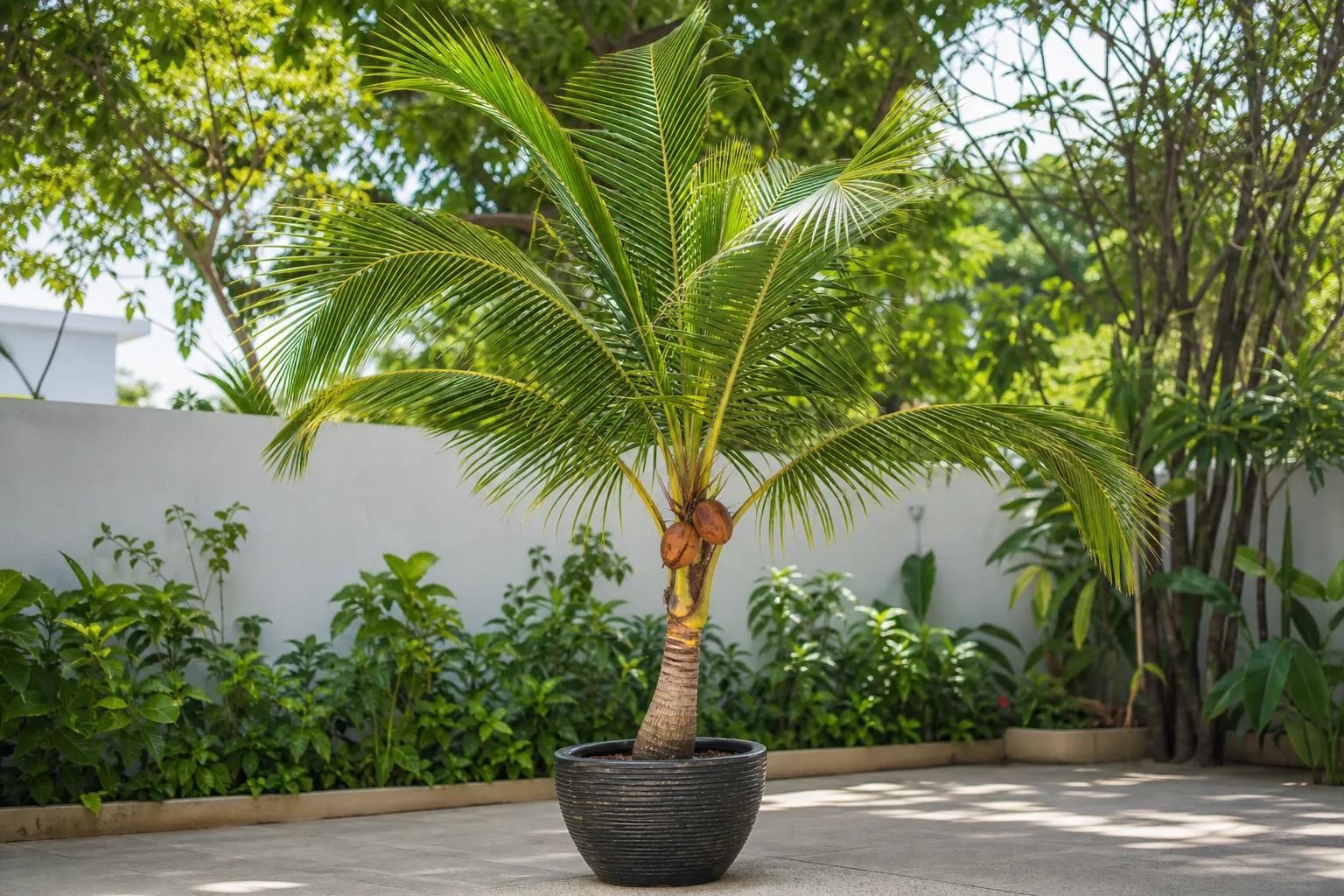
A healthy, well-fed coconut canopy looks rounded, with green leaves retained well down the crown. UF/IFAS notes that a properly fertilised Cocos nucifera can hold about 26 or more leaves, while a potassium-deficient South Florida ‘Malayan Dwarf’ often holds only about 13 before any pruning begins (UF/IFAS Pruning Palms).
When to prune Coconut Tree
Routine cleanup vs storm or fruit safety
From the palm’s perspective, there is no single “best month” for removing dead tissue—dead fronds and spent stalks can come off whenever they appear (UF/IFAS Pruning Palms). In practice:
- Any time: fully brown fronds that hang against the trunk; spent flower stalks; loose, ready-to-drop dead leaves before storm season
- Early stalk stage: small flower stalks when you want to prevent fruit set and messy or hazardous nut drop in yards, paths, or public spaces
- After correcting nutrition: only then consider limited removal of lower living leaves on a full, green canopy—and still stay at or below the horizontal leaf rule
Commercial palms are often pruned on a fixed schedule for appearance. Home growers usually do better pruning when a dead frond appears rather than stripping the crown on a calendar date.
After cold or wind damage
After a cold snap, leave cold-damaged fronds in place until the threat of further cold has passed; remaining leaf bases can help insulate the bud (UF/IFAS Pruning Palms). After wind, kinked but still living fronds can be removed if plenty of healthy canopy remains. If only a few damaged leaves are left after a severe storm, keep them temporarily as a photosynthate source until new spears expand.
What to check before cutting
Before the first live cut, check:
- Dead vs deficient: Fully brown and dry vs still-living yellow/orange older fronds with translucent spotting or tip necrosis (classic potassium stress)
- Crown health: Firm spear, no foul soft rot at the bud, no progressive premature nut drop plus blackened flower stalks (urgent disease signals on coconut; see UF/IFAS coconut disease notes)
- Canopy count: Roughly how many green fronds remain—if the palm already looks half-bare, do not remove living leaves “to buy time”
- Access and height: Tall landscape trunks need a pole saw or a qualified climber using non-spike methods—never climbing spikes
- Stress stack: Recent transplant, waterlogged mix, or cold indoor placement means delay cosmetic cuts; stabilise soil moisture and warmth first
Young container plants follow the same biology at smaller scale: remove only dead or clearly detached tissue, and protect the soft spear and trunk from wounds.
The first cut to make
Remove one fully dead frond (or one spent flower/fruit stalk) close to the trunk. That single cleanup cut teaches you the petiole angle, confirms your tools are sharp, and avoids the common mistake of starting with a ring of green lower leaves.
Only after dead tissue is gone should you decide whether any living lower fronds truly need to come off for clearance or safety—and most home coconut palms need little or none of that if feeding is adequate.
How to prune Coconut Tree step by step
Tools and trunk safety
Use sharp bypass loppers, a pruning saw, or a pole saw sized to the petiole. Wipe blades between palms with a disinfectant such as 70% isopropyl alcohol when disease is a concern in the neighbourhood.
Cut the petiole close to the trunk, but do not chop into the trunk with a machete. Fresh trunk wounds can admit Thielaviopsis trunk rot and never “heal” the way woody dicot bark does (UF/IFAS Pruning Palms; Thielaviopsis trunk rot). Do not yank fronds that resist—pulling can tear a strip of trunk tissue and create the same entry wound. Never use climbing spikes; spike holes are permanent and can attract pests or pathogens.
Removing dead fronds
- Identify fronds that are entirely brown and dry, usually hanging against the trunk.
- Support the frond so it does not tear bark as it falls.
- Cut the petiole flush with the trunk contour—close, clean, no trunk gouge.
- Clear debris from the crown base so water does not pool against wounds.
Leave fronds that are still partly green or that show deficiency patterns but remain alive. Removing those older leaves while potassium is short forces the palm to pull K from the next healthier leaves and can accelerate decline (UF/IFAS Pruning Palms). Fix nutrition with a palm-special programme described in the Coconut Tree fertilizer guide instead of cosmetic stripping.
Flower and fruit stalks
There is no evidence that removing living flower or fruit stalks harms the palm; diverted carbohydrates can support leaf production, and early stalk removal is far safer than waiting for heavy nut clusters to ripen over walkways (UF/IFAS Pruning Palms). UF/IFAS landscape guidance also notes harvesting with an extended saw pole when fruit is wanted (UF/IFAS Gardening Solutions).
If you are growing for seed, leave selected stalks and use the propagation guide for planting viable nuts. Outdoors in India and other tropical home gardens, treat falling nuts as an impact hazard—prune stalks early near doors, paths, and play areas.
How much you can safely remove
Safe anytime: all completely dead leaves and spent stalks.
Living leaves: ANSI-aligned practice for palms is not to remove leaves with tips above the horizontal (9:00–3:00) line. In some Florida counties, cutting above that line is even a civil offense (UF/IFAS Pruning Palms).
On a potassium-sufficient coconut with a full ~26-leaf canopy, theory allows removing about as many lower green leaves as the palm will produce before the next pruning cycle—Cocos nucifera produces roughly 10 leaves per year in South Florida estimates. Starting from a deficient 13-leaf canopy and removing 10 living leaves leaves a three-leaf “hurricane cut”—exactly the overpruned look extension agents warn against.
Rule for most growers: if the palm is not fully green and rounded, remove dead tissue only. Do not chase a pineapple or feather-duster silhouette.
What not to cut
- The spear leaf or any cut that damages the single apical bud
- Green fronds above the horizontal plane for appearance alone
- Yellowing but living older fronds on a nutrient-stressed palm
- Trunk wood while trimming petioles
- Entire crowns into a hurricane cut before storms—overpruned coconut palms observed after Florida hurricanes were more likely to lose their crowns than fuller palms nearby (UF/IFAS Pruning Palms)
Indoor or conservatory specimens outgrowing a room cannot be “kept small” by topping. Move the plant outdoors where climate allows, or accept that Cocos nucifera is a temporary indoor foliage palm—see the overview and repotting guides for realistic size management.
Aftercare and recovery timeline
After cleanup cuts:
- Keep the root zone evenly moist but draining—do not flood the crown.
- Maintain full sun outdoors or the brightest warm conservatory light indoors.
- Resume or start palm-special fertiliser during active warm-season growth if deficiency drove the yellowing you left in place.
- Watch the next spears: steady emergence of new fronds is the recovery signal, not instant greening of old tissue.
New coconut fronds emerge slowly. With roughly ten leaves per year in warm climates, expect visible canopy refill over months, not days. A correctly pruned palm should keep a rounded silhouette and firm spear. Warning signs after bad pruning include a tiny remaining tuft of soft young leaves, fresh trunk wounds, stalled spears, or progressive yellowing that moves upward—pause further cuts and reassess water, nutrition, and disease.
Mistakes to avoid
- Hurricane or feather-duster cuts that leave only a top tuft
- Stripping yellow K-deficient leaves instead of fertilising
- Climbing spikes or machete chops into the trunk
- Pulling resistant petioles until bark tears
- Topping the palm expecting side shoots
- Pruning for bushiness on a species that cannot branch from the trunk
- Stacking stress—hard canopy reduction the same week as transplant or cold damage
Related Coconut Tree guides
- Coconut Tree overview — climate fit, solitary growth habit, and realistic indoor limits
- Coconut Tree light — full sun outdoors; why dim rooms produce sparse crowns pruning cannot fix
- Coconut Tree watering — even moisture after cuts without soaking the bud
- Coconut Tree fertilizer — palm-special feeding before removing yellow living fronds
- Coconut Tree propagation — planting nuts when you leave fruit on the tree
- Coconut Tree soil — drainage that protects roots while the canopy refills
- Coconut Tree repotting — container size limits when topping is not an option
Conclusion
Coconut Tree pruning is mostly careful subtraction: dead fronds and unwanted flower or fruit stalks, cut cleanly beside an uninjured trunk, leaving a full green crown. Respect the horizontal leaf rule, refuse hurricane cuts, and treat yellow older leaves as a nutrition signal until they are fully dead. Protect the single growing tip—everything above the trunk depends on it—and let new spears, not aggressive shaping, rebuild the silhouette.