Mealybugs on Dracaena Lemon Lime: Checks & Treatment
Quick answer
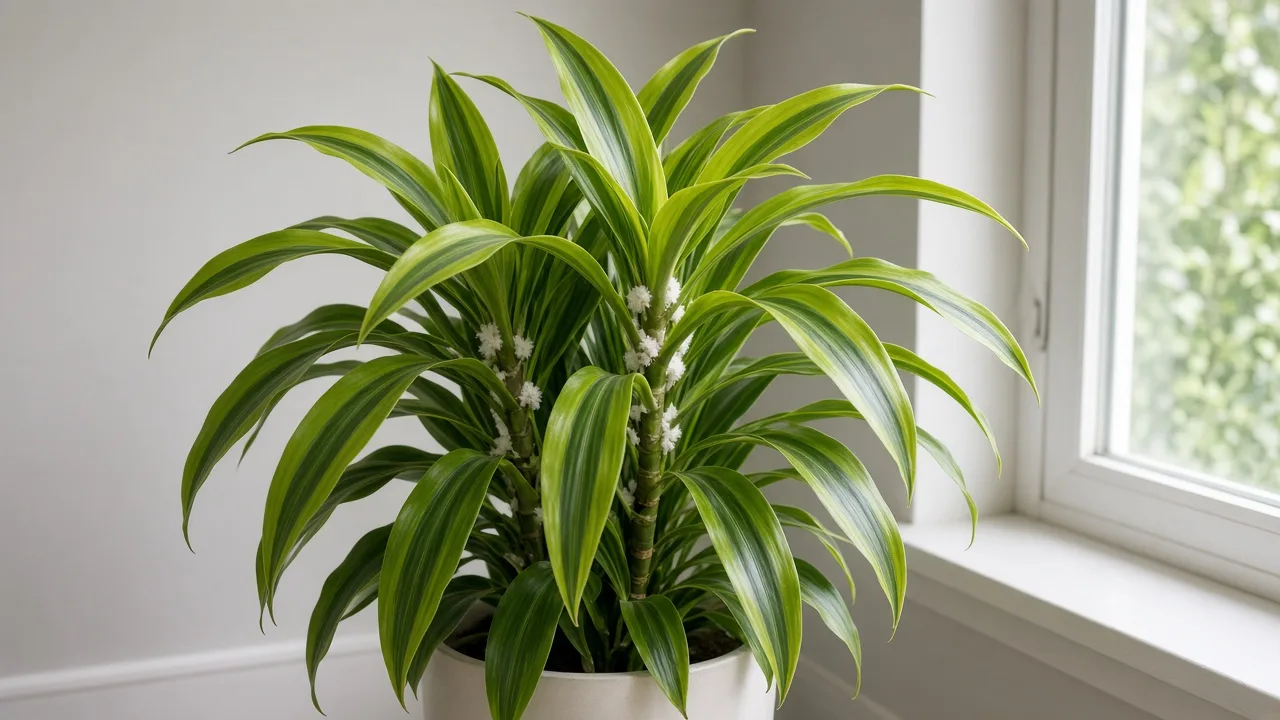
Mealybugs on Dracaena Lemon Lime look like loose white wax in the tight seams where narrow chartreuse-striped blades clasp the cane and along the arching leaf midrib on the underside. First, move the whole pot away from every other plant before you part leaves or rinse foliage.
Mealybugs on Dracaena Lemon Lime: Checks & Treatment
This guide covers mealybugs on Dracaena Lemon Lime. See also the general Mealybugs guide, watering, and light pages for this plant.
Mealybugs on Dracaena Lemon Lime: Checks & Treatment
Quick answer
Mealybugs on Dracaena Lemon Lime (Dracaena deremensis ‘Lemon Lime’) are easy to miss because the plant looks open and airy from across the room. Narrow arching blades banded in chartreuse and darker green hide pests in the seams where each leaf clasps the cane and along the underside midrib on the lowest arching leaves. Look for soft white wax that lifts on a dry swab, not the flat brown margins fluoride burn leaves behind.
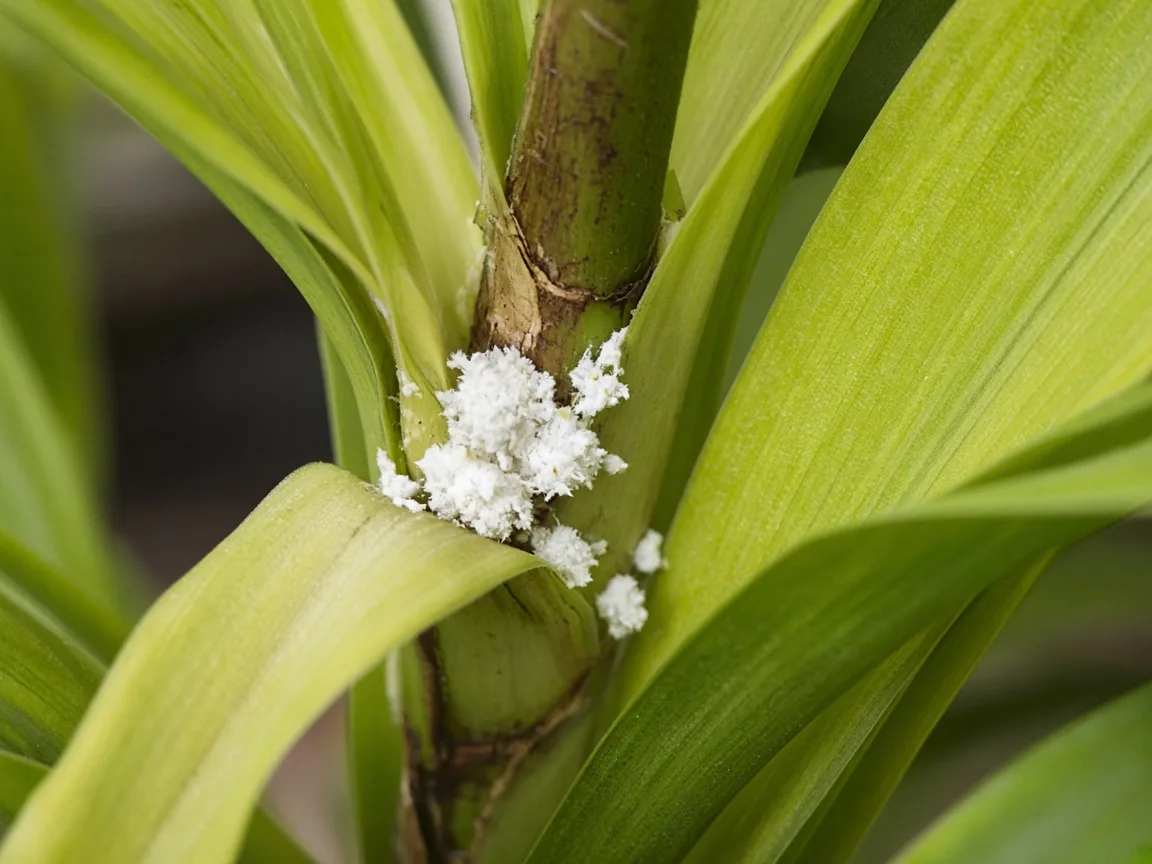
Illustrative generated diagnostic image, not a photograph of a documented infestation. Confirm a soft-bodied insect beneath the wax before treating your plant.
First fix: isolate the whole pot from every other plant. Do that before you part arching leaves, rinse blades, or carry the pot past a grouped display. Isolation contains mobile crawlers and stops a cleaning cloth or watering can from carrying insects to a neighboring spider-mite or aphid hotspot on another dracaena.
Once the pot is apart, confirm an insect beneath the wax, spot-test one hidden axil, treat only confirmed pests, then inspect weekly. For general mealybug biology and control options that apply across houseplants, see the main mealybug guide. The checks below focus on Lemon Lime’s warneckii habit, striped arching blades, fluoride-sensitive tips, and the lookalikes that share the same genus.
UC IPM describes mealybugs as small, soft, wax-covered insects that suck sap, often produce sticky honeydew, and cluster in protected sites on houseplants.
When to use this page vs other Dracaena Lemon Lime guides
Use this page when you see cottony wax, a soft-bodied insect, or recurring honeydew in leaf-to-cane joints or on arching blade undersides.
| Pattern | Read next |
|---|---|
| Fine pale stippling, delicate webbing, no cotton | Spider mites |
| Soft green or pear-shaped clusters on newest blades | Aphids |
| Brown dry tips without wax or stickiness | Brown tips (fluoride or dry air) |
| Yellow lower leaves on a heavy wet pot | Overwatering or root rot |
| Small dark flies when you water | Fungus gnats (often shares damp mix, not the same insect) |
| Stripes fading in a dim corner with no insects | Not enough light or leggy growth |
Where mealybugs hide on arching Lemon Lime blades
Glasshouse mealybugs live together in clusters in inaccessible plant parts such as leaf axils, leaf sheaths, and stem crotches. Lemon Lime’s narrow warneckii leaves create long sheltered seams even though the canopy looks sparse.
Work from the newest growth down each cane:
- Follow each arching blade to its insertion on the cane. Check the front-facing clasp and the hidden side behind the curve.
- Lift the lowest leaves gently and scan the underside midrib and the point where the sheath wraps the cane. Mealybugs often start low before you notice stickiness higher on the plant.
- Inspect every cane in a multi-stem pot. One clean stem beside a wax-coated neighbor is common on nursery-grown Lemon Lime.
- Shine a light into overlapping arching blades on dense specimens without snapping stiff tissue. Illuminate the seam; do not force leaves backward.
- Check the soil line, pot rim, cachepot lip, and drainage holes if foliar cleaning has not stopped new wax.
Healthy Lemon Lime tissue is smooth, striped, and attached firmly to firm cane wood. Mealybug wax is irregular, cottony, and often covers a pinkish segmented insect you can see with a hand lens.
Chartreuse stripes, fluoride tips, and wax lookalikes
Lemon Lime owners often mistake pest signs for care stress because this cultivar shows fluoride-sensitive brown tips and faded stripes in dim corners. Use the table before dabbing alcohol on arching blades.
| What you find | More likely explanation | Deciding check |
|---|---|---|
| Loose white wax in leaf-to-cane seams, sometimes sticky | Mealybugs | Soft segmented insect under movable wax |
| Fine pale stippling, delicate webbing, no cotton | Spider mites | Tap a blade over white paper and look for moving specks |
| Brown dry tips without wax or stickiness | Brown tips from fluoride or dry air | Damage follows margins; axils stay clean |
| Washed-out chartreuse with no honeydew | Low light | Stripes dull evenly; inspect axils anyway |
| Several yellow lower leaves on a heavy wet pot | Overwatering | Cane base softens; soil stays soggy |
| One oldest arching blade yellowing while the crown stays firm | Normal slow turnover on a cane plant | No honeydew; still inspect seams because pests often start low |
Wisconsin Extension notes that the cottony layer limits moisture loss and that crawlers retain legs and can move to new sites, especially stem tips and leaf junctures—exactly the arching warneckii joints Lemon Lime offers.
Confirm insects before treating the cane
Adult female mealybugs are oval, soft-bodied insects beneath a white waxy coating. Use these confirmation checks:
- Touch suspect wax with a dry cotton swab. Mealybug colonies lift or smear pink; normal plant tissue and mineral crust do not.
- Look for sticky honeydew on blade surfaces or the shelf below, or black sooty mould growing on that honeydew. The RHS links sooty mould to sap-feeding insects rather than to watering alone.
- Watch for ants visiting the pot; they are often drawn to honeydew and can protect colonies from predators.
If you see hard brown bumps that do not move and lack cottony fringe, compare spider mites and scale-like bumps on other dracaenas before treating.
Read the cane without breaking slow new growth
Lemon Lime opens new narrow blades slowly along each cane. A paused flush is not proof of pests by itself; weak light or a recently dried root ball can also slow growth. Cross-check brightness and the top-2-inch dry-down from the watering guide and light guide when seams look clean but nothing new is arching out.
Never rip arching leaves apart to hunt insects. That can scar striped blades and create brown tears that mimic pest damage later. Illuminate the seam, treat only what you can reach, and repeat weekly.
Treat axils and arching blades without soaking the crown
After isolation and confirmation, use a cotton swab moistened with 70% or weaker isopropyl alcohol on each visible insect. UC IPM advises testing the solution on a small part of the plant for one to two days before wider use because alcohol can burn foliage.
On Lemon Lime, spot-test one concealed axil on an older arching blade, wait one to two days, then dab only the insects—not the entire striped surface or cane. Work from the growing point outward so you do not push hidden crawlers deeper into overlapping blades. Replace the swab when it becomes waxy, and use a fresh swab for a different plant.
Wipe honeydew from mature leaves with plain water on a soft cloth, but do not leave treatment solution pooled where blades overlap at the cane tip.
Alcohol and pesticide safety
Use the smallest practical amount of alcohol in a ventilated place. Keep bottles, wet swabs, and treated plants away from flames, sparks, and hot surfaces until dry. Lemon Lime dracaena is toxic to cats and dogs; store alcohol and any labeled sprays where pets cannot chew drips from saucers or fallen arching leaves.
For commercial insecticidal soap or horticultural oil, use only products whose label allows the pest, plant type, and indoor setting. Follow ventilation and re-entry directions exactly. Do not mix products unless the label permits it.
When to add insecticidal soap
If fresh insects appear after careful weekly dabbing, use a commercial insecticidal soap labeled for indoor ornamental plants. Soap and alcohol are contact treatments: they work only where they touch the pest and do not leave long residual action. That matters on Lemon Lime because the innermost arching seams may stay unreachable until a new blade expands.
Spot-test soap on one striped leaf, keep the plant out of direct sun during treatment, and cover accessible undersides and joints rather than drenching the pot. Avoid fertilizing during an active infestation; tender new chartreuse flush can be easier for sap feeders to colonize. Review the fertilizer guide after pests are gone.
| Option | Appropriate use on Lemon Lime | Main limit or risk |
|---|---|---|
| Swab with alcohol | Small exposed colonies in axils or on undersides | Misses deep overlaps; can burn tissue; flammable |
| Labeled insecticidal soap | Repeated crawlers you cannot reach with a swab | Contact-only; needs full reachable coverage |
| Root-zone escalation | Fresh wax at drainage holes despite clean foliage above | Disturbs slow roots; needs product-specific guidance |
| Disposal | Severe, recurring infestation that reinfects the collection | Ends the plant but stops repeated indoor pesticide use |
Protect firm cane wood while treating a sparse canopy
Lemon Lime sometimes sheds older lower arching blades and keeps a tuft of striped foliage on a firm cane. Sparse leaves do not prove that mealybugs have reached the roots, and they are not a reason to water more often.
Keep using the top-2-inch dry-down check from the soil guide. If the mix stays wet, the cane base softens, or the pot smells sour, investigate root rot instead of repeatedly spraying the crown.
When drainage-hole wax changes the plan
Some mealybugs feed on roots, and foliar alcohol will not reach them. Suspect a root-zone problem when fresh white wax repeatedly appears at drainage holes or on roots despite clean arching blades above. Slide the root ball out once to confirm rather than disturbing the cane every week. If insects are present among roots, isolate discarded mix, clean the pot, and seek label-specific guidance from a local extension service.
A bounded monitoring and isolation plan
UC IPM notes that weekly repetition may be needed until the infestation is gone when using alcohol on houseplants, and that serious houseplant infestations can justify discarding the plant rather than endless treatment.
Use this finite protocol:
- Day 0: isolate the pot, confirm a live insect, remove exposed mealybugs, and spot-test any treatment.
- After 1–2 days: if the test axil is uninjured, treat remaining exposed insects per the chosen product label.
- Once each week: inspect every cane joint, both sides of each arching blade, pot rim, and drainage holes. Reset the count if you find a live insect, fresh wax, an egg mass, or returning honeydew.
- Release threshold: return the plant to the collection only after four consecutive weekly inspections find none of those signs. This four-check rule is a conservative LeafyPixels monitoring threshold based on extension advice to repeat treatment weekly; it is not a guarantee that every hidden egg has hatched.
Inspect neighboring plants during the same checks. Because Lemon Lime grows slowly, a clean month may pass before a new striped blade proves recovery—use pest-free inspections and firm cane tissue, not leaf count alone.
Judge recovery by new striped blades, not the oldest arch
An older arching blade that yellowed or scarred will not regain perfect chartreuse banding. Improvement looks like:
- no fresh wax at leaf-to-cane seams
- honeydew absent after wiping
- a new narrow blade arching out without cottony deposits in its fold
- firm cane wood from soil line to growing tip
- no insects on nearby plants
During cooler months or lower light, new growth may pause. Rely on repeated pest-free inspections rather than expecting a fast flush of replacement foliage.
Escalate or discard instead of treating indefinitely
Seek local extension help when you cannot identify the insect, labels do not cover indoor ornamentals, or confirmed root-zone wax persists after one careful unpotting. Maryland Extension notes that heavily infested houseplants may be easier to discard than to cure indoors, and the RHS advises that disposing of heavily affected plants can be simpler than eliminating entrenched mealybugs.
Discarding is reasonable when live insects continue after four correctly spaced weekly rounds, colonies remain deep in inaccessible overlaps, root-feeding forms are widespread, or nearby plants keep reinfesting. Seal the plant and potting mix before moving it through the home.
Mistakes that make a Lemon Lime infestation harder
- Treating brown tip burn like wax. Fluoride-sensitive dracaena margins stay flat; only movable cottony wax with an insect beneath needs alcohol.
- Pouring alcohol or soap into the cane overlap. Contact with the pest matters; pooled liquid stresses the growing point on a slow warneckii cane.
- Repotting on day one. Unpot only when drainage-hole wax or root inspection supports a below-ground infestation.
- Boosting water on a sparse plant. Fewer arching blades use less water; follow the watering guide instead of a calendar.
- Returning the pot after one clean day. Crawlers carry little wax and are easy to overlook.
- Ignoring dim-light stress while pests are present. Weak stripes and soft flush in a dark corner overlap with sap-feeder damage—cross-check light after insects are controlled.
Prevent a repeat around bright living rooms and desks
Female mealybugs do not travel far on their own; the RHS advises that new affected plants are a common entry route. Quarantine new houseplants for at least three weeks, including outer pots and stakes, before placing them beside an established Lemon Lime.
For a plant already in your home, make axil inspection part of normal watering. Rotate the pot, look behind each arching blade, and leave enough space that striped leaves do not rest against neighbors. Stable bright indirect light and a predictable dry-down support steady growth without the tender shoots that sap feeders prefer.
The Dracaena Lemon Lime overview explains the arching warneckii rhythm that helps you distinguish a resting plant from one declining under pests.
Related Dracaena Lemon Lime guides
- Dracaena Lemon Lime watering — keep moisture checks stable while the pot is isolated in a brighter quarantine spot.
- Dracaena Lemon Lime light — troubleshoot clean seams that still refuse to open new striped blades after pests are controlled.
- Dracaena Lemon Lime soil — assess drainage before unpotting for suspected root mealybugs.
- Yellow leaves on Dracaena Lemon Lime — when discoloration is the main symptom but insect evidence is unclear.