Brown Tips on Monstera Dubia: Causes & First Fixes
Quick answer
On Monstera dubia, a crisp brown tip is a moisture-delivery warning, but it does not identify one cause by itself. Check the base pot and climbing surface separately; if the root zone is neither dry nor waterlogged and room air is dry, stabilize humidity before adding water. Brown tissue will not turn green again, so judge the change by new leaves.
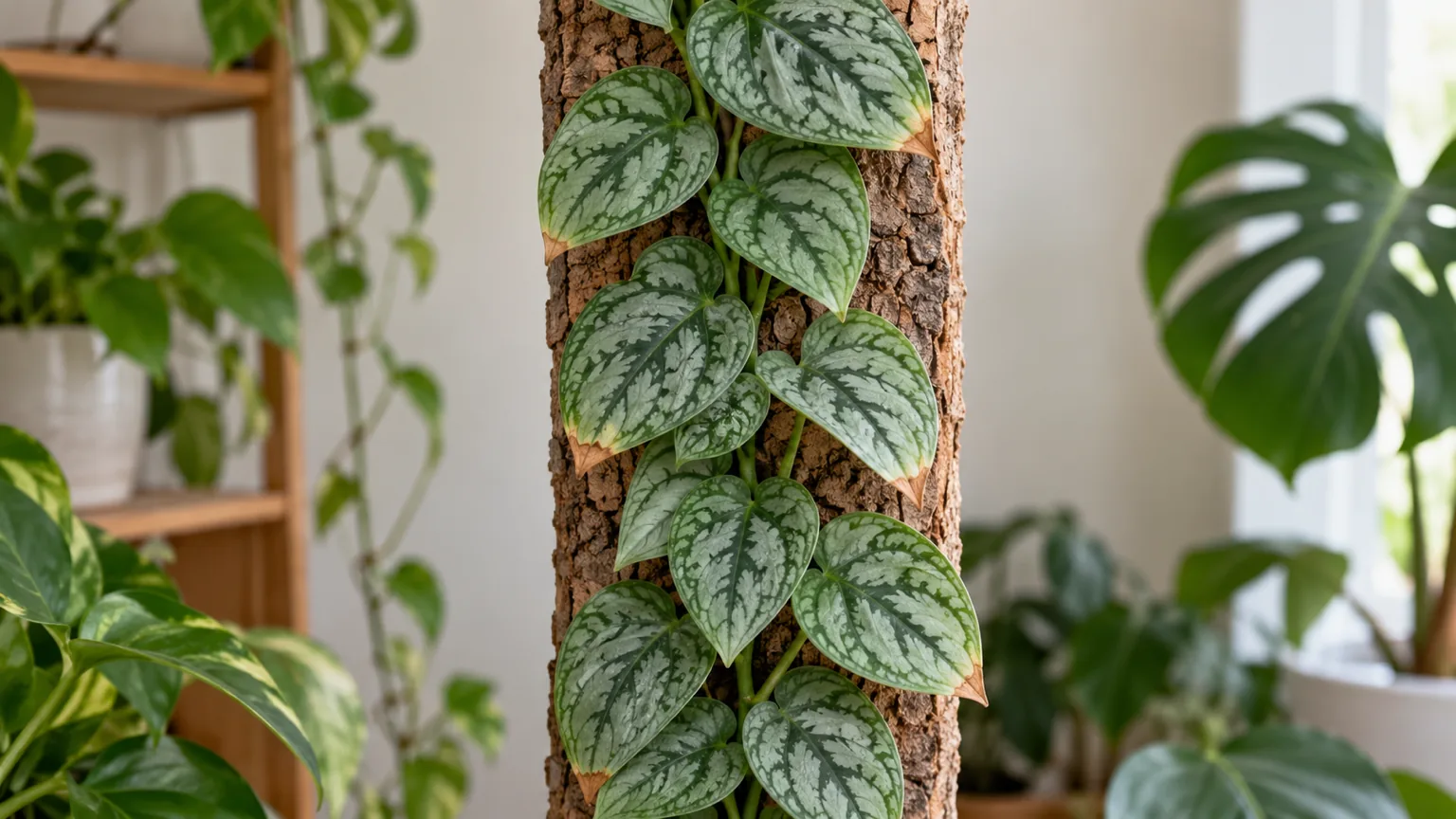
Brown Tips on Monstera Dubia: Causes, Checks & Fixes
This guide covers brown tips on Monstera Dubia. See also the general Brown Tips guide, watering, and light pages for this plant.
Brown Tips on Monstera Dubia: Causes, Checks & Fixes
Brown tips on Monstera dubia are a symptom, not a diagnosis. The first useful distinction is between a dry leaf-level environment and a struggling root zone: this plant can have a humid or dry climbing surface above a separate pot of airy mix. Check both before watering. If the pot is already moist and the leaves are firm apart from their tips, stabilize the air around the shingling vine rather than adding another drink. If the mix is genuinely dry, water it thoroughly and let it drain. The Monstera Dubia overview describes the plant’s board-grown habit; this guide narrows in on the particular clues that help explain dry tips.
What brown tips look like on Monstera Dubia
The common pattern is a tan, copper, or medium-brown point at the end of a leaf that feels dry or papery while most of the blade remains firm and silver-green. The dead area can extend a short distance along one or both edges, but the leaf does not usually become soft and wet. Older damage can remain as a small brown point after the condition that caused it has been corrected.
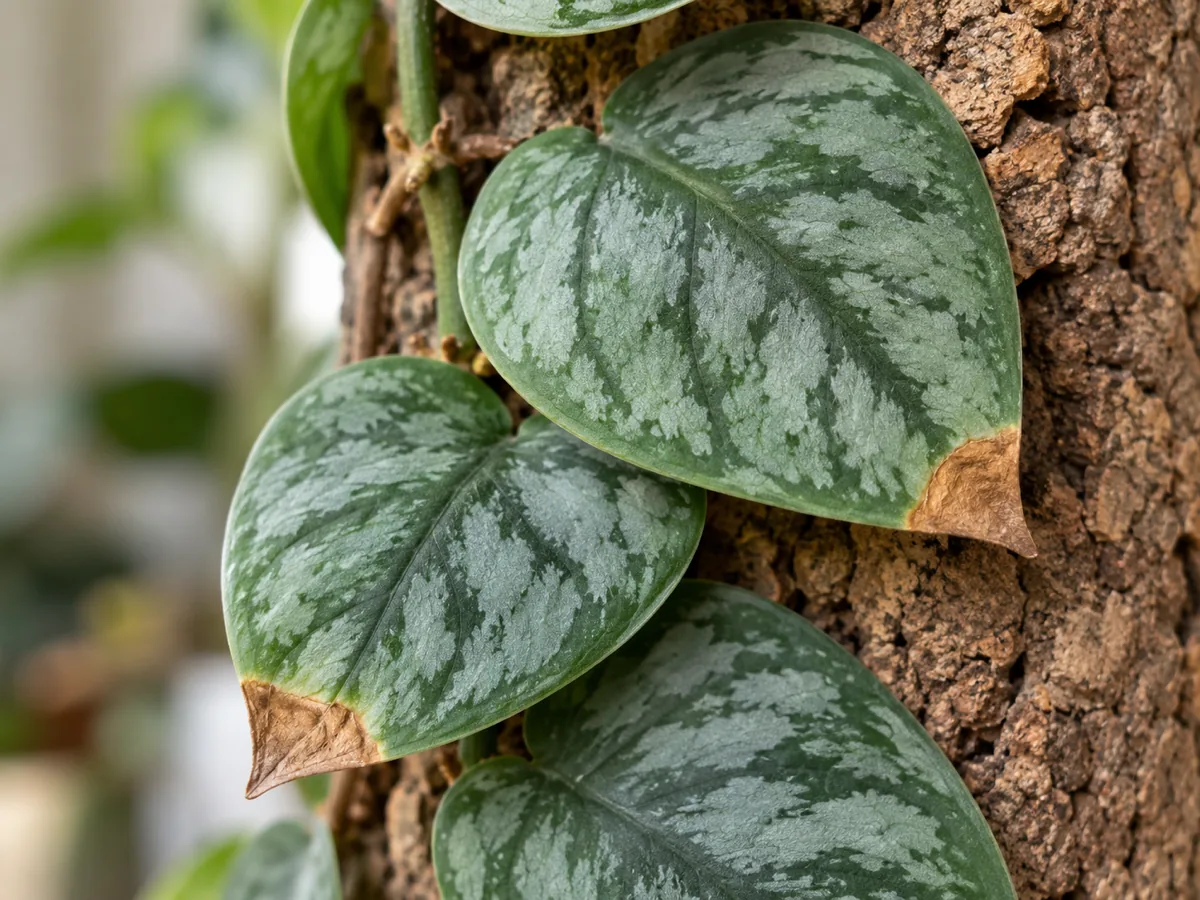
Dry, sharply outlined tips on otherwise firm juvenile shingles call for a check of air humidity and pot moisture before any extra watering.
Monstera dubia is grown indoors for its juvenile leaves, which overlap and lie close to a climbing surface. That arrangement makes the local conditions around the leaf and board worth inspecting: the room may be dry from heating, a nearby vent may blow across the vine, or one section of the board may sit closer to bright glass than the rest. Houseplant101 also describes brown, crispy edges as a possible low-humidity sign on this species, alongside leaves that do not lie flat against their support (Houseplant101’s Monstera dubia guide). Treat that as a clue, not proof; the same visual endpoint can follow a dry pot, damaged roots, fertilizer salts, or direct sun.
For a broader explanation of the shared causes of this symptom across houseplants, see the brown tips guide. Here, the helpful question is narrower: which part of this mounted Monstera Dubia is losing water faster than it can replace it?
Why Dubia’s shingling habit changes the diagnosis
The small, close-set juvenile leaves make a different growing setup from a free-standing Monstera with large blades. The vine’s stems and aerial roots press toward the board, while its potting roots remain in a container at the base. This creates two nearby but distinct moisture zones. The board or wrapped support can dry while the pot still holds enough water; the pot can also remain wet long after the exposed climbing surface feels dry.
Look at the pattern across the vertical vine. Tips on leaves facing a warm window, radiator, or air-conditioning stream suggest a localized exposure. Brown points scattered across leaves on different sides, especially when the room humidity has recently dropped, make a broader dry-air or water-delivery problem more plausible. The Royal Horticultural Society recommends bright indirect light for Monstera dubia, protection from direct sunlight, compost that is kept moist without becoming waterlogged, and humidity in the 60–80 percent range (RHS Monstera dubia care guidance). Those are useful reference conditions, but the condition of your own pot and leaves still decides which adjustment is needed.
The board is not a reason to keep the base pot wetter. If the support dries quickly, address that local environment with a measured humidity change or a modest adjustment to the support, while continuing to let the potting mix dry to its usual point. Penn State Extension notes that winter heating can lower indoor relative humidity substantially and that misting raises it only until the water evaporates; a humidifier or enclosed growing space gives a steadier change (Penn State Extension on humidity and houseplants). A few minutes of mist on the leaves is therefore a poor test of whether the air around the shingling surface is now suitable.
Check the board and base pot separately
Start without unpotting the plant. Touch the top few centimetres of mix and lift the nursery pot, if it is accessible. Note whether the mix is still cool and damp, the pot is heavy, or water is standing in a cachepot. Then look along the board and at the point where the vine meets it. The surface may feel dry even when the pot is moist. Record those observations before changing anything; they prevent the common mistake of using the board’s dryness as a watering signal.
Next, check the air where the leaves sit. A small hygrometer placed close to the middle of the shingling vine is more useful than a reading across the room, especially if the plant is on a shelf near a heater or window. Note the time of day, whether the heat or air conditioning is running, and which leaves face that airflow. If the reading is consistently much lower than the RHS range, dry ambient air is a credible contributor. If humidity is already steady and appropriate, do not keep increasing it in search of a cure; check the root zone, recent fertilizer use, light exposure, and whether the browning is confined to one exposed side.
Check the support gently rather than soaking it. If aerial roots have lost contact or the board is dusty and completely dry, note that for later correction, but do not pour water into the pot just to wet the board. A cedar plank, cork panel, or coir support may dry at a different speed from sphagnum or a moss pole. The Monstera Dubia watering guide is the right companion if you need to refine the pot’s dry-down check; it should not be replaced by a calendar interval.
Finally, inspect the newest leaves and the stem nodes. Look for firm stems, a normally opening leaf, and a stable silver-green surface. A few crisp tips with firm new growth are a smaller problem than browning that is advancing into whole leaf margins while several new shingles come in damaged. If the newest leaf is still unfurling, avoid handling or forcing it open to inspect the tip; a tear caused by handling can create a second, unrelated mark.
Match the pattern to the likely cause
Use the whole plant and recent care history together. Brown tips do not reveal a cause on their own. Penn State Extension’s general Monstera guidance likewise ties watering to soil dryness, recommends bright light without direct sun, and warns that overwatering can lead to root rot; this is useful genus-level context, not a Dubia-specific threshold (Penn State Extension’s Monstera guidance). George Weigel’s practical houseplant discussion also lists both too little water and roots damaged by persistently wet soil, along with water and fertilizer salts, as possible routes to brown tips (George Weigel on browning houseplants). Neither source makes the leaf tip a standalone test, so compare signs before choosing a correction.
| What you notice | What it points toward | What to check next |
|---|---|---|
| Dry tips, firm leaves, and humidity low near the vine | Dry room air or a hot, dry air stream | Measure at leaf height and check distance from vents or heaters. |
| Crispy tips plus a very light pot and dry mix below the surface | A root zone that is drying too far between waterings | Check how quickly the mix dries and compare it with the plant’s normal watering threshold. |
| Browning with yellowing, limp leaves, soft stems, or a pot that stays wet | Root stress, poor drainage, or possible rot | Stop adding water and inspect drainage and root-zone condition before changing humidity. |
| Damage mainly on the window-facing side or under a close grow light | Excess direct light or radiant heat | Check whether the plant recently moved or a light was moved closer; compare with the Monstera Dubia light guide. |
| White crust on the mix or pot rim after repeated feeding or softened tap water | Accumulated fertilizer or water minerals are possible | Review feeding and water history before flushing or repotting. |
| Fine pale stippling or webbing alongside brown edges | A pest may be present as well as a care issue | Inspect leaf undersides, midribs, and nodes before treating. |
The first fix for brown tips on Monstera Dubia
For a plant with crisp tips but a firm stem and a moist, draining root zone, the first fix is to make the air at leaf level more stable: run a humidifier near the climbing surface and aim toward the lower end of the RHS humidity range, around 60 percent. Keep the room ventilated and do not use a sealed bag or keep the foliage wet. This is one targeted change that addresses the leading dry-air pattern without risking wetter roots. If your hygrometer already shows stable humidity, skip this step and follow the matching diagnosis instead.
If the mix is dry at the plant’s normal check depth and the pot feels light, water the base pot thoroughly so the whole root ball is moistened, then let excess water drain away. Do not water again until the mix has dried to its normal threshold. If the pot is heavy and damp, with yellowing or a sour smell, do not add water or apply fertilizer; let the mix dry and check whether drainage is working. Repot only if the mix has collapsed, the pot has poor drainage, or roots show clear deterioration.
If the pattern follows direct sun or a heater vent, move the plant away from that exposure rather than changing its watering rhythm. Make the move gradual if it means a significant light change. The Monstera Dubia soil guide can help when the potting mix stays wet too long or has become dense; replacing good airy mix because one leaf tip is brown is unnecessary.
Correct a confirmed cause one at a time
When the room is dry: Keep the humidifier close enough to influence the leaves, but not so close that it blows condensation directly onto them. Check the humidity at the vine after the change and at a second time of day. Penn State Extension notes that common indoor humidity remedies vary in how much they affect the room; grouping plants or using an enclosed growing area can help some setups, but a hygrometer is the way to confirm the result. Avoid relying on repeated misting as a lasting humidity treatment.
When the pot dries too quickly: Check whether the plant has filled its container with roots, whether water runs straight through without wetting the mix, and whether the pot is exposed to warm air or strong light. Do not jump straight to a larger pot. If roots are circling densely or the mix has broken down, use the Monstera Dubia repotting guide and keep the replacement container only modestly larger. A much larger volume of wet mix can prolong dry-down and make the root-zone problem harder to read.
When fertilizer or water salts are plausible: Look for a visible mineral crust, a recent change in feed strength, or a schedule that continued while growth slowed. Pause feeding while the plant is stressed. If the mix drains freely and the root zone is not waterlogged, a careful flush with low-mineral water may reduce soluble residue; do not flush a pot that is already staying wet or has no drainage. Water-softening systems can add sodium, so if you know the household uses softened water, compare with a suitable untreated source rather than assuming that simply leaving water out overnight will remove all dissolved minerals.
When direct light is the match: Move the board out of the direct beam or add a sheer curtain. Sun damage tends to be strongest on exposed leaves and may look bleached, tan, or scorched across a broader patch rather than as a neat dry point at every tip. Once the new position is stable, observe new leaves before changing humidity or water as well.
When pests are present: Brown tips alone are not evidence of insects. If you also see webbing, stippling, or insects around the nodes, isolate the plant and identify the pest before selecting a treatment. Keep sprays off sensitive new growth until you have checked the product label and tested a small area; a pesticide is not a substitute for correcting dry air, poor watering, or salt accumulation.
Use the next Dubia shingle to judge recovery
The dry brown portion will not turn green again. A clean pair of scissors can shorten a conspicuous tip, but leave a narrow brown margin instead of cutting into healthy tissue. Do not remove every leaf that has a small mark: Monstera dubia makes its compact juvenile shingle panel from successive leaves, and retaining healthy green blade area helps the vine continue growing while the cause is addressed.
Think of recovery as a trend, not a color change in the old tissue. After the adjustment, check whether the brown boundary remains stable, whether any new tip is affected, and whether the next leaf opens normally and holds its usual firm texture. One clean leaf is encouraging, but it does not prove the whole cause has been removed if the board remains dry or the root ball keeps swinging between soaked and parched.
The timing depends on active growth. In warm, bright months, a growing vine may give you a new leaf sooner; in winter or low light it may pause, so a lack of immediate new growth is not by itself a reason to add fertilizer. Keep the care change steady long enough to compare at least one new leaf with the earlier pattern. If several leaves continue to brown at the tips or damage moves along the margins, return to the checks instead of trimming more foliage.
Mistakes that make diagnosis harder
The most damaging overcorrection is to water more often because a leaf tip looks dry. If the base pot is already damp, that can deprive roots of air while the climbing surface remains dry. Monstera as a houseplant is generally grown in a well-draining mix and watered according to soil dryness, not by a fixed day count; use that principle with the plant’s own small pot and current conditions rather than adopting a schedule from another Dubia owner.
Do not mist repeatedly and then assume humidity is solved. It gives a short-lived surface effect, can leave foliage wet, and does not tell you what humidity is doing later in the day. Do not fertilize to “green up” a brown tip before you know whether the root zone is healthy. Salts from excess feed may worsen tip injury, and a damaged leaf cannot reverse its necrosis by receiving more nutrients.
Avoid repotting, trimming, moving the board, and changing water source all at once. Each may be appropriate in a specific case, but changing several variables together removes the evidence that would tell you what helped. Make the correction that best matches the observed pattern, take a note or photo, and reassess before making a second change unless the plant is rapidly declining.
Prevent another round of brown tips
Keep the care routine for the base pot separate from the routine for the support. For watering, use the top few centimetres of mix and pot weight as checks, then water thoroughly and allow drainage. The RHS describes Monstera dubia as preferring compost that is moist but not waterlogged and recommends watering when the top few centimetres feel dry. A fixed “every six days” rule cannot account for a dark winter shelf, a sunny summer window, a small nursery pot, or a newly expanded board.
Place the plant in bright filtered light where the board and leaf tips do not touch hot glass or sit in the path of a heater. A light adjustment should preserve the soft, indirect exposure the species is normally given. Check humidity at the plant when seasons change; heated rooms can become much drier in winter, so the same board location may behave differently in January than it did in June.
Use a light feeding hand during active growth and follow the fertilizer label rather than increasing concentration to compensate for slow growth. If white mineral crust appears, note whether it followed fertilizer or a change in water source and correct that input first. Keep the airy mix and drainage intact so watering does not create a root problem while you are trying to prevent tip damage.
Once a week, glance along the vine rather than checking only its newest leaf. Look for new crispy ends, leaves lifting from the board, unusually long gaps between shingles, or changes in stem firmness. This quick inspection makes the next adjustment evidence-based: brown tips with flat, firm leaves and low humidity point toward the air, while yellowing and a persistently heavy pot send you back to the base roots. For other Dubia-specific issues, the Monstera Dubia problems hub keeps the care symptoms together.
When to worry about brown tips
Brown tips are usually a manageable cosmetic signal when the affected area stays small and the rest of the vine remains firm. Give the issue more attention if the brown area advances down the blade, most new leaves emerge affected, or tip injury appears along with yellow leaves, soft stems, persistent wet mix, or a sour odor. Those combined signs suggest that the roots or drainage may be involved, and repeated humidity adjustments alone will not solve them.
If a large section of the vine is collapsing or the stem at a node turns soft, inspect the root zone promptly and remove only tissue that is clearly dead. A plant may not recover if the main stem and its viable nodes have rotted, but a living, firm section with a healthy node may still be salvageable; Houseplant101 describes node cuttings as one way to propagate Monstera dubia (its Dubia propagation notes). Do not take cuttings from a plant with active pests until you have identified and contained the infestation.
Related Monstera Dubia guides
Use this page when the main issue is dry, crispy brown tissue at the leaf tips. Open the Monstera Dubia watering guide if soil moisture and pot weight are inconsistent, the light guide if damage faces a window or lamp, and the soil guide if mix texture or drainage is the concern. If leaves yellow while the mix stays wet or stems soften, compare with the root-rot guide rather than treating it as simple humidity stress.
When several symptoms overlap, use the Plant Problem Diagnosis Tool to organize the clues for this plant before changing more than one condition.