Spider Mites on Monstera Dubia: Signs and Treatment
Quick answer
Spider mites on Monstera Dubia leave scattered pale stippling, sometimes followed by bronze patches or fine webbing on leaf undersides. First isolate the plant; then confirm moving mites with a loupe or white-paper tap before rinsing or using a labeled contact treatment.
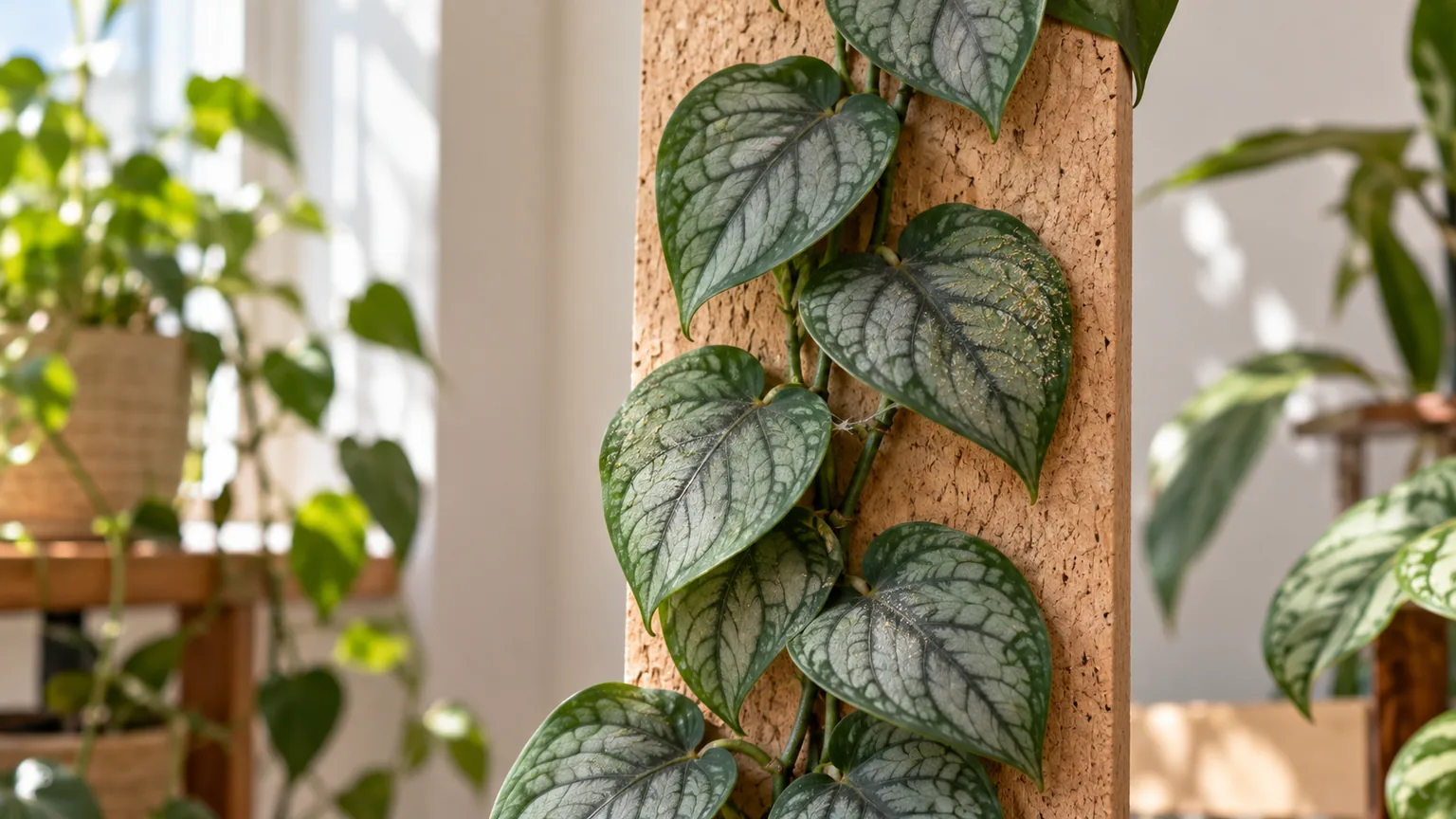
Spider Mites on Monstera Dubia: How to Spot and Stop Them
This guide covers spider mites on Monstera Dubia. See also the general Spider Mites guide, watering, and light pages for this plant.
Spider Mites on Monstera Dubia: How to Spot and Stop Them
Quick answer
On Monstera Dubia, spider mites usually show first as a fresh scatter of tiny pale dots on a leaf, with fine silk or more obvious yellow-bronze areas appearing as the population grows. The plant’s normal silver-green juvenile pattern can make the first damage easy to miss, and the shingled leaves can hide their undersides against a board. If you see moving specks or suspect silk, move the Dubia away from the rest of the collection first. Then confirm the pest before you rinse or spray; a dry room alone is not proof of mites.
Spider mites are tiny arachnids that feed on leaf cells, often in colonies on the undersides of leaves; their feeding can create stippling and, at higher numbers, webbing and leaf loss (UC IPM’s spider-mite guide). For the general pest life cycle and control options, see the spider mites guide. The Dubia-specific challenge is finding them through the overlapping leaf-and-support arrangement without peeling the vine loose or watering an already moist pot.
What spider-mite damage looks like on Monstera Dubia
The RHS lists Monstera Dubia as the “Shingle plant” and shows its silver-green juvenile leaves lying against a support; the same profile recommends bright indirect light, avoiding direct sun, and 60–80% humidity (RHS houseplant profile). On a healthy Dubia, the pale pattern is broad and organized around the darker veins, unlike a new peppering of separate, irregular pinpricks. Compare affected leaves with clean leaves of similar age on the same vine; if pale marks are multiplying outside the usual pattern, especially around the midrib, inspect the underside before deciding what caused them.
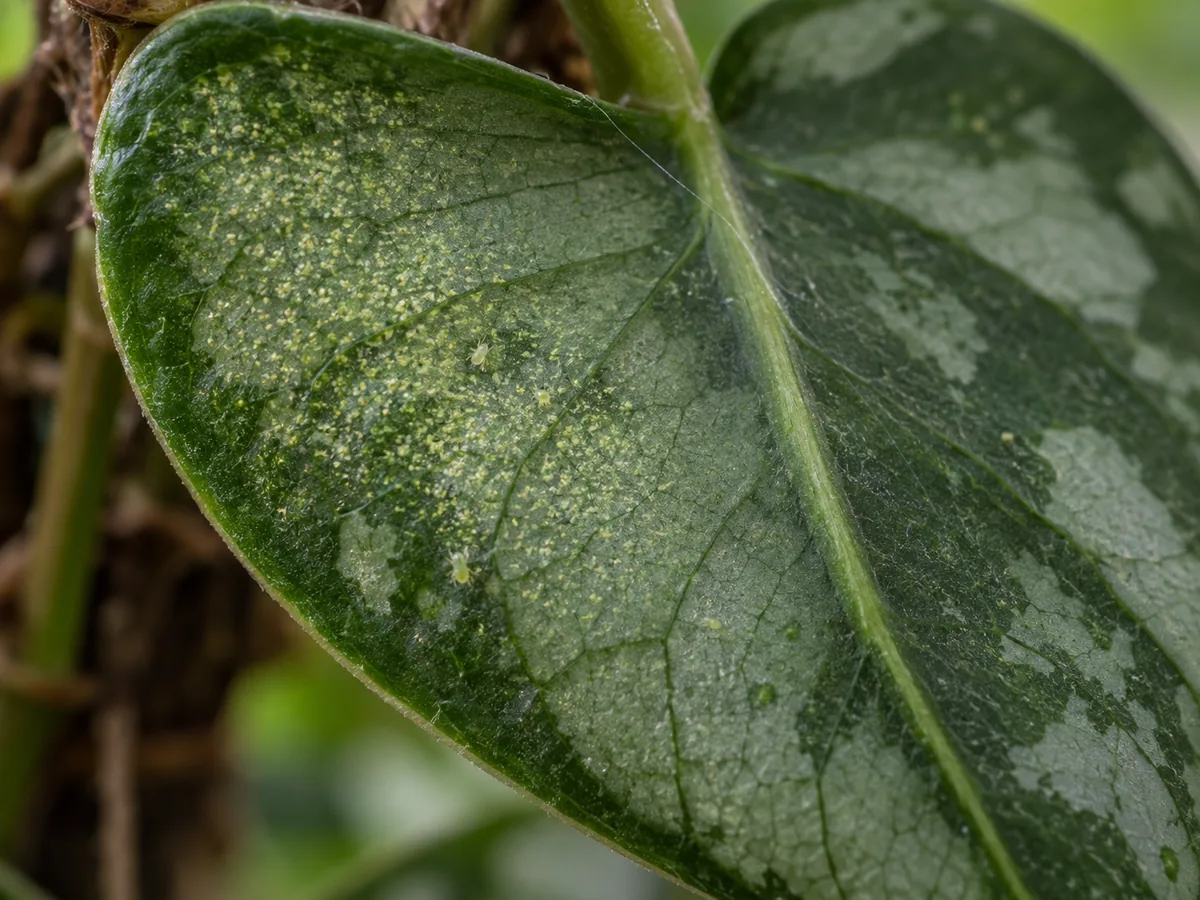
Fine pale stippling and a very light silk thread are easier to distinguish from Dubia’s natural silver pattern when you inspect the leaf underside.
Early mite injury may look like dullness or a dusty cast rather than a dramatic web. As feeding continues, individual stipples can merge into pale or bronze patches; a badly affected leaf may yellow, dry, and drop. Spider mites make fine silk, but conspicuous webbing is usually a later clue rather than a requirement for diagnosis. Wisconsin Extension’s damage notes describes the progression from stippling to pale, dry foliage and notes that visible webbing can cover leaves when numbers are high. A faint thread at a node is therefore worth checking, while a room spider’s loose web without moving mites is not enough to call this an infestation.
Why Dubia’s shingling growth changes the inspection
Monstera Dubia is normally grown as a juvenile vine that presses its leaves close to a flat surface. That attractive shingle pattern also creates narrow spaces: an older leaf can shade the blade behind it, and the board makes the back of the vine difficult to see from the front. Because spider mites spend much of their time on leaf undersides, a quick look at the face of the plant can miss the active colony. Start where a leaf blade, petiole, and stem meet; then check the midrib and any leaf edge that sits close to the support.
Do not pull every shingled leaf away from the board to inspect it. Dubia’s close contact with a support is part of its growth habit, and tugging a leaf or vine to expose its underside can tear tissue or loosen a node. Instead, slide the board a little away from the wall, use a phone camera or small mirror to view the hidden side, and gently angle the support toward a window. If the vine is on a removable board, move the whole board with the pot so you can see behind the leaves without unmounting them. Older, middle-aged leaves and the midrib are useful inspection points because spider mites are often found there (Wisconsin Extension’s scouting notes).
The humidity question needs the same plant-specific care. Dubia benefits from humid air around its shingle growth, while spider-mite problems are favored by warm, dry conditions; those facts do not mean every leaf that lifts from the board has mites. Wisconsin Extension notes that hot, dry conditions support mite development and that drier indoor air can make houseplant infestations harder to manage (Wisconsin Extension on hot, dry conditions). Keep the Dubia’s humidity and the pot’s moisture as separate checks: a board may feel dry while the potting mix is still damp. If leaves lift but you cannot find moving specks or silk, check support moisture and humidity through the Monstera Dubia humidity and care overview before treating for pests.
How to confirm spider mites before treating
A pale leaf is a reason to inspect, not a diagnosis. Use a bright window or work light and examine several leaves from both sides, especially the leaves near the lower or middle part of the climbing panel. Move the board rather than bending the vine. Look along the midrib, veins, petiole joints, and the shaded gaps where two shingled leaves overlap. A phone’s close-focus camera can help you see whether a speck is moving; a 10× hand lens makes tiny mites easier to distinguish from dust (UC IPM’s identification guidance).
If the marks are difficult to read, hold a clean sheet of white paper below one affected section and tap the leaf or support lightly. Pause and watch the paper. Tiny moving dots that travel across it are stronger evidence than color alone. You do not need to identify the mite species or count individuals to begin a mechanical rinse, but seeing a moving mite helps prevent a needless pesticide application. Insecticidal soap and oil act on contacted pests; treating a plant without confirming mites can expose Dubia’s foliage to a product that may not solve the actual problem.
Fine silk is a useful supporting sign. Spider-mite silk tends to sit close to the leaf or stem and may connect leaf veins, a midrib, or a petiole. Ordinary spider silk is often more open and draped across a larger gap; Epic Gardening’s spider-mite guide also distinguishes compact mite webbing from a loose spider web. The webbing comparison above is one reason a loose strand across the room is not enough to confirm mites. If there is no silk, do not stop checking: at an early stage, moving mites or a developing stipple pattern may be the only clues.
What else can make a Dubia leaf look stippled?
Use the pattern and the presence or absence of moving pests together. A single color change does not identify the cause, and Dubia’s normal leaf markings make same-plant comparison more useful than comparing it with a different Monstera species.
| What you notice | More consistent with | What to check next |
|---|---|---|
| Stable silver-green pattern that repeats on clean leaves, with no moving specks or silk | Normal juvenile Dubia markings | Compare leaves of similar age and use the Dubia overview for its shingling habit. |
| New irregular pinpoints plus moving specks under the blade, sometimes with fine silk | Spider mites | Isolate the vine and inspect the midrib and overlapping leaves again. |
| One pale or scorched patch on the window-facing side, with no moving specks and no spread to shaded leaves | Light injury is more plausible | Check the recent sun exposure in the Dubia light guide. |
| Leaves pulling away from the board or dry edges, but no stippling that spreads and no mites on a paper tap | Dry support or low humidity may be involved | Check the board and root zone separately; see the low-humidity guide. |
Light injury can be especially misleading when the board has been turned toward a stronger window. If only the exposed side has a fixed bleached area and repeated checks show no mites, correct the light gradually rather than spraying; the Monstera Dubia light guide covers that separate problem. Conversely, if new pinpoints continue to appear on leaves facing away from the window, revisit the undersides and do the paper test.
Spider mites are not a watering diagnosis. Wet soil, dry soil, and root problems can all make a leaf look unhappy, but none confirms a mite colony. If Dubia’s mix stays wet, smells sour, or the leaves yellow without stippling, use the watering guide and soil guide to check those root-zone causes rather than adding water or pesticide at random. The global pest guide covers broader identification; this page is for the specific pattern created by checking a shingled Dubia vine.
First fix: isolate the Monstera Dubia
Move the plant away from neighboring houseplants as soon as spider mites are plausible. This is the first action because it limits contact with nearby leaves while you confirm what is happening. Spider mites can move from plant to plant on fine webbing and can also be carried on tools or clothing (Wisconsin Extension on spread and scouting). Keep the board, pot, and any tools together during inspection so you do not brush the vine across other plants on the way to a sink or shower.
If you have several Dubias on one support or a tight plant shelf, separate the suspect plant rather than treating the whole collection “just in case.” Keep it in a bright place with enough room to see both sides of the board, but do not leave it in hot direct sun while you work. Wash your hands and clean any pruners or ties that touched the affected leaves. If you brushed a visible web onto nearby foliage, inspect those plants too; do not assume they are infested until you find a mite, new stippling, or silk.
Rinse a board-grown Dubia without unmounting it
After you confirm mites or see clear fresh stippling with silk, a thorough water rinse is the simplest first treatment. Place the pot in a sink, tub, or shower where you can control runoff. Keep one hand behind a delicate leaf if needed, and use a gentle stream to reach the undersides, midribs, petioles, and gaps between shingled leaves. Turn or tilt the support enough to expose its back. Do not use pressure that bends the leaf blades sharply or pulls aerial roots from the board.
A water rinse removes some mites and webbing but may not reach every egg or every individual tucked into a leaf overlap. The University of California IPM program lists water sprays among management options and emphasizes treating the undersides where colonies live; a forceful rinse is a physical knockdown, not a guarantee of eradication. Livingetc’s houseplant experts likewise recommend wiping or showering foliage to clear webbing and debris before a contact treatment (Livingetc’s spider-mite advice). For Dubia, that means exposing the leaf surfaces without dismantling the shingle panel.
Wipe visible silk from the accessible support surface with a clean damp cloth, then let the plant drain. Do not flood a porous board or moss wrap in an attempt to raise humidity, and do not use the pot’s watering as mite treatment. The support and the root zone have different jobs: maintain the pot’s usual dry-down, and keep the plant in moving room air after rinsing. If the vine is too large to carry, use a damp cloth and a controlled spray bottle at the plant’s isolated location rather than dragging it through the room.
When water alone is not enough
If moving mites return or new stippling appears after a careful rinse, choose a product whose label specifically permits use on houseplants and targets spider mites. Insecticidal soap or horticultural oil can be options, but they work only where spray reaches the pest. UC IPM advises confirming mites first, fully covering leaf undersides, and avoiding treatment when a plant is water-stressed or conditions are very hot (UC IPM’s management guidance). Follow the product label for dilution, timing, plant safety, and any protective equipment; do not invent a stronger mix or combine products.
For a Dubia on a board, rotate the support and apply the labeled treatment to the undersides and tucked midribs, not just the visible front faces. Let the product dry as directed before placing the plant near other foliage. Avoid spraying in direct sun or on a plant that is already limp from a missed watering. If the label calls for a repeat application, follow its interval; coverage matters because contact products do not leave a lasting barrier. Wisconsin Extension notes that soap and oil affect the mites they touch and have no residual activity, so repeated, thorough coverage is part of management (Wisconsin Extension on contact treatments).
Do not reach first for a broad insecticide or a homemade detergent mix. UC IPM warns that broad-spectrum insecticide treatments for other pests can trigger spider-mite outbreaks (UC IPM’s pesticide caution), so a broad spray is not a precaution to add automatically. A houseplant treatment still needs to match its label and the pest it actually lists. Do not spray the rest of the collection as a precaution. If another plant has visible mites, isolate and inspect it separately rather than sharing a Dubia-specific dose or schedule.
Repeat checks and judge recovery by new leaves
One clean rinse or one spray is not a reliable finish line. Spider-mite eggs are laid on leaf undersides and hatch timing depends on temperature; Wisconsin Extension gives a range of 3–15 days for eggs to hatch (Wisconsin Extension’s life-cycle notes). This is why a plant can look cleaner immediately after treatment and still need follow-up. Inspect the same leaf undersides, the newest shingle, and the midribs on a regular schedule while the plant remains isolated. If using a product, repeat only at the label interval.
Keep a short log: date, leaf checked, whether moving specks were seen, and whether fresh stippling appeared. On a climbing Dubia, mark one affected leaf with a loose paper tag on its petiole rather than writing on the blade. That helps you tell whether a patch is old damage or a new one without repeatedly handling the vine. Check neighboring plants at the same time, especially any that shared the board, shelf, or tools.
Treat the old damaged area as a record of what happened, not as a test of whether treatment worked. Spider mites remove cell contents as they feed, so pale, bronze, or dried tissue may remain visible after the pest is controlled. A partly green Dubia leaf can still contribute energy; keep it unless most of the blade has dried or it has become too damaged to handle safely. Recovery is better judged by no new stippling, no moving mites on repeated checks, and a clean unfolding leaf than by the old leaf returning to an even color. UC IPM describes the cellular feeding injury and progression to pale or dry leaves in its spider-mite damage notes.
There is no dependable calendar date when every Monstera Dubia will look normal again. Pest numbers, room temperature, how much foliage was damaged, and the plant’s growth all affect what you see. The pest can be controlled before the vine replaces every marked leaf. Keep the plant separate through several follow-up inspections and the full labeled treatment interval; then continue to look at new leaves for a while after it returns to the collection. If the leaves remain marked but no new damage appears, do not keep spraying simply to erase old stipples.
Prevent another outbreak without overwatering Dubia
Keep the air around the board appropriate for Dubia, but do not treat humidity as a pesticide. RHS recommends 60–80% humidity and bright indirect light for the Shingle plant. A humidifier or a plant cabinet can help maintain a steadier environment; use enough airflow to keep leaves from remaining wet. Spider mites do better in warm, dry conditions, so avoiding a persistently hot, dry corner is sensible, but raising humidity alone will not remove mites that are already feeding.
Separate the pot’s watering from the board’s surface. RHS advises watering Dubia when the top few centimetres of compost feel dry and adjusting frequency to conditions (RHS watering guidance for Dubia). If the board dries and a leaf lifts, check the mix before watering again. The Monstera Dubia watering guide explains that root-zone check, and the soil guide helps when a chunky mix stays wet too long. Extra water in the pot cannot correct a dry patch of support or wash mites from an underside.
Use bright filtered light and keep the board at a temperature and position that do not expose Dubia to a blast of hot sun. Wipe dust from the leaves with a damp cloth when it builds up, taking care not to rub the natural silver pattern as if it were residue. Check the newest leaves and the back of the panel weekly during active growth, and inspect again when room air becomes drier. When you bring home another plant, keep it separate long enough to inspect both sides of its leaves before placing it on the Dubia shelf. These small checks make the first speck easier to catch than a webbed panel.
When the infestation is too advanced to nurse easily
A few stippled leaves do not mean the vine is lost. If the stem is firm, the growing tip is intact, and several leaves still have green tissue, isolation and careful treatment are reasonable. Remove only leaves that are mostly dry or collapsing; stripping every marked leaf at once can leave a small shingling vine with too little functioning foliage. Keep the affected plant out of the collection until the repeated checks are clear.
If nearly every leaf is webbed, the growing tip has failed, and moving mites return despite correctly labeled treatment, weigh the time and risk of continued isolation against replacing the plant. If you choose to discard it, bag the plant; then clean and inspect the support and nearby shelf before putting them back beside healthy plants. Do not put an infested support back beside healthy plants until it has been cleaned and inspected.
Related Monstera Dubia guides
Use the Monstera Dubia overview for its normal shingling growth, board setup, and humidity needs. Use this spider-mite guide when you find moving specks, fresh stippling, or fine silk on a Dubia leaf. The problems hub helps route an uncertain symptom to the right plant-specific page.
If the leaves lift from their support but you cannot confirm mites, start with the low-humidity guide and inspect the board separately from the pot. If the marks are on the window-facing surface and no mites appear on a paper tap, check the light guide. When a group of larger insects is visible around the growing tip or node instead of tiny moving specks or fine silk, compare the signs with the aphids guide.
Related tool
Use the Pest Identifier Tool if the paper test or close-up still leaves you unsure which pest is present. It is a second check for a suspected pest; it does not replace looking at the hidden undersides of Dubia’s shingled leaves.