Low Humidity on Oleander: Xeromorphic Traits & Winter Fixes
Quick answer
Low humidity is virtually never a primary cause of decline for Oleander (Nerium oleander). Evolved along arid Mediterranean riverbeds and rocky scrublands, oleanders possess remarkable xeromorphic adaptations—including a thick waxy cuticle and deep stomatal crypts lined with protective trichomes—that confer exceptional tolerance to dry air and high vapor pressure deficit (VPD). If an overwintered or container oleander displays browning tips, curling leaves, or defoliation indoors, the true cause is almost always acute root-zone dehydration, direct convective scorch from forced-air heating vents, or explosive spider mite infestations favored by warm, dry indoor air. Never mist the foliage: misting fails to alter ambient humidity and triggers fungal leaf spot from Cercospora nerii-indici.
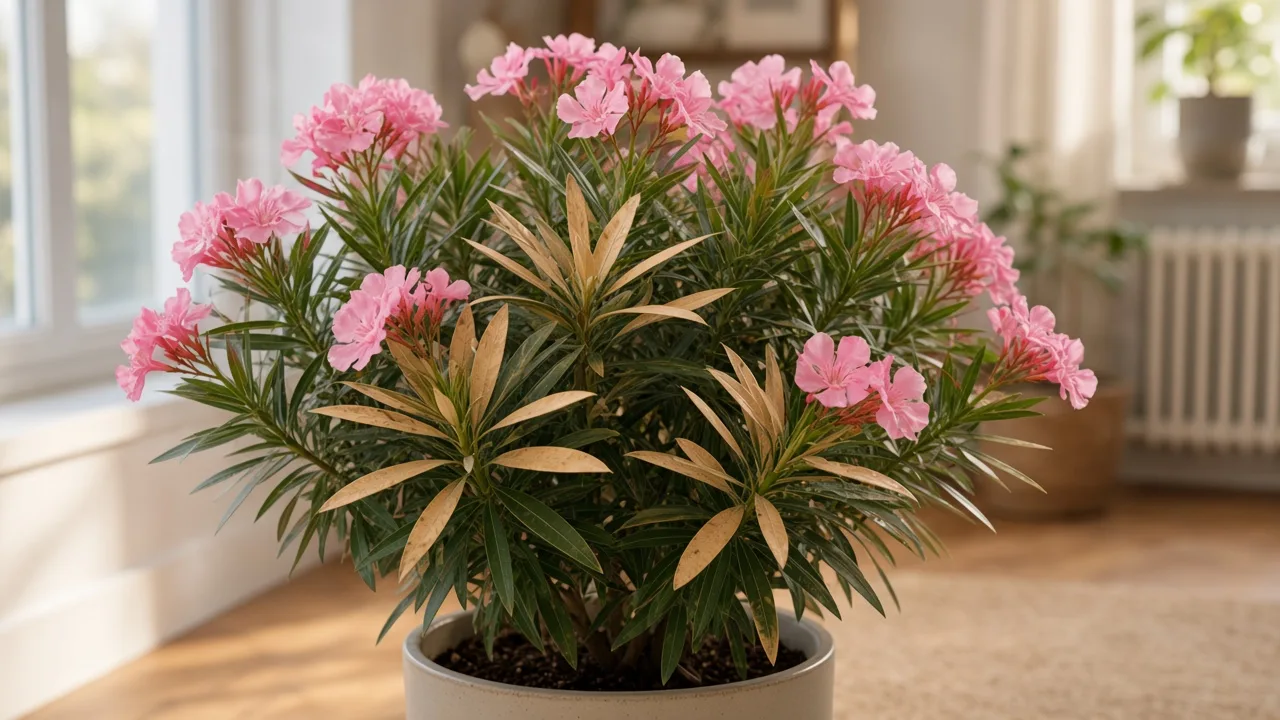
Low Humidity on Oleander: Myth vs. Reality, Xeromorphic Adaptations & Winter Care
This guide covers low humidity on Oleander. See also the general Low Humidity guide, watering, and light pages for this plant.
Low Humidity on Oleander: Myth vs. Reality, Xeromorphic Adaptations & Winter Care
Quick answer
Low ambient humidity is virtually never the root cause of leaf damage or decline on Nerium oleander. Unlike delicate tropical foliage plants, oleander evolved in the arid river valleys and rocky washes of the Mediterranean basin, where summer relative humidity routinely plummets below 20%. The plant is anatomically built to withstand extreme evaporative pull: its leathery leaves feature a thick, multi-layered cutinized epidermis and specialized stomatal crypts lined with microscopic hairs that prevent atmospheric desiccation.
When container-grown oleanders brought indoors for winter display crisp margins, browning tips, or premature leaf shed, plant parents often assume the dry indoor air is to blame. In reality, the damage almost invariably stems from localized heat register drafts (convective scorching), severe root-zone underwatering, or explosive spider mite infestations that flourish in warm, low-humidity rooms.
First step: Move the oleander immediately away from forced-air heating ducts, radiators, and space heaters, placing it in a cool, bright location with steady natural airflow. Check the root ball: if the potting substrate has pulled away from the container sides, provide a thorough bottom-soak. Crucially, resist the urge to mist foliage; wetting oleander leaves indoors fails to raise humidity and directly invites fungal leaf spot infections from Cercospora nerii-indici.
For universal environmental concepts and general mechanics of dry indoor air across common houseplant groups, consult our broad overview on low humidity stress.
What “low humidity” symptoms look like on Oleander
Because oleander foliage is naturally xeromorphic, authentic ambient humidity stress rarely presents as simple, generalized wilting. Instead, secondary complications triggered by dry indoor conditions produce distinct visual and tactile signals across the canopy.
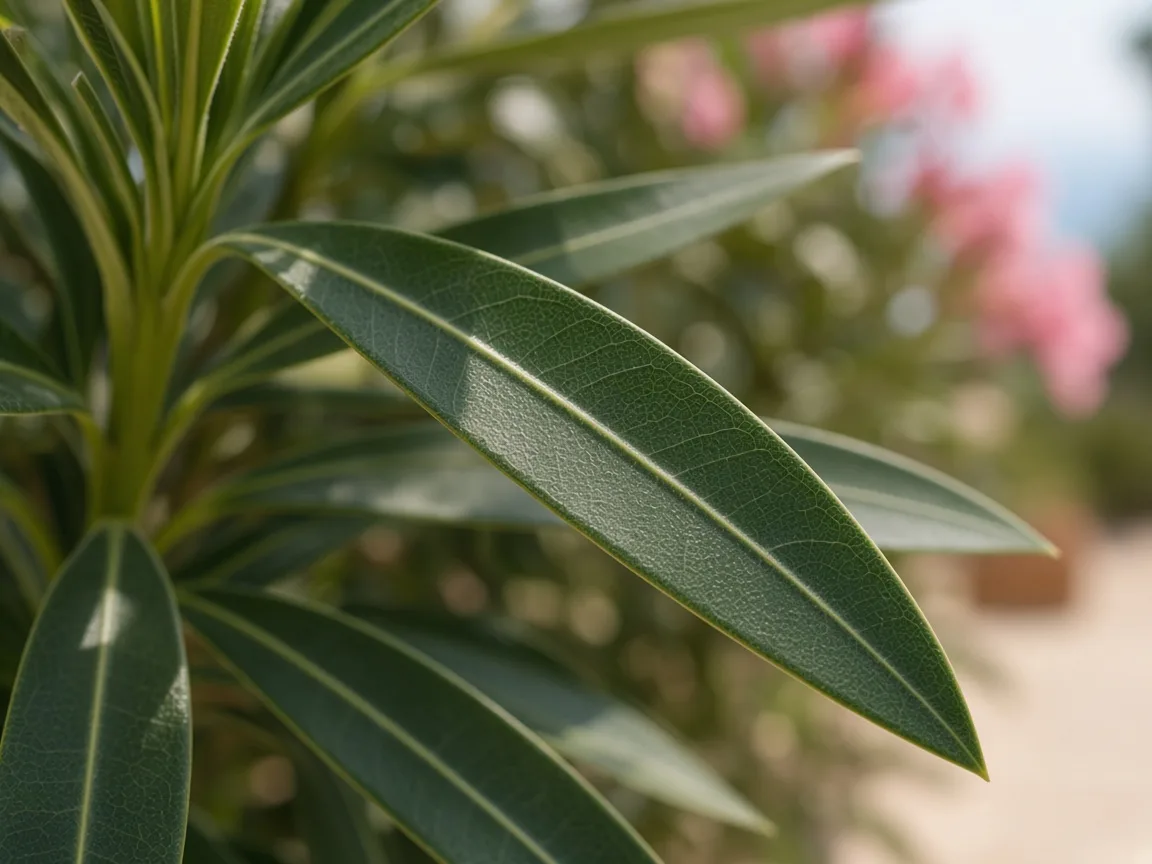
Macro view of Nerium oleander foliage: thick waxy cuticle and sunken stomata prevent dry air desiccation, distinguishing true cultural stress from lookalikes.
Examine your plant carefully to distinguish between cultural dehydration, thermal draft scorch, and pest outbreaks:
- Localized brittle tips and margins (Heating vent scorch): Leaves situated directly in the airstream of a furnace register develop dry, papery, pale-tan tips that curl upward. Notably, this symptom is asymmetric, concentrating heavily on the side of the shrub facing the heat source while foliage shielded on the opposite side remains pristine.
- Fine chlorotic stippling and dulling (Spider mite activity): As sap-feeding mites pierce leaf epidermal cells, the glossy deep-green blade develops millions of tiny pinprick yellow specks. Foliage gradually takes on a dusty, bronze, or bleached cast, frequently accompanied by delicate, silky webbing nestled in the terminal leaf whorls and petiole junctions.
- Curled, inward-rolling leaf margins: When root moisture fails to meet transpirational demand, leaf margins roll inward along the central midrib, reducing the exposed surface area of the blade to conserve internal moisture.
- Lower leaf yellowing and sudden abscission: In response to severe indoor water deficits or root asphyxiation, the shrub sheds older foliage near the base of woody canes while terminal whorls cling to life, as detailed in our guide on oleander yellow leaves.
- Lack of leaf-edge guttation or softness: Unlike soft-leaved tropicals, oleander leaves remain stiff and fibrous even when stressed, snapping cleanly rather than drooping limply unless vascular failure has occurred.
If whole branches suddenly collapse with distinct yellow borders separating brown tissue from green, refer to our diagnostic protocol for oleander brown tips to rule out bacterial leaf scorch (Xylella fastidiosa).
Xeromorphic adaptations: Why Oleander tolerates dry air
Nerium oleander is widely recognized in botanical literature as a classic xeromorphic sclerophyll. Documented by NC State Extension and the Missouri Botanical Garden, oleander is native to the Mediterranean region, southern Asia, and dry riverbeds (wadis) characterized by blistering summer heat, rocky substrates, and severe atmospheric drought.
To survive and flourish under high vapor pressure deficit (VPD)—where hot, dry air aggressively draws water vapor out of living plant cells—oleander has evolved three sophisticated anatomical defense mechanisms:
1. Thick cutinized multiseriate epidermis
The upper (adaxial) surface of an oleander leaf is covered by a dense, hydrophobic waxy cuticle synthesized from cutin and long-chain fatty acids. Directly beneath the cuticle lies a multiseriate (multi-layered) upper epidermis composed of tightly packed, thick-walled cells lacking chloroplasts. This cellular armor acts as an impenetrable vapor barrier, reducing cuticular transpiration to nearly zero and reflecting intense ultraviolet and solar radiation.
2. Sunken stomatal crypts lined with trichomes
Unlike mesophytic houseplants whose stomata sit flush on the leaf surface, oleander confines its stomatal pores strictly to the lower (abaxial) surface within deep structural cavities known as stomatal crypts or stomatal pits.
- These crypts are densely lined with microscopic, unicellular epidermal hairs called trichomes.
- As water vapor exits the stomatal guard cells, the tangled trichomes trap a stagnant microscopic boundary layer of saturated, humid air within the crypt.
- This micro-boundary layer dramatically flattens the humidity gradient between the internal spongy mesophyll and the exterior atmosphere, keeping transpiration remarkably low even when ambient room humidity drops to 15% or 20%.
3. High VPD tolerance and hydraulic resilience
Because of its stomatal architecture, Nerium oleander maintains photosynthetic function under high vapor pressure deficits that would cause a fern or calathea to desiccate and crisp. As noted by UF IFAS Extension, the plant’s rigid, lignified leaf venation prevents mechanical cell collapse during temporary water deficits, enabling the shrub to endure extreme atmospheric dryness without structural injury as long as root water is replenished.
Indoor overwintering hazards: Heating vents and spider mites
While Oleander is hardy outdoors in USDA Zones 8 through 10, gardeners in colder temperate zones (Zones 7 and below) must overwinter potted specimens indoors before autumn frosts arrive, as advised by Clemson Cooperative Extension. It is during this indoor confinement that “low humidity problems” are erroneously reported.
The real hazards during indoor overwintering are environmental dynamics unique to artificial heating:
Convective scorch from forced-air vents
Central furnaces blow dry air heated to 90°F–110°F (32°C–43°C) at high velocity. When this turbulent airstream strikes a potted oleander, it strips the stagnant boundary layer from the stomatal crypts faster than the plant can replenish it, causing physical desiccation and thermal scorch on leaf tips and margins. This is convective mechanical damage, not an intrinsic inability to tolerate still, dry air.
Explosive spider mite proliferation
The two-spotted spider mite (Tetranychus urticae) is the preeminent pest of overwintered oleanders. According to Colorado State University Extension, hot, dry conditions dramatically shorten the spider mite life cycle: at low relative humidity and temperatures around 80°F (27°C), a mite generation can develop from egg to reproductive adult in as few as 5 to 7 days.
In heated living rooms, the absence of natural rainfall, predatory beneficial insects, and wind permits mite populations to multiply exponentially. As thousands of mites puncture the leathery epidermis to extract sap, the leaves turn pale, stippled, and yellow. Owners frequently mistake this pest-induced chlorosis for “dry air suffering” and attempt to treat it with misting or extra watering, leaving the underlying infestation unchecked. For targeted eradication measures, see our guide on spider mites on Oleander.
Why misting Oleander foliage is unnecessary and dangerous
A pervasive myth among indoor gardeners is that spritzing foliage with a hand mister remedies dry air. For Nerium oleander, misting is not merely ineffective—it is actively hazardous to the plant’s health.
The thermodynamic reality of misting
Fine water droplets sprayed onto waxy oleander leaves evaporate within 5 to 15 minutes in a heated room, producing zero measurable increase in 24-hour ambient relative humidity. Because oleander absorbs water exclusively through its extensive root system and possesses an impermeable waxy cuticle on its upper leaf surface, foliage cannot take in moisture from misting.
Promoting Cercospora leaf spot (Cercospora nerii-indici)
Applying free water to oleander foliage indoors creates the exact microenvironment required for fungal spore germination. According to UC IPM, overhead wetting is the primary predisposing factor for fungal leaf spot pathogens, particularly Cercospora nerii-indici and Alternaria species.
- Fungal conidia require several hours of continuous surface moisture to produce germ tubes and penetrate through stomatal crypts or microscopic cuticle cracks.
- Once established, Cercospora produces irregular, dark brown to black circular lesions surrounded by yellow chlorotic halos across the leaf blades.
- As lesions coalesce, affected leaves turn entirely yellow and drop prematurely, severely defoliating the shrub.
In short, misting fails to address dry air, damages the plant’s natural defense barriers, and introduces devastating foliar diseases that are difficult to eradicate indoors.
How to confirm the real cause of Oleander leaf distress
Before altering your care routine or purchasing humidifiers, execute this systematic five-step diagnostic inspection to pinpoint the genuine stressor:
- Verify furnace and draft exposure: Measure the distance between your oleander and the nearest heat source. If the container sits within 2 meters of a heating vent, radiator, wood stove, or duct return, convective heat scorch is your primary suspect.
- Perform the deep root-zone moisture probe: Oleander foliage remains stiff even when soil is bone dry. Push a wooden dowel or moisture probe 5 to 8 centimeters deep into the substrate, as outlined in our oleander watering guide. If the dowel emerges completely dry and clean, and the container feels unusually lightweight when lifted, your plant is suffering from acute container underwatering.
- Inspect leaf undersides with magnification: Using a 10x hand lens or smartphone macro camera, examine the abaxial surface of several stippled or pale leaves, particularly along the midrib and within leaf axils. Look for moving red, green, or amber microscopic specks, spherical eggs, and fine silk strands signaling active spider mites.
- Examine container soil surface for salt crusts: In containers watered with mineral-rich tap water or overfed with synthetic plant foods, white or yellowish crystalline crusts form on the potting soil surface and terra cotta rims. High osmotic salt concentrations burn delicate root tips, preventing water uptake and producing marginal leaf scorch.
- Evaluate ambient room temperatures: Oleanders overwinter best in cool, semi-dormant conditions (45°F–60°F / 7°C–15°C). If kept in a 75°F (24°C) room under low winter light, high respiration rates deplete stored carbohydrates, causing weakened growth and leaf drop.
The first fix for Oleander in dry indoor air
Your immediate first action: Relocate the shrub to a cool, bright location shielded completely from forced-air heating currents, without misting or running close-range humidifiers.
Follow this disciplined remediation sequence:
Step 1: Optimize placement and air movement
Move the container to an unheated sunroom, cool greenhouse, enclosed porch, or bright south-facing window where temperatures remain between 45°F and 60°F (7°C to 15°C) and drafts cannot reach the foliage. Oleanders demand maximum solar energy; ensure the plant receives at least 4 to 6 hours of direct sunlight or unfiltered bright daylight, following benchmarks in our oleander light guide.
Step 2: Calibrate deep container rehydration
If the soil is dry and shrunken:
- Slowly pour water over the surface until moisture runs freely from the drainage holes.
- Allow the pot to sit in drainage runoff for no more than 20 minutes to re-hydrate hydrophobic peat, then discard all standing saucer water completely.
- Never let oleander roots sit in standing water; poor drainage rapidly incites root rot, leading to systemic drooping leaves.
Step 3: Address spider mites if detected
If mites are present, take the plant to a shower or utility basin (or outdoors on a mild day above 50°F / 10°C) and thoroughly sponge or rinse the undersides of the leaves with tepid water to dislodge pest colonies and webbing. If populations persist, apply an insecticidal soap or horticultural oil spray labeled for woody ornamentals, ensuring complete coverage of leaf undersides and branch axils. Repeat treatment after 7 days to disrupt newly hatched eggs.
Step 4: Leach accumulated soil salts
If white mineral crusts coat the soil surface, leach the container by slowly pouring fresh, low-mineral water (equivalent to twice the volume of the pot) through the soil mix to wash out soluble salts, allowing the substrate to drain thoroughly.
[!WARNING] Severe Toxicity Warning: All vegetative parts of Nerium oleander contain lethal cardiac glycosides (such as oleandrin, neriine, and folinerin), as classified by the ASPCA Animal Poison Control. Always wear impermeable gloves and safety goggles when cleaning foliage or pruning stems. Ingestion can cause severe vomiting, irregular heartbeats, and fatality in humans, dogs, cats, and livestock. Never compost or burn oleander prunings.
Lookalike symptom check
Do not treat every leaf symptom as an environmental humidity issue. Compare your plant’s signs against this differential diagnostic matrix:
| Observed Symptom | True Cause | Key Distinguishing Feature |
|---|---|---|
| Crispy tips on vent-facing canopy | Convective heat scorch | Confined strictly to branches in the direct path of forced-air heating vents. |
| Pale yellow stippling + webbing | Spider mites (Tetranychus urticae) | Microscopic mites, spherical eggs, and fine webbing visible on leaf undersides under 10x magnification. |
| Inward leaf rolling + light pot | Acute underwatering | Entire canopy rolls inward; soil is bone dry 5 cm down; restores within hours of deep watering (underwatering guide). |
| Uniform brown leaf margins | Fertilizer / mineral salt burn | White chalky crust on soil surface; uniform marginal browning across older, lower canopy. |
| Single branch flagging + neon yellow halo | Oleander Leaf Scorch (Xylella) | Asymmetric dieback starting on one branch; broad neon-yellow margin separating dead brown tissue from live blade. |
| Circular black/brown spots with yellow halos | Cercospora leaf spot (C. nerii-indici) | Distinct circular spots caused by misting or wet foliage; spreads under humid, stagnant conditions. |
| Widespread yellow leaves + soggy soil | Overwatering / root rot | Soil smells sour; roots are dark, mushy, and foul-smelling; leaves drop while wet (overwatering guide). |
Recovery timeline and realistic expectations
Recovering an oleander from winter indoor stress requires patience and realistic horticultural benchmarks:
- 24 to 48 hours: Dehydrated leaves that were rolling inward should re-hydrate and stiffen following a deep root soak, restoring the natural 45-degree upright orientation along the canes.
- 1 to 2 weeks: Convective heat scorch and spider mite damage will cease spreading once the shrub is relocated away from registers and treated with insecticidal soap.
- Damaged foliage limitations: Dead leaf tips and necrotic margins will never regenerate or turn green. Cellular death is permanent. However, as long as the underlying care issue is resolved, damaged leaves will continue photosynthesizing efficiently until the plant naturally sheds them during spring flushes.
- 3 to 6 weeks: In late winter or early spring, as day lengths increase and temperatures rise, terminal growth whorls will activate. New shoot growth emerging from branch tips should be completely unblemished, deep green, and leathery.
Mistakes to avoid
Avoid these common missteps when caring for Oleander in low-humidity environments:
- Do not run a cool-mist humidifier aimed directly at the shrub: Cold moisture settling on dense oleander foliage in stagnant indoor air creates an ideal breeding ground for foliar blights and botrytis gray mold.
- Do not mist leaves with a spray bottle: As established, misting fails to modify room humidity and directly encourages Cercospora nerii-indici leaf spot infections.
- Do not overwater out of fear of dry air: Potted oleanders have drastically reduced water requirements during cool winter months. Keeping container soil soggy to “compensate” for dry air suffocates feeder roots and causes fatal root rot. Always follow soil dry-down protocols in our oleander soil guide.
- Do not fertilize stressed or overwintering oleanders: Never feed a shrub that is dormant, drought-stressed, or pest-infested. Fertilizer salts accumulate in dry soil and scorch damaged root systems. Delay feeding until active spring growth resumes.
- Do not keep the plant in dark, heated interiors: Low light combined with 70°F+ temperatures forces weak, spindly, etiolated shoots that are highly vulnerable to pests. Prioritize cool temperatures and maximum sun.
Long-term environmental management and prevention
Prevent environmental stress and ensure vigorous summer blooming by aligning indoor and outdoor care with oleander’s natural Mediterranean lifecycle:
- Provide unfiltered sunlight: Maintain a minimum of 6 hours of full direct sun during the outdoor growing season, and the brightest available south-facing window during winter indoor storage.
- Utilize free-draining substrate: Pot container oleanders in a gritty, high-porosity blend composed of 50% premium potting soil, 25% coarse horticultural sand or pumice, and 25% perlite to ensure rapid drainage and prevent waterlogging.
- Practice soak-and-dry irrigation: During hot summer months, water container plants thoroughly whenever the top 5 centimeters of mix dry out. In winter, reduce watering frequency, allowing the soil to dry halfway down the container before re-saturating.
- Maintain cool winter dormancy: Overwinter potted shrubs in an unheated garage, cool porch, or greenhouse maintained at 45°F to 55°F (7°C to 13°C). Cool temperatures suppress spider mite reproduction, slow plant respiration, and preserve vital carbohydrate reserves for explosive spring flowering.
- Spring transition protocol: In spring, after all danger of frost has passed, move the shrub back outdoors gradually. Place it in partial shade for 4 to 5 days before returning it to all-day full sun to prevent UV cuticle sunburn.
Related Oleander guides
Deepen your cultivation knowledge and troubleshoot other care aspects across our comprehensive Oleander diagnostic cluster:
- Oleander plant overview — Complete botanical profile, landscape specifications, and hardiness parameters.
- Oleander watering guide — Precise seasonal moisture schedules, container drainage, and deep soaking protocols.
- Oleander light requirements — Solar exposure benchmarks, indoor overwintering lighting, and sunburn prevention.
- Oleander soil mix — Formulating ideal Mediterranean container blends for optimal root aeration.
- Spider mites on Oleander — Detailed eradication techniques for indoor mite outbreaks in dry winter air.
- Brown tips on Oleander — Differentiating fertilizer salt scorch from fatal bacterial leaf scorch (Xylella fastidiosa).
- Oleander problems hub — The complete diagnostic directory for pests, pathogens, and physiological disorders on Nerium oleander.
Related tool
Use the Humidity Calculator to evaluate atmospheric vapor pressure deficit (VPD) and environmental parameters for your Oleander before adjusting your cultivation routine.