Orange Tree Repotting Guide for Containers
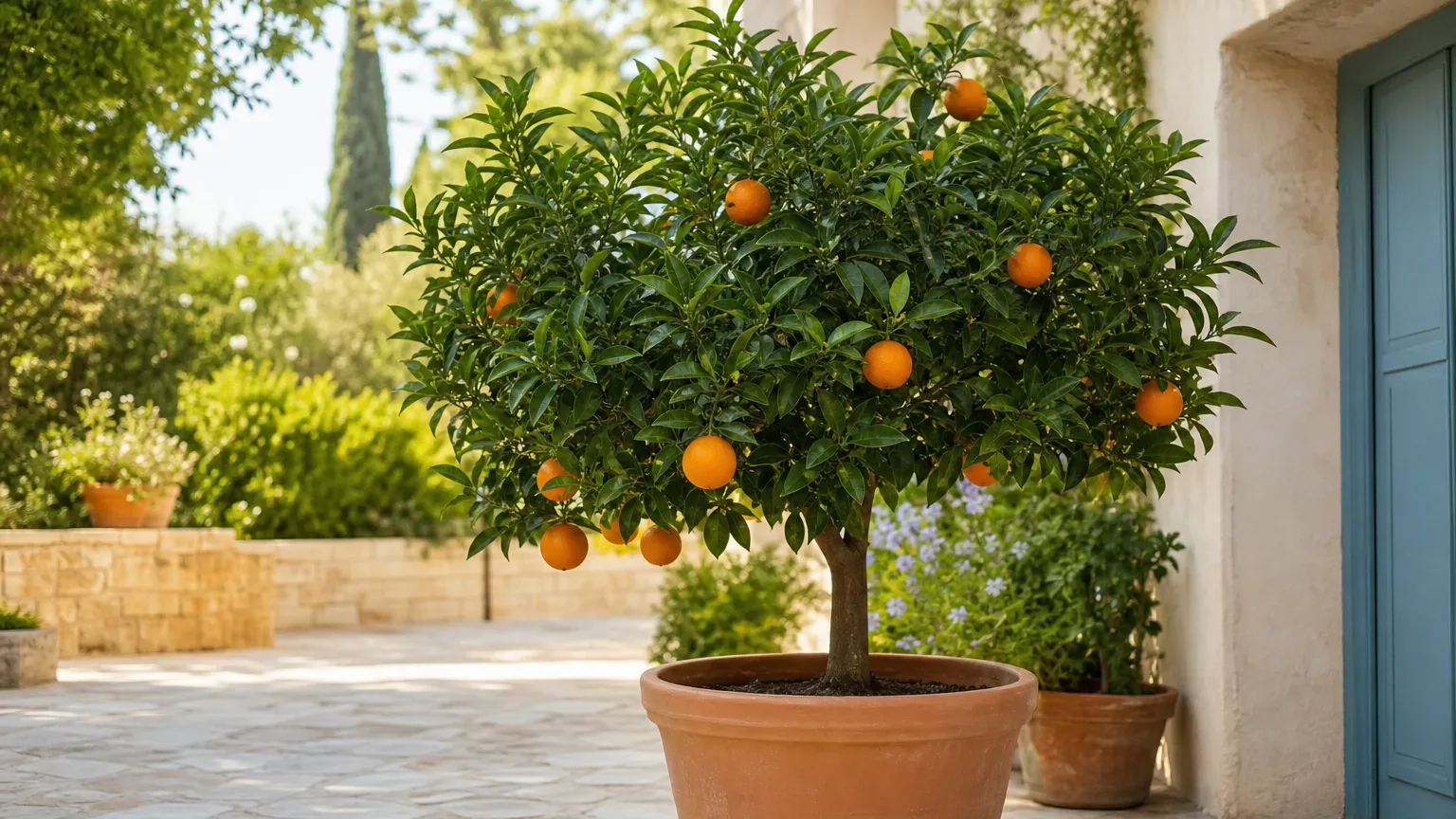
Orange Tree Repotting Guide for Containers
Orange Tree Repotting Guide for Containers
Repotting an orange tree is container maintenance for a woody fruit crop, not a quick houseplant refresh. Citrus sinensis is a sun-loving evergreen that can reach up to 30 feet in open ground, yet a terrace santra must keep feeder roots healthy inside a pot that heats, dries and saturates much faster than garden soil. The goal is to restore drainage, correct circling roots, and keep the graft union visible — not simply to add more compost.
For most young container oranges, inspect the root ball each spring and expect a move about every 2–3 years while growth is vigorous. An older tree in its final tub may stay there longer if you refresh the surface mix, lightly root-prune when needed, and manage canopy size. Start with the Orange Tree care hub if you need to decide whether the present symptom is truly a repotting issue rather than light, water or nutrition.
Why a container orange eventually needs repotting
Sweet orange is a productive citrus tree, not a compact foliage plant. Missouri Botanical Garden notes that Citrus sinensis grows in deep, evenly moist, well-draining, slightly acidic sandy loams and can be grown in colder climates as a container plant brought indoors for winter (Missouri Botanical Garden sweet orange profile). In a pot, roots repeatedly meet the wall, turn inward, and occupy the air spaces that once held water and oxygen in useful balance.
Old organic mix also settles. As pore space collapses, water may race down channels around a dry root mass or linger in an airless core. The Orange Tree soil guide explains how to rebuild a slightly acidic, free-draining citrus mix; repotting is the moment to replace degraded material rather than hiding it beneath a layer of compost.
Signs your orange tree needs a larger pot
Roots at one drainage hole are a clue, not a diagnosis. Slide the root ball out and look for several signals together: thick roots circling the wall, a dense mat across the base, very little loose mix, a tree that needs water again within a day, declining growth despite strong sun and feeding, or a canopy that rocks the container in wind. Penn State lists rapid drying, roots through drainage holes and crowded root balls among the practical signs that a container plant needs attention (Penn State repotting guidance).
A healthy root-bound orange usually has firm cream, tan or light-brown feeder roots and a solid, earthy-smelling root ball. Dark mushy roots, sour odour and mix that remains wet for days point toward oxygen loss or decay, not a need for a giant pot. Review the Orange Tree watering guide before upsizing a plant whose main symptom is yellowing in wet soil.
Diagnose the pot before blaming the roots
Check the drainage holes with a stick and observe one full watering. Water should wet the whole root ball and then leave the pot freely. A container without a functioning bottom outlet cannot provide reliable root aeration. Do not add gravel as a substitute for holes, and do not leave the nursery pot standing in a full cachepot or saucer.
Also rule out a light shortage. An orange in shade may stall even with perfect roots, while a fruiting tree may pause after a heavy crop. Use the Orange Tree light guide if internodes are stretching or the canopy is thinning without clear root congestion.
Best time to repot orange in India
Choose the start of warm active growth, usually early spring after cold risk has passed or the first warm flush before punishing summer heat. Warm roots can colonise fresh mix quickly, and new shoots provide a visible recovery signal. RHS identifies spring, as plants start into growth, as generally the best time to repot and prune roots (RHS repotting advice).
In humid tropical India, an early post-monsoon window can also work when the tree is actively growing and the mix will not remain waterlogged. Avoid elective work during a heat wave, while the tree carries a heavy fruit load, after severe drought, in cool winter dormancy, or during weeks of continuous monsoon rain. Emergency action is justified if the pot is broken, the tree is falling, or roots are rotting, but keep that move as gentle as possible.
Choose a stable pot, not the biggest pot
For a young tree, move up by roughly 5–10 cm in diameter, adjusting for the shape of the root ball rather than chasing a litre target. RHS advises that for containers under 25 cm, the new pot should be only about 2.5–5 cm deeper and wider than the previous one, and no more than one third larger overall (RHS repotting size guidance). The new container should be wide enough for a modest collar of fresh mix, deep enough to keep the existing root crown at the same level, and heavy enough that the canopy cannot lever it over.
Plastic is light and retains moisture, which can help in hot, dry regions but makes a top-heavy orange easier to overturn. Terracotta is stable and breathes through its walls, yet it dries fast on a western terrace. A broad, thick-walled plastic, fibre, wood or masonry-style planter often gives the best compromise for a mature orange, provided the slab beneath it can support the wet weight.
Why an oversized pot can set orange back
A root ball moved into an enormous planter cannot use the surrounding water quickly. That unused mix stays wet while the centre may still be dry, creating two moisture zones that are difficult to manage. RHS identifies this mismatch between a small root system and a large volume of wet compost as the central risk of overpotting.
Citrus are especially sensitive to chronically wet roots. Missouri Botanical Garden describes sweet orange as intolerant of heavy, saturated soils (MBG drainage note). Do not solve top-heaviness by burying the trunk or graft union deeper. Use a broader pot, shorten badly placed canopy growth at the appropriate pruning time, or add a temporary flexible stake.
Use fresh, free-draining citrus mix
Orange prefers fertile, slightly acidic, well-drained soil. A useful container blend follows the cluster standard of 60% quality potting mix, 20% fine pine bark, and 20% perlite or pumice, aiming for a pH around 5.5–6.5. RHS recommends either a specially formulated peat-free citrus compost or a nutrient-rich soil-based compost such as John Innes No 2 with about 20 per cent sharp sand or grit to improve drainage (RHS citrus repotting mix).
Moisten dry ingredients before use so they do not pull water away from the old root ball. Sieve out large stones and unfinished compost, but do not pack fine garden clay into a pot. If the current mix smells sour or has decomposed into sludge, remove more of it carefully and inspect for soft roots rather than transferring the failure intact.
Prepare the tree and workspace
Water the orange thoroughly the day before if the root ball is very dry; a lightly moist root mass holds together and reduces fine-root tearing. Prepare the pot, mix, clean cutting tools and a support before lifting the tree. For a large specimen, work with another person and handle the root ball and pot — not the trunk or graft union — as the main load.
Wear gloves and eye protection. Citrus sinensis commonly carries slender spines at leaf axils, especially on vigorous young shoots, and disturbed roots plus wet mix make slips more likely. Clean secateurs or a sharp knife before cutting roots. Keep exposed roots shaded and work efficiently, especially on a hot terrace. Do not combine repotting with a hard prune merely for convenience; remove only broken, dead or dangerously unbalanced shoots unless canopy reduction is needed to offset planned root pruning.
How to repot a young orange step by step
- Confirm drainage. Open every hole and cover only large outlets with mesh or a curved shard that prevents mix loss without blocking flow.
- Remove the tree. Lay the pot on its side, support the root ball and ease it free. Cut a disposable nursery pot rather than hauling on the trunk.
- Inspect the roots. Tease loose fine roots outward. Cut dead, mushy or sharply circling roots with a clean blade.
- Set the height. Add enough mix so the top of the old root ball sits just below the rim and the graft union remains above the soil line.
- Backfill. Work fresh mix around the sides with your fingers or a blunt stick. Firm lightly; do not ram it solid.
- Water once, deeply. Apply water slowly until it exits the holes. This settles mix around roots and reveals whether drainage is working.
- Stabilise if needed. Use a temporary soft tie and stake, then remove it after the root ball has anchored.
RHS recommends watering until moisture emerges from the drainage holes after repotting, which confirms that the new medium has been wetted through (RHS first-watering procedure). Empty the saucer afterward.
Correct circling roots without stripping the root ball
Fine circling roots can be teased outward. Thick woody roots that wrap the base or turn toward the trunk need clean cuts, because simply placing the intact spiral into fresh soil preserves the defect. Penn State notes that container-grown trees commonly develop circling roots and recommends severing or shaving the outer root mass before landscape planting so new roots can grow outward (Penn State container-root guidance).
Be conservative with a stressed or fruiting orange. Do not bare-root a healthy tree just to make the roots look tidy, and do not remove a large fraction of the root system in one session. RHS citrus guidance also advises disturbing roots as little as possible when moving a recently bought plant into a more attractive pot of similar size (RHS minimal-disturbance repotting).
Root-pruning an orange that cannot move to a bigger pot
Once a terrace tree reaches its final manageable tub, same-pot renewal is more sensible than endless upsizing. At the start of warm growth, remove the root ball, shave or slice away only the congested outer layer and base, loosen the remaining edge, and return the tree to the cleaned container with fresh mix. RHS advises that a light root trim — removing up to about 15% of the root system for many established container plants — can maintain plants in the same pot, with larger reductions staggered over time to limit stress (RHS root-pruning guidance).
Between full repottings, top-dress by removing the top layer of compost and replacing it with fresh material, as RHS recommends for citrus in the years between pot moves (RHS citrus top-dressing). Treat the 15% figure as a ceiling for a healthy orange, not a quota. Remove less if roots are sparse, damaged or dry. Reduce a little soft top growth if necessary to restore balance, but save structural canopy work for the Orange Tree pruning guide rather than stacking two severe interventions.
Transplanting container orange into the ground
Open ground is often the best long-term destination when the cultivar is suitable and there is room for a spreading fruit tree. Choose full sun, reliable drainage and clearance from buildings and utilities. Dig broad enough to loosen the surrounding soil, but do not create a deep compost-filled sump. Correct circling roots, place the root flare and graft union at grade, backfill mainly with the excavated soil and water to settle it.
In heavy or seasonally wet ground common across parts of India, plant on a raised mound rather than lowering the root ball into a basin. Keep mulch away from the trunk so the crown stays dry. MBG notes that sweet orange is hardy in Zones 9–11 and that young trees need protection when temperatures fall below freezing (MBG hardiness context); in frost-prone pockets, keep the tree in a movable container or choose a protected microclimate before committing to an in-ground planting.
Post-repot care: the first month
Return the tree to bright light, but give brief protection from the fiercest afternoon sun if substantial roots were removed. A routine one-size-up repot with little root disturbance can usually return to its normal sunny position quickly. Keep the root ball evenly moist during recovery, checking both the old core and new outer mix because they may dry at different rates.
Do not feed heavily on day one. Wait for firm new leaves or an active shoot before resuming the Orange Tree fertilizer plan. Fertilizer cannot repair torn roots, and strong salts in a recently disturbed, unevenly moist root zone add avoidable stress.
What normal recovery looks like
Temporary stillness or a small amount of older-leaf drop can follow a major move. The useful signs are a stable trunk, leaves that remain firm through the day, an earthy-smelling mix, and eventually a new flush. Repeated wilting in wet soil, spreading yellowing, a loose trunk or sour odour are not routine transplant shock; inspect drainage and moisture before watering again.
For a ground transplant, plan follow-up watering through establishment rather than assuming rainfall will be enough on its own. The aim is a moist root ball with oxygen present, not a permanently flooded planting hole.
When not to repot orange
Leave the tree alone when roots are not crowded, drainage is good and growth is proportionate to the container. Do not repot solely because one leaf yellowed, flowers dropped, or a nursery pot looks plain. A decorative outer pot can hide the grow pot as long as runoff is emptied promptly.
Delay elective work during flowering or fruit fill if the pot is functioning, because disturbance may add water stress at a demanding stage. If growth is pale but roots have room, investigate the Orange Tree fertilizer guide and soil pH. If the goal is simply another plant, use the Orange Tree propagation guide rather than dividing or cutting apart a woody root ball.
When to use this page vs other Orange Tree guides
Use this guide for pot size, root inspection, same-pot renewal and transfer into open ground. Use Orange Tree soil to formulate the mix, Orange Tree watering to set the post-move moisture rhythm, and Orange Tree pruning to keep the canopy within terrace scale. The Orange Tree overview is the better starting point when several care factors are wrong at once.
Related Orange Tree guides
- Orange Tree care hub — the complete species profile and care routes.
- Orange Tree soil guide — drainage, pH and container-mix decisions.
- Orange Tree watering guide — how to water a newly moved root ball.
- Orange Tree pruning guide — canopy control for a container tree.
- Orange Tree light guide — sun and acclimation after a disruptive move.
Conclusion
Repot an orange tree when the root ball proves that it has outgrown or outlived the container, not because a calendar says so. Work at the start of warm growth, step up modestly, keep the graft union above the mix, correct circling roots and water the fresh mix through once. For a mature terrace santra, same-pot root renewal or a carefully planned move into well-drained ground is usually better than an impractically large planter.