Yellow Leaves on Orange Tree: Causes, Checks & Fixes
Quick answer
Yellow leaves on an orange tree (Citrus sinensis) stem from distinct physiological disruptions: sharp interveinal yellowing on new leaves indicates iron chlorosis triggered by high soil pH (>7.5) or cold, wet roots; uniform pale yellowing on older lower leaves signals mobile nitrogen deficiency; an inverted green V-pattern marks magnesium deficiency; and dull yellowing with leaf drop points to overwatering. First step: test root-zone moisture with a probe and measure soil pH before applying fertilizers; if soil is alkaline (pH > 7.5) and newest leaves are yellow with green veins, drench with chelated iron (Fe-EDDHA) and acidify with elemental sulfur.
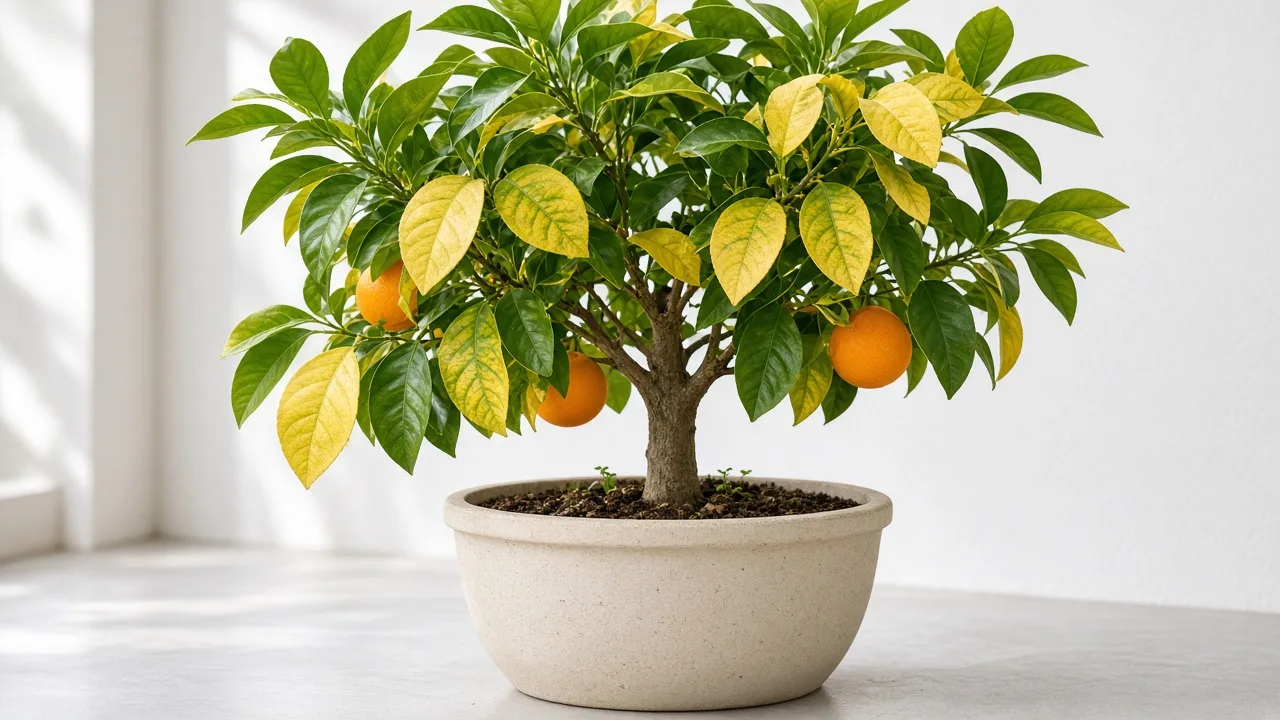
Yellow Leaves on Orange Tree: Causes, Checks & Fixes
This guide covers yellow leaves on Orange Tree. See also the general Yellow Leaves guide, watering, and light pages for this plant.
Yellow Leaves on Orange Tree: Causes, Checks & Fixes
Quick answer
Yellow leaves on an orange tree (Citrus sinensis) are not a single generic complaint; they represent a specific vascular distress signal that differs entirely depending on leaf age, vein coloration, and symmetry. On sweet oranges, sharp interveinal yellowing on soft new flushes indicates iron chlorosis, almost always brought on by alkaline soil (pH > 7.5), cold substrate, or root-smothering moisture. In contrast, uniform pale yellowing on older, lower leaves signals nitrogen deficiency, as the tree robs mobile nitrogen from mature foliage to fuel new growth. Distinct inverted green “V” patterns on mature leaves mark magnesium starvation, mottled miniature leaves indicate zinc deficiency, and dull, drooping yellow leaves that drop while limp denote overwatering and root decay.
For universal causes of leaf chlorosis across houseplants and garden flora, explore our general yellow leaves guide. On sweet orange trees, however, effective treatment hinges on identifying the precise chlorosis pattern across the canopy rather than applying random fertilizer or watering blindly.
First step: measure soil pH and check root-zone moisture depth. If your container or garden soil tests alkaline (pH above 7.2) and the yellowing is concentrated on new growth with dark green veins, apply chelated iron in the Fe-EDDHA form and lower the pH with agricultural sulfur. If the soil is waterlogged and foul-smelling, halt irrigation immediately and restore bottom drainage before adding any nutrients.
When to use this page vs other Orange Tree guides
Yellowing foliage frequently overlaps with other citrus stressors. Use this diagnostic routing table to ensure you treat the primary problem:
| What You Observe on the Tree | Primary Diagnostic Cause | Recommended Action & Guide |
|---|---|---|
| Sharp yellowing between green veins on newest shoots; soil pH > 7.5 | Iron chlorosis (micronutrient lockout) | Stay on this guide |
| Oldest lower leaves turn uniformly pale chartreuse; overall canopy slows down | Nitrogen starvation | Stay on this guide & see Fertilizer Guide |
| Inverted green “V” at leaf base with yellow margins on mature leaves | Magnesium deficiency | Stay on this guide (apply Epsom salts) |
| Dull, yellowing leaves dropping rapidly; potting mix dense, soggy, or sour | Anaerobic root rot / waterlogging | Orange Tree Overwatering & Root Rot |
| Crisp brown leaf tips and margins with a yellow transition halo; white soil crust | Fertilizer salt burn or tap water salinity | Orange Tree Brown Tips |
| Wilting, curling yellow leaves with bone-dry soil pulling away from pot walls | Prolonged chronic drought | Orange Tree Underwatering |
| Asymmetrical, blotchy yellow mottle crossing leaf veins; lopsided bitter fruit | Citrus Greening / HLB (C. Liberibacter) | Stay on this guide (quarantine & extension testing) |
| Overall cultivation, light requirements, and container setups | Preventative cultural care | Orange Tree Overview & Soil Guide |
What yellow leaves look like on Orange Tree
On Citrus sinensis, chlorosis patterns correspond directly to nutrient mobility within the plant’s vascular tissue and environmental stressors in the root zone.
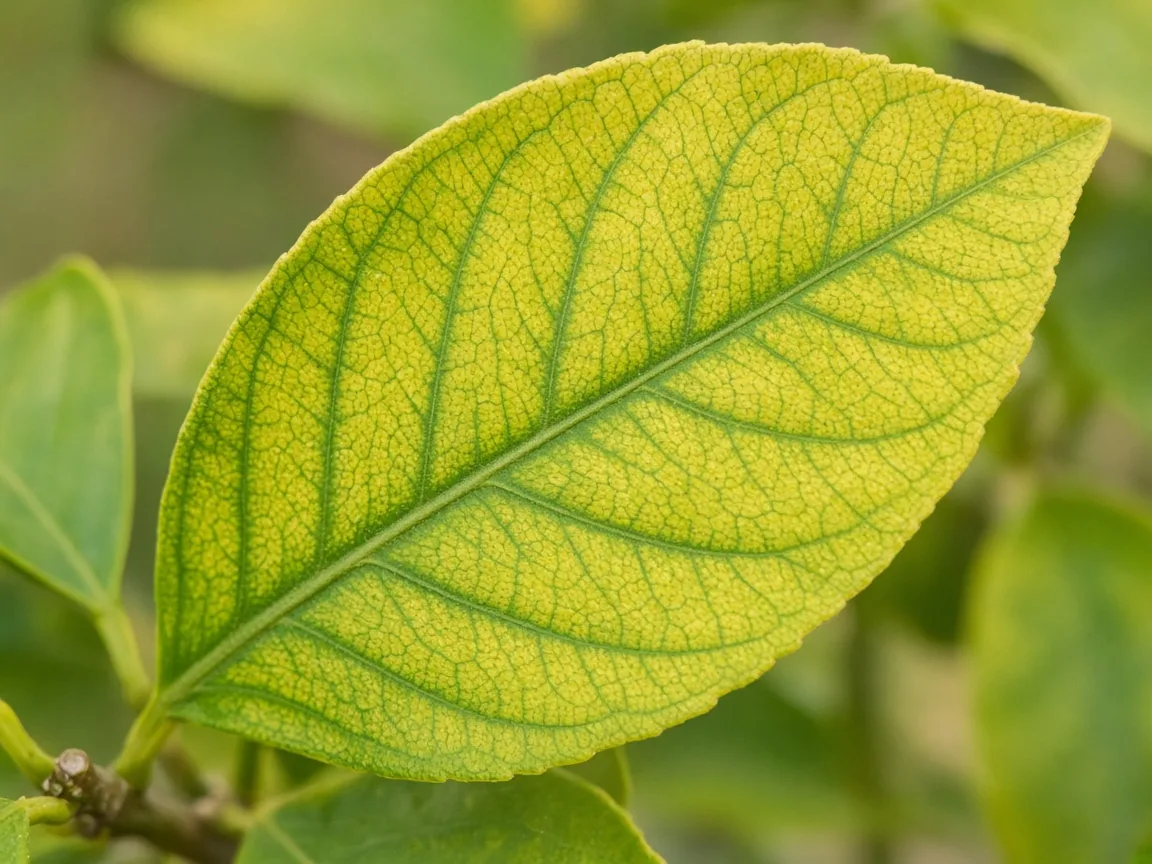
Interveinal chlorosis and nutrient yellowing patterns on Citrus sinensis foliage, showing dark green veins contrasting against pale yellow leaf blades.
Visual diagnostic markers
- New Growth vs. Old Growth Locus: Highly mobile elements (nitrogen, magnesium) are salvaged from older tissues to sustain fresh growth, causing the lower, interior canopy to yellow first. Immobile elements (iron, zinc, manganese) cannot be relocated from older leaves; their absence is visible only on newly expanding shoots at branch tips.
- Interveinal Chlorosis (The “Ribbed” Pattern): The leaf blade (lamina) turns pale yellow, cream, or ivory, while the primary midrib and intricate network of lateral veins remain conspicuously dark green.
- The Inverted Green “V”: Discoloration starts at the tip and outer margins of older leaves, advancing inward while leaving an arrowhead or inverted “V” of healthy green tissue anchored at the petiole base.
- “Little Leaf” Rosetting: Leaves emerge drastically smaller than normal, narrow, pointed, and mottled with pale yellow blotches between major veins, held closely together on shortened twigs.
- Dull Abscission: Overwatered foliage loses its waxy luster, turns a dull, muddy yellow, and drops freely at the abscission zone where the petiole meets the branch, often leaving the petiole attached temporarily.
The citrus chlorosis differential: identifying the exact cause
Accurately solving yellow leaves requires walking through the six distinct categories of citrus chlorosis.
1. Iron deficiency (iron chlorosis): new growth and alkaline soil lockout
Iron is an essential cofactor for chlorophyll biosynthesis and enzyme systems within citrus chloroplasts. However, iron is strictly immobile once incorporated into mature foliage. When iron becomes unavailable, mature leaves remain green, but every newly unfurled flush emerges with sharp interveinal chlorosis: the background tissue turns pale chartreuse, yellow, or almost paper-white, while the vein network stands out in dark green contrast.
True iron deficiency in citrus is rarely caused by an actual absence of iron in the potting mix or garden soil. Instead, it is an uptake lockout caused by high soil pH. As noted in UC ANR citrus fertilization protocols, when soil pH climbs above 7.5 (common in limestone soils or containers irrigated with alkaline tap water), ionic iron precipitates into insoluble ferric hydroxides that root hairs cannot absorb. Cold, saturated soils during early spring also temporarily paralyze citrus roots, producing cold-induced iron chlorosis even in fertile soils.
2. Nitrogen deficiency: uniform pale yellowing on oldest leaves
Nitrogen is the foundational engine of citrus vegetative growth, required in high volumes to produce proteins, amino acids, and chlorophyll. Unlike iron, nitrogen is highly mobile in the plant. According to UF/IFAS citrus nutrition research, when an orange tree runs low on root-available nitrogen, it actively breaks down chlorophyll in its oldest, lowest leaves and translocates the salvaged nitrogen upward to fuel the newest growth flushes.
Consequently, nitrogen deficiency begins as a uniform, pale greenish-yellow wash across the entire surface of older mature leaves. The midrib and veins fade simultaneously with the leaf blade; there is no green venation contrast. Over time, the entire lower canopy turns pale yellow, vegetative growth flushes stall, and older leaves abscise prematurely, leaving the tree with sparse foliage and thin canopy cover.
3. Magnesium deficiency: the inverted green “V” on mature foliage
Magnesium sits at the very center of the chlorophyll molecule, enabling photosynthesis. Like nitrogen, magnesium is mobile within Citrus sinensis. When magnesium supply is insufficient, the tree pulls the nutrient from older leaves to support fruit development and terminal bud elongation.
Symptoms of magnesium deficiency appear during mid-to-late summer on mature leaves, especially on heavily fruiting branches. As documented in Texas A&M AgriLife citrus nutrition guidelines, the symptom produces a dramatic visual signature: yellowing begins at the tip and outer margins of mature leaves and moves inward, leaving a distinct inverted green “V-shaped” pattern along the midrib at the leaf base. In severe cases, the entire leaf turns golden yellow with only the petiole end retaining green tissue before the leaf drops.
4. Zinc deficiency: “little leaf” and interveinal mottling
Zinc is an essential micronutrient that governs the production of indoleacetic acid (auxin), the plant hormone responsible for leaf expansion and stem elongation. Because zinc is immobile in citrus, deficiency symptoms develop on new flushes.
Zinc deficiency manifests as “little leaf” accompanied by irregular chlorotic mottling. Young leaves remain small, narrow, and upright, pointing stiffly upward from the branch. Pale yellow blotches develop between the lateral veins, while a narrow band of tissue along the midrib and main veins stays green. Twig internodes become drastically compressed, resulting in bunched, bushy rosettes of miniature foliage at branch terminals.
5. Citrus Greening / HLB: asymmetrical blotchy mottle
Citrus Greening, also known as Huanglongbing (HLB) or “yellow dragon disease,” is a devastating bacterial infection caused by Candidatus Liberibacter asiaticus and vectored by the invasive Asian citrus psyllid (Diaphorina citri). Because HLB disrupts the tree’s phloem vascular system, it causes dramatic foliar yellowing that gardeners frequently mistake for simple nutrient chlorosis.
However, University of California IPM on Huanglongbing (HLB) provides the critical distinction: nutritional deficiencies produce symmetrical patterns identical on both sides of the leaf midrib, whereas HLB produces an asymmetrical “blotchy mottle”. If you draw a line down the central vein of an HLB-infected leaf, the yellow patches on the left half will not match the green and yellow pattern on the right half; yellowing crosses veins haphazardly. Infected trees also show bright yellow shoots (“huanglongbing”), twig dieback, small lopsided fruit that fails to color properly at the blossom end, and bitter, abortive seeds.
6. Overwatering and root suffocation: dull yellowing with leaf abscission
Sweet orange trees demand abundant root aeration and cannot tolerate waterlogged, anaerobic soil conditions, as emphasized by NC State Extension on Citrus sinensis culture. When container potting mix or heavy clay soil remains saturated, soil pores fill with water, driving out oxygen. Feeder roots suffocate and succumb to aquatic oomycetes like Phytophthora nicotianae.
Without functional roots, the tree can no longer take up water or minerals. Leaves lose their deep, glossy luster, fade to a dull yellowish-green, and drop while still soft and pliable. If your orange tree is dropping yellow leaves by the handful while the potting soil feels damp or smells sour, overwatering and root decay—not nutrient starvation—are the culprit. Consult our orange tree watering guide to reset irrigation intervals.
Citrus yellow leaf diagnostic chart
Use this quick-reference matrix to cross-check symptom morphology, leaf location, symmetry, and primary corrective action:
| Symptom Pattern | Affected Foliage | Leaf Symmetry | Most Likely Cause | Primary Corrective Action |
|---|---|---|---|---|
| Sharp interveinal yellowing (green veins, yellow blade) | Newest growth flushes | Symmetrical | Iron (Fe) chlorosis / Alkaline pH | Drench with Fe-EDDHA chelated iron; lower pH to 6.0–6.8 |
| Uniform pale chartreuse across whole leaf & veins | Oldest, lowest mature leaves | Symmetrical | Nitrogen (N) deficiency | Apply balanced citrus fertilizer with nitrate/ammonium N |
| Inverted green “V” at leaf base with yellow margins | Mature leaves near fruit | Symmetrical | Magnesium (Mg) deficiency | Soil or foliar drench of Epsom salts (magnesium sulfate) |
| Small narrow leaves (“little leaf”) with yellow mottling | Young shoots and twigs | Symmetrical | Zinc (Zn) deficiency | Apply chelated zinc or neutral zinc foliar spray in spring |
| Asymmetrical blotchy mottle crossing veins irregularly | Random branches / whole tree | Asymmetrical | Citrus Greening / HLB (C. Liberibacter) | Quarantine tree; contact local agricultural extension for PCR test |
| Dull, limp yellow leaves dropping freely; dark mushy roots | Mid and lower canopy | Non-specific | Overwatering / Anaerobic root rot | Halt water; improve pot drainage; treat with root fungicide if severe |
How to confirm the root cause: step-by-step diagnostic checks
Before pouring fertilizers or acidifiers onto your orange tree, complete these four confirmation checks:
- Verify Soil pH: Insert a calibrated digital soil pH probe or conduct a distilled-water slurry test. The target root-zone pH for Citrus sinensis is 6.0 to 6.8. If your reading is 7.4 or higher, iron, zinc, and manganese are locked out chemically, regardless of how much fertilizer is present in the soil.
- Inspect Moisture at the Feeder Root Zone: Citrus roots primarily inhabit the top 12 to 18 inches of soil (or the mid-to-lower portion of a container). Probe 3 to 4 inches down. If the substrate is muddy, cool, and waterlogged, root suffocation is the primary driver of yellowing.
- Map the Canopy Position: Note whether yellowing is restricted to soft new shoots at the outer canopy periphery (iron/zinc) or mature, leathery leaves near the trunk and lower branches (nitrogen/magnesium).
- Evaluate Leaf Symmetry: Pick three symptomatic leaves and compare the left and right halves across the main midrib. If the chlorosis pattern is a mirror image, the cause is nutritional or environmental. If the pattern is an irregular, patchy blotch that crosses lateral veins randomly, suspect Citrus Greening.
The first fix: what to do today
Make one targeted correction based on your diagnosis today. Do not apply an all-in-one chemical cocktail.
First-Response Decision Tree:
1. Is soil soggy/stagnant? ───────> STOP watering; elevate container; ensure drainage holes flow freely.
2. Is soil pH > 7.2 + new flush chlorotic? ──> Apply Fe-EDDHA chelated iron drench at root zone.
3. Are oldest leaves uniformly pale? ───────> Apply balanced citrus fertilizer at half label rate.
4. Is green inverted "V" present? ─────────> Drench with 1 tbsp Epsom salt per gallon of clean water.
If the root cause is unclear, your safest universal starting action is to flush container soil with pure rainwater or distilled water to eliminate excess salts, allow the top 2 inches of potting mix to dry, and check the drainage holes for root blockages.
Targeted treatment protocols
Soil acidification and iron chelate application
When alkaline soil precipitates iron, foliar sprays offer only temporary cosmetic relief. Permanent recovery requires correcting root-zone chemistry:
- Choose the Right Iron Chelate: Standard iron sulfate or iron EDTA chelate becomes chemically useless when soil pH exceeds 6.5. For alkaline or calcareous soils, use Fe-EDDHA (ethylenediamine-di-o-hydroxyphenylacetic acid). Fe-EDDHA remains stable and fully bioavailable to citrus roots even in soils with a pH up to 9.0.
- Apply Soil Drench: Dissolve Fe-EDDHA powder in tepid rainwater per manufacturer instructions (typically 1 to 2 teaspoons per gallon for patio containers) and drench the root zone thoroughly in early morning.
- Acidify Soil Long-Term: Work finely ground elemental sulfur or agricultural sulfur into the top inch of container mix, or incorporate composted pine bark. Sulfur is oxidized by soil microbes into sulfuric acid over 4 to 8 weeks, steadily driving pH down into the ideal 6.0–6.8 range. Review our orange tree soil guide for complete substrate formulation.
Restoring balanced citrus nutrition
Citrus trees have high nutrient requirements and require macro- and micronutrients in specific proportions:
- Select Balanced Citrus Food: Use a fertilizer formulated specifically for citrus with an N-P-K ratio close to 2-1-1 or 3-1-2 (such as 12-6-6 or 8-4-8), containing added sulfur, iron, zinc, and manganese. Learn more in our orange tree fertilizer guide.
- Correct Magnesium Depletion: Dissolve 1 tablespoon of Epsom salts (magnesium sulfate) in 1 gallon of water. Apply as a root drench once every 4 weeks during heavy fruit set. For faster uptake on severely yellowing mature leaves, apply as a 1% foliar spray during cool evening hours.
- Foliar Micronutrient Sprays: In early spring as the major growth flush expands to two-thirds its mature size, apply a foliar spray containing chelated zinc and manganese. Citrus leaves absorb trace minerals efficiently through young epidermal cuticles, bypassing alkaline root lockouts.
Rescuing waterlogged root systems
As noted in Royal Horticultural Society citrus problem diagnostics, chronic overwatering in poorly drained containers is the fastest way to induce root rot and systemic leaf yellowing.
- Remove Standing Runoff: Never let a potted orange tree sit in a water-filled drainage tray. Empty saucers within 15 minutes of watering.
- Aerate the Potting Mix: If the substrate is compacted garden clay, gently tease the root ball and repot into an open, airy mix consisting of 50% coarse peat or coco coir, 30% composted pine bark fines, and 20% coarse perlite or pumice.
- Prune Diseased Roots: If unpotting reveals brown, soft, or foul-smelling roots that slough off under gentle pressure, trim away dead roots with sterile shears and allow the root ball to dry slightly before repotting into fresh, moist media.
What not to do: common citrus care mistakes
- Do Not Dump General High-Nitrogen Lawn Fertilizer: Lawn fertilizers lack essential citrus trace minerals (iron, zinc, manganese) and contain high salt indices that burn fragile citrus feeder roots, worsening leaf drop.
- Do Not Apply Granular Iron Sulfate to Alkaline Pots: In alkaline soil (pH > 7.5), iron sulfate oxidizes almost instantaneously into insoluble rust, wasting money and adding unwanted salts without feeding the tree. Use Fe-EDDHA instead.
- Do Not Water on a Rigid Calendar: Never water an orange tree simply because it is Sunday. Always feel the top 2 inches (5 cm) of soil; water only when that upper layer has dried out.
- Do Not Spray Micronutrients in Direct Hot Sunlight: Applying foliar iron, zinc, or magnesium solutions during the heat of midday (above 85°F / 29°C) will cause severe foliar burn and leaf drop. Spray early in the morning or near dusk.
- Do Not Ignore Asymmetrical Yellowing: If you live in an HLB-quarantine zone (such as Florida, Southern California, or Texas) and observe asymmetrical blotchy mottle, do not assume it is simple starvation. Report suspected Citrus Greening to your local agricultural extension service immediately to protect regional groves.
Recovery timeline and realistic leaf expectations
Understanding how citrus foliage regenerates will keep you from abandoning effective treatments prematurely:
- Severely Chlorotic Leaves May Not Turn 100% Green: Leaves that have bleached to ivory-white have suffered irreversible chloroplast damage. While mildly chlorotic leaves will regreen within 2 to 4 weeks of treatment, severely affected leaves will eventually drop once fresh growth matures.
- 2 to 3 Weeks Post-Correction: Leaf drop should halt completely, and the dark green venation on moderately chlorotic leaves will begin to expand outward into the yellow lamina.
- 4 to 6 Weeks Post-Correction: The tree will activate axillary buds and push a vigorous new vegetative flush. If soil pH and nutrition have been corrected, these emerging leaves will be supple, deep emerald green, and fully formed.
- Full Canopy Restoration: Rebuilding a full, lush canopy after extensive defoliation takes 3 to 6 months across two seasonal growth flushes.
Long-term prevention: keeping Orange Tree foliage dark green
Sustaining vibrant, healthy citrus foliage requires aligning daily care with natural citrus biology:
- Irrigate with Rainwater or Buffered Water: If your municipal tap water is hard and alkaline, collect rainwater whenever possible, or add a mild acidifier (such as organic citrus acidifier or vinegar at 1 teaspoon per gallon) to neutralize bicarbonates.
- Monitor Soil pH Seasonally: Test the container soil pH every spring and midsummer. Reapply top-dressed elemental sulfur or organic compost to prevent pH creep.
- Feed Rhythmically with Flushes: Synchronize fertilizer applications with natural growth flushes in early spring, early summer, and late summer. Cease heavy feeding in late autumn to prevent tender frost-susceptible growth.
- Ensure Full Direct Sunlight: Sweet oranges require 8 to 12 hours of direct sun daily. Low light reduces photosynthetic sugar production, predisposing foliage to chlorosis and dieback.
- Inspect for Citrus Pests: Regularly check new shoots for aphids and Asian citrus psyllids, which transmit viral and bacterial pathogens. Learn more on our Orange Tree problems hub.
Related Orange Tree guides
Strengthen your cultivation routine and cross-check symptoms with our dedicated Citrus sinensis resources:
- Orange Tree Care Overview - Comprehensive care guide covering indoor and outdoor sweet orange cultivation
- Orange Tree Soil & Potting - Formulating aerated citrus mixes, pot selection, and managing root-zone pH
- Orange Tree Fertilizer Guide - Essential N-P-K ratios, micronutrient scheduling, and preventing fertilizer burn
- Orange Tree Watering Guide - Soil dry-down depth, soak-and-dry irrigation cycles, and container drainage
- All Orange Tree Problems - Diagnostic hub for pest identification, fungal leaf spots, and abiotic disorders
Related tool
To calculate the precise nutrient application rates and avoid salt burn or trace mineral imbalances on your sweet orange tree, use our Plant Fertilizer Calculator customized for container and orchard citrus.