Mealybugs on Orange Tree: Identification, Treatment &
Quick answer
First, isolate potted orange trees and inspect the hidden crevices beneath fruit buttons (calyxes), twig forks, and leaf undersides. Dab visible cottony clusters directly using a cotton swab dipped in 70% isopropyl alcohol to dissolve protective wax without soaking the plant. If honeydew and black sooty mold are present, control attending ants with a sticky trunk barrier, and follow up with a 1% to 2% horticultural oil spray only when temperatures are below 85°F (29°C) and the tree is not in bloom.
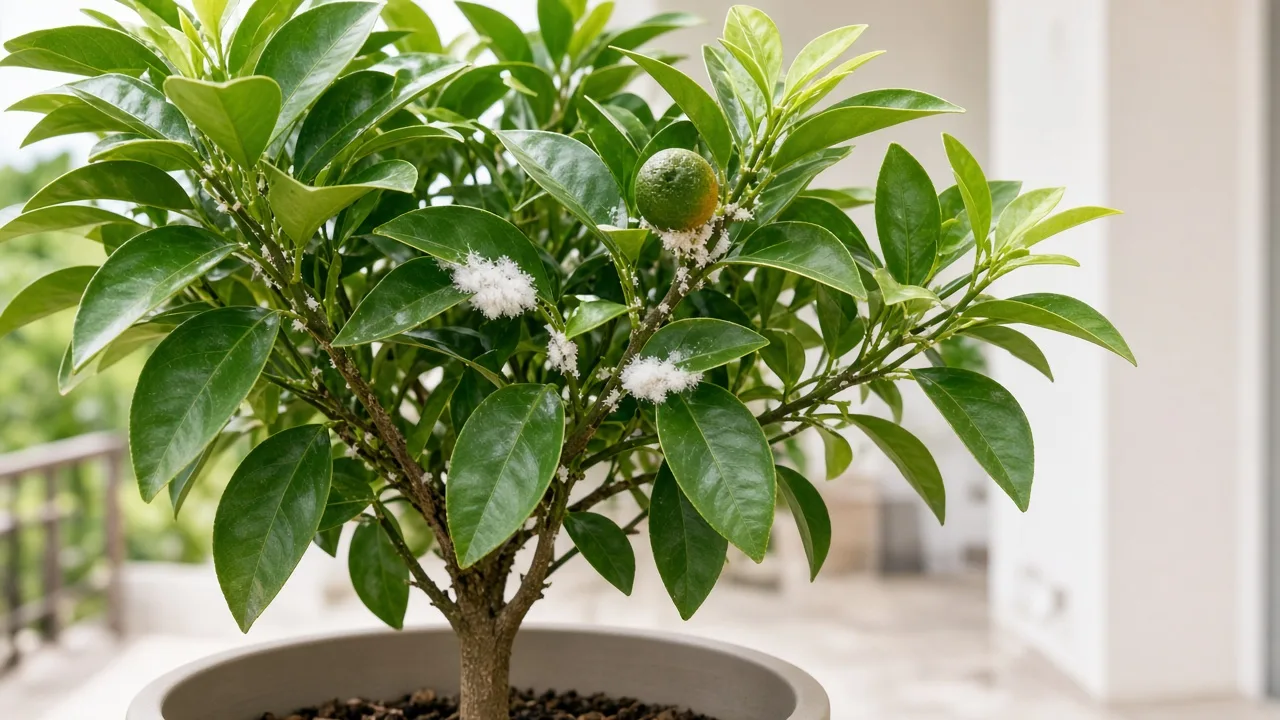
Mealybugs on Orange Tree: Causes, Checks & Fixes
This guide covers mealybugs on Orange Tree. See also the general Mealybugs guide, watering, and light pages for this plant.
Mealybugs on Orange Tree: Causes, Checks & Fixes
Quick answer
First, isolate container-grown sweet orange trees (Citrus sinensis) from neighboring plants, or examine the canopy of garden trees to determine the infestation perimeter. Check the underside of leaves, branch crotches, and especially the sheltered ring directly beneath the fruit calyx (the green “button” where the stem joins the orange). When you locate cottony white deposits, confirm live, soft-bodied insects beneath the wax and immediately dab them with a cotton swab soaked in 70% isopropyl alcohol.
Citrus mealybugs thrive in dense, sheltered citrus canopies where their waxy secretions repel light water sprays. In small populations, targeted mechanical cleaning and alcohol spot dabbing eliminate colonies without stressing the tree. However, if honeydew excretion has coated the foliage in black sooty mold or if ants are actively defending the pests, you must disrupt ant trails and apply a 1% to 2% narrow-range horticultural oil spray. Never spray oils during flowering or when ambient temperatures exceed 85°F (29°C), as citrus foliage is vulnerable to oil-induced phytotoxicity. For universal mealybug biology across general indoor plants, refer to our comprehensive mealybugs guide; this guide focuses strictly on the unique morphology, fruiting cycles, and pest interactions of the orange tree.
What mealybugs look like on an Orange Tree
On sweet orange (Citrus sinensis), the primary culprit is the citrus mealybug (Planococcus citri). Female citrus mealybugs are oval, distinctly segmented, soft-bodied insects roughly 3 to 4 mm long with a pale pinkish to yellowish body concealed beneath a powdery, white filamentous wax. Unlike longtailed mealybugs, their marginal waxy filaments are relatively uniform in length without elongated tail filaments. As NC State Extension’s citrus mealybug factsheet details, adult females deposit 300 to 600 eggs inside dense, fluffy cotton ovisacs, from which tiny yellow, mobile crawlers emerge to colonize new growth and fruit clusters.
The evergreen architecture of Citrus sinensis—characterized by glossy, dark green winged petioles, dense interior branching, and sharp axillary thorns described in NC State Extension’s Citrus sinensis profile—provides countless sheltered microhabitats that shield mealybug colonies from direct wind, predatory birds, and topical sprays.
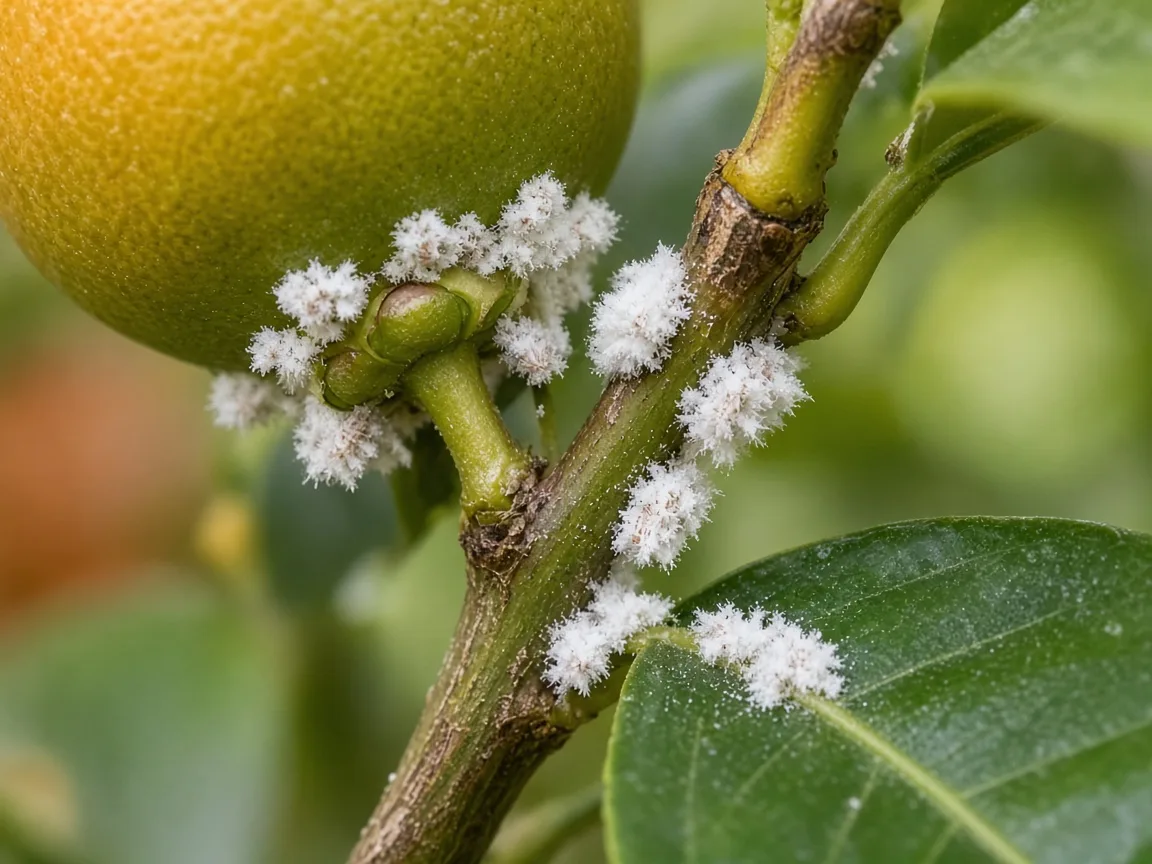
Inspect the protected fruit calyx (button) and leaf undersides; cottony wax shields soft pinkish mealybugs feeding on citrus sap.
Infestations on orange trees typically display several distinct hallmarks:
- Cottony clusters beneath the fruit button: Mealybugs wedge themselves tightly under the green calyx where the fruit connects to the pedicel. This site offers protection from rain, sun, and contact insecticides.
- Fruit scarring and lumpy rinds: As feeding colonies extract phloem sap from the developing fruit peel, they inject toxic saliva that causes cell hyperplasia. According to UC IPM citrus mealybug guidelines, this feeding induces raised, irregular hard lumps on young oranges and can trigger severe premature fruit drop when colonies cluster along the fruit stem.
- Copious honeydew and black sooty mold (Capnodium citri): Citrus mealybugs ingest massive quantities of phloem sap, discharging excess carbohydrates as sticky honeydew. A black, velvet-textured fungus known as sooty mold colonizes this sugary residue, heavily coating leaves, branches, and fruit. While sooty mold does not directly infect plant tissue, it forms a physical barrier that drastically reduces photosynthetic light absorption.
- Twig crotches and leaf axils: Tight angles where green twigs emerge from main scaffolds harbor dense cottony masses, often hidden behind the citrus spines.
Hiding zones: fruit buttons, twig crotches, and leaf undersides
To successfully eradicate citrus mealybugs, growers must look beyond casual canopy inspections. Orange trees produce thick, leathery leaves and dense interior twigs that create humid, shaded pockets. If you only look at the upper leaf surfaces, you will miss early-stage infestations until the tree is already covered in sooty mold.
The single most critical diagnostic zone on an orange tree is the calyx or “button” of developing fruit. During late spring and summer, crawlers migrate toward green fruitlets, wedging themselves under the sepals. A single fruit can harbor dozens of insects hidden beneath the button, feeding silently until the rind becomes distorted or the fruit drops prematurely.
The second major hiding zone comprises twig forks and thorny leaf axils. Orange shoots frequently produce sharp thorns at the nodes, particularly on vigorous juvenile water sprouts or rootstock suckers. Mealybugs congregate at the base of these thorns and inside the tight union of branch forks.
Finally, examine the undersides of older leaves, especially along the prominent central midrib. Here, female mealybugs produce their fluffy ovisacs away from direct overhead sun, safe from ordinary overhead hose rinsing.
How to confirm citrus mealybugs and rule out lookalikes
Because sweet oranges can host several sap-feeding pests that produce honeydew or white residues, confirming the insect under the wax is essential before applying treatments.
| What you see on the Orange Tree | Most likely cause | How to confirm on Citrus sinensis |
|---|---|---|
| Soft, oval pinkish insects under cottony wax in fruit calyxes and twig crotches; sticky honeydew | Citrus mealybug (Planococcus citri) | Part the wax with a toothpick; verify soft, segmented pinkish bodies and cottony egg sacs. |
| Large, fluted white egg sacs (10–12 mm) with yellow-orange or red-brown scale bodies on twigs | Cottony cushion scale (Icerya purchasi) | Look for hard, distinctly ridged or fluted white egg sacs attached to woody twigs rather than soft massed colonies in fruit buttons. |
| Tiny white moth-like insects fluttering when foliage is shaken; circular waxy rings on leaf undersides | Woolly whiteflies or citrus whiteflies | Gently tap branches; adult whiteflies take flight immediately. Immature nymphs remain flat and translucent on leaf undersides. |
| White powdery coating across leaf surfaces without insects or sticky honeydew | Powdery mildew or mineral spray residue | Scrape the surface; powdery mildew forms dry fungal mats on tender shoots without honeydew or sooty mold. |
| Brown, immobile domed shells attached to green twigs and leaf veins | Soft scale or armored scale | Lift the edge with a fingernail; adult scale insects have a smooth, firm waxy or hardened shell without cottony wax filaments. |
If you notice honeydew or black fungal growth but cannot immediately spot insects, look for ant trails along the trunk. Where ants march up an orange tree, sap-sucking pests are almost certainly present. You can also utilize our Pest Identifier Tool to cross-reference multiple citrus symptoms before starting treatments.
Ant mutualism: why managing ants is required
One of the greatest obstacles to controlling citrus mealybugs on orange trees is ant mutualism. Species such as Argentine ants (Linepithema humile) and native field ants establish a symbiotic relationship with citrus mealybugs. In exchange for feeding on sugar-rich honeydew, ants provide armed defense, actively attacking, driving away, and killing predatory insects such as lady beetle larvae and parasitic mini-wasps.
As UC IPM’s mealybug pest notes highlight, biological and chemical controls often fail completely if ants are allowed to patrol the tree canopy. Unchecked ants disrupt natural predator feeding and physically transport mealybug crawlers to uninfested shoots, accelerating canopy-wide infestation.
To break this mutualism, you must restrict ant access:
- Prune canopy skirts: Trim lower citrus branches so no leaves or twigs touch the ground, mulch, or adjacent fences. Any contact point creates a physical bridge that bypasses trunk treatments.
- Apply sticky trunk barriers: Wrap a 3- to 4-inch protective band of waterproof paper, heavy plastic wrap, or tree tape around the main trunk, then apply a layer of sticky horticultural barrier (such as Tanglefoot) onto the band. Never apply sticky adhesives directly to young, green citrus bark, which can cause chemical burns.
- Deploy targeted ant baits: Place enclosed sugar-based borate ant bait stations near the base of the trunk. Foraging worker ants carry the slow-acting toxicant back to the underground nest, eliminating the entire ant colony without introducing pesticides into the citrus canopy, as noted in Gardening Know How’s citrus sooty mold guide.
What to do first: targeted spot treatment
First action: isolate container orange trees and begin direct manual spot treatment with 70% isopropyl alcohol.
Never begin by drenching the entire orange tree with systemic insecticides or broad-spectrum sprays. Broad-spectrum chemicals kill beneficial insects, trigger secondary spider mite flare-ups, and fail to penetrate the thick wax of mealybugs sheltered under fruit buttons.
Instead, follow this methodical protocol supported by NC State Extension residential treatment advice:
- Dip a cotton swab in 70% isopropyl alcohol. Ensure the swab is saturated but not dripping excessively.
- Dab each visible colony directly. Touch the swab directly to the cottony cluster at twig forks, fruit buttons, and leaf undersides. The alcohol instantly dissolves the hydrophobic protective wax and dehydrates the insect’s cuticle on contact, causing the mealybug to turn from white to a dull brownish-pink.
- Spot-test an inconspicuous leaf first. Although citrus leaves have a thick, waxy cuticle that tolerates alcohol better than tender ferns, always test one lower leaf and wait 24 to 48 hours to confirm there is no localized tissue necrosis or leaf burn.
- Avoid whole-canopy alcohol spraying. Never pour rubbing alcohol into the container soil or spray undiluted alcohol across the entire canopy, as excessive alcohol runoff damages tender root hairs and can scorch expanding citrus blossoms.
For small container trees or patio specimens, two to three rounds of careful alcohol spot-dabbing spaced five days apart will eliminate early infestations before populations expand into fruit clusters.
Horticultural oil spray protocols: timing, bloom, and temperature safety
When citrus mealybugs spread across multiple branches or colonize developing fruit clusters where hand-swabbing cannot reach, horticultural oil becomes the frontline organic treatment. High-grade, narrow-range horticultural mineral oils (and OMRI-listed superior oils) work purely through physical contact: the oil film coats the mealybugs and their egg masses, suffocating the insects and disrupting their cellular respiration.
However, citrus trees exhibit specific physiological sensitivities to oil applications. You must strictly obey three critical safety protocols:
1. The bloom safety rule
Never apply horticultural oil while an orange tree is in bloom, or within 10 days after petal fall.
Oil droplets degrade the delicate petals of citrus flowers, foul the stigmatic surfaces, and cause widespread flower drop, which drastically reduces fruit set. Furthermore, wet oil sprays can harm honeybees and native solitary bees actively pollinating citrus blossoms. Wait until fruitlets have set and reached at least marble size before applying oil sprays.
2. The 85°F (29°C) temperature ceiling
Horticultural oils must only be sprayed when ambient temperatures are between 50°F and 85°F (10°C to 29°C). As emphasized by University of Nevada, Reno Extension, applying horticultural oils when temperatures exceed 85°F (29°C)—or when high heat is forecast within 24 to 48 hours—causes severe phytotoxicity. The oil interferes with leaf transpiration, trapping heat inside the glossy citrus tissue and causing extensive leaf scorch, yellowing, and sudden leaf drop. Spray during the calm, cool hours of early morning so the oil emulsion dries thoroughly before the midday sun intensifies.
3. The soil moisture requirement
Never spray oil onto a water-stressed, wilted, or drought-stricken orange tree. Thirsty citrus trees absorb surface oils into their foliar vascular system, resulting in severe leaf drop and twig dieback. Always irrigate the tree thoroughly the day before spraying, ensuring the root zone is evenly moist as outlined in our Orange Tree watering guide.
Application technique and crawler timing
Mix narrow-range horticultural oil at a 1% to 2% concentration (approximately 2.5 to 5 tablespoons per gallon of clean water). Ensure constant agitation in your tank sprayer. Spray with high pressure, directing the nozzle upward to thoroughly coat the undersides of leaves, deep into thorny twig forks, and directly into fruit clusters.
Because oil does not leave a toxic chemical residue, it only kills insects it contacts directly. Egg sacs protect unhatched eggs from complete smothering. Therefore, schedule a second application 10 to 14 days later to destroy the newly hatched, vulnerable crawlers before they secrete their full protective wax.
Biological control with the mealybug destroyer (Cryptolaemus montrouzieri)
In warm climates, greenhouses, and outdoor orchards, biological control offers an effective, self-sustaining solution. The most celebrated predator of the citrus mealybug is the mealybug destroyer (Cryptolaemus montrouzieri), a predatory lady beetle native to Australia.
According to UC IPM biological control recommendations, both adult beetles and larvae feed voraciously on all stages of Planococcus citri. Adult beetles are small (3 to 4 mm), featuring dark brown-black wing covers with a distinctive reddish-orange head and thorax.
Fascinatingly, the larvae of Cryptolaemus montrouzieri exhibit aggressive mimicry: they grow up to twice the size of an adult mealybug and are entirely covered in long, curly white waxy filaments, making them resemble giant mealybugs. Homeowners unfamiliar with this beneficial insect often make the grave mistake of spraying and killing the very predators helping them. Before treating white waxy insects on your orange tree, examine them closely: Cryptolaemus larvae move much faster than sluggish citrus mealybugs and actively search out mealybug egg sacs to devour.
To successfully utilize Cryptolaemus:
- Release adult beetles in early spring once ambient temperatures consistently exceed 65°F (18°C), as they are cold-sensitive and do not survive freezing winters.
- Ensure ant populations have been completely excluded using trunk barriers; otherwise, aggressive ants will kill or repel the beetles.
- Do not spray broad-spectrum insecticides or horticultural oils for at least two weeks before or after releasing biological controls.
Recovery timeline and fruit salvage
Recovering from a citrus mealybug infestation requires patience, as citrus trees operate on seasonal growth flushes.
- Days 1–3: Immediately following alcohol spot dabbing and ant exclusion, live mealybug populations drop sharply. Attacked insects shrivel and discolor.
- Weeks 2–3: A follow-up horticultural oil spray eliminates newly emerged crawlers. Attending ants disappear from the trunk. Black sooty mold stops expanding because fresh honeydew supplies have ceased.
- Weeks 4–6: Existing sooty mold dries into a brittle, flaky crust. Gently washing foliage with a mild 1% horticultural soap solution or warm water rinses away dead mold flakes and sticky residue, restoring light penetration to the leaves.
- Months 2–4: The tree pushes out a clean vegetative flush from terminal shoots. Damaged fruit rinds may retain slight scarring or surface irregularities, but the internal fruit flesh remains completely healthy, juicy, and delicious. Severe twig dieback should be pruned out using sanitized bypass pruners.
Recovery must be evaluated by the absence of active waxy colonies, normal expansion of fresh leaves, and healthy fruit sizing, rather than expecting damaged rinds to become blemish-free.
Orange Tree care cross-check and stress prevention
Pests exploit physiologically stressed trees. Aligning baseline cultivation with the specific needs of Citrus sinensis dramatically reduces susceptibility to recurring infestations:
- Avoid excessive nitrogen feeding: Heavy applications of quick-release synthetic nitrogen stimulate surges of succulent, soft vegetative growth with thin cell walls. Citrus mealybugs thrive on high-amino-acid sap and rapidly reproduce on over-fertilized foliage. Feed container oranges with a balanced, slow-release organic citrus fertilizer containing essential micronutrients (iron, zinc, manganese) applied only during active spring and summer growth.
- Maintain appropriate ambient humidity: While citrus trees need good air circulation, extremely dry, arid microclimates can stress container trees kept indoors during winter. Use our Humidity Calculator Tool to calibrate optimal environmental targets for potted citrus.
- Ensure sharp drainage: Overwatering suffocates citrus roots, causing root rot that weakens the tree’s immune defense. Plant in a porous, slightly acidic loam-based mix amended with 20% coarse perlite or pumice as detailed in our Orange Tree soil guide, and follow the soil dry-down checks in our Orange Tree watering guide.
- Provide full sun: Position outdoor trees where they receive at least 6 to 8 hours of unfiltered sunlight, or supplement indoor overwintered trees with full-spectrum horticultural lighting as outlined in our Orange Tree light guide. Direct sunlight warms the canopy, discourages excessive humidity pockets, and promotes thick, resilient leaf cuticles.
Related tool
To evaluate whether your indoor or greenhouse growing conditions are stressing your citrus tree and inviting pest flare-ups, consult the LeafyPixels Humidity Calculator. Calibrating relative humidity and vapor pressure deficit helps prevent foliar dehydration without creating stagnant moisture pockets.
When to use this page vs other Orange Tree guides
Use this guide when you observe soft, white cottony insects, fluffy egg masses, or sticky honeydew focused around fruit buttons, branch forks, and leaf undersides on an orange tree.
- If you see dark brown, immobile, shell-like bumps firmly adhered to green twigs without fluffy white wax, consult our guide to scale insects on orange trees.
- If yellowing foliage is accompanied by fine silk webbing and yellow stippling across leaf blades, see our guide on spider mites.
- If leaves are turning uniformly yellow or dropping while the potting mix remains saturated, consult Orange Tree yellow leaves and the Orange Tree problems hub to diagnose watering and drainage disorders.
Related Orange Tree guides
- Orange Tree care overview — Comprehensive cultural essentials for growing healthy container and garden citrus.
- Orange Tree problems hub — Symptom-based triage guide for distinguishing nutrient deficiencies, diseases, and insect pests.
- Orange Tree watering guide — How to balance moisture requirements during flowering, fruit set, and winter dormancy.
- Orange Tree light guide — Sunlight thresholds and supplemental grow light strategies for overwintering citrus indoors.
- Orange Tree soil guide — Formulating well-draining, slightly acidic potting mixes to prevent root decline.
Conclusion
Citrus mealybugs can threaten both the ornamental vigor and fruit harvest of an orange tree by colonizing fruit buttons, causing rind deformities, and coating leaves in suffocating black sooty mold. By eliminating mutualistic ants with sticky trunk barriers, spot-treating early colonies with 70% isopropyl alcohol, and spraying narrow-range horticultural oil during safe temperature windows outside of bloom, you can effectively eradicate the pest and restore vigorous growth to your Citrus sinensis.