Brown Tips on Orange Tree: Causes, Checks & Fixes
Quick answer
Brown tips on an orange tree (Citrus sinensis) primarily result from fertilizer salt accumulation, municipal tap water chloride or sodium toxicity, and dry wind desiccation. Because citrus moves soluble minerals to leaf margins via the transpiration stream, toxic salts accumulate at the tips of older glossy leaves. First step: flush the container soil thoroughly with clean rainwater or distilled water using a 3-to-1 pot leaching protocol to wash out residual salts, then withhold synthetic fertilizers until fresh growth flushes appear.
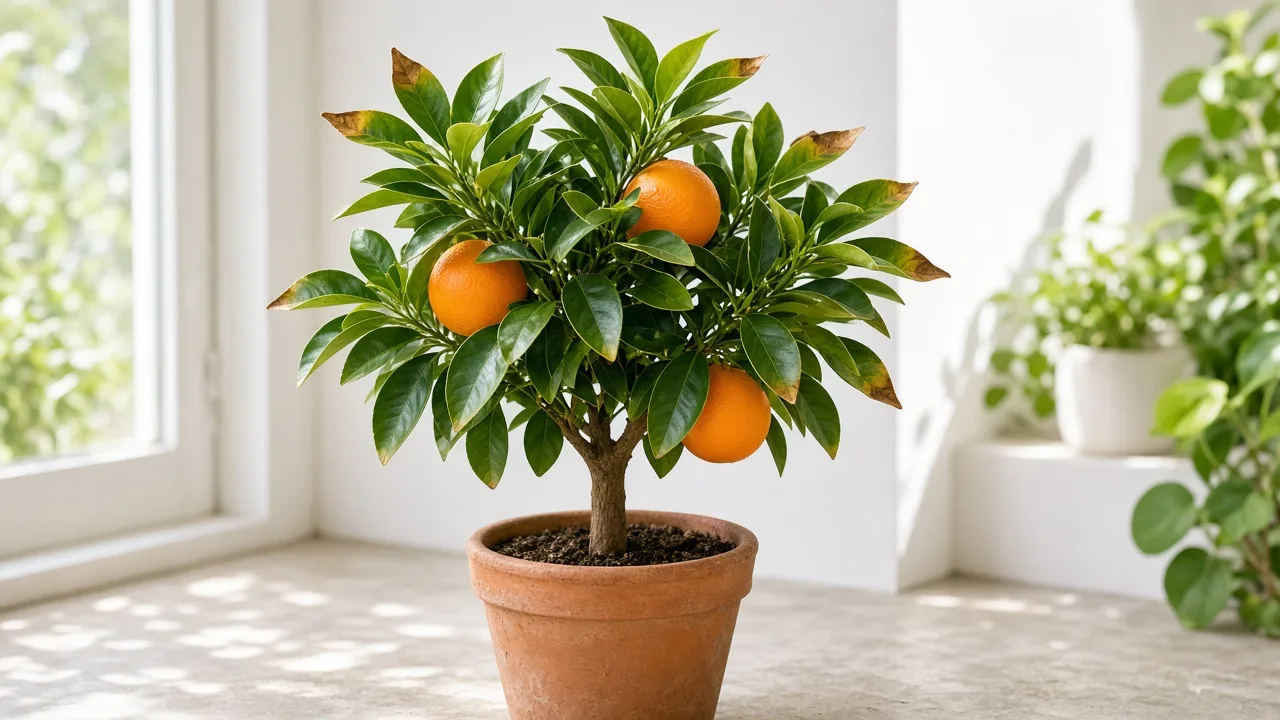
Brown Tips on Orange Tree: Causes, Checks & Fixes
This guide covers brown tips on Orange Tree. See also the general Brown Tips guide, watering, and light pages for this plant.
Brown Tips on Orange Tree: Causes, Checks & Fixes
Quick answer
Brown tips on an orange tree (Citrus sinensis) signify cellular necrosis at the leaf apex, which commonly advances along the leaf perimeter as marginal scorch. Unlike thin-leaved foliage plants that crisp from brief drops in ambient air moisture, citrus trees possess thick, coriaceous (leathery), waxy leaves designed to regulate transpiration. When leaf tips turn brown on an orange tree, it is predominantly a physiological response to root-zone mineral stress: fertilizer salt burn from heavy synthetic feeding, chloride or sodium toxicity from municipal tap water, or hot, dry wind desiccation stripping moisture faster than roots can replace it.
For how tip scorch functions across indoor and outdoor plants generally, see our global brown tips guide. On orange trees, however, the problem centers on the tree’s vascular dynamics—salts and toxic ions travel upward through the xylem and concentrate at the leaf terminals, producing localized tissue collapse on older leaves first.
First step: immediately leach the root zone. Flush the potting mix with pure rainwater or distilled water using three times the container’s volume to dissolve and drain out accumulated fertilizer salts and sodium ions. Cease all synthetic feeding until the tree produces a vigorous flush of clean, unburned foliage.
When to use this page vs other Orange Tree guides
Marginal browning can overlap with other citrus ailments. Use this routing table to confirm whether your tree requires salt remediation or a different care intervention:
| What You See on the Tree | Primary Diagnostic Cause | Recommended Guide |
|---|---|---|
| Crisp brown tips and outer margins on mature, older leaves; white mineral crust on soil | Fertilizer salt burn or tap water salinity | Stay on this guide |
| Uniform yellowing across entire older leaves with green veins; leaves shedding | Nitrogen depletion or wet root suffocation | Orange Tree Yellow Leaves |
| Wilting or dull curled leaves; soil soggy and emitting a sour, stagnant odor | Anaerobic root decline from waterlogged soil | Orange Tree Overwatering & Root Rot |
| Inward curling leaves, dry drooping twigs, bone-dry potting mix pulling from pot edge | Prolonged moisture deficit | Orange Tree Underwatering |
| Stippled bronze flecking on leaf tops with fine webbing beneath leaf margins | Spider mite feeding damage mimicking tip burn | All Orange Tree Problems |
| General seasonal irrigation and potting substrate setup | Preventative cultural care | Orange Tree Watering & Soil Guide |
What brown tips look like on Orange Tree
On Citrus sinensis, leaf tip burn exhibits distinctive visual patterns depending on whether the underlying damage is chemical, environmental, or hydraulic.
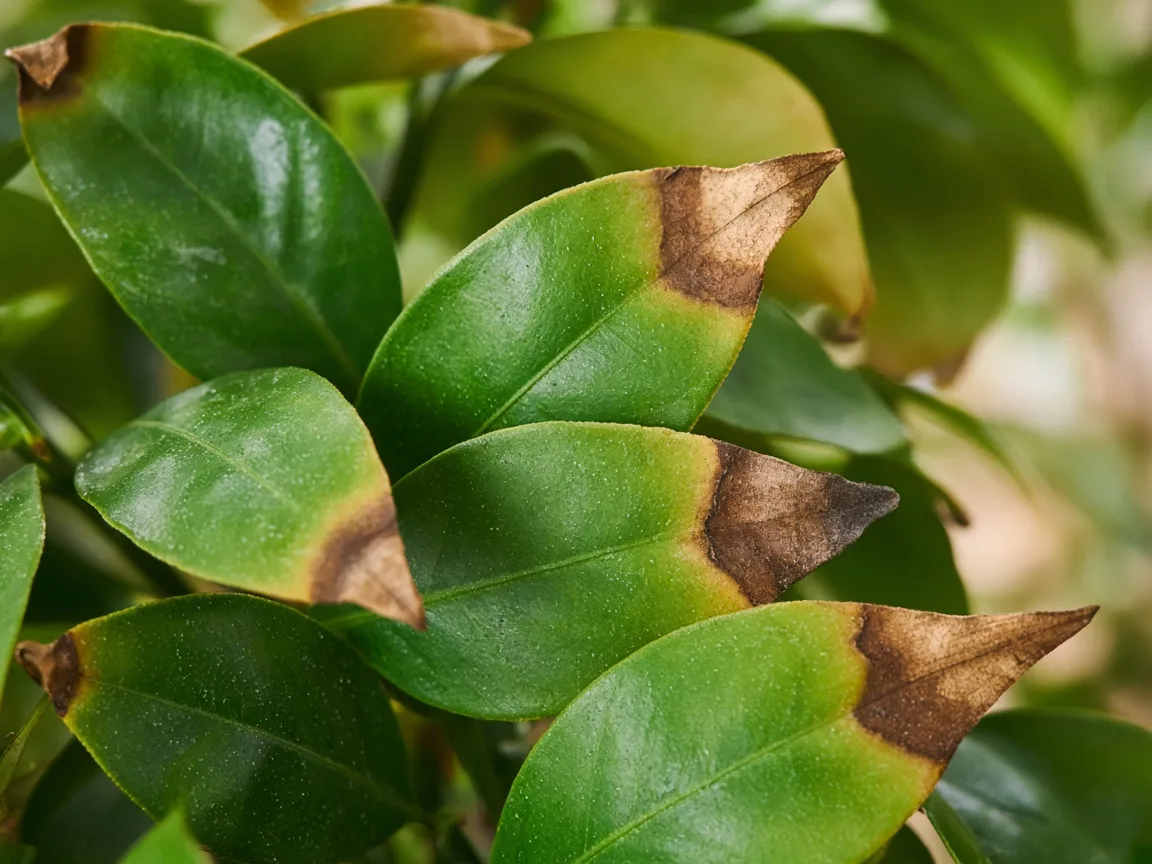
Tip and marginal necrosis on Citrus sinensis leaves from fertilizer salt accumulation and chloride toxicity—compare with healthy deep green foliage.
Visual diagnostic markers
- Apical to Marginal Necrosis: The symptom begins as a dry, dull tan or dark brown spot at the very tip of the leaf blade. Over days or weeks, this necrotic area spreads basipetally (downward) along the lateral leaf margins, creating a scorched outer perimeter while the central lamina and midrib remain green.
- Chlorotic Transition Halo: A narrow, pale yellow or chartreuse band frequently separates the dead, brittle brown tissue from the healthy green interior of the leaf. This indicates active osmotic stress where cells are dying from accumulated minerals.
- Older Foliage Locus: Symptoms appear almost exclusively on fully mature, hardened older leaves. Because citrus trees accumulate absorbed minerals over time, older leaves that have transpired for months bear the highest concentration of toxic ions. New spring flushes typically look pristine until they mature.
- Substrate Mineral Scaling: The top layer of the potting mix, the inner clay pot rim, or the exterior of drainage holes often exhibits a chalky, crystalline white or yellowish residue—a clear sign of excessive dissolved fertilizer salts.
- Brittle Leaf Drop: When salt burn or chloride injury turns severe, the affected leaves become brittle, curl slightly downward at the apex, and drop cleanly from the petiole (leaf stem), leaving the bare petiole temporarily attached to the twig.
The physiology of citrus leaf burn: why tips scorch first
Understanding why orange trees exhibit tip burn requires examining citrus vascular biology. As evergreen woody perennials, orange trees maintain active transpiration whenever exposed to sunlight and warmth.
Water and dissolved nutrients are drawn into the feeder roots and propelled upward through xylem vessels to the canopy. According to research from UF/IFAS Extension on citrus nutrition and toxicity, chloride and soluble mineral ions move readily in the transpiration stream and accumulate at the terminus of the leaf veins—specifically the apex and outer margins.
Unlike annual crops, the glossy, thick leaves of Citrus sinensis persist on the tree for twelve to twenty-four months. If the potting mix contains excess chemical fertilizer, or if municipal tap water introduces sodium and chlorine with every watering, these non-metabolized ions steadily build up in the foliage. Once leaf chloride levels exceed roughly 0.3% to 0.5% on a dry weight basis, cell cytoplasm dehydrates, chlorophyll degrades, and localized cellular necrosis occurs. Because the tip is the absolute terminus of the vascular pathway, it burns first.
Primary causes of brown leaf tips on Citrus sinensis
1. Fertilizer salt burn from heavy synthetic citrus feedings
Citrus trees are heavy feeders that demand nitrogen, potassium, and trace minerals to fuel vegetative flushes, fragrant blossoms, and fruit development. However, hobby growers frequently apply concentrated synthetic citrus fertilizers too frequently or to dry potting soil. Synthetic fertilizers are chemical salts (ammonium nitrate, potassium sulfate, urea). When applied in excess, the salt concentration in the soil solution surpasses that inside root cells. This creates reverse osmotic pressure, drawing water out of tender citrus root hairs—a phenomenon known as chemical desiccation or root burn. The damaged roots can no longer hydrate leaf perimeters, and excess absorbed salts scorch the leaf tips.
2. Chloride and sodium toxicity from municipal tap water
City tap water frequently contains chlorine, chloramines, dissolved sodium, and fluorides, often accompanied by high mineral hardness (calcium carbonate). In regions with alkaline tap water, repeated watering without acid buffering causes both an unfavorable rise in soil pH and a steady accumulation of chloride and sodium ions. The University of California IPM Program highlights that salt toxicity manifests as dry, brittle leaf margins and root dieback. Furthermore, using water from home water softeners is fatal to container citrus: water softeners swap beneficial calcium ions for sodium ions, triggering rapid sodium toxicity and extensive marginal necrosis.
3. Dry wind desiccation and atmospheric scorch
Orange trees thrive in warm, sunny conditions, but dry, gusty winds dramatically accelerate transpiration. When containerized trees are placed on exposed balconies, breezy patios, or in direct drafts from indoor heating vents, water evaporates from the leaf tips faster than root systems can absorb moisture from the potting soil. As noted in the UC Statewide IPM guidelines on leaf scorch and burn, wind injury and low ambient humidity cause leaf tips and margins to desiccate, curl, and turn crisp brown even when the root ball appears damp.
4. Chronic shallow watering and salt stratification
Watering an orange tree with a small cup of water every few days is one of the most common container mistakes. Shallow watering moistens only the upper two inches of soil without allowing water to drain out the bottom. Every milligram of mineral salt introduced through tap water or fertilizer remains trapped in the pot. Over weeks, water evaporates from the soil surface, leaving concentrated mineral deposits in the root zone. Without thorough leaching, salinity levels escalate until leaf tips die.
5. Micronutrient imbalances and high soil pH
Citrus sinensis requires a slightly acidic root-zone pH between 5.5 and 6.5, as detailed by the Missouri Botanical Garden Plant Finder. When soil pH climbs above 7.0 due to alkaline tap water or hard potting media, critical micronutrients such as iron, zinc, and manganese become chemically insoluble and unavailable to the roots. Growers often mistake the resulting interveinal chlorosis for underfeeding and dump more synthetic N-P-K fertilizer into the pot, drastically worsening the salt burden without solving the underlying micronutrient lockout.
Diagnostic inspection: step-by-step confirmation checks
Before implementing remedies, follow this systematic diagnostic sequence:
- Examine Leaf Age and Pattern: Determine which leaves display necrosis. If brown tips are restricted to mature, dark green leaves on the lower and middle canopy, salt accumulation or chloride toxicity is highly probable. If tip burn appears exclusively on soft, newly emerging spring shoots, suspect intense sun scorch, direct pesticide phytotoxicity, or severe copper/boron deficiency.
- Inspect the Soil Surface and Pot: Look across the surface of the potting mix and along the rim of terracotta or plastic containers. A powdery white, yellowish, or crusty mineral ring confirms excessive soluble salt accumulation.
- Evaluate the Irrigation Source: Review the water you provide. Are you using softened tap water, municipal municipal water with heavy chlorine odor, or well water with high electrical conductivity (EC)? Switching to pure rainwater or reverse osmosis water is often the single most restorative action.
- Conduct a Root Ball Check: Gently slide the root ball from its container. Healthy orange tree roots are fibrous, firm, and light tan or cream-colored with white growing tips. Roots damaged by fertilizer salts or waterlogging appear dark brown, brittle or mushy, and lack active pale tips.
- Check Microclimate Exposure: Is the tree situated directly in the path of a HVAC forced-air register, a radiator, or an unbuffered outdoor wind tunnel? Dry air currents compound root stress.
Lookalike symptoms and differential diagnosis
| Symptom Pattern | Suspected Issue | Distinguishing Features from Salt Burn |
|---|---|---|
| Brown tips and outer margins on oldest leaves; white soil crust | Fertilizer salt burn / Salinity | Clear demarcation line, chlorotic transition halo; healthy midrib; oldest leaves affected first |
| Pale bleached patches turning tan-brown in the center of sun-facing leaves | Sunburn (Solar scorch) | Affects top canopy leaves facing direct afternoon glass/sun; leaf margins remain green |
| Yellowing begins at leaf tips and margins, progressing to necrotic spots | Potassium (K) deficiency | Mottled yellowing precedes necrosis; common on heavily fruiting trees in sandy, depleted soils |
| Entire leaf tips curl downward, turn blackish-brown, and drop prematurely | Overwatering / Root rot | Potting soil smells stagnant; leaves drop while still soft; roots are dark and slough off easily |
| Bleached speckles, dull bronzed leaf surface, fine webbing at tips | Spider mite infestation | Microscopic mites visible under 10× hand lens; leaf tips become crispy due to chronic sap loss |
| Brittle brown leaf margins following sudden cold snaps below 32°F (0°C) | Freeze injury | Affects outer canopy uniformly; leaves turn dark, water-soaked, then crisp and desiccated |
The first fix: pot leaching protocol
Your immediate priority is to wash accumulated chemical salts and toxic ions out of the potting mix. Do not trim leaves, repot, or spray foliar chemicals today. Implement this three-step leaching protocol:
Container Leaching Protocol for Citrus sinensis:
Step 1: Move the container to an outdoor patio, lawn, or shower where water drains freely.
Step 2: Calculate 3× the container's volume in pure rainwater or reverse osmosis water.
Step 3: Pour the water slowly and evenly across the soil surface in 3 divided batches,
        allowing the entire volume to percolate through the root zone and escape freely.
Leaching execution details
- Prepare Water Quality: The Royal Horticultural Society recommends watering citrus with rainwater to prevent tap water mineral deposits. If rainwater is unavailable, use distilled, deionized, or reverse osmosis water. Never use municipal water through a salt-based softener.
- First Application: Pour water equivalent to the container’s volume (e.g., 3 gallons of water for a 3-gallon pot) evenly over the soil. This dissolves crystalline salts clinging to soil particles and bark chips. Let it drain completely for 15 minutes.
- Second & Third Flushes: Pour the remaining two volumes of water through the pot. This flushes the dissolved mineral ions down through the drainage holes and completely out of the container system.
- Discard Runoff: Ensure the pot drains freely and never sits in the runoff saucer. Allowing a container to reabsorb salty runoff water defeats the entire purpose of leaching.
Step-by-step recovery plan
Once the potting soil has been thoroughly leached, support the tree’s vascular recovery with this progressive timeline:
Phase 1: Stabilize hydration (Weeks 1–2)
- Withhold all fertilizers completely. Adding nitrogen or mineral salts to damaged roots causes catastrophic root collapse.
- Monitor moisture using the finger test or a wooden skewer. As described in our orange tree watering guide, allow the top 2 to 5 centimeters (1 to 2 inches) of potting mix to dry before watering again.
- When watering, always apply enough clean water so that roughly 10% to 20% escapes the base, preventing re-accumulation of residual minerals.
Phase 2: Microclimate adjustment (Weeks 2–4)
- Shield the tree from harsh, dry winds. If kept outdoors, move the container against a warm, south-facing sheltered wall or courtyard screen.
- If overwintering indoors, maintain adequate ambient humidity. As the Royal Horticultural Society notes on citrus problems, indoor citrus suffering from dry heated air and draughts drops foliage quickly; elevate humidity by grouping plants or placing the pot over a tray of moist pebbles.
- Ensure the tree receives 6 to 8 hours of bright, indirect sunlight or gentle direct morning sun. Avoid placing salt-stressed trees under blazing midsummer afternoon sun while root absorption is compromised. Consult our orange tree light guide for seasonal lighting requirements.
Phase 3: Balanced nutrient reintroduction (Weeks 4–8)
- Wait until active new growth buds (flushes) swell at leaf axils before resuming nutrition.
- Select a specialized citrus fertilizer with an N-P-K ratio close to 2-1-1 or 3-1-2 that derives its potassium from potassium nitrate or potassium sulfate—never muriate of potash (potassium chloride).
- Dilute the fertilizer to one-half or one-quarter the manufacturer’s recommended label strength. Apply weakly on a bi-weekly schedule rather than dumping heavy monthly doses.
- Verify that the fertilizer formula includes chelated micronutrients: iron (Fe-EDDHA for alkaline soils), zinc (Zn), manganese (Mn), and magnesium (Mg).
Micronutrient management: balancing trace elements without salt burn
A common mistake among citrus growers is treating all leaf discolorations with heavy synthetic nitrogen, which accelerates tip burn. Citrus trees have unique micronutrient demands that must be managed with balanced, low-salinity formulations:
- Iron (Fe): Iron deficiency causes distinct interveinal chlorosis on the newest leaves (yellow leaves with dark green veins). If soil pH is high, soil-applied iron becomes locked. Apply chelated iron foliar sprays or drench with Fe-EDDHA, which remains soluble across broader pH ranges without adding excess salt index.
- Zinc (Zn) & Manganese (Mn): Deficiencies in zinc cause “little leaf” and mottled yellowing along veins. Foliar applications of chelated zinc and manganese bypass root-zone salinity entirely, delivering nutrition directly to the leaf lamina without raising the soil electrical conductivity.
- Magnesium (Mg): Magnesium deficiency produces an inverted green “V” shape at the base of mature leaves, with yellowing outer edges. An occasional light drench of Epsom salts (magnesium sulfate, 1 tablespoon per gallon of water) supplies magnesium without adding chloride or sodium.
- Avoid Potassium Chloride: Ensure your fertilizer label does not list potassium chloride (muriate of potash). High chloride fertilizers are inexpensive but notoriously destructive to container-grown citrus roots.
Mistakes to avoid
- Trimming Off the Brown Tips with Scissors: While trimming the dead brown margins might seem cosmetically appealing, cutting into living green leaf tissue creates an open wound that invites fungal leaf spots (Colletotrichum) and accelerates water loss from the cut margin. If you must trim for aesthetics, leave a narrow 1 mm margin of dead brown tissue intact.
- Applying Fertilizer to “Help” a Stressed Tree: Never feed a tree exhibiting active leaf burn. Fertilizer is not medicine; it is a metabolic input. Applying chemical salts to damaged, dehydrated roots finishes them off.
- Using Softened Water: Never irrigate an orange tree with water processed by a salt-based water softener. Sodium toxicity causes rapid, irreversible marginal necrosis and severe leaf drop.
- Letting Pots Sit in Drainage Trays: Allowing runoff water to sit in the collection saucer allows the soil to wick dissolved salts back into the root ball, causing chronic salinity stress. Always empty saucers within 20 minutes of watering.
- Overpotting into Heavy, Waterlogged Soil: Sinking a small tree into an oversized container filled with dense garden soil suffocates roots and prevents healthy dry-down cycles. Review our orange tree soil guide for coarse, well-aerated citrus potting blends.
Recovery timeline and expectations
Understanding what real citrus recovery looks like prevents unnecessary panic:
- Existing Brown Tips Will Never Re-Green: Cells killed by salt toxicity or desiccation cannot regenerate. Accept that burned leaves will carry their brown margins indefinitely.
- 2 to 3 Weeks: With thorough leaching and clean water, the progression of browning along the margins of existing foliage should halt completely. The soil surface will remain free of new mineral crusts.
- 4 to 8 Weeks: In the presence of adequate warmth and bright light, the tree will initiate a new vegetative flush from apical and axillary buds.
- Full Canopy Renewal: These newly unfurled leaves will be pliable, vibrant green, and completely free of tip scorch. Over the following 6 to 12 months, the tree will naturally shed older, damaged leaves as the vigorous new canopy expands.
How to prevent brown tips next time
Maintain an environment that respects citrus biology across all four seasons:
- Rainwater First: Collect rainwater whenever possible. If using municipal tap water, let it sit to off-gas chlorine, or filter it through an activated carbon filter. If your local water is hard and alkaline, periodically flush with pure rainwater or acidified water (using a splash of vinegar or citrus acidifier to maintain soil pH at 6.0).
- Routine Scheduled Leaching: Mark your calendar to flush container citrus with three volumes of water every 6 to 8 weeks during active summer growth. This prevents salts from ever reaching toxic thresholds.
- Wind Breaks: Position container orange trees in microclimates protected from persistent dry winds. Use decorative patio screening, fences, or companion shrubs to buffer high-velocity air.
- Soil Drainage Integrity: Ensure the container potting mix retains roughly 20% coarse perlite, pumice, or grit to maintain open macro-pores. Roots require oxygen to actively regulate ion uptake.
- Seasonal Feeding Adjustments: Switch from high-nitrogen feeds in spring and summer to a balanced, diluted formulation in late summer, and cease heavy feeding during winter dormancy.
For complete cultural requirements and seasonal care routines, consult our Orange Tree overview guide and browse our full library of Orange Tree problem guides.
Related Orange Tree guides
- Orange Tree Overview - Comprehensive care requirements, species biology, and fruiting conditions
- Watering Orange Trees - Soil dry-down depth, container drainage, and seasonal watering rhythms
- Orange Tree Soil & Potting - Loam-based, free-draining citrus mix formulations and pH management
- Orange Tree Light Requirements - Direct sun thresholds, indoor lighting, and preventing leaf scorch
- All Orange Tree Problems - Diagnostic hub for pest identification, nutrient deficiencies, and leaf drop
Related tool
Use the Humidity Calculator to assess vapor pressure deficit and dry-air stress on your orange tree before altering its fertilization or watering schedule.