Spider Mites on Orange Tree: Causes, Checks & Fixes
Quick answer
Spider mites on an orange tree (Citrus sinensis) cause fine chlorotic stippling across glossy leaf surfaces, grayish-bronze foliage dullness, and delicate silk webbing beneath leaves and in petiole axils. First step: isolate the tree (or separate the affected branch sector) and wash both upper and lower leaf surfaces with a firm spray of lukewarm water to mechanically dislodge mites and web colonies before scheduling narrow-range horticultural oil or insecticidal soap applications outside of hot weather (>85°F/29°C).
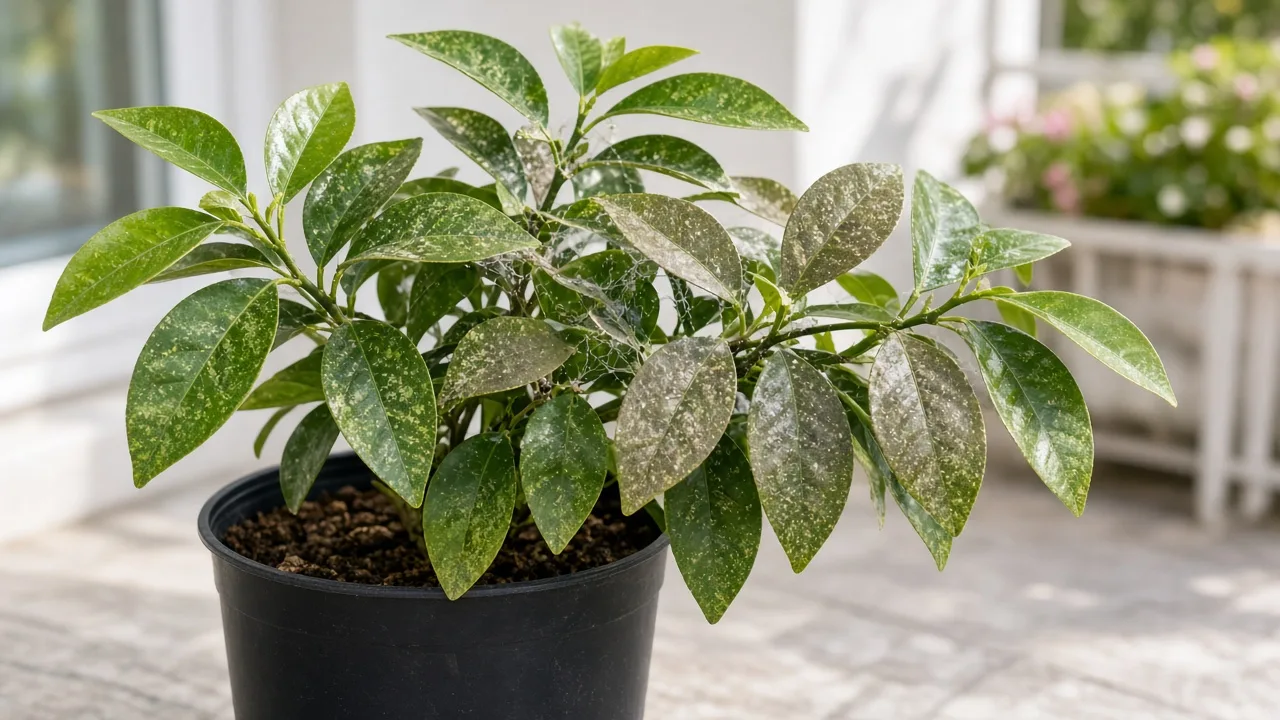
Spider Mites on Orange Tree: Causes, Checks & Fixes
This guide covers spider mites on Orange Tree. See also the general Spider Mites guide, watering, and light pages for this plant.
Spider Mites on Orange Tree: Causes, Checks & Fixes
Quick answer
First, isolate container-grown sweet orange trees (Citrus sinensis) from neighboring plants or mark off infested canopy quadrants on garden trees. Immediately wash both the upper and lower leaf surfaces, winged petioles, and branch axils with a firm, high-pressure spray of lukewarm water. This physical washdown knocks down motile mites, disrupts fine webbing nests, and washes away dusty road grime that accelerates pest multiplication.
Spider mites feed by inserting piercing-sucking stylets directly into epidermal and palisade mesophyll cells, destroying chlorophyll and leaving hundreds of pale pinprick stipples across the glossy, dark green citrus foliage. In severe outbreaks, the cumulative loss of foliar cell contents causes foliage to turn a dull grayish-bronze, followed by sudden defoliation and the shedding of tender green fruitlets. While general mite mechanics and dry-air reproductive speed are covered in our comprehensive spider mites pest guide, managing mites on Citrus sinensis demands species-specific care: citrus trees are uniquely vulnerable to spray-induced foliar phytotoxicity when treated with oils during hot weather. After an initial water knockdown, confirm the pest population and apply a 1% to 2% narrow-range horticultural oil or insecticidal soap spray strictly when ambient temperatures remain below 85°F (29°C) and the tree is fully hydrated.
What spider mites look like on Orange Tree (Citrus sinensis)
On sweet orange (Citrus sinensis), spider mite feeding alters the vibrant, reflective cuticle of healthy evergreen leaves. Because citrus leaves possess a thick, waxy upper epidermis designed to withstand intense subtropical sun, early feeding does not present as broad wilting or ragged chew marks. Instead, it appears as an uneven dusting of microscopic, pale yellow or bleached chlorotic dots across the leaf surface.
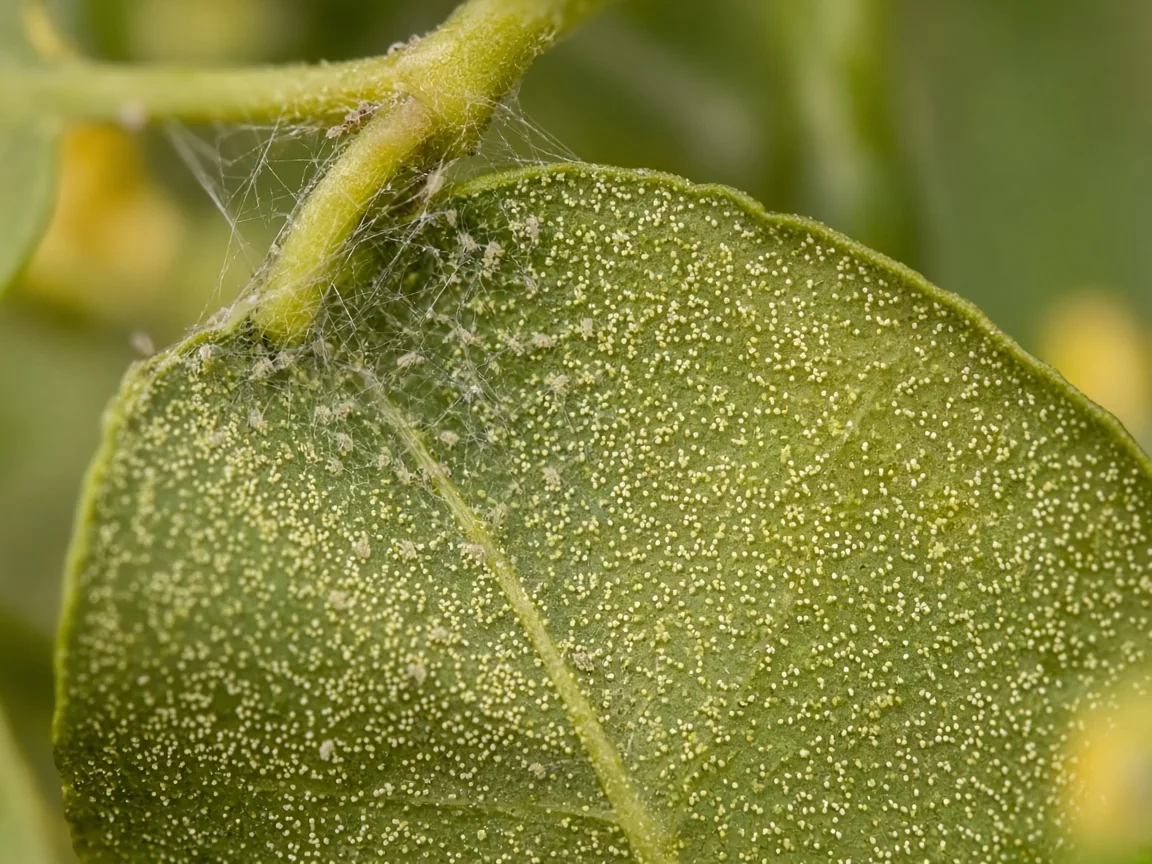
Close-up of spider mite feeding damage on an orange tree leaf: fine chlorotic stippling across the upper epidermis with subtle webbing at the petiole axil.
As mite colonies expand, diagnostic visual patterns become unmistakable:
- Chlorotic stippling and foliar bleaching: Each feeding puncture extracts cellular sap and chloroplasts. On deep green orange leaves, dense feeding produces a sandblasted or bleached appearance. As documented by the UC Statewide IPM Program for Citrus Red Mite, severe feeding leads to “stippling” on leaves and green fruit, which can coalesce until entire leaf blades take on a bleached, pale look.
- Bronzing and foliar dullness: When thousands of feeding wounds oxidize under direct sunlight, affected leaves lose their natural luster and turn a sickly, matte grayish-bronze. Heavily bronzed leaves become brittle, dry, and drop prematurely from the canopy.
- Fine silk webbing at petiole axils and leaf margins: While some citrus-specific mites spin minimal silk, species like the twospotted spider mite produce delicate sheets of webbing. This webbing is concentrated on leaf undersides, stretched between the slightly winged petiole and the stem, and wrapped around thorny branch junctions.
- Premature fruitlet and blossom drop: During spring flowering and fruit set, mites readily feed on the tender green rinds of juvenile oranges (fruitlets). Stressed by sap depletion and water loss through puncture wounds, the tree triggers abscission layers at the pedicel, causing marble-sized developing oranges to yellow and drop prematurely.
The three citrus spider mite species: Identification and habits
Unlike generic houseplants that typically host only common twospotted mites, Citrus sinensis is targeted by three distinct phytophagous tetranychid mite species. Accurately identifying which species is colonizing your orange tree dictates where to inspect and how to treat.
1. Citrus red mite (Panonychus citri)
The citrus red mite is the most widespread mite pest on cultivated citrus worldwide. According to UF/IFAS Featured Creatures on Citrus Red Mite, adult females are globular, dark ruby-red to purplish, and measure approximately 0.5 mm in length. A defining anatomical characteristic is the presence of prominent white tubercles (bumps) on their dorsal surface, each bearing a stiff, curved bristle (seta).
Unlike many other spider mites, Panonychus citri feeds predominantly on the upper surface of mature and expanding leaves, as well as the green rind of ripening oranges. They spin very little silk webbing. Citrus red mites favor moderate temperatures and low relative humidity, reaching peak reproductive velocity during spring and autumn flushes; hot summer temperatures above 90°F (32°C) often suppress their populations.
2. Twospotted spider mite (Tetranychus urticae)
The twospotted spider mite is a notorious pest of indoor container citrus, greenhouses, and sheltered patio trees. As outlined in the UF/IFAS Extension guide on Twospotted Spider Mite, adult females are oval, about 0.4 to 0.5 mm long, and vary from translucent yellowish-green to straw-colored, featuring two large, irregular dark pigment spots on the lateral sides of their abdomen.
Tetranychus urticae colonizes almost exclusively the undersides of orange leaves. They produce profuse quantities of fine, elastic silk webbing that forms protective canopy canopies over their egg clusters and nymph colonies. Twospotted spider mites thrive in hot, arid conditions (85°F to 95°F / 29°C to 35°C with relative humidity below 40%), reproducing from egg to adult in as little as 7 to 10 days during warm summer months or indoors near heating vents.
3. Texas citrus mite (Eutetranychus banksi)
The Texas citrus mite is primarily encountered in warm citrus-growing belts across the southern United States and the Caribbean. As described by UF/IFAS Featured Creatures on Texas Citrus Mite, adult females are broadly oval, somewhat flattened, and range in color from tan to greenish-brown with dark brown or black spots arranged along the margins of the body. Their legs are relatively long and pale.
Texas citrus mites feed almost exclusively on the upper surface of leaves, particularly concentrated along the main midrib and lateral veins. They produce very sparse webbing, often limited to tiny anchor threads for their flat, disc-shaped eggs. Feeding results in circular, silver-gray chlorotic halos along leaf veins that merge into widespread foliar etching.
Why Orange Trees get spider mites: Environmental triggers
Spider mite outbreaks on Citrus sinensis are rarely random accidents; they are almost always provoked by specific cultural stressors that favor mite biology while suppressing their natural predators.
- Arid microclimates and winter heating: Spider mites have evolved high reproductive rates in dry air where transpiration and evaporation are rapid. When container orange trees are moved indoors for winter frost protection, indoor central heating routinely drives ambient relative humidity below 30%. In such parched conditions, mite reproduction accelerates while citrus foliage suffers localized moisture stress.
- Dust accumulation on foliage: Dust particles settling on evergreen citrus leaves physically impede and kill beneficial predatory mites, lady beetles, and lacewing larvae. Simultaneously, dust absorbs protective moisture from the leaf boundary layer, creating an ideal dry, dusty environment where spider mite colonies flourish unchecked.
- Soil moisture stress and drought cycles: When an orange tree experiences irregular watering—drying out to the point of root desiccation followed by heavy drenching—foliar turgor pressure drops. Stressed citrus leaves accumulate higher concentrations of soluble nitrogen and free amino acids in their sap, creating an enriched food supply that supercharges female mite egg production.
- Disruption of natural biological control: Applying broad-spectrum synthetic chemical insecticides (such as pyrethroids or carbaryl) in an attempt to control other pests kills off beneficial predatory mites (Neoseiulus and Phytoseiulus) and predatory beetles (Stethorus punctillum). Because spider mites quickly develop physiological resistance to standard insecticides, spraying broad-spectrum products frequently triggers catastrophic secondary mite flare-ups.
How to confirm spider mites on Orange Tree
Before mixing sprays, conduct simple, definitive home diagnostic checks to confirm active mite populations rather than treating old damage or unrelated leaf issues.
- The white paper tap test: Take a rigid sheet of plain white paper or a white plastic clipboard and hold it directly underneath a stippled orange branch. Sharply tap the branch 3 to 4 times with your hand or a pencil. Wait 5 seconds, then examine the paper in bright light. Look for microscopic specks the size of finely ground pepper grains. If those specks begin slowly crawling across the paper, you have confirmed active mites. Rub your fingertip firmly across the crawling specks: if they leave small green or reddish streaks on the paper, they are live, sap-engorged mites.
- Hand lens inspection (10x to 14x magnification): Inspect the upper surface of stippled leaves along the central midrib, and turn the leaves over to examine the base where the blade meets the winged petiole. Under magnification, you will clearly see translucent, spherical eggs suspended in webbing, white cast-off nymph skins, and eight-legged adult mites actively moving across leaf veins.
- Axillary spine and shoot inspection: Sweet orange trees naturally form slender axillary thorns along juvenile stems. Examine the tight angles where thorns meet leaf petioles; these protected crevices serve as primary staging grounds for spider mite webbing and egg clusters.
Lookalike symptoms: Distinguishing mites from nutritional and fungal disorders
Because chlorosis on citrus foliage can stem from root rot, mineral deficiencies, or sap-feeding insects, compare what you observe against the differential diagnostic table below before intervening.
| Symptom Pattern on Orange Tree | Primary Indicators | Probable Cause | Next Guide to Consult |
|---|---|---|---|
| Microscopic pale yellow stippling across upper leaf surface, bronzing, fine silk webbing, crawling specks on paper tap | Tiny distinct puncture dots, foliar dullness, webbing at petiole axils, no honeydew | Spider mites (Panonychus citri, Tetranychus urticae) | Stay on this page |
| Fluffy white cottony wax clustered under green fruit buttons, in twig crotches, sticky honeydew, sooty mold | Soft-bodied pink insects beneath cottony wax, distorted fruit peel | Citrus mealybugs (Planococcus citri) | Orange Tree mealybugs |
| Curled, distorted tender young shoots on new growth flush, sticky honeydew, small dark insects clustered at shoot tips | Soft pear-shaped insects on newest leaves, leaf curling without webbing | Citrus aphids (Aphis spiraecola, Toxoptera aurantii) | Orange Tree aphids |
| Uniform yellowing across entire older leaf blades; leaves shed smoothly while twigs stay healthy | No stipples, no webbing; chlorosis starts along leaf veins on oldest growth first | Nitrogen deficiency or natural leaf senescence | Orange Tree yellow leaves |
| Bright yellow blotches between dark green veins (interveinal chlorosis) on youngest new leaves | Network of green veins on a pale yellow blade background; leaves remain normal size | Iron or manganese deficiency | Orange Tree problems hub |
| Saturated mix, yellowing leaves that drop while limp, sour odor from pot, mushy brown root tips | Roots soft and decayed, leaf drop during cool weather | Overwatering / root rot | Orange Tree watering guide |
| Dry, crispy brown leaf margins and tips without stippling dots or webbing | Papery edges caused by dry winter indoor air or salt buildup from tap water | Low ambient humidity / foliar dehydration | Orange Tree low humidity |
The first fix: Immediate isolation and high-pressure water rinse
The moment you confirm active spider mites on an orange tree, take one decisive, non-chemical first action: isolate the tree and administer a high-pressure water rinse.
- Quarantine container trees: Move container-grown citrus at least 10 to 15 feet away from other indoor houseplants or outdoor patio specimens to prevent mites from walking or ballooning on silk threads onto adjacent plants. For in-ground trees, mark the affected branch sector to prevent dragging equipment through clean foliage.
- Support the branches and pot: Tilt container trees slightly outward over a drainage basin, lawn, or shower floor so runoff drains away from the root ball. Wrap the top of the pot with a plastic bag or towel to prevent dislodged mites and excess water from saturating the potting mix.
- Administer a firm water spray: Using a garden hose nozzle set to a focused “flat” or “jet” pattern, or a handheld bathroom showerhead with vigorous pressure, thoroughly spray every part of the tree. Direct the water blast from underneath the leaves upward, ensuring complete contact with leaf undersides, petiole axils, thorny shoot nodes, and fruit clusters. As highlighted in the UC IPM Pest Notes on Spider Mites, spraying plants forcefully with water is one of the most effective cultural controls for dislodging mites, destroying webbing, and removing the dust that promotes outbreaks.
- Allow the canopy to dry in good air circulation: Set the tree in a bright, sheltered spot with gentle air movement so foliage dries fully within 2 to 3 hours. Never leave wet citrus leaves in stagnant, cool darkness, which invites fungal infections.
A thorough physical rinse instantly removes up to 70% to 80% of motile nymphs and adults while destroying the micro-webbing shelters that protect mite eggs from topical contact sprays.
Step-by-step management: Horticultural oils and insecticidal soaps
While a water rinse provides immediate knockdown, spider mite eggs embedded along citrus veins will hatch within 4 to 8 days. To break the reproductive cycle, follow up with targeted topical sprays.
Narrow-range horticultural oils
Narrow-range (superior) horticultural oils (paraffinic or mineral oil emulsions diluted to a 1% to 2% concentration) are the gold standard for citrus spider mite management. Horticultural oil works through physical smothering: it coats the respiratory spiracles of adult mites and nymphs, leading to asphyxiation, while also suffocating eggs by blocking gas exchange through the egg chorion.
- Mixing rate: Mix 1 to 2 tablespoons (15 to 30 ml) of narrow-range horticultural oil per gallon (3.8 liters) of clean water. Keep the sprayer constantly agitated during application to prevent the oil from separating.
- Coverage: Spider mites do not ingest systemic chemicals through plant tissue; oils are purely contact insecticides. You must achieve complete, dripping coverage over both upper and lower leaf surfaces, green twigs, and fruit clusters.
Critical temperature and water-stress safety rules
Citrus trees have sensitive foliar stomata and delicate waxy leaf cuticles. Applying oils incorrectly can cause severe phytotoxic damage that is far worse than the original mite infestation.
[!WARNING] Strict Temperature Threshold: Never spray horticultural oil or insecticidal soap on an orange tree when ambient temperatures exceed 85°F (29°C), or when temperatures are forecast to exceed 85°F within 24 hours of application. As warned by the University of Nevada, Reno Extension, applying horticultural oils in hot weather or direct sunlight causes severe foliar burn, leaf drop, and bark necrosis because the oil layer traps heat and prevents foliar respiration.
Strict Water-Stress Rule: Never apply oil sprays to a drought-stressed orange tree. Stressed foliage pulls oil deep into leaf mesophyll cells, resulting in rapid leaf yellowing and defoliation. Always inspect soil moisture and water your orange tree deeply 24 to 48 hours before applying an oil treatment.
Bloom Precaution: Do not spray oils during open citrus bloom. Oil films can burn fragile white petals and stigma surfaces, inhibiting pollination and reducing your fruit harvest.
Application cadence
- Day 1: High-pressure water rinse to knock down adults and wash away dust.
- Day 3: Apply 1% to 1.5% narrow-range horticultural oil spray in the early morning before sunlight becomes intense.
- Day 8–10: Re-inspect using the white paper tap test. Apply a second thorough oil spray to eliminate newly hatched crawlers before they reach reproductive maturity.
- Day 15–17: Conduct a final tap test. If isolated live specks remain, apply a third targeted spot spray.
Biological control: Predatory mites and natural enemies
For greenhouse collections, sunrooms, and outdoor citrus trees where chemical applications are undesirable, biological control offers highly effective, self-sustaining suppression of spider mites.
1. Neoseiulus californicus
The predatory mite Neoseiulus californicus is the premier biological control agent for citrus spider mites. As detailed in UF/IFAS Extension on Neoseiulus californicus, this specialist phytoseiid mite preys aggressively on tetranychid mites including twospotted spider mites, citrus red mites, and Texas citrus mites.
Neoseiulus californicus possesses distinct advantages for citrus growers:
- It tolerates high ambient temperatures (up to 95°F / 35°C) and handles lower relative humidity (down to 40%–50%) much better than Phytoseiulus persimilis.
- When spider mite populations drop to near zero, N. californicus can survive by consuming citrus pollen, thrips larvae, and alternative micro-arthropods, maintaining a standing predatory presence in the tree canopy to prevent pest resurgence.
2. Beneficial predator preservation
Outdoor citrus trees frequently host native biological allies that maintain natural balance:
- Spider mite destroyers (Stethorus punctillum): Tiny, shiny black lady beetles whose adults and larvae consume hundreds of mites daily.
- Green lacewing larvae (Chrysoperla carnea): Voracious generalist predators that actively scour citrus foliage for mites and aphids.
- Minute pirate bugs (Orius species): Small predatory bugs that pierce mite eggs and motile nymphs.
To protect these beneficial insects, avoid using broad-spectrum synthetic chemical sprays. If releasing commercial predatory mites, wait at least two weeks after any horticultural oil or insecticidal soap application to ensure chemical residues have broken down.
Recovery timeline and fruit salvage
Recovering from a spider mite infestation on an orange tree is a gradual biological process tied to citrus growth cycles.
- Days 1–5: Following the initial water rinse and first oil application, active crawling mites and silk webbing vanish. Foliage stops accumulating fresh puncture wounds.
- Weeks 2–3: A second follow-up spray eliminates newly hatched nymphs. A paper tap test reveals zero crawling specks. Leaf drop ceases completely.
- Weeks 4–6: Existing chlorotic stippling remains visible; bleached or bronzed cells will not turn solid green again because the damaged chlorophyll and mesophyll cells cannot regenerate. However, healthy unaffected green tissue remains fully functional, driving photosynthesis to support the root system and developing fruit.
- Months 2–4: The tree enters its next active vegetative flush, unfurling a canopy of glossy, deep green shoots free of blemishes. Developing oranges that held through the infestation expand and color normally. Any minor stippling on the fruit rind remains purely superficial and does not compromise the sweetness, acidity, or juiciness of the internal orange segments.
Judge recovery by the emergence of clean, firm new growth, strong fruit retention, and the persistent absence of moving specks on white paper tests—not by the disappearance of old stipple marks on mature leaves.
Orange Tree care cross-check and prevention
Strengthening your orange tree’s baseline growing conditions ensures strong natural defenses and makes the canopy inhospitable to spider mites:
- Maintain balanced, deep watering: Never allow potted citrus to completely dry out into drought stress. Check the upper 2 to 5 cm (1 to 2 inches) of potting mix; when the surface feels partly dry and the container feels noticeably lighter, water deeply until water flows freely from the drainage holes. Follow the seasonal moisture routines outlined in our Orange Tree watering guide.
- Ensure sharp soil drainage: Plant container citrus in an airy, slightly acidic loam-based mix amended with 20% coarse perlite, pumice, or horticultural grit as detailed in our Orange Tree soil guide. Good aeration protects roots from suffocation while supporting uninterrupted foliar hydration.
- Provide intense sunlight and air circulation: Citrus sinensis requires at least 6 to 8 hours of direct, unfiltered sunlight daily. Full sun thickens the foliar cuticle, making leaf penetration harder for mite stylets. When overwintering trees indoors, supply supplemental full-spectrum grow lights as explained in our Orange Tree light guide.
- Wash the foliage monthly: Make it a routine care habit to rinse the canopy of your orange tree once a month with a gentle spray of water. Washing off dust eliminates the micro-grit layer that protects spider mites and deters natural predators.
- Calibrate ambient humidity indoors: When indoor central heating runs during winter, use our LeafyPixels Humidity Calculator to monitor vapor pressure deficit and target a comfortable 45% to 60% relative humidity around container citrus.
- Pet safety reminder: Be mindful that ASPCA Animal Poison Control identifies Orange (Citrus sinensis) as toxic to dogs, cats, and horses due to essential oils and psoralens found in the peel, stems, and leaves. Keep pruned foliage, discarded rinds, and runoff from sprays away from curious household pets.
When to worry
While minor mite stippling is manageable, escalate treatment immediately if you observe the following emergency thresholds:
- Dense webbing enveloping terminal shoots: If silk sheets begin shrouding entire branch tips and binding new leaf flushes together, mite populations have reached extreme densities that can rapidly kill branch terminals.
- Canopy leaf drop exceeding 25%: When an orange tree rapidly sheds more than a quarter of its foliage over a single week while the potting mix is neither bone-dry nor waterlogged, acute mite-induced foliar extraction is actively collapsing the tree’s vascular balance.
- Mass fruitlet abortion: If marble-sized green oranges turn yellow and drop en masse alongside bronzing leaves, the tree is under critical stress and dropping fruit to preserve core vascular reserves. Isolate the tree, rinse immediately, and apply a mild soap or oil spray within 24 hours.
Conclusion
Spider mites on an orange tree (Citrus sinensis) are an aggressive but fully manageable pest problem when addressed with species-specific care. Whether your tree is targeted by upper-surface citrus red mites, web-spinning twospotted spider mites, or vein-hugging Texas citrus mites, the diagnostic roadmap remains clear: confirm active pests with the white paper tap test, perform an immediate high-pressure water rinse to knock down adults and clean off dust, and apply narrow-range horticultural oil or insecticidal soap strictly outside of high heat (>85°F/29°C). By maintaining even soil moisture, rinsing foliage periodically, and supporting natural predators, you can keep your sweet orange tree vibrant, glossy, and productive season after season.
Related Orange Tree guides
- Orange Tree care overview — Core horticultural requirements for cultivating sweet orange trees in pots and outdoor gardens.
- Orange Tree problems hub — Complete diagnostic index for distinguishing fungal diseases, insect pests, and nutrient disorders.
- Orange Tree watering guide — How to balance seasonal irrigation demands during flowering, fruit set, and winter rest.
- Orange Tree light guide — Sunlight requirements, placement recommendations, and indoor grow light strategies.
- Orange Tree soil guide — Formulating porous, free-draining citrus potting mixes to protect root health.
Related tool
To determine whether your indoor growing environment or winter storage area is suffering from dry air that accelerates spider mite outbreaks, use the LeafyPixels Humidity Calculator. Aligning relative humidity and temperature helps safeguard citrus foliage against foliar dehydration and pest pressure.