Orange Tree Propagation Guide: Citrus sinensis Methods
Orange Tree Propagation Guide: Citrus sinensis Methods
Orange Tree Propagation Guide: Citrus sinensis Methods
An orange tree (Citrus sinensis) can be multiplied several ways, but only some paths give you a fruiting santra on a timeline that makes sense for a terrace or courtyard. Commercial sweet oranges are almost always a scion (the fruiting top) joined to a rootstock (the roots and lower trunk) by budding or grafting, which lets growers combine stress tolerance, size control, and known fruit quality in one plant. (UF/IFAS Citrus Propagation) At home, most people either buy that finished grafted tree or root semi-ripe cuttings to clone a plant they already like. Seed is possible—and interesting for seedlings—but fruit can take years and may not match the orange you ate.
This guide explains which method fits your goal, when to work during warm active growth, how to root cuttings without a nursery mist house, what to expect from seed, and how to care for young plants once they exist. For everyday culture after rooting, use the cluster guides on light, watering, and soil rather than treating propagation as a substitute for full-tree care.
Why Sweet Orange Propagation Confuses Home Growers
Orange propagation advice online often blurs three different projects: cloning a cultivar, growing any citrus seedling, and performing nursery-grade budding. They are not interchangeable. A rooted cutting gives you a genetic copy of the parent shoot, but it is own-rooted—you do not get the rootstock advantages commercial growers select for wet soil, anchorage, or vigor. (UF/IFAS Citrus Propagation) A seedling may look like an orange tree quickly, yet juvenility delays flowering and fruit for years, and fruit quality can differ from the parent when seedlings arise from zygotic embryos rather than nucellar (maternal) tissue. (UF/IFAS Citrus Propagation)
Scion, rootstock, and the graft union
On a nursery sweet orange, the swollen graft union a few inches above the soil is the boundary between two plants. The scion carries the leaves, flowers, and santra you chose—‘Washington’ navel, a regional selection, or another named type. The rootstock governs much of what you cannot see: anchorage, tolerance to adverse soil, and overall vigor. NC State Extension lists grafting among standard propagation routes for sweet orange because that pairing is how dependable orchard and container trees are built. When you root a cutting, you skip that engineered match unless you later bud onto a rootstock yourself.
What Citrus sinensis does in warm active growth
Citrus sinensis is a sun-loving evergreen that pushes flushes of new wood in warm months. Missouri Botanical Garden describes sweet orange as a spiny tree that can reach up to about 30 feet (9 m) in open ground, with slender thorns especially at leaf axils on vigorous young shoots. RHS notes propagation by semi-ripe cuttings in summer or layering in early spring—the same semi-ripe stage the broader RHS citrus growing guide recommends for home citrus clones. Try to root orange wood during those active windows, not during a cool stall when stems sit damp without callusing.
Choose Your Propagation Path First
Pick the method that matches whether you want fruit soon, a clone of a known tree, or a low-cost experiment.
When buying a grafted nursery tree is the smart move
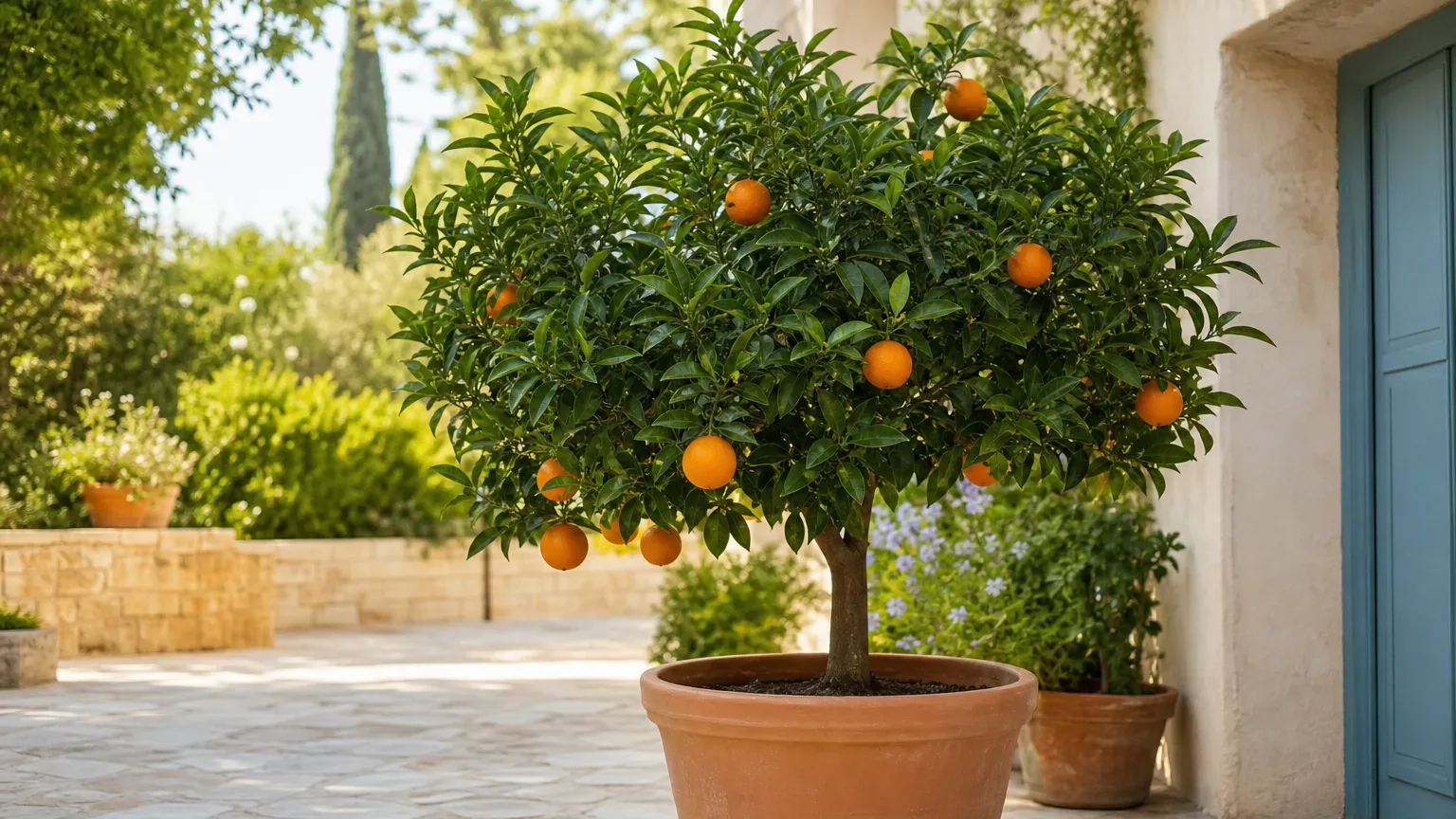
If the goal is reliable santra on a balcony within a reasonable wait, buy a named grafted tree with a visible, healthy graft union and no suckers from below the union. The orange tree overview hub aligns with this: grafted stock is the practical path to predictable fruit quality and earlier bearing. The RHS notes that ungrafted citrus may take up to ten years to fruit, while grafted plants are sold closer to cropping age—often in flower or with small fruit showing. (RHS citrus growing guide) In India, reputable nurseries commonly sell grafted santra and navel types on rootstocks suited to local soils; inspect for scale, wet roots, and dieback before you plan to propagate from a sick parent.
When semi-ripe cuttings fit a terrace grower
Choose cuttings when you already have a healthy, correctly identified sweet orange and want a backup plant or a gift clone. The RHS lists semi-ripe cuttings as the easiest home propagation route for citrus, producing genetically identical plants that usually fruit within a few years on their own roots. (RHS citrus growing guide) Expect more patience than buying grafted stock, but less than seed. Missouri Botanical Garden’s cutting guide adds a practical caution: citrus may root slowly or not at all without rooting hormone, unlike soft herbs that root casually.
When seed is worth trying—and when it is not
Seed makes sense for education, rootstock experiments, or when you accept unknown fruit quality. UF/IFAS explains that seeds from many citrus varieties are polyembryonic, producing nucellar seedlings genetically like the mother—important in commercial rootstock production—but some seeds produce zygotic “off types” that must be discarded. (UF/IFAS Citrus Propagation) Even viable seedlings face years of juvenility before fruit. The RHS warns that seed-grown citrus can take several years to begin fruiting and the fruit may be inferior to the parent; it also discourages sowing seed from supermarket fruit because of biosecurity and disease risks. (RHS citrus growing guide) RHS adds that sweet orange seedlings do not come true to type. Treat seed as a side project, not a shortcut to duplicate a premium navel orange.
Best Timing for Orange Tree Propagation
Orange wood roots when the plant is metabolically active and the stem is the right maturity—not whenever you happen to prune.
Active growth in India and wood maturity
Commercial budding is done when rootstock bark is slipping (separating easily from the wood), typically from about April through November in Florida nursery culture, whenever stock plants are in active growth. (UF/IFAS Citrus Propagation) On an Indian terrace, mirror that logic: work during warm spring through monsoon-active growth, when nights stay mild and new flushes harden. Avoid taking cuttings just before a cool dry spell that stalls rooting while cut ends stay damp. Semi-ripe wood is firm, partially hardened, and no longer the soft shiny tip that bends without snapping. UF/IFAS budwood guidance—using wood from the last or current flush after it begins to mature—translates to cuttings too: skip the tenderest new shoot and select stems that can hold a leaf without wilting instantly. (UF/IFAS Citrus Propagation)
How to Propagate Orange Trees From Semi-Ripe Cuttings
This is the home method most growers should practice first. Think humidity, drainage, and patience—not a water jar on a kitchen shelf.
Selecting, preparing, and rooting the cutting
Take 4–6 inch (10–15 cm) cuttings from healthy, disease-free wood with no scale or dieback. (Missouri Botanical Garden — Propagating by cuttings) Cut just below a node, remove flowers and buds, and strip the lower leaves so nothing buried will rot. Leave two or three leaves at the top, reduced by about one-third if they are large. Wear thick gloves: sweet orange foliage contains essential oils and psoralens toxic to pets, and RHS describes Citrus sinensis as spiny. Keep pets away from trimmings.
Use a sterile, free-draining mix—half perlite and half peat-free potting compost, or sand and perlite—as used for cutting propagation generally. (Missouri Botanical Garden — Propagating by cuttings) Moisten the mix, punch a hole with a pencil so hormone is not wiped off, and dip the base in IBA-containing rooting powder because citrus roots reluctantly without it. (Missouri Botanical Garden — Propagating by cuttings) UF/IFAS rootstock-cutting protocols similarly use auxin powders and high humidity or mist while leaves photosynthesize without roots. (UF/IFAS Citrus Propagation) At home, a clear humidity dome or sealed bag over the pot—opened briefly every few days—beats a dry windowsill. Bright indirect light during rooting; full sun cooks enclosed cuttings.
Rooting timeline and first pot-up
Under warm conditions, orange cuttings often begin rooting in several weeks, though citrus can be slower than pothos or coleus. Tug gently after 4–6 weeks: resistance suggests roots. Move to a small pot of orange-appropriate soil once roots are several centimetres long and new growth starts. Do not jump straight to a huge container; oversize pots stay wet and invite rot. Harden gradually into the full sun mature sweet oranges need, as described in the light guide.
Growing Orange Trees From Seed
Seed propagation is straightforward botany with a long clock.
Polyembryonic seed, juvenility, and biosecurity
Many citrus seeds carry multiple embryos. Nucellar seedlings clone the mother plant genetically—valuable for rootstock—but zygotic seedlings can appear and should be removed in commercial production because they are variable. (UF/IFAS Citrus Propagation) Home growers rarely know which embryo sprouted from a random fruit, so treat every seedling as unknown quality until it fruits.
UF/IFAS recommends sowing citrus seed ¼–½ inch deep in sterile medium; emergence often occurs in 2–3 weeks under warm, bright conditions. (UF/IFAS Citrus Propagation) RHS advises sowing at 16°C in spring. Train seedlings to a single stem with no low branches for the first 6–8 inches so you have a clear trunk later, as UF/IFAS recommends for rootstock seedlings. (UF/IFAS Citrus Propagation) Fruiting still waits on juvenility—expect years, not months. Crowded, wet seed flats also invite damping-off at the soil line; use sterile mix, thin seedlings, and airflow. If you only want one tree, a grafted nursery plant is time-cheap by comparison.
The RHS specifically warns against growing from supermarket fruit because of disease introduction risk. (RHS citrus growing guide) Commercial citrus propagation relies on certified disease-free budwood in regulated production systems. (UF/IFAS Citrus Propagation) A kitchen experiment is fine if you isolate the seedling and accept it may never match commercial health standards—but do not assume a grocery santra seed is a sanitary clone of a premium orchard tree.
How Nurseries Propagate Sweet Orange
Understanding commercial methods clarifies why your cutting is not the same as a nursery tree.
Budding—inserting a single scion bud under rootstock bark—is the method of choice for young citrus because it works reliably and needs less skill than many graft types. (UF/IFAS Citrus Propagation) Inverted T budding is common when bark slips; chip budding is used when bark is not slipping. After union, the rootstock top is removed and the scion is forced into growth. Finished liners are field-ready around 18–20 inches tall. (UF/IFAS Citrus Propagation) Budding demands disease-free budwood, a rootstock seedling of pencil thickness, sharp tools, and practice wrapping unions. It is rewarding craft work, but it is not the fastest answer for a first-time terrace grower who mainly needs a second named navel orange in a pot. If you want rootstock-specific traits—dwarfing, wet-soil tolerance—buy the combination already budded.
Aftercare for New Orange Plants
Young sweet oranges fail after rooting when treated like established orchard trees.
Move newly rooted cuttings and seedlings into stronger light over 1–2 weeks. Mature culture is full sun; the watering guide rhythm—deep water, then let the upper 2–5 cm of mix approach dry—applies once roots fill the pot. Keep seedlings and fresh cuttings evenly moist, not soggy, until active new leaves expand.
Hold fertilizer until roots claim the pot and new leaves darken, then use light citrus fertilizer doses during active growth only. Repot when roots circle or water runs straight through; step up pot size modestly. Remove flower buds for the first year on very young own-root plants if you want canopy strength, though a healthy grafted nursery tree may arrive already flowering—stabilize water and light before chasing fruit. Begin shaping with the pruning guide once wood is firm, watching for thorns and removing any shoot from below a graft union on purchased trees.
Common Orange Propagation Failures
Most failures are moisture, wood maturity, or impatience—not bad luck.
Wet, airless mix rots orange stems before callus forms—especially soft tips without hormone. Missouri Botanical Garden’s general cutting guidance applies: drainage, humidity without saturation, and rooting hormone for reluctant species like citrus. (Missouri Botanical Garden — Propagating by cuttings) If leaves blacken at the base, discard the batch, sterilize trays, and retry with firmer wood in warmer weather.
Leggy pale seedlings topple without bright light immediately after emergence. Seed is cheap; repeating with clean trays beats nursing moldy flats through monsoon humidity. On purchased grafted trees, shoots from below the graft union are rootstock, not your sweet orange—remove them promptly or they will outcompete the scion.
When to use this page vs other Orange Tree guides
Use this page when you are starting a new sweet orange from cuttings, seed, or a nursery purchase decision. Use the overview for species identity, mature size, pet toxicity, and thorn caution. Use light for sun hours and terrace placement, watering when a young or established pot dries unevenly, soil for mix and pH, fertilizer once roots are active, repotting when roots bind the container, and pruning for shape and graft-sucker removal—not for the initial rooting steps covered here.
Conclusion
Orange tree propagation is really three choices. Buy grafted when you want known santra quality and the shortest reasonable path to harvest. Root semi-ripe cuttings when you need a clone of a healthy parent and can provide humidity, drainage, and rooting hormone through warm active growth. Sow seed only when you accept years of juvenility and uncertain fruit that may not come true to type. Match wood maturity and season to Citrus sinensis’s growth rhythm, harden young plants into full sun, then hand off daily care to the watering, soil, and light guides once roots are working. That sequence—honest method choice, clean technique, patient aftercare—beats repeating generic “stick it in water” advice that sweet orange often ignores.