Underwatering on Orange Tree: Causes, Checks & Fixes
Quick answer
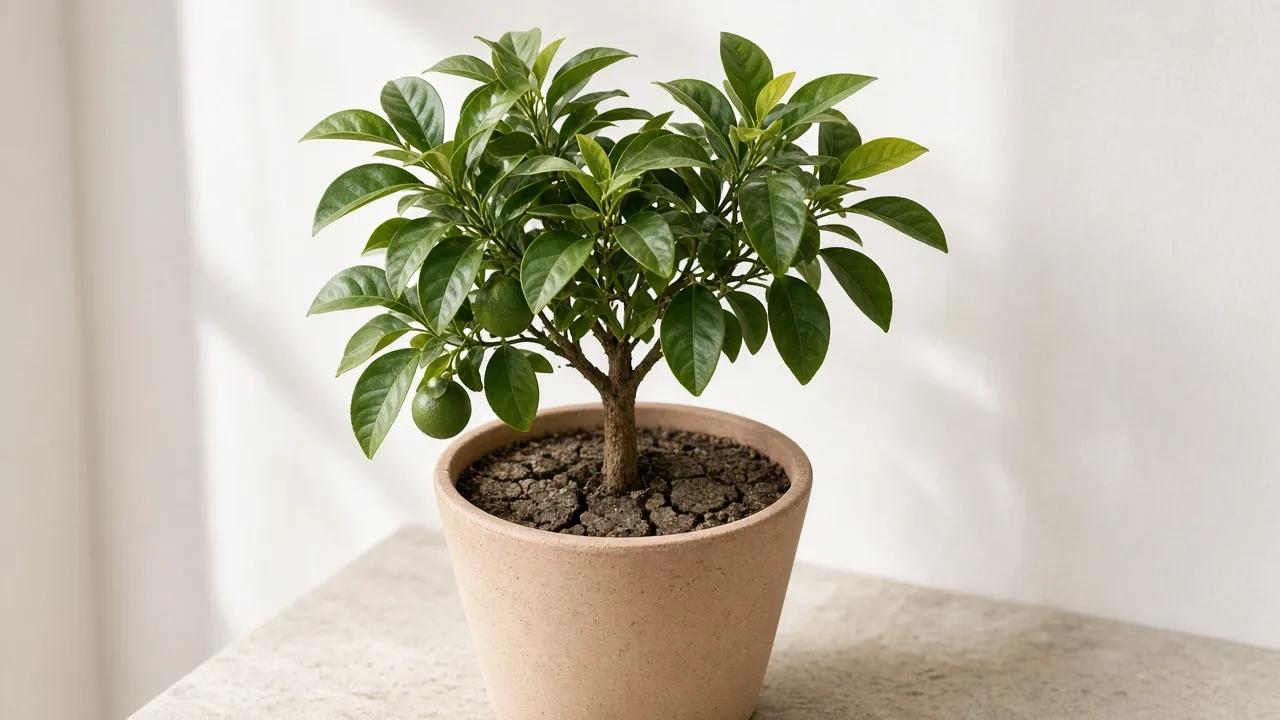
Underwatering on an orange tree (Citrus sinensis) triggers a distinct hydraulic survival response: mature and young leaves curl inward longitudinally along the midrib, lose their glossy waxy sheen, and droop with stiff, brittle petioles. Severe moisture deficits cause premature shedding of fragrant flowers and pea-sized developing fruitlets as the tree aborts reproductive sinks to preserve vascular hydration. First step: perform a deep basin immersion soak to thoroughly rehydrate hydrophobic rootballs, then calibrate regular irrigation to soak the entire root zone whenever the top 2 to 3 inches of substrate dry out.
Underwatering on Orange Tree: Causes, Checks & Fixes
This guide covers underwatering on Orange Tree. See also the general Underwatering guide, watering, and light pages for this plant.
Underwatering on Orange Tree: Causes, Checks & Fixes
Quick answer
Underwatering on an orange tree (Citrus sinensis) causes an acute vascular deficit that directly compromises leaf turgor and cellular metabolism. Because citrus trees possess thick, coriaceous (leathery) evergreen foliage coated in a protective waxy cuticle, they do not wilt into soft, limp ribbons like herbaceous plants. Instead, an orange tree suffering from drought stress exhibits inward longitudinal leaf curling along the central midrib, causing leaves to roll upward into narrow, canoe-like troughs. The foliage loses its glossy dark-green luster, turning a dull, grayish-matte shade, while petioles droop stiffly. If the drought coincides with flowering or fruit set, the tree will aggressively abort delicate blossoms and pea-sized developing fruitlets to conserve moisture.
For how drought stress and vascular deficit impact houseplants and woody shrubs in general, consult our global underwatering guide. On Citrus sinensis, however, the defense mechanism is distinctly structural: the tree rolls its leaf blades upward to shield the stomata concentrated on the leaf undersides from solar irradiation and wind, creating a humid boundary microclimate that slows catastrophic transpiration.
First step: administer an emergency deep basin immersion soak. If container peat or bark potting substrate has become bone-dry, it shrinks away from the container rim and turns hydrophobic, causing surface-applied water to channel straight down the pot walls without wetting the root core. Submerge the container in a large tub of tepid water for 30 to 45 minutes until the root ball is re-saturated, drain thoroughly, and establish a consistent watering routine when the top 2 to 3 inches (5 to 7 cm) of soil dry out.
When to use this page vs other Orange Tree guides
Foliar curling, drooping, and leaf drop can stem from multiple citrus stressors. Use this diagnostic routing table to determine whether moisture deprivation is your tree’s primary problem:
| What You Observe on the Tree | Primary Diagnostic Cause | Recommended Guide |
|---|---|---|
| Inward leaf curling along midrib; dull, crisp foliage; light container; dry soil pulled from pot rim | Hydraulic drought deficit / Hydrophobic substrate | Stay on this guide |
| Uniform yellowing on older lower leaves; limp, soft leaf drop; wet, soggy, or sour-smelling soil | Anaerobic root suffocation from overwatering | Orange Tree Overwatering & Root Rot |
| Stems and leaves hanging downward limply while soil remains damp; soft petioles | Vascular root collapse or severe fungal rot | Orange Tree Drooping Leaves & Wilting |
| Pale chlorotic foliage with dark green veins on tender newest growth | Micronutrient lockout (iron/zinc) or alkaline soil pH | Orange Tree Yellow Leaves |
| Crisp brown leaf tips and margins on older leaves; white crust on soil surface | Soluble fertilizer salt accumulation or tap water salinity | Orange Tree Brown Tips |
| Dry, crispy leaf margins during winter indoor heating; leaves shedding green | High vapor pressure deficit and dry indoor air | Orange Tree Low Humidity |
| Comprehensive seasonal irrigation scheduling, soil mixes, and light requirements | Baseline cultural care protocols | Watering, Soil, & Light |
What underwatering looks like on Orange Tree
Recognizing the exact visual markers of dehydration on Citrus sinensis prevents mistaking drought stress for root rot, viral infections, or insect feeding.
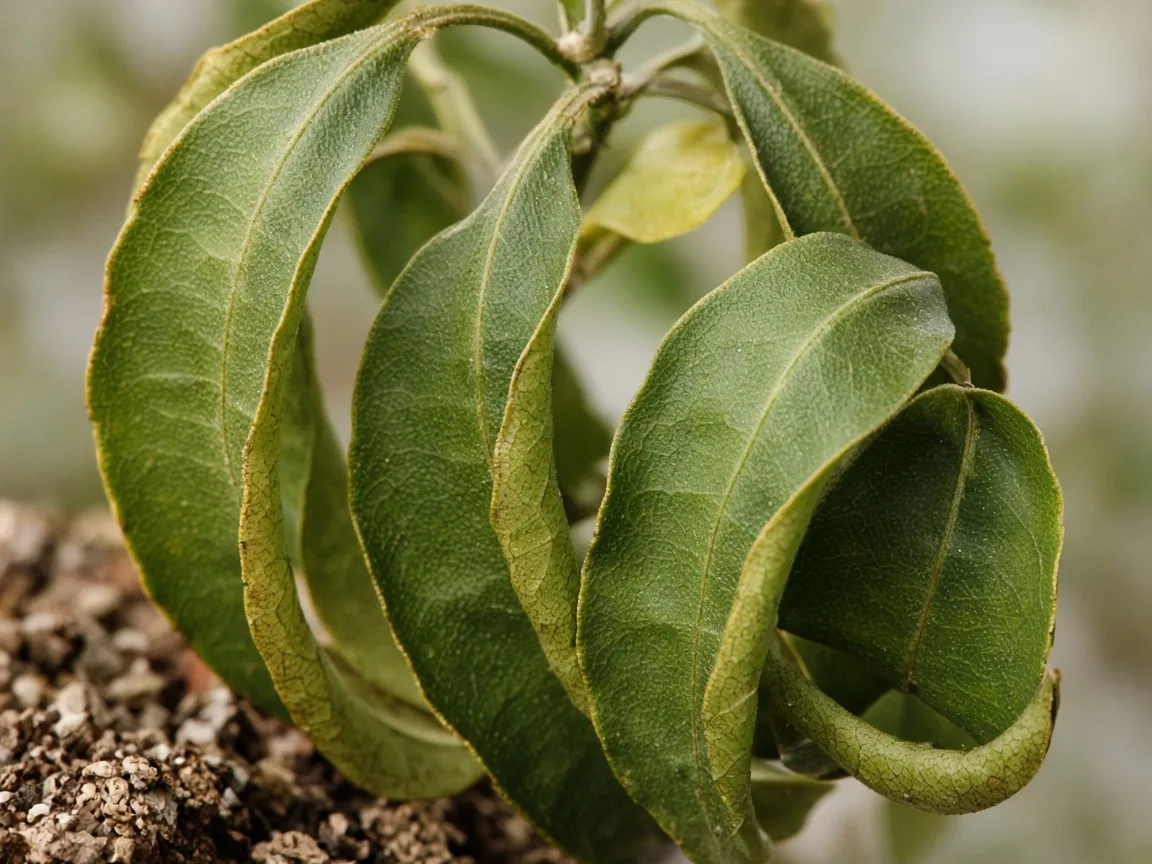
Citrus hydraulic drought response: longitudinal inward leaf rolling along the midrib and loss of foliar luster on Citrus sinensis—compare with healthy flat, glossy leaves.
Primary visual diagnostic markers
- Longitudinal Inward Leaf Rolling: Rather than drooping loosely, citrus leaves roll their lateral margins upward and inward toward the central midrib. This inward curl forms a distinct “V” or canoe shape along the leaf length.
- Loss of Surface Luster (Gray-Green Cast): The glossy, deep emerald reflection characteristic of healthy sweet orange leaves fades into a flat, dusty, grayish-green tone as epidermal cells lose hydrostatic pressure.
- Stiff, Brittle Petiole Droop: Petioles (leaf stems) angle downward toward the branch, but the leaves remain stiff and papery to the touch. If crinkled gently between your fingers, they feel dry and sound rustling rather than soft and flaccid.
- Abortion of Blossoms and Fruitlets: Developing sweet orange trees allocate substantial water to floral nectar and swelling fruit tissue. Under moisture stress, pea-sized green fruitlets turn dull yellowish-green at the calyx button and drop in large quantities overnight. Unopened flower buds shrivel and brown on the branch.
- Soil Shrinkage and Container Gap: In potted citrus, the desiccated soil block contracts, pulling 0.5 to 1 centimeter away from the interior walls of the container. The pot becomes noticeably feather-light, and dry root hairs become visible in the perimeter crevice.
- Terminal Shoot Wilt and Dieback: In protracted drought conditions, the soft, non-lignified green tips of active growth flushes desiccate, hook downward in a “shepherd’s crook” shape, and turn crispy brown.
Citrus hydraulic drought response: why orange leaves curl inward
To effectively correct underwatering, it helps to understand the specialized vascular anatomy of Citrus sinensis. Sweet orange trees originate in subtropical regions characterized by seasonal monsoonal moisture punctuated by dry spells. Consequently, they possess sophisticated physiological adaptations to minimize cavitation—the formation of air bubbles in xylem vessels under extreme negative water potential.
According to research from the UF/IFAS Extension research on citrus water requirements and irrigation, citrus leaves feature exceptionally high stomatal density on their abaxial (lower) surface, while the adaxial (upper) surface is virtually free of stomata and shielded by a thick, waxy cuticle. When the soil moisture potential drops, drying roots produce abscisic acid (ABA), which is transported via xylem sap directly to leaf guard cells. This chemical signal forces rapid stomatal closure to arrest transpirational water loss.
However, stomatal closure alone cannot prevent passive cuticular evaporation under bright sunlight and warm temperatures. To further protect their vascular integrity, orange tree leaves execute an inward longitudinal curling motion. By rolling the leaf margins inward along the midrib, the tree shields its abaxial stomata from air currents and direct solar exposure. This mechanical rolling traps a pocket of still, humid air against the stomata, reducing the vapor pressure deficit between the leaf interior and the surrounding atmosphere.
When moisture deprivation intensifies beyond the leaf’s hydraulic buffering capacity, the tree initiates physiological triage. As documented in the UC IPM cultural guidelines for growing citrus, water is immediately reallocated from developing fruitlets and open flowers back into the woody scaffolding of the limbs and trunk. The tree synthesizes ethylene at the fruitlet pedicel, forming an abscission zone that causes young, pea-sized oranges to drop cleanly from the branch. This protects the vegetative crown from irreversible xylem cavitation at the cost of the season’s fruit harvest.
Underwatering vs overwatering on Citrus sinensis
Because both underwatering and overwatering cause citrus foliage to display distress, growers frequently misdiagnose the problem and provide water to an already drowning root system, or withhold water from a parched tree.
The following differential table highlights the decisive diagnostic contrasts:
| Diagnostic Feature | Underwatered Orange Tree | Overwatered Orange Tree |
|---|---|---|
| Leaf Curl Morphology | Edges roll inward and upward along midrib forming a tight trough | Leaves droop downward from petiole without tight longitudinal inward roll |
| Foliar Texture & Feel | Dry, crisp, papery, stiff, and rustling | Soft, limp, pliable, sometimes water-soaked or rubbery |
| Foliar Color | Dull grayish-green, lacking luster; older leaves may develop crisp brown tips | Diffuse pale yellowing (chlorosis) beginning along leaf veins and spreading evenly |
| Leaf Abscission Pattern | Leaves cling tenaciously until bone-dry, or drop while still green/rolled | Leaves drop freely while still limp and yellow, often with green petioles remaining on twigs |
| Fruit & Flower Response | Sudden drop of dry, pea-sized fruitlets and shriveled blossoms | Fruitlets turn yellow, soften, turn mushy at stem end, and drop with yellow leaves |
| Substrate Condition | Bone-dry 3+ inches down; pulled away from container rim; feather-light pot | Saturated, muddy, soggy at depth; foul or stale anaerobic odor; heavy pot |
| Root Ball Appearance | Light tan or cream, fibrous, brittle, completely dry root tips | Dark brown to black, slimy, hollow shells that slough off leaving wire-like cores |
| Response to Deep Soak | Rapid turgor recovery; leaves uncurl within 2 to 12 hours | Leaves yellow further and drop rapidly; soil remains stagnant; condition deteriorates |
The definitive field test is root-zone inspection and turgor response. As noted in the Royal Horticultural Society citrus problem diagnostic guide, underwatered citrus foliage re-inflates and flattens within hours of root-zone rehydration, whereas overwatered root systems cannot uptake water due to anaerobic rot and continue to shed foliage following irrigation.
Primary causes of moisture deficit in container and garden orange trees
Understanding how an orange tree becomes moisture-starved allows you to pinpoint the environmental or cultural breakdown in your care routine:
1. Hydrophobic peat and bark potting substrates
Most commercial citrus potting soils consist of sphagnum peat moss, aged pine bark, and perlite. When these organic materials dry out completely, organic waxes and lipids coat the soil particles, rendering them intensely hydrophobic (water-repellent). When a grower pours water onto a hydrophobic root ball, the water cannot penetrate the compacted core. Instead, it beads up, runs across the surface, and streams down the perimeter gap between the shrunken soil and the pot wall, escaping out the drainage holes. The grower assumes the tree has been watered, but the root core remains completely dry.
2. High vapor pressure deficit, dry winds, and direct sun
Sweet orange trees demand 6 to 8 hours of direct sunlight to support vegetative growth and fruit maturation. However, when outdoor temperatures climb above 85°F (29°C), especially in low-humidity climates or on windy patios, transpirational water loss through the canopy skyrockets. Even a moderately moist container can be stripped of available water in less than 24 hours under intense solar radiation and desiccating breezes.
3. Root-bound container confinement
Orange trees are vigorous woody perennials with expansive fibrous root systems. When a tree remains in the same container for more than two to three seasons, dense root masses displace the potting soil. With very little soil volume left to retain moisture, the tree rapidly depletes all available water between waterings, resulting in chronic, recurring drought stress cycles every 48 hours.
4. Chronic shallow surface watering
Applying small volumes of water (such as a single cup or watering can splash) every few days moistens only the top 1 inch of soil. The critical feeder roots of Citrus sinensis, which occupy the middle and lower thirds of the container or root zone, receive zero hydration. These deep roots desiccate and die back, leaving the tree functionally moisture-starved despite frequent surface applications.
5. Porous unglazed terracotta in hot microclimates
While unglazed terracotta pots provide excellent breathability that prevents waterlogging, their porous clay walls wick moisture continuously from the potting soil into the dry surrounding air. In warm, breezy indoor rooms or under direct outdoor sunlight, terracotta pots dry out two to three times faster than glazed ceramic, plastic, or resin containers.
Diagnostic inspection: step-by-step confirmation checks
Before reaching for the hose or watering can, follow these five sequential diagnostic steps to verify water deficit:
- Perform the Container Lift Test: Grasp the container by the rim and lift it a few inches off the floor or ground. A properly hydrated citrus container has substantial, solid heft. A drought-stressed container feels startlingly light, like lifting a box of dry sawdust.
- Execute the Deep Probe Check: Do not rely on surface appearance. Insert a dry wooden skewer, moisture meter, or your index finger 2 to 3 inches (5 to 7 cm) straight down into the root zone halfway between the trunk and the container rim. If the skewer comes out completely clean and dry with zero damp particles clinging to the wood, the root zone is parched.
- Inspect for Edge Shrinkage Gaps: Examine the boundary where the potting soil meets the inner container wall. If you observe an open gap wide enough to slip a pencil into, the substrate has undergone significant volumetric shrinkage due to moisture loss.
- Observe Water Drainage Dynamics (The Bypass Test): Pour 1 cup of water onto the surface of the soil. Does it instantly soak downward into the substrate, or does it pool on top, bead up, and immediately sheet off into the edge gap, pouring straight out of the bottom drainage holes within five seconds? Rapid runoff with zero surface infiltration confirms hydrophobic soil bypass.
- Inspect the Feeder Root Zone: Gently ease the tree partially out of its container if possible. Healthy citrus feeder roots are plump, light tan to white, and firm. Dehydrated roots appear shriveled, brittle, and dusty, but do not smell sour or slough off when touched.
Lookalike symptoms and differential diagnosis
Curling leaves and leaf drop can be triggered by several distinct citrus disorders. Use this comparison table to differentiate true underwatering from common lookalikes:
| Symptom Manifestation | Suspected Disorder | Key Distinguishing Factors |
|---|---|---|
| Inward rolling along midrib; dull matte foliage; dry, light substrate | True Underwatering | Fast uncurling after deep soaking; light container; dry root ball |
| Leaves drop while green or pale yellow; substrate soggy; roots dark and rotten | Overwatering / Root Rot | Sloughing mushy roots; stagnant smell; leaves drop limp without rolling inward |
| Leaf tops show fine pale yellow stippling; faint webbing on leaf undersides and tips | Spider Mite Infestation | Microscopic mites visible under 10× hand lens; webbing traps dust; soil moisture variable |
| Outer leaf margins turn crisp brown with yellow halos; white mineral crust on soil | Fertilizer Salt Scorch | Necrosis confined to perimeter of mature leaves; caused by excess salts, not drought alone |
| Inward curling on distorted, cupped new flushes with sticky honeydew | Aphids / Leaf Curl Pests | Distorted puckering of soft new spring shoots; visible insect colonies in leaf axils |
| Mass shedding of green leaves in winter without curling | Winter Leaf Drop | Caused by cold root zones below 55°F (13°C) combined with warm, bright indoor air |
The first fix: deep basin immersion and hydrophobic rewetting
Your immediate goal is to break soil hydrophobicity and rehydrate the entire root core without causing mechanical root trauma. Do not prune branches, apply fertilizer, or repot the tree today. Execute the deep basin immersion protocol:
Deep Basin Immersion Protocol for Desiccated Citrus sinensis:
Step 1: Place the potted orange tree into a wide tub, basin, or large bucket.
Step 2: Fill the outer basin with lukewarm water until it reaches 1/2 to 2/3 up the pot walls.
Step 3: Allow the pot to bottom-soak for 30 to 45 minutes until the soil surface darkens.
Step 4: Lift the container, allow all gravity water to drain for 30 minutes, and empty runoff.
Protocol execution details
- Water Temperature Matters: Use lukewarm water between 65°F and 75°F (18°C to 24°C). Shocking dehydrated roots with ice-cold tap water inhibits root hydraulic conductivity and induces physiological root stress. As emphasized by the Royal Horticultural Society recommendations for growing container citrus, container citrus potting composts can become intensely water-repellent when dried out, requiring gentle bottom-soaking or repeated slow saturation to re-establish capillary water channels.
- Break the Surface Tension: If the root ball floats or the top inch remains dusty during bottom-soaking, gently poke several small vertical holes into the upper 2 inches of soil using a blunt chopstick. Pour 2 to 3 cups of water slowly around the base of the trunk to wet the top while water wicks upward from the basin.
- Check for Complete Saturation: Keep the pot submerged until air bubbles stop rising to the surface and the top layer of substrate feels cool, dark, and damp to the touch.
- Drain Thoroughly: Remove the pot from the basin and place it on an elevated grid, outdoor patio, or draining sink. Allow all excess gravitational water to pour freely from the bottom holes for at least 30 minutes.
- Never Leave in Saucer Water: Once draining ceases, return the tree to its decorative saucer or cachepot, but inspect the saucer after 1 hour. Discard any residual standing water immediately. Allowing a recovering tree to sit in stagnant runoff creates anaerobic root rot, compounding drought stress with root death.
For outdoor inground orange trees where basin immersion is impossible, the UF/IFAS Citrus Research and Education Center home citrus watering guidelines recommend constructing a temporary circular earthen berm around the drip line and applying slow, trickle irrigation for 1 to 2 hours to allow moisture to penetrate past hydrophobic surface crusts down to deep taproots.
Step-by-step recovery plan
Restoring an underwatered sweet orange tree requires careful staged rehabilitation over the subsequent two months:
Phase 1: Rehydration and turgor monitoring (Days 1 to 3)
- Move the tree into bright, indirect light or filtered morning sunlight. Avoid exposing an intensely dehydrated tree to blazing, 95°F (35°C) direct midday sun while its vascular vessels are refilling.
- Monitor leaf turgor closely. Within 2 to 12 hours of the deep basin soak, the tight inward midrib curl should relax, and the leaf blades should begin flattening.
- Do not apply any foliar sprays, insecticides, or leaf shines. Stomata are re-opening and need clean air exchange.
Phase 2: Calibrating the deep watering schedule (Weeks 1 to 4)
- Transition to a disciplined moisture monitoring routine rather than a rigid calendar schedule. Check the soil every 2 to 3 days in warm weather and every 5 to 7 days in cool weather.
- As outlined in our dedicated orange tree watering guide, wait until the top 2 to 3 inches (5 to 7 cm) of potting mix feel dry to the touch before watering again.
- When watering, apply water slowly and evenly across the entire surface until 10% to 20% of the total volume drains freely from the base. This ensures complete root core wetting and flushes residual minerals out of the root zone.
- Re-check pot weight after watering to recalibrate your sense of what a fully hydrated container feels like.
Phase 3: Root-zone moisture retention and mulching (Weeks 4 to 8)
- Apply a 1-inch (2.5 cm) layer of coarse organic mulch, such as medium pine bark nuggets, over the soil surface. Keep the mulch 2 inches away from the tree’s trunk flare to prevent bark rot. Mulch suppresses surface evaporation, buffers soil temperature, and prevents the top layer of potting mix from crusting into a hydrophobic barrier.
- Ensure the potting mix provides optimal moisture retention without waterlogging. If your current soil dries out uncontrollably fast or lacks organic water-holding capacity, review our orange tree soil guide for coarse, peat-bark-perlite formulations engineered specifically for citrus roots.
Phase 4: Nutrient reintroduction and canopy regeneration (Months 2+)
- Withhold all fertilizers until you observe active, healthy vegetative buds swelling and unfurling along branch axils.
- Once new green shoots emerge, feed with a balanced, slow-release citrus fertilizer containing essential micronutrients (iron, zinc, manganese, and magnesium) at half label strength.
- Provide 6 to 8 hours of direct sunlight to support robust photosynthesis. If transitioning outdoors or increasing lighting, follow our orange tree light guide to acclimate the canopy gradually and prevent sunscald on tender new growth.
Mistakes to avoid
Avoid these common missteps when reviving a dehydrated orange tree:
- Applying Fertilizer to “Boost” Weak Trees: Never feed a drought-stressed orange tree. Concentrated fertilizer salts draw moisture out of already desiccated root hairs via reverse osmosis, causing severe chemical burn and root necrosis. Wait until the tree is fully turgid and producing new shoots.
- Light, Daily Sprinkling: Giving an orange tree a small cup of water daily creates a perpetually dry lower root ball and encourages weak, shallow surface roots prone to rapid desiccation. Always water deeply and thoroughly, then allow the top layer to dry.
- Pruning Off Inward-Curled Leaves Immediately: Many growers panic and clip off curled foliage, assuming the leaves are dead. Curled leaves on an orange tree are alive and functional; they curl as a temporary hydraulic defense. Give the tree 48 hours after a deep soak before assessing leaf viability. Only prune leaves that are completely brown, crisp, and brittle.
- Placing the Parched Tree in Scorching Direct Sun: While citrus loves sunlight, placing a dehydrated tree with closed stomata and empty xylem vessels into intense 90°F+ direct afternoon heat accelerates leaf scorching and stem dieback. Provide temporary light shade for 48 hours until vascular turgor is restored.
- Leaving the Container Sitting in Runoff Water: Setting a potted citrus permanently in a full drainage tray suffocates lower roots and causes fungal root rot (Phytophthora). Empty all drainage trays within 30 minutes of watering.
Recovery timeline and expectations
Understanding the physiological timeline of citrus recovery prevents unnecessary worry:
- 2 to 6 Hours Post-Soak: Water potential within the xylem equilibrates. Guard cells and mesophyll cells rehydrate, and leaf blades begin uncurling from the margins outward.
- 24 to 48 Hours: Viable leaves completely flatten out and regain their semi-glossy emerald sheen. Leaves that suffered lethal desiccation will shrivel, turn brown, and drop cleanly at the petiole.
- 1 to 2 Weeks: Transpiration rates normalize. Any blossoms or tiny pea-sized fruitlets that suffered irreversible vascular severance will drop. Do not worry if your tree sheds immature fruit; this is a vital survival adaptation that prevents tree exhaustion.
- 4 to 8 Weeks: In the presence of adequate warmth and bright light, dormant axillary buds will break, producing a vigorous flush of fresh, pliable green leaves and new feeder roots to rebuild the canopy.
How to prevent underwatering next time
Maintaining proper hydration across all seasons keeps your orange tree resilient, fruitful, and pest-free:
- Establish the Top 2-to-3 Inch Rule: Routinely check soil moisture depth before watering. Water deeply whenever the top 2 to 3 inches (5 to 7 cm) of potting mix feel dry, adjusting frequency dynamically as temperatures shift between summer heat and winter dormancy.
- Utilize Organic Bark Mulching: Maintain a 1-inch layer of coarse pine bark across the container surface to shade the root zone, conserve moisture, and prevent soil crusting.
- Upgrade Root-Bound Trees Promptly: Every two years, inspect the root ball in early spring. If roots circle the perimeter densely, pot up into a container 2 to 3 inches wider using a porous, well-aerated citrus mix.
- Buffer Against Strong Winds and Heat Waves: Position containerized citrus in locations protected from persistent dry winds, such as near courtyard screens or patio walls. During extreme summer heat waves, increase inspection frequency to daily checks.
- Respect Botanical Cultural Requirements: As documented by the Missouri Botanical Garden Plant Finder, Citrus sinensis requires consistently moist but well-drained substrate, sharp drainage, and high light to thrive without stress.
For complete cultural requirements, seasonal schedules, and pest diagnostics, visit our Orange Tree overview guide and browse our comprehensive library of Orange Tree problem guides.
Related Orange Tree guides
- Orange Tree Overview - Complete care guidelines, species biology, and fruiting conditions
- Watering Orange Trees - Deep watering techniques, seasonal irrigation rhythms, and drainage setup
- Orange Tree Soil & Potting - Formulating coarse, moisture-retentive, well-draining citrus substrates
- Orange Tree Light Requirements - Direct sun thresholds, indoor grow lights, and heat acclimation
- All Orange Tree Problems - Diagnostic hub for citrus pests, leaf discolorations, and physiological disorders
Related tool
Use the Watering Can Calculator to determine the precise volume of water required to thoroughly saturate your container size without underwatering or causing root suffocation.