Root Rot on Orange Tree: Causes, Checks & Fixes
Quick answer
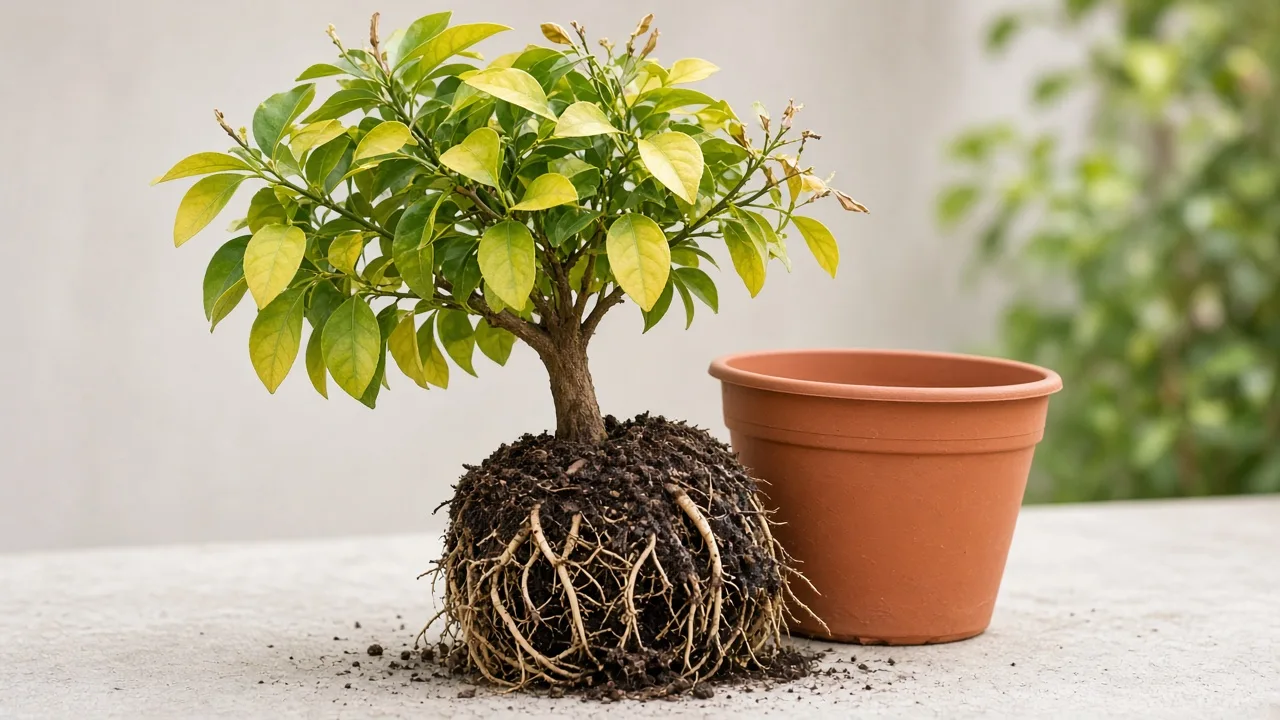
Root rot on an orange tree (Citrus sinensis) is caused primarily by soil-borne oomycete water molds (Phytophthora nicotianae, Phytophthora citrophthora) and Pythium species that thrive in waterlogged, poorly drained soil. Diagnostic signs include dark, mushy feeder roots whose outer cortex sloughs off easily to leave bare, string-like central vascular cylinders ('rat-tailing'), accompanied by sour soil, trunk foot rot or gummosis, canopy chlorosis, and twig dieback. First step: immediately stop all irrigation, gently unpot the tree to inspect the feeder roots, excise all black, rotten tissue with sterilized shears, and drench the root zone with potassium phosphite or Bacillus amyloliquefaciens before repotting into an airy, porous citrus substrate with the graft union set 2–4 inches above the soil line.
Root Rot on Orange Tree: Causes, Checks & Fixes
This guide covers root rot on Orange Tree. See also the general Root Rot guide, watering, and light pages for this plant.
Root Rot on Orange Tree: Causes, Checks & Fixes
Quick answer
Root rot on sweet orange (Citrus sinensis) is an aggressive underground decay driven by soil-borne oomycete pathogens—primarily Phytophthora nicotianae (also known as Phytophthora parasitica), Phytophthora citrophthora, and opportunistic Pythium species. While sweet orange trees are sun-worshiping evergreens that demand steady moisture during flowering and fruit sizing, they are completely intolerant of heavy, waterlogged soils. When soggy media excludes oxygen from the root zone, root hypoxia in saturated soils suffocates fibrous feeder roots, opening wounds for swimming water mold spores to invade, liquefy root tissues, and sever moisture transport to the canopy.
For broader mechanics on how anaerobic decay operates across all plant families, review our comprehensive global root rot guide. On sweet orange, the distinct signature is not merely damp soil, but dark, foul-smelling feeder roots where the outer root cortex sloughs away to expose a wire-like central vascular cylinder (“rat-tailing”), frequently paired with weeping amber gum lesions (gummosis) near the soil line and sudden twig dieback.
First step: immediately cease all irrigation and unpot or excavate the root ball to inspect root integrity. Wash away heavy, sour potting mix with room-temperature water, excise all blackened, mushy, or stripped roots back to healthy white wood with ethanol-sterilized shears, drench surviving roots with a systemic phosphonate or biofungicide, and repot into an open, bark-heavy citrus mix with the graft union positioned strictly 2–4 inches above the soil line.
When to use this page vs other Orange Tree guides
Symptoms of root rot often mirror other environmental stresses in citrus because both damage the tree’s vascular hydration. Use the diagnostic matrix below to determine whether root rot or a sibling problem is affecting your orange tree:
| Symptom pattern on Orange Tree | Likely cause | Relevant guide |
|---|---|---|
| Black, foul-smelling roots; cortex sloughs off stele; gummy trunk lesions | Oomycete root rot (Phytophthora / Pythium) | Stay on this page |
| Saturated, heavy pot; yellowing lower leaves; roots tan and firm | Early moisture excess before fungal invasion | Orange Tree overwatering |
| Feather-light pot; curled leaves; dry, brittle root tips; rapid recovery after soaking | Root desiccation from moisture deficit | Orange Tree underwatering |
| Midday leaf drooping that perks up at dusk on damp soil; firm roots | High heat transpiration stress or cold soil dormancy | Orange Tree drooping leaves |
| Sudden whole-canopy wilting while soil stays wet; branches shriveling | Advanced vascular collapse or severe root death | Orange Tree wilting |
| Interveinal yellowing on new leaves; dark green veins; healthy root ball | Micronutrient deficiency (iron, zinc, or manganese) | Orange Tree yellow leaves |
| General seasonal irrigation schedules and soil dry-down testing | Cultural moisture management baseline | Orange Tree watering guide |
| Formulating an airy, porous substrate for container or raised-bed citrus | Root-zone aeration and mix formulation | Orange Tree soil guide |
What root rot looks like on Orange Tree
Unlike herbaceous plants that collapse uniformly into mush, a woody sweet orange tree exhibits root rot through a combination of distinct underground feeder root destruction, lower trunk bark decay, and progressive canopy starvation. Because container and orchard citrus rely on a dense mat of fine feeder roots located in the upper 12 inches (30 cm) of soil, root rot systematically destroys the tree’s absorption capacity long before primary scaffold limbs show distress.
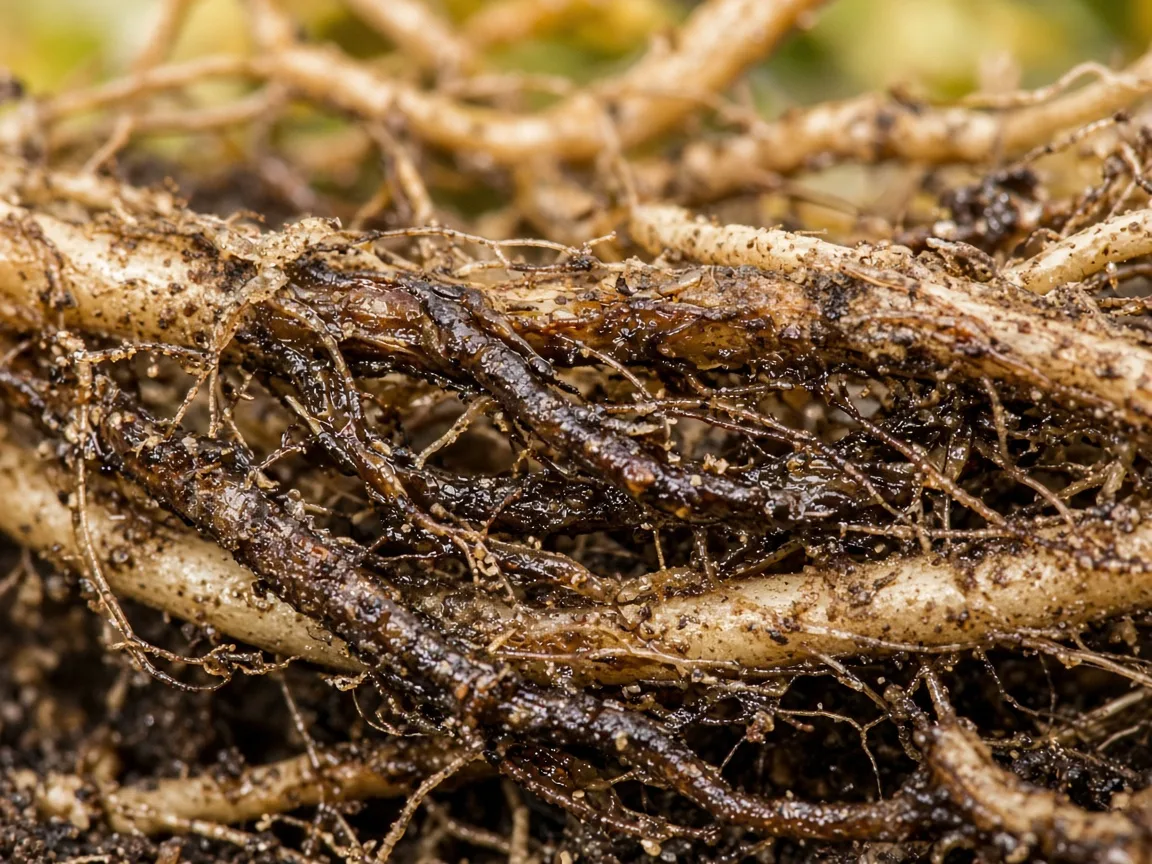
Close-up: Advanced Phytophthora root rot on Citrus sinensis feeder roots, showing cortex sloughing and characteristic “rat-tailing” stele exposure.
Underground feeder root symptoms: the “rat-tailing” phenomenon
The hallmark botanical diagnostic for citrus root rot occurs within the fibrous root system. When you gently wash soil from an infected sweet orange root ball:
- Root cortex sloughing (“rat-tailing”): In a healthy orange tree, feeder roots are crisp, flexible, and pale cream or tan. Under Phytophthora infection, the feeder root cortex sloughs off cleanly when pulled between your thumb and index finger. The parenchymatous outer sheath slides away like a wet sleeve, exposing the tough, string-like, off-white central vascular cylinder (stele). This stripped, thread-like appearance is universally referred to by citrus pathologists as “rat-tailing.”
- Blackened feeder root loss: The fine, branching feeder mats that absorb water and trace nutrients turn water-soaked, reddish-brown, and ultimately jet black. Over time, these feeder tips disintegrate completely, leaving only stubby, blackened primary roots.
- Sour, anaerobic odor: Saturated, rotted citrus root balls produce a noticeable sour, swampy, or fermented odor, generated by anaerobic bacteria that feast on decomposing root carbohydrates in oxygen-depleted soil.
Companion foot rot and gummosis near the soil line
In citrus, root rot rarely stays confined beneath the soil. Pathogens splash upward or migrate along the root flare to attack the bark at the trunk base:
- Water-soaked bark lesions: Dark, greasy patches appear on the lower trunk just above or below the soil line. As cortical tissues die beneath the surface, the bark cracks vertically and dries out.
- Gummosis (amber resin weeping): Sweet orange trees respond to fungal and oomycete invasion by producing defensive resins. Copious amounts of sticky, amber-to-brown water-soluble gum exude from bark cracks around the root flare and lower trunk. If you scrape away the outer bark with a sterile blade, the underlying cambium shows a distinctive reddish-brown to dark olive discoloration, contrasting sharply with the creamy white tissue of healthy wood.
- Trunk girdling: If foot rot spreads around the circumference of the trunk, it severs the phloem tubes that carry sugars from the canopy down to the roots, sealing the tree’s demise.
Aboveground canopy collapse and branch dieback
Because damaged roots cannot transport water or minerals to the leaves, the canopy begins to starve even while sitting in soaking wet soil:
- Dull, lusterless foliage: The characteristic glossy sheen of Citrus sinensis leaves fades to a flat, dusty olive green.
- Canopy chlorosis: Leaves develop a widespread, sickly yellowing along the midrib and primary veins, resembling nitrogen deficiency, as damaged roots lose the ability to assimilate soil nutrients.
- Sudden canopy collapse: During unseasonably warm afternoons, the entire canopy may suddenly wilt and flags. Unlike temporary midday drooping, leaves fail to recover turgor overnight.
- Twig dieback (“stagheading”): Leaves drop prematurely, often leaving petioles attached to green twigs. The exposed shoot tips subsequently brown, wither, and die back from the periphery toward the trunk, giving the tree a thin, barren, “stagheaded” canopy.
- Fruit and blossom drop: Fruiting orange trees abruptly drop marble-sized fruitlets and blossom clusters as the tree sheds reproductive burdens to conserve dwindling carbohydrate reserves.
Citrus-specific root rot pathogens: Phytophthora and Pythium
To treat root rot effectively, citrus growers must understand that its primary culprits are not true fungi, but destructive oomycetes—frequently termed “water molds.” Because oomycetes have cell walls made of cellulose rather than chitin, standard garden fungicides (such as copper sprays or sulfur) are largely ineffective against subterranean infections.
The principal pathogens attacking Citrus sinensis include:
- Phytophthora nicotianae (syn. P. parasitica): The most widespread citrus root rot and foot rot pathogen in warm subtropical climates and indoor container environments. It thrives in high temperatures (80°F to 90°F / 27°C to 32°C). It actively destroys feeder roots throughout late spring, summer, and early autumn, producing both extensive root cortex necrosis and aggressive trunk foot rot lesions.
- Phytophthora citrophthora: Highly damaging in cooler, wet Mediterranean conditions and winter greenhouse culture (active at 60°F to 75°F / 15°C to 24°C). Because sweet orange roots slow their metabolic defenses in cool soil, P. citrophthora attacks dormant root systems during winter irrigation cycles, often accompanied by brown rot of low-hanging fruit.
- Pythium species: Opportunistic oomycetes (such as Pythium ultimum) that colonize waterlogged media where dissolved oxygen has plummeted. While generally less aggressive than Phytophthora on mature citrus rootstocks, Pythium swiftly wipes out tender feeder root caps in saturated nursery pots and young cuttings.
All of these water molds reproduce by forming sporangia that release microscopic, flagellated zoospores. These motile zoospores swimming through free water detect chemical exudates leaking from stressed citrus root tips, encyst on the root surface, germinate, and penetrate the cortical cell walls within hours. In waterlogged soil, millions of zoospores can infest an entire container within days.
The graft union rule: protecting scion from foot rot
Almost every sweet orange tree grown for fruit or container display is not grown on its own roots. Instead, a fruiting sweet orange scion (Citrus sinensis, such as ‘Washington Navel’, ‘Valencia’, or ‘Cara Cara’) is grafted onto a specialized citrus rootstock.
This anatomical distinction is the single most critical factor in citrus root disease management:
- Rootstock tolerance: Commercial rootstocks (such as Trifoliate orange Poncirus trifoliata, ‘Swingle’ citrumelo, ‘Carrizo’ citrange, and ‘Kuharske’) possess significant genetic resistance to Phytophthora feeder root decay.
- Scion vulnerability: Sweet orange scion tissue has virtually zero resistance to Phytophthora nicotianae and P. citrophthora.
Research from UF/IFAS Extension on Phytophthora diseases confirms that if an orange tree is planted too deeply, or if the soil settles so that the graft union touches moist potting media, the pathogen bypasses the resistant rootstock entirely and attacks the scion bark. This triggers devastating foot rot lesions, extensive bark lesions and gummy exudates, and rapid trunk girdling.
[!IMPORTANT] Always maintain the graft union at least 2–4 inches above soil level. Never bury the swollen graft scar, and ensure organic mulches, moss, or decorative pebbles do not rest against the scion trunk.
How to confirm root rot: step-by-step diagnostic inspection
Before initiating drastic surgical treatments, perform a thorough, methodical inspection to differentiate active pathogen-induced root rot from simple overwatering or fertilizer burn:
- Perform the multi-point moisture check: Push a wooden dowel or moisture meter 4–6 inches deep into the root ball near the container wall and halfway toward the trunk. If the probe emerges coated in cold, dark, muddy media, yet the canopy foliage is wilted or dropping, moisture transport has failed at the root level.
- Check container heft: Lift the container. A waterlogged pot harboring root rot will feel extraordinarily heavy and dense, indicating that water is accumulating in saturated pore spaces without being transpired by the tree.
- Unpot and conduct the feeder root pull test: Carefully tilt the container on its side and slide the root ball free. Locate several clusters of fine, fibrous feeder roots in the outer and bottom layers of the root mass. Grasp a small cluster between your fingers and pull gently:
- Healthy response: The root is firm, flexible, and holds its outer layers intact without breaking.
- Root rot confirmation: The outer cortical tissue separates immediately, sliding off in your fingers and leaving bare, stringy vascular threads (“rat-tailing”).
- Inspect the trunk flare and graft union: Clear topsoil away from the crown until the primary lateral roots (root flare) are visible. Check for dark, wet-looking bark fissures, gum exudation, or loose bark peeling away from the wood.
- Rule out lookalikes:
- Drying under-watering: Soil is bone-dry and pulls away from container walls; roots are brown and dry, but brittle and stiff rather than slimy, with no cortex sloughing.
- Fertilizer salt burn: Root tips appear scorched or stunted, but lack slimy cortex slippage, and white crusts of saline mineral deposits coat the soil surface or pot rim.
The first fix: root salvage and targeted fungicide drenching
If your diagnostic inspection confirms active Phytophthora or Pythium root decay, taking halfway measures (such as merely letting the pot dry out) will allow persistent oomycete resting oospores to consume the remaining root system. You must execute an immediate root salvage protocol.
Step 1: Unpot and wash the root system
Move the tree to a shaded work area protected from drying winds. Gently slide the root ball out of the pot. Using a garden hose fitted with a gentle spray nozzle or a bucket of lukewarm water, wash away all existing potting mix from the root ball. Discard this contaminated media immediately into household garbage—never reuse it or add it to compost piles.
Step 2: Surgical root and bark excision
Using sharp bypass pruners or floral shears dipped in 70% isopropyl alcohol or a 10% bleach solution between cuts:
- Prune away all blackened, mushy, or stripped “rat-tailed” roots back to clean, firm, pale cream-colored wood.
- Make clean, perpendicular cuts, avoiding tearing or crushing healthy root cylinders.
- If localized foot rot lesions are present on the rootstock trunk, carefully scrape away dead, discolored bark with a sterile knife until you reach a clean margin of healthy, green cambium. Allow the wound to air-dry; do not seal it with wound paint or pruning tar, which traps moisture and fosters pathogen proliferation.
Step 3: Targeted chemical or biological drenching
Because oomycetes reside systemically within infected root vascular bundles, physical pruning must be paired with an effective drench:
- Potassium phosphite (phosphonate) systemic drench: Apply a registered potassium phosphite drench (FRAC Mode-of-Action Group 33). Unlike contact fungicides, phosphite ions are absorbed systemically by roots and foliage, translocating through both xylem and phloem. Phosphonates act directly to inhibit Phytophthora mycelial growth and trigger the citrus tree’s systemic acquired resistance (SAR) mechanisms, prompting the rapid synthesis of defensive phytoalexins.
- Bacillus amyloliquefaciens biofungicide: For organic growers, drench the root zone with a beneficial rhizobacterial inoculation containing Bacillus amyloliquefaciens (or Bacillus subtilis). These beneficial bacteria colonize newly trimmed root surfaces, producing antifungal lipopeptides (surfactins and iturins) that competitively exclude water molds from invading open root wounds.
Step 4: Repot into a high-porosity citrus mix
Select a container that matches the size of the remaining healthy root mass—do not return a severely reduced root system to a massive pot of wet soil. Ensure the container features multiple large drainage holes.
Pot the tree in a fresh, ultra-porous citrus substrate formulated according to our Orange Tree soil guide. A superior citrus mix consists of:
- 50% coarse composted pine bark or fir bark chips (1/4 to 1/2 inch)
- 30% coarse perlite or pumice
- 20% peat-free loam or coconut coir
Position the tree so that the primary root flare rests exactly at the soil surface and the graft union sits safely 2–4 inches (5–10 cm) above the final substrate line. Settle the mix by tapping the pot gently; do not pack the soil down with heavy hand pressure, which destroys critical air pores.
Step-by-step recovery and aftercare
Post-surgical care dictates whether your sweet orange tree regenerates a vigorous root system or collapses under shock:
- Balance the canopy: If more than 30% of the root system was excised, the diminished root ball will struggle to support full canopy transpiration. Lightly prune back thin, unproductive interior shoots and unlignified green water sprouts. Remove all developing fruitlets, flowers, and flower buds immediately so the tree redirects its metabolic energy toward root regeneration rather than fruit production.
- Initial hydration: Water the newly potted tree thoroughly once with a mild phosphite or biofungicide solution until runoff flows freely from drainage holes, settling the bark mix around the roots.
- Position in bright, sheltered light: Keep the tree in bright, indirect sunlight or 50% dappled shade for 10–14 days. Shield it from scorching direct noon sun and dry, desiccating winds while root water uptake remains compromised. Review our Orange Tree light guide to acclimate the tree back into full sun once fresh vegetative flushes appear.
- Implement strict soak-and-dry watering: Never water on a fixed calendar. Check moisture by probing 2–3 inches into the porous bark mix. Water only when the upper mix feels distinctly dry and the pot feels significantly lighter, as detailed in our Orange Tree watering guide. Always empty catch saucers within 15 minutes of watering.
- Withhold synthetic fertilizers: Do not apply high-nitrogen chemical fertilizers, slow-release granules, or concentrated liquid feeds to a recovering orange tree. Damaged root hairs cannot process fertilizer salts, and elevated electrical conductivity in the root zone will desiccate newly emerging root tips. Wait until the tree produces its first full, healthy vegetative growth flush before introducing balanced, dilute citrus fertilizer.
Recovery timeline and realistic expectations
Rebuilding a compromised citrus root system requires patience and physiological stability:
- Weeks 1 to 3 (Stabilization): Canopy wilting should cease during morning and evening hours. Weeping gummosis lesions on the lower trunk should stop exuding fresh liquid resin and begin to harden into dark, crystalline crusts. No fresh shoot growth will occur during this initial shock period.
- Weeks 4 to 8 (Feeder root regeneration): Beneath the soil, surviving lateral roots begin pushing new, white feeder root tips into the porous bark substrate. Light leaf drop of older, yellowed leaves may continue as the tree sheds inefficient foliage.
- Weeks 8 to 16 (Vegetative flush recovery): As subterranean water absorption stabilizes, branch tips will swell and push a fresh flush of pale green leaves. These new leaves should emerge crisp, flat, and glossy, without chlorotic midribs or cupping.
- Irreversible damage threshold: If foot rot lesions have encircled more than 50% of the trunk circumference (complete vascular girdling), or if all primary roots have rotted through to the taproot core, the tree cannot be saved. Furthermore, wood that has suffered advanced branch dieback (“stagheading”) will remain permanently dead and must be pruned back to live, green branch collars once recovery is underway.
Mistakes to avoid
Avoid these common missteps that accelerate citrus root rot mortality:
- Drowning a wilting tree: Assuming that limp leaves on an orange tree always mean drought. Pouring gallons of water into a soggy pot suffocates remaining root hairs and accelerates Phytophthora zoospore production.
- Burying the graft union: Piling potting mix, garden soil, or decorative mulch over the graft scar to “stabilize” an unstable tree. This exposes vulnerable scion bark to lethal foot rot pathogens.
- Fertilizing to “boost” recovery: Drenching stressed roots with synthetic citrus fertilizers. Mineral salts burn newly regenerating feeder tips, triggering secondary root dieback.
- Using heavy, moisture-retentive garden soil: Planting container citrus in dense backyard clay, fine sand, or standard moisture-retention potting soils that lack large, stable air pore spaces.
- Reusing contaminated pots and tools: Transferring salvaged trees into unsterilized pots or using pruners that carry pathogen-laden sap between trees without alcohol disinfection.
[!CAUTION] Sweet orange foliage, peels, and stems contain essential oils and psoralens that are toxic to dogs and cats if ingested. When unpotting, root-washing, and pruning infected trees, dispose of pruned citrus roots and branches securely away from pets. Additionally, take care when handling spiny citrus branches; wear thick leather gloves to prevent punctures from sharp axillary thorns.
How to prevent root rot next time
Preventing Phytophthora and Pythium infections is vastly easier than curing an established root rot outbreak:
- Optimize substrate aeration: Ensure your citrus potting substrate maintains an air-filled porosity of at least 15% to 20%. Coarse composted pine bark chips resist rapid compaction and provide durable structural macropores that drain freely while holding thin moisture films.
- Select superior containers: Grow container citrus in unglazed terracotta pots, fabric grow bags, or specialized root-aeration containers. These porous containers allow lateral gas exchange across the root zone, preventing moisture stratification at the bottom of the pot.
- Ensure free-draining elevation: Never allow pots to sit directly on flat concrete surfaces or inside water-holding saucers. Elevate pots on ceramic pot feet or wooden plant dollies to ensure drainage holes remain completely unobstructed.
- Adjust irrigation seasonally: Sweet orange water consumption drops by more than 60% during cool winter months. Allow the top third of the container mix to dry between waterings from late autumn through early spring.
- Choose resistant rootstocks: When purchasing new sweet orange cultivars, verify that the nursery has grafted the scion onto disease-resistant rootstocks (such as ‘Swingle’ citrumelo or Poncirus trifoliata) rather than susceptible rootstocks like sour orange (Citrus aurantium).
Related tool
To ensure your container citrus potting substrate achieves the precise drainage and aeration balance required to eliminate root rot risks, formulate your substrate using our Soil Mix Calculator with orange-tree pre-selected.
Related Orange Tree guides
- Orange Tree care overview — Comprehensive cultural requirements, climate zones, and cultivar selection.
- Orange Tree watering guide — Proper seasonal irrigation intervals, pot heft testing, and moisture management.
- Orange Tree soil guide — Formulating acidic, high-porosity citrus potting mixes and drainage architecture.
- Orange Tree light guide — Optimizing full-sun exposure for canopy vigor, blooming, and fruit set.
- Orange Tree overwatering guide — Identifying early substrate saturation before fungal root pathogens take hold.
- Orange Tree wilting guide — Diagnosing severe vascular collapse and moisture delivery failure.
- Orange Tree yellow leaves guide — Differentiating nutrient chlorosis from root-induced leaf discoloration.
- All Orange Tree problems — Complete diagnostic index of sweet orange pests, diseases, and physiological disorders.