Underwatered Panda Plant: Wrinkled Leaves & Rehydration
Quick answer
An underwatered Panda Plant (Kalanchoe tomentosa) signals acute dehydration through soft, deflated, wrinkled leaves that feel leathery and flexible rather than plump and firm. As drought continues, lowest leaves shrivel into dry brown crisps and drop, while the potting soil pulls away from the container rim. First step: bottom-water the container by submerging the bottom half of the pot in a basin of lukewarm water for 30 to 45 minutes until the rootball re-hydrates completely.
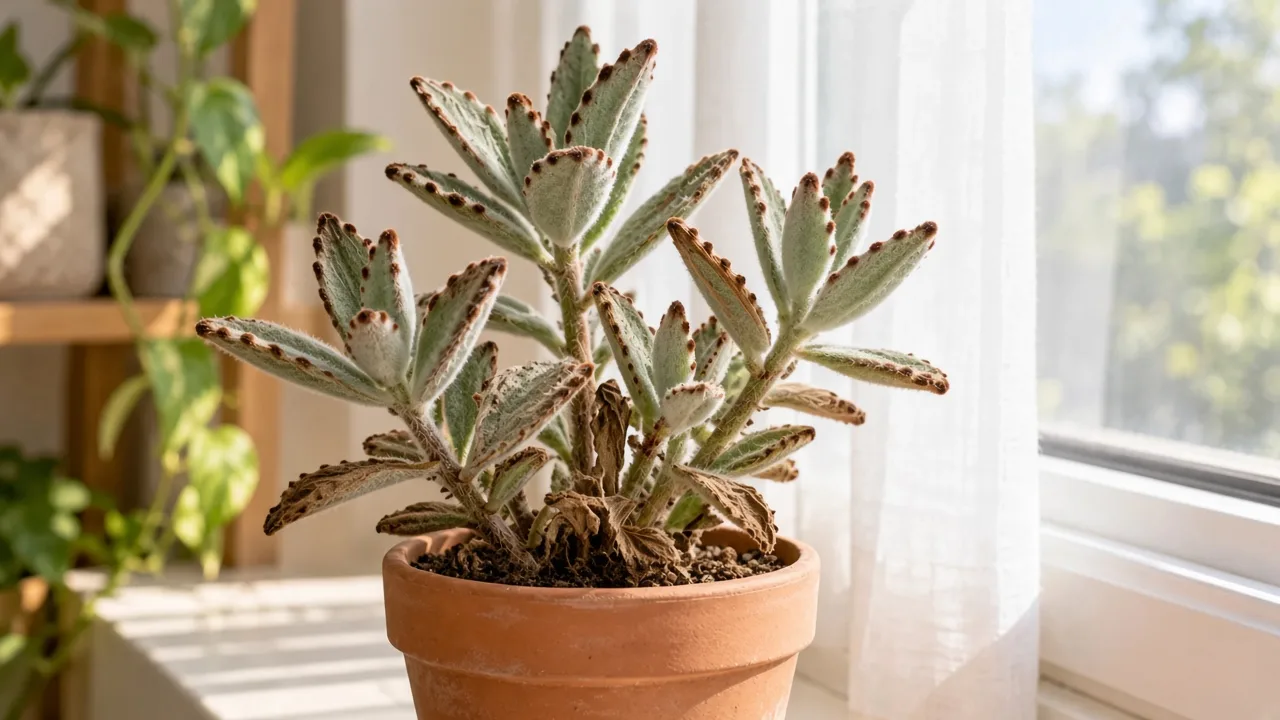
Underwatered Panda Plant: Signs, Wrinkled Leaves & Safe Bottom-Soak Fixes
This guide covers underwatering on Panda Plant. See also the general Underwatering guide, watering, and light pages for this plant.
Underwatered Panda Plant: Signs, Wrinkled Leaves & Safe Bottom-Soak Fixes
Quick answer
An underwatered Panda Plant (Kalanchoe tomentosa) communicates water stress through its thick, velvety foliage: leaves lose their plush, rigid plumpness, becoming deflated, leathery, and wrinkled with visible horizontal creases. As drought deepens, the plant systematically sacrifices its lowest foliage, which shrivels into dry, papery brown crisps and drops to preserve moisture for the terminal apex. For universal soil hydrology and drought mechanics across houseplant families, review our global underwatering guide.
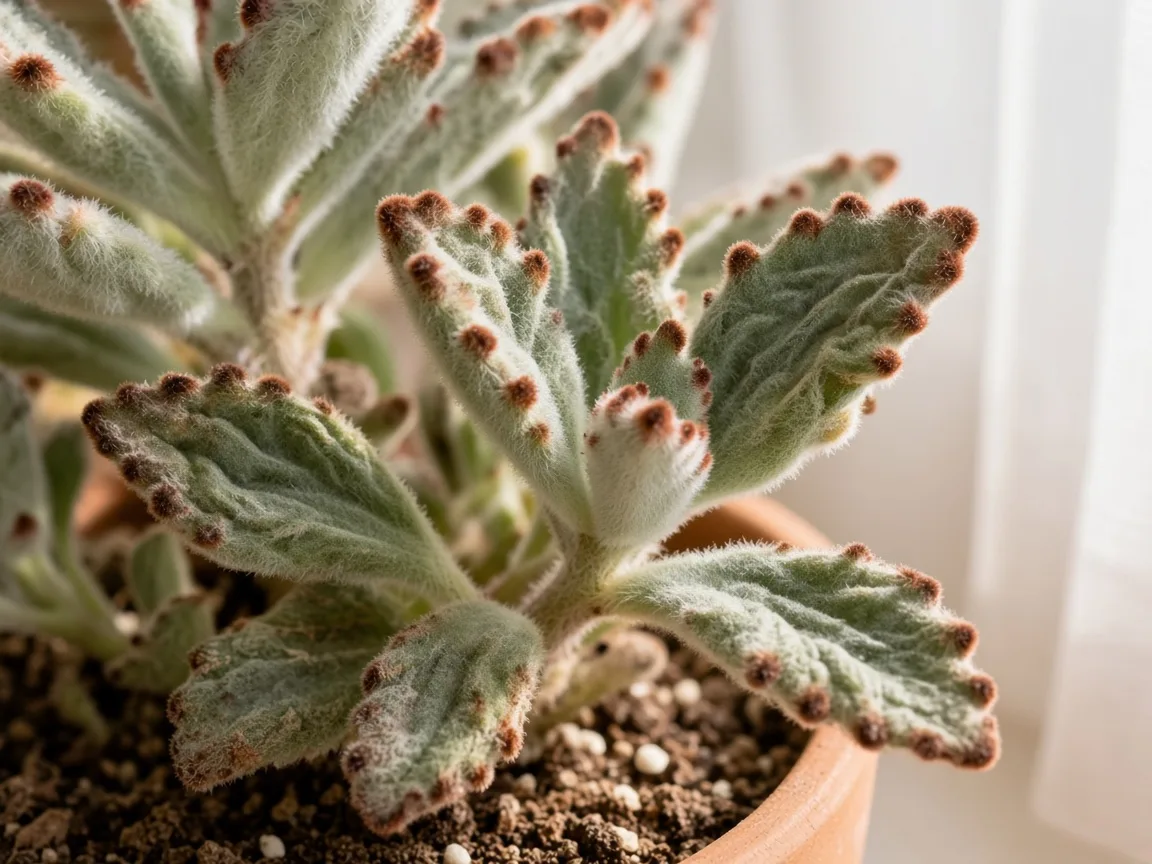
Wrinkled, deflated, leathery velvety leaves on an underwatered Panda Plant with dry shrunk soil. Your first fix is overcoming soil hydrophobicity through a deep bottom-soak: when succulent potting soil bakes completely dry, it repels top-poured water. Set the pot in a bowl or sink filled with 2 to 3 inches of room-temperature water for 30 to 45 minutes, allowing capillary action to pull moisture upward into the desiccated core of the rootball. Once the topsoil feels damp, remove the pot, drain completely for 30 minutes, and watch the leaves plump back up over the next 24 to 48 hours.
How drought impacts Panda Plant physiology
Kalanchoe tomentosa is a master of drought survival, native to rocky, arid granite outcrops in east-central Madagascar. According to botanical research from NC State Extension, the plant relies on three physiological adaptations to withstand drought:
- Trichome boundary layer: The dense silvery-white felt covering both leaf surfaces reduces ambient wind velocity across the epidermis, lowering transpirational moisture loss by up to 50%.
- Crassulacean Acid Metabolism (CAM): The plant keeps its stomata tightly closed during the heat of the day, opening them only at night to absorb carbon dioxide and store it as malic acid.
- Parenchymal water vacuoles: Fleshy leaves act as water storage tanks. Under normal conditions, these cells maintain high turgor pressure, keeping leaves stiff and thick.
When drought exceeds the plant’s natural safety buffer, internal water reserves are consumed:
- Turgor loss: Water exits the vacuoles to maintain vascular flow. Leaves lose thickness, feel bendable, and form distinct wrinkles on the leaf surfaces.
- Feeder root desiccation: Extended drought kills off fine micro-feeder root hairs. If soil remains bone-dry for months, the plant must regrow root hairs before it can rehydrate effectively.
- Lower leaf abscission: The plant reallocates mobile nitrogen and water from older basal leaves to the apical meristem, turning lower leaves into crispy brown husks that detach cleanly.
Diagnostic checklist: Underwatering vs. Overwatering vs. Root Rot
Because overwatering and root rot can also cause leaves to droop or drop, confirm the diagnosis using this matrix:
| Diagnostic Feature | True Underwatering | Overwatering Stress | Root Rot Emergency |
|---|---|---|---|
| Leaf Texture | Thin, deflated, leathery, wrinkled | Swollen, squishy, water-soaked, translucent | Soft, mushy, collapsing |
| Foliage Color | Matte silver-gray; lower leaves dry brown | Pale yellow, translucent yellow-green | Dark brown, blackening from stem upward |
| Stem Condition | Rigid, woody, firm, and completely solid | Soft or spongy at the soil line | Black, squishy, hollow, rotting |
| Soil State | Bone-dry, dusty, pulled away from pot walls | Saturated, heavy, cool, clumpy | Saturated, muddy, foul sour smell |
| Weight of Pot | Feather-light when lifted | Noticeably heavy and water-logged | Heavy and wet |
Step-by-step rehydration protocol for hydrophobic soil
When potting mix has dried into a hard brick, pouring water into the top of the pot fails because the water streams down the gap between the soil and pot wall without penetrating the rootball. Clemson Cooperative Extension recommends sub-irrigation to restore moisture to hydrophobic media:
Step 1: The bottom-soaking bath
- Fill a basin, bowl, or sink with 2 to 3 inches of room-temperature water.
- Place your potted Panda Plant directly into the water basin. Ensure the pot has an open bottom drainage hole.
- Allow the pot to sit undisturbed for 30 to 45 minutes. Water will wick upward through the container’s bottom hole via capillary action, gradually re-moistening the compacted peat and pumice particles.
- Check the soil surface: once the top layer of mix feels cool and damp to the touch, the entire root ball is saturated.
Step 2: Thorough drainage
- Lift the pot out of the water basin and let it drain freely in an empty sink for 20 to 30 minutes.
- Never let the pot sit permanently in standing drainage water; empty the decorative saucer before returning the plant to its windowsill.
Step 3: Monitoring turgor recovery
- 24 Hours: Feeder roots absorb moisture and transport it upward. Wrinkled leaves begin expanding and softening of creases is noticeable.
- 48 to 72 Hours: Vacuoles refill completely. The velvety foliage becomes thick, rigid, and plump again, unable to bend without snapping.
- If leaves remain wrinkled: The root system has suffered extensive feeder root dieback. Maintain normal soak-and-dry intervals; the plant will regenerate feeder roots over the next 2 to 3 weeks and plump up after the subsequent watering cycle.
Calibrating seasonal watering to prevent chronic drought
- Active growing season (Spring & Summer): Water thoroughly every 2 to 3 weeks. Check moisture depth by inserting a wooden skewer to the bottom of the pot; water only when the skewer emerges 100% dry. Review our Panda Plant watering guide.
- Dormant season (Autumn & Winter): Reduce watering frequency to once every 4 to 6 weeks. Cool temperatures lower transpiration, allowing the plant to cruise safely through winter with minimal moisture.
- Container selection: Grow in unglazed terracotta with open drainage holes. Terracotta breathes while preventing both waterlogging and excessive soil baking, per our Panda Plant soil guide.
Related tool
Use our Succulent Watering Calculator to determine the exact watering volume and interval tailored to your pot volume, container material, and ambient room temperature.
Related Panda Plant guides
- Panda Plant overview — comprehensive natural history and species care requirements
- Watering guide — soak-and-dry irrigation practices to maintain optimal turgor
- Soil guide — mineral pumice and grit formulations that rehydrate evenly
- Light guide — lighting thresholds and temperature management for succulents
- All Panda Plant problems — complete diagnostic troubleshooting index