Yellow Leaves on Panda Plant: Causes & Recovery Fixes
Quick answer
Yellow leaves on a Panda Plant (Kalanchoe tomentosa) are most commonly caused by overwatering, insufficient light, or natural lower-leaf aging. If bottom leaves turn swollen, translucent, and mushy, saturated soil is suffocating the roots. If 1 or 2 of the oldest basal leaves slowly turn dry and yellow while the top rosettes remain vibrant and compact, it is normal senescence. First step: feel the yellow leaf—if watery and soft, cease watering immediately; if dry and papery, allow it to drop naturally.
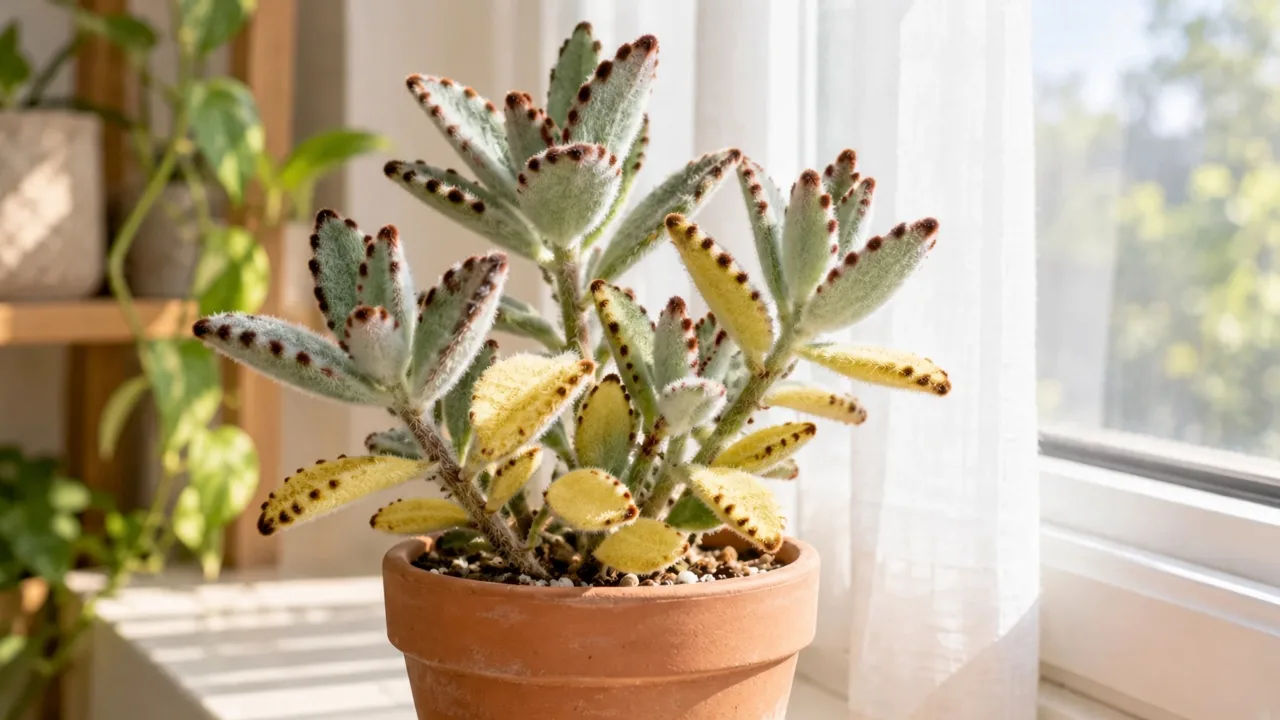
Yellow Leaves on Panda Plant: Causes, Natural Shedding & Recovery Fixes
This guide covers yellow leaves on Panda Plant. See also the general Yellow Leaves guide, watering, and light pages for this plant.
Yellow Leaves on Panda Plant: Causes, Natural Shedding & Recovery Fixes
Quick answer
Yellow leaves on a Panda Plant (Kalanchoe tomentosa) require careful diagnostic triage: the symptom ranges from completely harmless botanical aging to an acute overwatering emergency. In nature, Kalanchoe tomentosa develops into a semi-woody shrub that systematically discards its oldest basal leaves as new rosettes crown the apex. For universal chlorosis mechanics across indoor houseplants, consult our global yellow leaves guide.
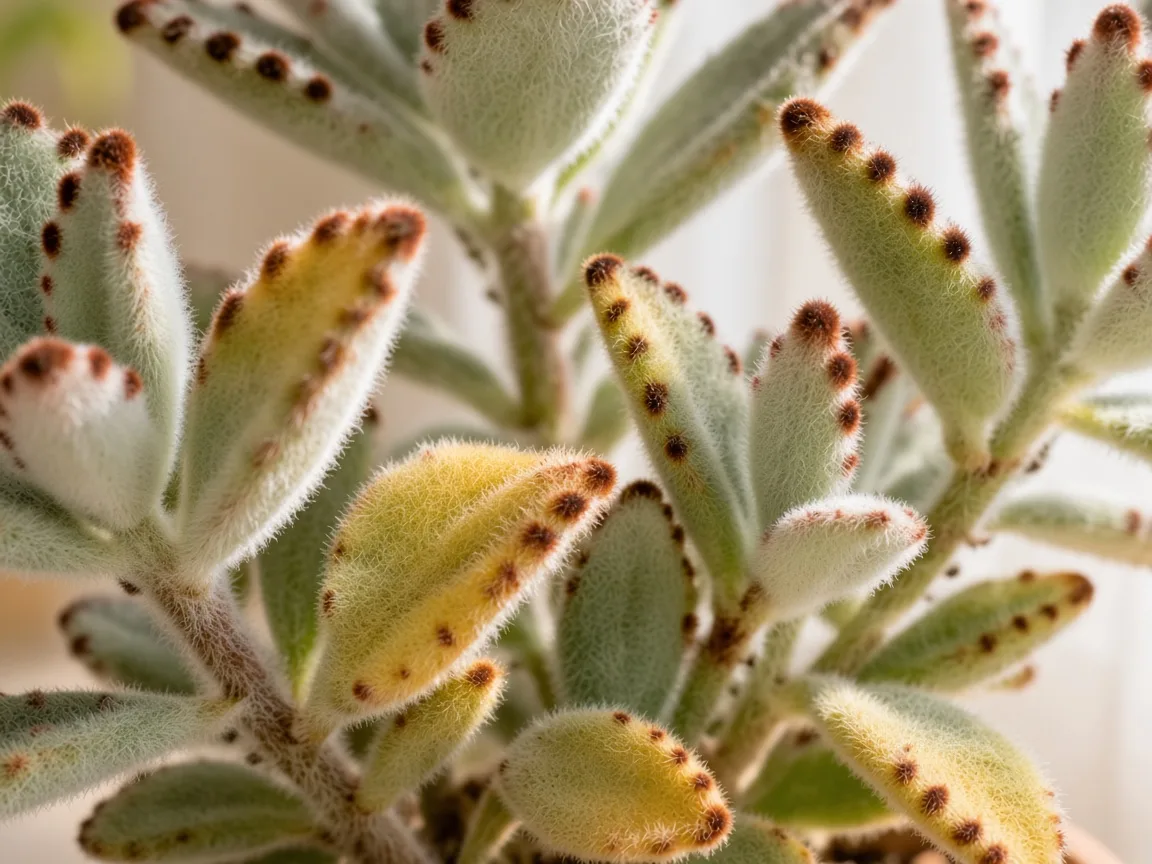
Yellowing lower velvety leaves on a Panda Plant contrasted with healthier silver growth above. Your first fix is a tactile inspection: touch the yellow leaf. If it is soft, swollen, watery, or translucent, your soil is holding too much water and suffocating roots—stop watering immediately and inspect the rootball. If the yellow leaf is dry, papery, and firmly attached at the very base of the main stem while the top rosettes remain tight, silver, and adorned with dark chocolate teeth, your plant is undergoing normal seasonal senescence: allow the leaf to detach naturally.
Primary causes of yellow leaves on Panda Plant
1. Chronic overwatering and root asphyxiation
This is by far the most dangerous cause of yellowing in succulents. As Clemson Cooperative Extension explains, saturated potting media displaces pore-space oxygen. Lacking oxygen, root hairs die and fail to transport nutrients. Furthermore, cells in the thick succulent leaves absorb water under high hydrostatic pressure until cellular walls burst (edema). The damaged leaf turns a sickly, translucent yellow, feels like a squishy water balloon, and drops at the slightest brush of a hand.
2. Natural lower leaf senescence (Normal aging)
According to NC State Extension, Panda Plant naturally develops an upright, branched, woody habit. As the stem lengthens and thickens, the oldest leaves at the bottom of the stalk reach the end of their lifespan. The plant systematically reabsorbs mobile carbohydrates and nitrogen from these older leaves to fuel newly emerging apical buds. The leaf fades from silver to pale yellow, shrivels into a dry brown husk, and falls away cleanly.
3. Insufficient sunlight
In dim rooms (under 400 foot-candles), the plant cannot maintain chlorophyll synthesis. Leaves throughout the lower and middle canopy fade to a washed-out yellow-green, the distinctive dark chocolate margin spots fade away, and stems stretch into leggy growth.
4. Nitrogen and mineral depletion in exhausted media
If a Panda Plant has been in the same container of gritty mineral mix for 3 or more years without repotting or light feeding, substrate minerals become depleted. As mobile nitrogen is pulled from older leaves to support terminal growth, lower foliage develops uniform chlorosis while remaining dry and firm.
5. Pest-induced chlorosis (Spider mites & mealybugs)
Sap-sucking pests puncture epidermal cells and drain sap. Fine feeding by spider mites produces speckled yellow stippling that eventually coalesces into yellow, bronzed patches across the felted blade, detailed in our spider mites guide.
Diagnostic triage: Identifying the exact cause of yellowing
| What You See & Feel | Primary Underlying Cause | Severity Level | Immediate Action |
|---|---|---|---|
| 1–2 lowest leaves turn yellow, then dry, papery brown; rest of plant is compact and firm | Natural lower leaf senescence | Completely normal | Allow leaves to fall naturally; maintain routine care |
| Lower leaves turn watery, translucent yellow, soft, squishy; drop effortlessly; soil damp | Overwatering & cellular edema | Critical emergency | Stop watering → unpot to inspect roots → dry out |
| Leaves across entire plant fade to dull pale yellow-green; chocolate margins disappear | Insufficient light (Low PAR) | Moderate | Acclimate to 4–6 hrs direct sun → follow light guide |
| Fine yellow stippling dots covering leaves; delicate webbing in leaf teeth | Spider mite infestation | Moderate | Isolate plant → spot-treat with alcohol swab → rinse |
| Uniform pale yellowing on older leaves; plant is rootbound in old dry mineral soil | Nutrient depletion (Nitrogen) | Low | Repot into fresh gritty mix → feed dilute fertilizer |
Step-by-step remediation protocol
Take targeted action based on your diagnostic assessment:
If caused by overwatering:
- Immediately unpot the plant to inspect the root ball.
- If roots are firm and pale tan: lay the rootball on dry paper towels for 24 to 48 hours in a warm room out of direct sunlight until excess water evaporates.
- If roots are black, slimy, or foul-smelling: prune away dead roots back to clean tissue, or behead the healthy stem above the rot line per our root rot guide.
- Repot into an unglazed terracotta pot filled with 65% mineral pumice/perlite and 35% cactus soil. Do not water for 10 days.
If caused by low light:
- Gradually acclimate the plant to higher light over 10 to 14 days to prevent leaf scorch.
- Position directly on an east-, south-, or west-facing windowsill receiving at least 4 to 6 hours of bright filtered sunlight or gentle direct morning sun.
- If natural light is limited, install a full-spectrum LED grow light positioned 8 to 12 inches above the canopy on a 12-hour timer.
If caused by nutrient exhaustion:
- Verify that the rootball is rootbound and the soil has been unfertilized for over a year.
- Refresh the substrate by potting into a slightly larger terracotta container with fresh gritty mix.
- During active spring and summer growth, apply a specialized low-nitrogen succulent fertilizer diluted to quarter-strength once every 6 to 8 weeks. Never fertilize dormant plants in autumn or winter.
Long-term prevention for Panda Plant
- Grow in breathable terracotta: Porous unglazed clay walls allow moisture to evaporate from all sides, preventing the waterlogged conditions that cause translucent yellow leaves.
- Formulate high-porosity mineral substrate: Mix 60% to 70% coarse inorganic grit (pumice, perlite, granite grit) with 30% to 40% organic cactus mix, as detailed in our Panda Plant soil guide.
- Follow strict soak-and-dry watering: Always verify complete root-ball dryness using a wooden skewer before watering. Empty drainage trays within 15 minutes.
- Provide generous sunlight: Maintain at least 800 to 1,200 foot-candles of light to support chlorophyll synthesis and crisp chocolate margins.
Related tool
Use our Yellow Leaves Diagnosis Tool to input your plant’s soil moisture, leaf texture, and sunlight exposure to receive an instant diagnostic breakdown.
Related Panda Plant guides
- Panda Plant overview — comprehensive natural history and species care profile
- Watering guide — soak-and-dry irrigation practices to prevent yellowing edema
- Soil guide — custom mineral pumice and grit formulations for succulent health
- Light guide — sunlight intensity thresholds to maintain vibrant chlorophyll
- All Panda Plant problems — complete diagnostic troubleshooting directory