Panda Plant Root Rot: Diagnosis, Stem Cuts & Rescue
Quick answer
Root rot on Panda Plant (Kalanchoe tomentosa) is a lethal oomycete and fungal infection triggered by saturated, oxygen-starved soil. Roots turn black, slimy, and foul-smelling, and decay ascends into the stem collar ('black leg'), causing lower leaves to drop en masse. First step: unpot the plant immediately, wash the roots, and perform surgical excision. If the main stem base has softened, behead the plant 1 to 2 inches above the rot line, callous the clean cutting for 5 to 7 days, and root in dry pumice.
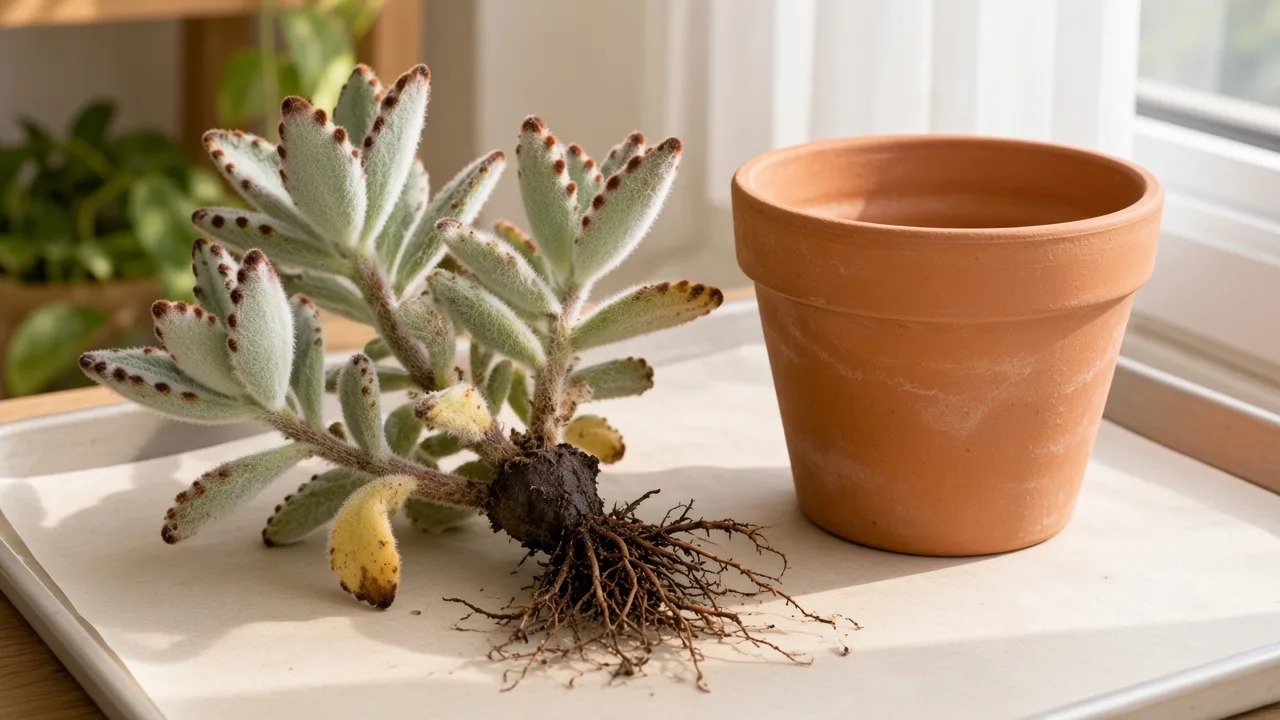
Root Rot on Panda Plant: Emergency Beheading & Surgical Rescue Guide
This guide covers root rot on Panda Plant. See also the general Root Rot guide, watering, and light pages for this plant.
Root Rot on Panda Plant: Emergency Beheading & Surgical Rescue Guide
Quick answer
Root rot on a Panda Plant (Kalanchoe tomentosa) is a lethal, fast-moving emergency caused by opportunistic water molds (Pythium and Phytophthora) and fungi (Fusarium) attacking roots suffocated by standing water. As roots decay, fungal mycelium migrates upward into the vascular bundles of the central stem, creating a condition known as basal rot or ‘black leg’, where lower leaves drop en masse and the stem collar collapses into black mush. For universal root pathology and commercial treatments across houseplant taxa, explore our global root rot guide.
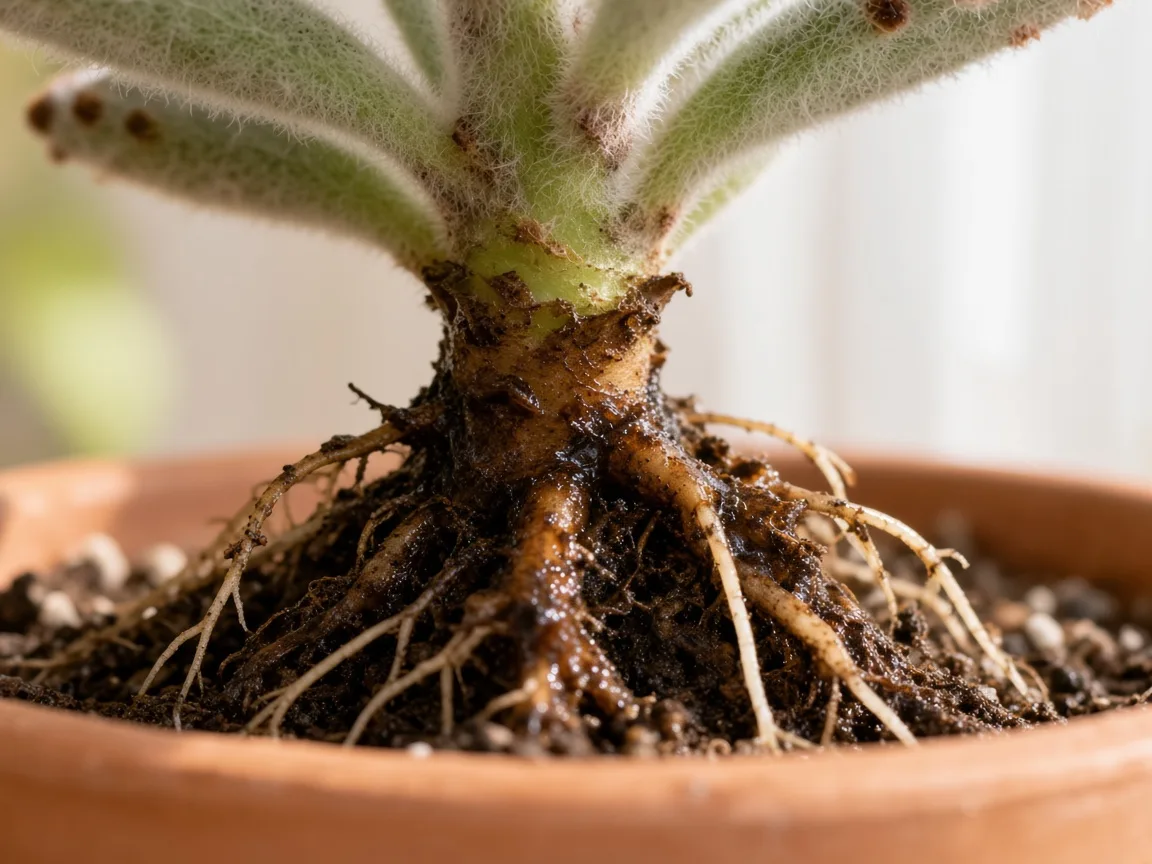
Blackened decaying roots and a dark soft basal stem collar on an unpotted Panda Plant with root rot. Act the same day: slide the plant out of its container and wash the soil away to inspect the root mass. If decay is confined strictly to lower root tips, prune away rotted strands and repot into dry pumice. If the stem collar at the soil line is soft, discolored, or hollow, you must execute an emergency apical ‘beheading’: sever the healthy top rosette well above the rot line, callous the stem for 5 to 7 days, and re-root it in completely dry mineral substrate.
How root rot destroys Kalanchoe tomentosa
In its native granite hills in Madagascar, Kalanchoe tomentosa grows in fast-draining, gravel-filled crevices where rains drain away in seconds. When cultivated indoors in dense, peat-heavy soil or pots without drainage, root rot develops in three progressive stages:
- Anaerobic asphyxiation: Saturated soil displaces pore-space oxygen. Lacking oxygen for cellular respiration, the fine feeder root hairs die, stripping the plant’s ability to absorb water and minerals.
- Cortex disintegration: UW-Madison Extension notes that Pythium and Phytophthora zoospores swim through waterlogged soil, entering suffocated root tissue. The pathogens produce pectinases that dissolve root cell walls. The outer cortex sloughs off easily when tugged, leaving behind only a thin, hair-like vascular stele.
- Vascular occlusion and basal stem melt: Pathogens invade the main xylem and phloem vessels. Fungal hyphae and host defenses clog the vascular streams, causing the top of the plant to wilt and drop leaves despite sitting in wet soil. When rot reaches the soil level, the stem turns water-soaked, black, and squishy, leading to structural collapse.
Confirming root rot: the physical diagnosis
Before performing emergency surgery, unpot the specimen and check for these three definitive markers:
| Diagnostic Test | Healthy Root System | Root Rot Breakdown |
|---|---|---|
| Root Color & Texture | Pale tan, golden-cream, firm, fibrous, and elastic | Dark brown to coal-black, slimy, stringy, breaks into mush |
| Stem Collar Firmness | Rigid, dense, woody, pale green or grayish bark | Spongy, squishy, black, sunken, or hollow at the soil line |
| Aroma | Fresh, clean, earthy forest-floor scent | Sour, sulfurous, swampy, or decaying odor |
| Foliage Reaction | Plump, velvety, stiff leaves anchored firmly to stem | Lower leaves turn translucent yellow and fall off in clusters |
The emergency surgical rescue protocol
Choose the appropriate rescue path based on whether rot is confined to the roots or has penetrated the central stem:
Route A: Root pruning (If the main stem collar is firm and healthy)
If the central stem base is solid and woody, and only a portion of the root system is rotted:
- Rinse all remaining soil away from the root ball under a gentle stream of lukewarm water.
- Sterilize sharp pruning scissors in 70% isopropyl alcohol.
- Snip away all dark, slimy, or hollow root strands, cutting back into healthy, firm, pale tan tissue.
- Mist the remaining root mass with 3% hydrogen peroxide to oxidize residual pathogens.
- Lay the plant on dry paper towels in a warm, shaded room for 24 hours so root pruning cuts can dry and callous.
- Repot into a clean, unglazed terracotta pot filled with a dry 70% pumice/perlite and 30% cactus soil blend. Do not water for 10 days.
Route B: Emergency beheading (If the basal stem is soft or blackened)
If rot has reached the stem collar, root pruning will not work because pathogens have already invaded the vascular core. You must perform an apical decapitation:
- Locate the healthy cut zone: Identify a point on the main stem at least 1 to 2 inches above the highest visible brown or water-soaked tissue.
- Execute the surgical cut: Using a new razor blade or sterilized craft knife, slice cleanly straight across the stem.
- Inspect the vascular core: Examine the cross-section of the cutting under bright light. The stem interior must be completely uniform, crisp, and pale green or creamy-white.
Critical check: If you see any brown dots, black specks, or dark circular rings in the central vascular ring, the rot has already ascended to that level. Sterilize your blade and cut another 1/2 inch higher until the cut face is 100% pristine.
- Remove lower leaf pairs: Gently wiggle and remove the bottom 2 or 3 leaves to create an exposed 1- to 1.5-inch bare stem shank.
- Enforce callous formation (5 to 7 days): Place the cutting upright in an empty, clean glass or ceramic cup in a warm room out of direct sunlight. Allow the cut stem end to form a hard, dry, leathery callous. Never plant an uncalloused succulent cutting—the raw wound will immediately rot.
- Potting in dry mineral substrate: Insert the calloused stem 1 inch deep into pure dry horticultural pumice or a 70% pumice/perlite mix.
- Withhold all water for 14 days: Do not water the cutting. Without roots, water will only cause decay. The cutting will rely on water reserves stored in its velvety leaves to initiate adventitious root development.
- Root confirmation: After 3 to 4 weeks, give the cutting a very gentle upward tug. Resistance confirms that a fresh root system has anchored into the mineral mix. Begin light soak-and-dry watering per our Panda Plant watering guide.
Long-term prevention: creating rot-proof conditions
- Always choose unglazed terracotta: Porous clay pot walls allow moisture to evaporate laterally, eliminating the perched water table that breeds water molds.
- Formulate high-porosity mineral substrate: Never use standard peat potting soil straight from the bag. Blend at least 60% to 70% coarse inorganic amendments (pumice, perlite, granite grit) with 30% to 40% organic cactus mix, as outlined in our Panda Plant soil guide.
- Follow the soak-and-dry method: Never water on a fixed weekly calendar. Always verify that a wooden skewer pushed to the container bottom emerges completely dry before applying water.
- Maximize sunlight: Place your Panda Plant in bright filtered sunlight or direct morning sun. Strong solar irradiance accelerates water transpiration and keeps the root zone aerobic, per our Panda Plant light guide.
Related tool
Assess your plant’s container drainage, pot material, and watering frequency with our Root Rot Risk Checker to determine if your current setup is safe from water molds.
Related Panda Plant guides
- Panda Plant overview — comprehensive natural profile and species care requirements
- Watering guide — soak-and-dry irrigation practices to prevent root asphyxiation
- Soil guide — custom high-porosity mineral substrate recipes
- Light guide — sun thresholds for rapid soil drying and compact growth
- Propagation guide — propagating stem cuttings and leaf rosettes safely
- All Panda Plant problems — full diagnostic troubleshooting index