Mealybugs on Panda Plant: Causes, Checks & Safe Removal
Quick answer
Immediately isolate your Panda Plant from other houseplants. Inspect the stem nodes, leaf axils, and rosettes with a magnifying glass to distinguish irregular white mealybug wax from natural silver trichomes. Spot-treat visible pests using a fine cotton swab dipped in 70% isopropyl alcohol, avoid broad oil sprays that ruin fuzzy foliage, and check the rootball for subterranean root mealybugs if decline persists.
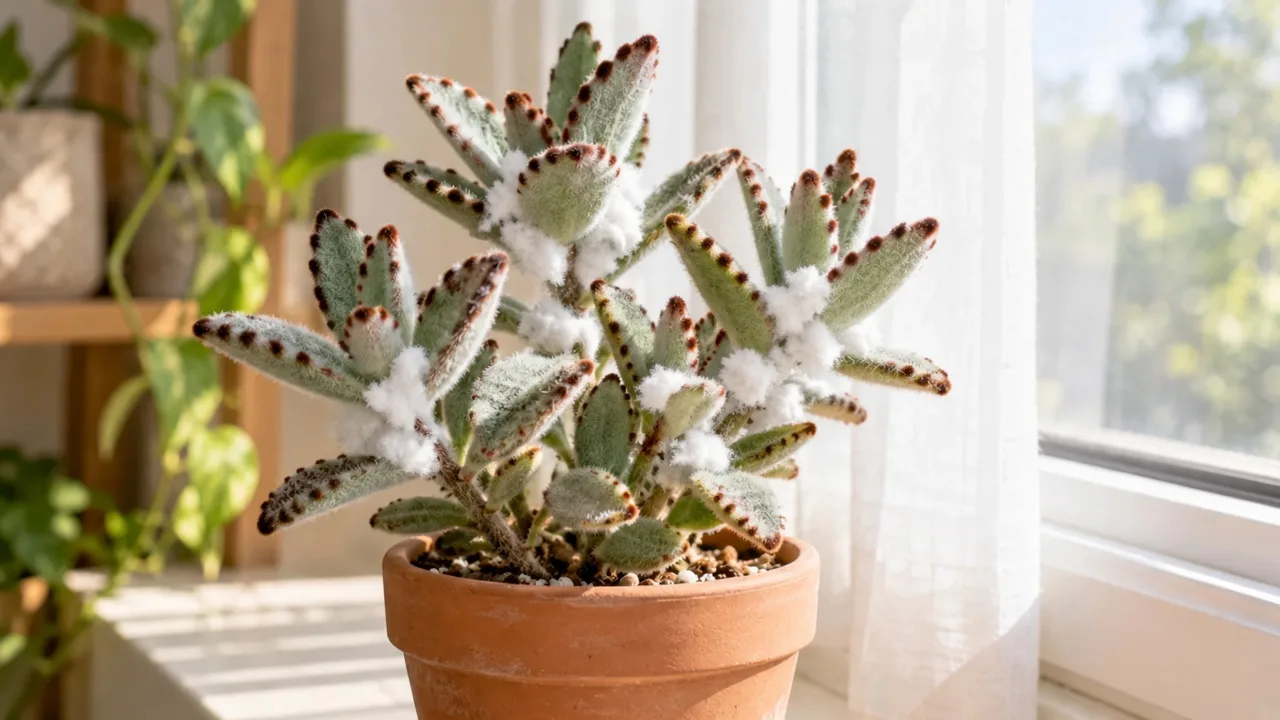
Mealybugs on Panda Plant: Diagnosis, Safe Removal & Root Checks
This guide covers mealybugs on Panda Plant. See also the general Mealybugs guide, watering, and light pages for this plant.
Mealybugs on Panda Plant: Diagnosis, Safe Removal & Root Checks
Quick answer
Immediately isolate your Panda Plant (Kalanchoe tomentosa) away from all neighboring houseplants to halt the spread of crawling nymphs. Mealybugs represent one of the most deceptively dangerous pests for this Madagascan succulent because their cottony white wax blends seamlessly into the plant’s dense coat of silvery-white foliar trichomes. Do not spray horticultural oils, neem oil, or heavy insecticidal soaps over the entire plant; oil-based drenches dissolve the protective leaf hairs, suffocate epidermal pores, and cause severe chemical leaf burn.
Instead, take a fine-tipped cotton swab lightly dipped in 70% isopropyl alcohol and touch every visible insect mass directly. The alcohol instantly dissolves the insect’s protective waxy carapace and kills it on contact while leaving surrounding velvety foliage uninjured. If your Panda Plant shows persistent wilting, lower-leaf shedding, or stalled growth despite proper hydration, unpot the specimen to inspect the succulent rootball for subterranean root mealybugs (Rhizoecus). For foundational species details and cultural requirements, start with our Panda Plant overview.
What mealybugs look like on Panda Plant
On most smooth-leaved houseplants, a mealybug infestation creates glaring white cottony spots that are easy to spot at a glance. On a Panda Plant, the pest operates under natural camouflage. Foliar mealybugs (Pseudococcus and Planococcus species) produce fluffy, filamentous white wax that closely mimics the color, texture, and density of Kalanchoe tomentosa’s felt-like leaf surface. Adult females measure roughly 1 to 4 millimeters in length, featuring oval, segmented bodies rimmed with short waxy filaments. Immature nymphs (crawlers) are tiny, mobile, and yellowish-orange, moving rapidly along stems before settling into a protected crevice and spinning their waxy coats.
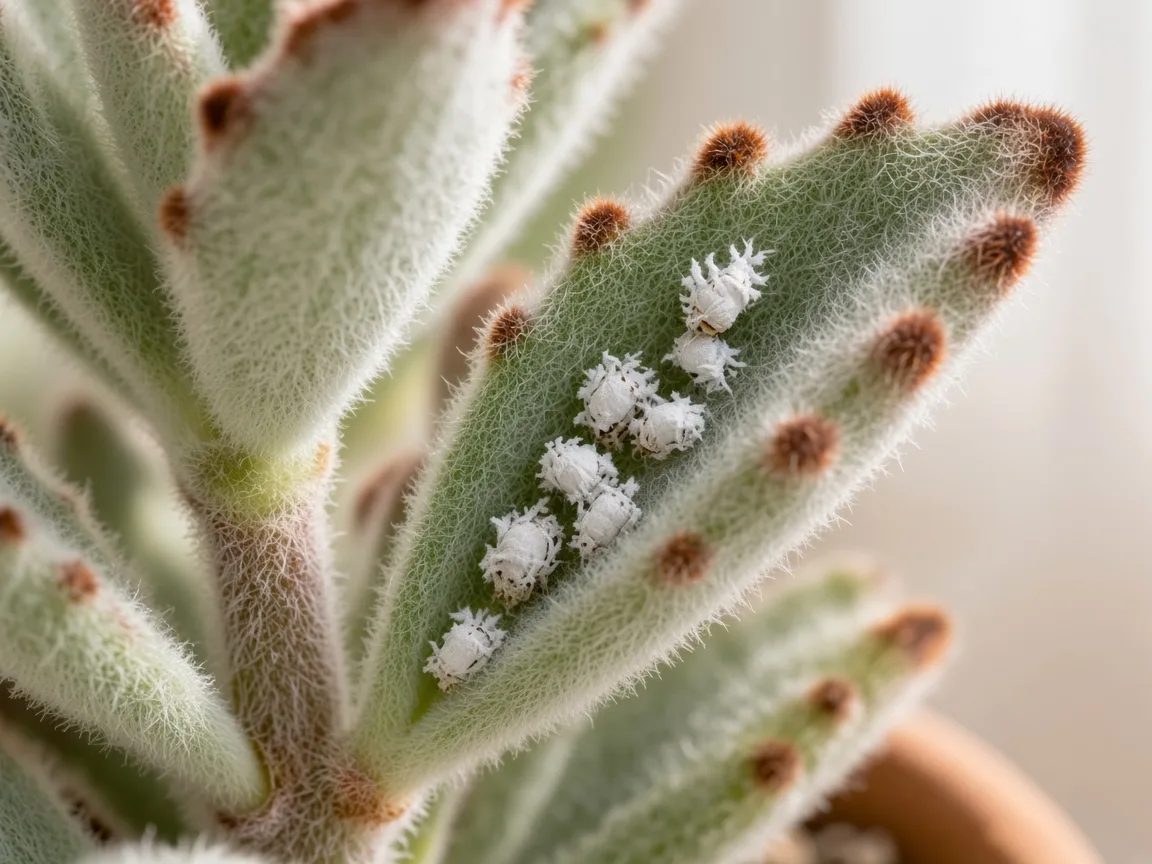
Under close magnification, the soft segmented bodies and cottony wax of mealybugs stand out against the natural, fine silvery trichomes of Kalanchoe tomentosa leaf axils.
According to the NC State Extension profile for Kalanchoe tomentosa, Panda Plant is particularly vulnerable to mealybugs and spider mites. As sap-sucking insects, mealybugs use piercing-sucking stylets to tap directly into the phloem vessels of succulent leaves and stems. In doing so, they rob the plant of moisture and nutrients, leading to chlorosis, puckered leaf margins, and stunted apical shoots. Furthermore, mealybugs excrete excess plant sugars as sticky honeydew. While honeydew on smooth succulents forms shiny droplets, on a Panda Plant it mats the delicate trichomes together into dirty, gummy patches that attract airborne spores of black sooty mold.
The trichome camouflage trap: distinguishing mealybug wax from tomentose foliage
The specific botanical epithet tomentosa means “covered with dense, matted hairs.” These specialized epidermal structures, called trichomes, serve critical biological roles for the plant in its native arid habitats of Madagascar: they reflect intense solar radiation, reduce wind velocity across the leaf blade, and drastically lower transpirational water loss. However, these identical trichomes create a diagnostic camouflage trap for indoor growers:
- Uniform felt vs. localized clumps: Panda Plant trichomes form an unbroken, velvet-smooth carpet across both dorsal and ventral leaf surfaces, culminating in rich chocolate-brown or rusty dentate margins. Mealybug wax, by contrast, is irregular, globular, and clustered. Look for asymmetric white tufts nestled deeply into the V-shaped junction where the fleshy petiole meets the woody central stem.
- Tactile response and alcohol solubility: Healthy leaf trichomes are dry, velvety to the touch, and firmly anchored to the leaf epidermis. They do not smear, dislodge easily, or dissolve in liquid. When you touch a suspect white mass with a fine cotton swab moistened with 70% isopropyl alcohol, mealybug wax will instantly dissolve, collapsing the cottony structure and revealing a yellow, pink, or brownish insect carcass.
- Pitted leaf scars and honeydew residue: Normal fuzzy foliage remains completely matte and non-sticky. If you observe areas where the hairs appear wet, glued together, or crusty with dark residue, sap-feeding insects have been feeding above that zone. Under strong artificial light or a 10x jewelers loupe, active mealybugs exhibit distinct segmentation beneath their wax filaments, unlike the uniform cell structure of plant trichomes.
Relying on a casual five-second glance over the top of the plant will cause you to miss an early infestation. By the time mealybug colonies migrate out onto the broad leaf surfaces, the stem nodes and basal leaf axils are often heavily colonized.
Foliage mealybugs vs root mealybugs: two distinct threats
When dealing with Kalanchoe tomentosa, you must distinguish between two completely different ecological threats: foliar mealybugs (Pseudococcus longispinus and Planococcus citri) and root mealybugs (Rhizoecus species).
Foliar mealybugs (Pseudococcus & Planococcus)
Foliar species inhabit the aerial portions of the plant. They target the tender tissue of newly emerging rosettes, flower stems (if present), and the sheltered recesses of lower stem joints. According to UC IPM guidelines on mealybug management, mealybugs thrive in sheltered plant cracks and crevices where environmental extremes and chemical sprays cannot easily penetrate. Because foliar mealybugs feed on high-pressure vascular streams in stems and leaf bases, heavy feeding quickly causes premature shedding of lower fleshy leaves and distorted terminal growth.
Root mealybugs (Rhizoecus)
Root mealybugs are subterranean specialists that spend their entire lifecycle below the potting line. As detailed by University of Wisconsin Extension pest notes, root mealybugs are tiny, wingless insects covered in fine, white, powdery wax that infest container-grown plants and succulent rootballs. They feed directly on the fine feeder roots responsible for water and mineral uptake.
Because root mealybugs live out of sight beneath the substrate, their symptoms closely mimic chronic drought or early root decay:
- The Panda Plant’s plump, velvety leaves lose turgor pressure, appearing dull, deflated, and wrinkled despite damp soil.
- Lower leaves yellow and drop in sequence from the base upward.
- The plant fails to produce new seasonal growth during spring and summer.
- When you gently slip the rootball out of its container, you will see chalky, white, hydrophobic waxy deposits clinging to the root tips and the inner walls of terracotta pots.
If your plant is declining and the aerial leaves are clean, you are almost certainly battling subterranean Rhizoecus.
Confirming mealybugs and ruling out lookalikes
Before initiating treatment, cross-examine what you see against common physiological disorders and succulent pests. Misidentifying the issue can lead to treatments that do more harm than good to delicate tomentose leaves.
| Symptom / Sign | Most Probable Cause | Key Diagnostic Confirmation | Correct Next Action |
|---|---|---|---|
| Clumped, sticky white cotton in leaf axils; soft segmented bodies beneath | Foliar mealybugs (Pseudococcus / Planococcus) | Melts instantly when touched with 70% isopropyl alcohol; sticky honeydew present | Isolate immediately; spot-treat with alcohol swab; inspect weekly |
| White powdery deposits and chalky webbing lining the rootball and pot interior | Root mealybugs (Rhizoecus) | Seen exclusively below soil line; roots appear dry, brittle, and stunted | Unpot plant; wash roots; drench or repot into fresh gritty mix |
| Uniform, smooth, silvery-gray velvet covering entire leaf surface | Natural trichomes (normal anatomy) | Dry, firmly attached, does not wipe away or dissolve in alcohol | No treatment needed; normal healthy Kalanchoe tomentosa foliage |
| Small, immobile brown or tan oval bumps anchored along woody stems | Scale insects (Coccoidea) | Hard waxy shell; no fluffy cotton; secretes honeydew | Scrape off gently with alcohol swab or blunt wooden pick |
| Leaves wrinkling, softening, and deflating without white residue or pests | Underwatering or drought | Soil bone-dry; roots firm; leaves plump up within 24 hours of watering | Follow our Panda Plant watering guide |
| Stems turning black, soft, and mushy at soil line; leaves dropping rapidly | Root rot or overwatering | Foul odor; black rotted roots; waterlogged potting medium | Inspect roots; cross-check our root rot guide |
If leaf loss or drooping occurs without cottony wax or sticky residue, check for care misalignments using our Panda Plant problems index before reaching for pest controls.
First fix: immediate quarantine and precision alcohol spot treatment
When an infestation is detected, your immediate first move must be physical containment:
First Action: Move the infested Panda Plant into a completely separate room, away from all other houseplants and succulents.
Mealybug crawlers are microscopic and move quickly across plant shelves, saucers, and windowsill frames. The Royal Horticultural Society mealybug profile stresses that isolating infested plants and inspecting neighboring collections is essential to prevent widespread glasshouse and indoor outbreaks.
Once isolated, perform precision spot eradication:
- Prepare your tools: Procure high-purity 70% isopropyl alcohol and a box of fine-tipped cotton swabs (or a small watercolor paintbrush). Do not use 90% or higher concentrations, as ultra-high concentrations evaporate too rapidly to penetrate dense waxy egg masses and can burn plant cuticle.
- Precision contact: Dip the tip of the swab into the alcohol, pressing off excess liquid against the rim of the bottle so it is moist but not dripping wet.
- Touch the insects directly: Gently touch each visible cottony tuft and segmented body with the swab. The alcohol dissolves the protective epicuticular wax layer on the insect within seconds, causing immediate desiccation and death. The pest will darken to a yellowish-brown or red color.
- Avoid foliar saturation: Do not rub or scrub the broad face of the velvety leaf. Confine your swab strictly to the pest and the immediate stem joint. Keep the swab off clean green tissue as much as possible.
- Inspect the pot rim: Run an alcohol-dampened paper towel around the inside rim of the pot and underneath the drainage tray, where wanderers frequently hide.
Repeat this manual swab inspection every 4 to 5 days. Mealybug eggs hatch on a continuous cycle indoors, and newly emerged crawlers will venture out from hidden crevices over the subsequent two to three weeks.
Why broad horticultural oils and soap washes destroy Panda Plant felt
A standard recommendation for houseplant pests is to hose down the plant with insecticidal soap or neem oil spray. Never do this on a Panda Plant.
Unlike glabrous (smooth) succulents like Jade Plant or Snake Plant, Kalanchoe tomentosa has specialized pubescent leaves. Spraying oil-based or detergent-based liquids across the foliage results in catastrophic damage:
- Trichome dissolution and matting: Horticultural oils and insecticidal soaps work by breaking down lipophilic waxes. In doing so, they dissolve the natural lipid barriers of the leaf trichomes. The fine silvery hairs become permanently matted, sticky, and discolored, turning from a soft velvet gray into an unsightly dull, patchy brown.
- Severe chemical phototoxicity: The UF/IFAS Extension guide on insecticidal soaps cautions that soaps and oils cause significant phytotoxic injury to sensitive or hairy plants, particularly when applied in warm conditions or under direct sunlight. Oil droplets trapped within the trichomes act as miniature lenses, scorching the underlying leaf tissue and producing permanent necrotic sunken pits.
- Trapped moisture and fungal rot: Clemson Cooperative Extension Kalanchoe guide emphasizes that Kalanchoes are drought-adapted succulents that deteriorate when kept overly wet. The dense hair coat traps aqueous sprays for hours or days, creating stagnant micro-pockets that invite fungal leaf spotting and stem rot.
Keep broad chemical sprays away from Panda Plant foliage. Precision manual alcohol application remains the safest, most effective contact treatment for foliar colonies.
How to inspect and treat root mealybugs in the succulent rootball
If aerial spot-treating fails to halt your Panda Plant’s decline, or if you discover white chalky powder around the pot’s drainage holes, you must inspect the root system.
Step 1: Unpot and diagnose
Allow the potting medium to dry out completely. Succulent roots tear easily when wet, but dry roots release cleanly. Gently invert the container, supporting the main stem base with one hand, and slide the rootball free. Examine the outer surface of the root mass under bright light:
- Healthy Panda Plant roots are fibrous, pale tan or light golden-brown, and slightly flexible.
- Root mealybugs appear as chalky, white, hydrophobic patches that look like powdered sugar or dried white mold clinging to the root tips. If you prod the white cluster gently, tiny, slow-moving oval insects will emerge from the wax.
Step 2: Clear the contaminated substrate
Take the plant over a disposal bucket away from your growing area and gently crumble away all old soil from the root ball. Discard the old substrate into a sealed trash bag—never reuse this soil or add it to compost. Rinse the bare root system under a lukewarm, gentle stream of tap water to wash away residual wax, crawlers, and eggs.
Step 3: Root drench or repotting
Depending on the severity of the infestation, choose one of two rescue routes:
- Mechanical clean and repot: If root damage is light, trim away dead or withered root strands using sterilized scissors. Allow the bare roots to air-dry in a warm, shaded spot for 24 hours so root pruning cuts can callous over. Repot the plant into a clean terracotta container filled with a fresh, fast-draining mineral mix, as outlined in our Panda Plant soil guide. Do not water for the first 5 to 7 days after repotting to prevent bacterial or fungal infection in newly trimmed root tissue.
- Systemic insecticide drench: In cases of severe, recurrent root mealybugs, physical washing alone may leave microscopic eggs intact. Where permitted by indoor pesticide regulations and product labeling, an ornamental systemic drench containing an active ingredient like imidacloprid can be applied once the plant is established in fresh mix. Systemic compounds are absorbed through the root vasculature, turning the plant’s sap lethal to root mealybugs and emerging foliar crawlers alike without touching the delicate felted foliage. Always follow label directions and safety protocols precisely.
Recovery timeline and realistic tissue recovery
Understanding how Kalanchoe tomentosa heals prevents unrealistic expectations and improper interventions during the recovery period:
- What will not heal: Feeding punctures caused by mealybug stylets leave microscopic wounds that often callous into small, corky tan scars. Leaves that suffered chemical scorch, heavy chlorosis, or necrotic scarring will never regenerate fresh trichomes or turn velvety green again. Those cosmetic blemishes are permanent.
- What recovery looks like: Success is measured by zero new pest sightings over a 30-day window and the emergence of pristine new growth. Look at the terminal apex of the stem: fresh rosettes should unfurl with upright posture, clean silver-white pubescence, and sharp chocolate-brown margins, free of stickiness or distortion.
- Realistic timeline:
- Days 1–7: Initial alcohol spot eradication kills mature adults and visible egg sacs. The plant stabilizes in isolation.
- Days 8–21: Latent eggs hatch into mobile crawlers. Weekly alcohol swab sweeps catch and eliminate these juveniles before they can reproduce.
- Days 22–45: Pest population reaches zero. New root hair develops if subterranean treatments were performed.
- Weeks 6–12: Panda Plant resumes visible vegetative growth at its natural, slow succulent pace.
Pet safety reminder during treatment
Panda Plant contains bufadienolides—cardiac glycosides that cause vomiting, diarrhea, lethargy, and abnormal heart rhythms if ingested by companion animals, as documented by the ASPCA Animal Poison Control warning. Always isolate the plant in a high, secure location away from chewing pets while performing treatments and monitoring recovery.
Preventing mealybugs on Panda Plant
Because eradicating mealybugs from felted foliage requires meticulous labor, prevention is by far your best strategy:
- Quarantine all new purchases: Keep any newly acquired succulent or houseplant isolated for a minimum of 14 to 21 days before introducing it to your collection. Inspect the stem joints and rootball of new plants thoroughly.
- Provide intense, bright light: Panda Plants require high light levels to maintain strong cell walls and tight, compact growth. According to NC State Extension, provide at least six hours of bright, indirect sunlight daily. When grown in dim lighting, stems stretch and internodes lengthen, creating weak, succulent tissue that mealybugs easily pierce. Consult our Panda Plant light guide for ideal foot-candle targets and placement recommendations.
- Practice strict soak-and-dry watering: Overwatered succulents develop bloated, thin-walled leaf tissue that attracts phloem-feeding pests. Allow the potting soil to dry out completely from top to bottom before watering thoroughly. Never let the pot sit in standing saucer runoff. Check our Panda Plant watering guide to master seasonal hydration cycles.
- Maintain clean growing areas: Wipe down plant shelves, window ledges, and saucers regularly with a mild disinfectant. Avoid reusing unwashed pots or dusty stakes.
For broader biological information regarding life cycles, natural predators, and universal pest management across all species, explore our comprehensive mealybugs guide.
When to use this page vs other Panda Plant guides
Use this guide whenever you confirm cottony white wax, sticky honeydew, or subterranean powdery deposits on Kalanchoe tomentosa. However, if symptoms diverge, route your diagnosis through other specialized guides:
- If the plant shows yellowing or soft, translucent leaves without cottony wax or sticky residue, check for overwatering and stem decay with our root rot guide.
- If leaves are wrinkling, deflating, or curling inward on a clean plant in dry soil, read our underwatering guide.
- If your Panda Plant is growing tall, weak, and floppy with pale leaves and wide gaps between leaf pairs, refer to our Panda Plant light guide.
- To explore all potential fungal, cultural, and pest problems affecting this species, browse the Panda Plant problems index.
Related tool
Panda Plants thrive in dry, arid indoor environments and suffer when ambient moisture remains trapped around their fuzzy leaves. Use our Plant Humidity Calculator to determine if your room’s humidity and air circulation are contributing to lingering moisture that attracts pests and invites fungal decay.
Related Panda Plant guides
- Panda Plant Care Overview — Complete profile, native habitat, seasonal rhythms, and botanical characteristics.
- Panda Plant Problems Index — Symptom-based troubleshooting hub for common ailments.
- Panda Plant Watering Guide — How to execute the soak-and-dry method safely.
- Panda Plant Soil & Substrate Guide — Custom mineral grit and perlite recipes for perfect drainage.
- Panda Plant Light Requirements — Sunlight thresholds to prevent leggy growth and maintain chocolate margins.