Spider Mites on Panda Plant: Causes & Safe Removal
Quick answer
Spider mites on Panda Plant (Kalanchoe tomentosa) appear as fine silken webbing between leaf teeth and terminal buds, accompanied by tiny yellow stippling dots and dull, bronzed foliage. They thrive in the warm, dry air favored by indoor succulents. Do not spray neem oil or heavy insecticidal soaps—oils permanently dissolve and mat the protective foliar trichomes. Instead, isolate the plant, spot-treat webs with a 70% isopropyl alcohol swab, and use shielded mechanical rinsing or predatory mites.
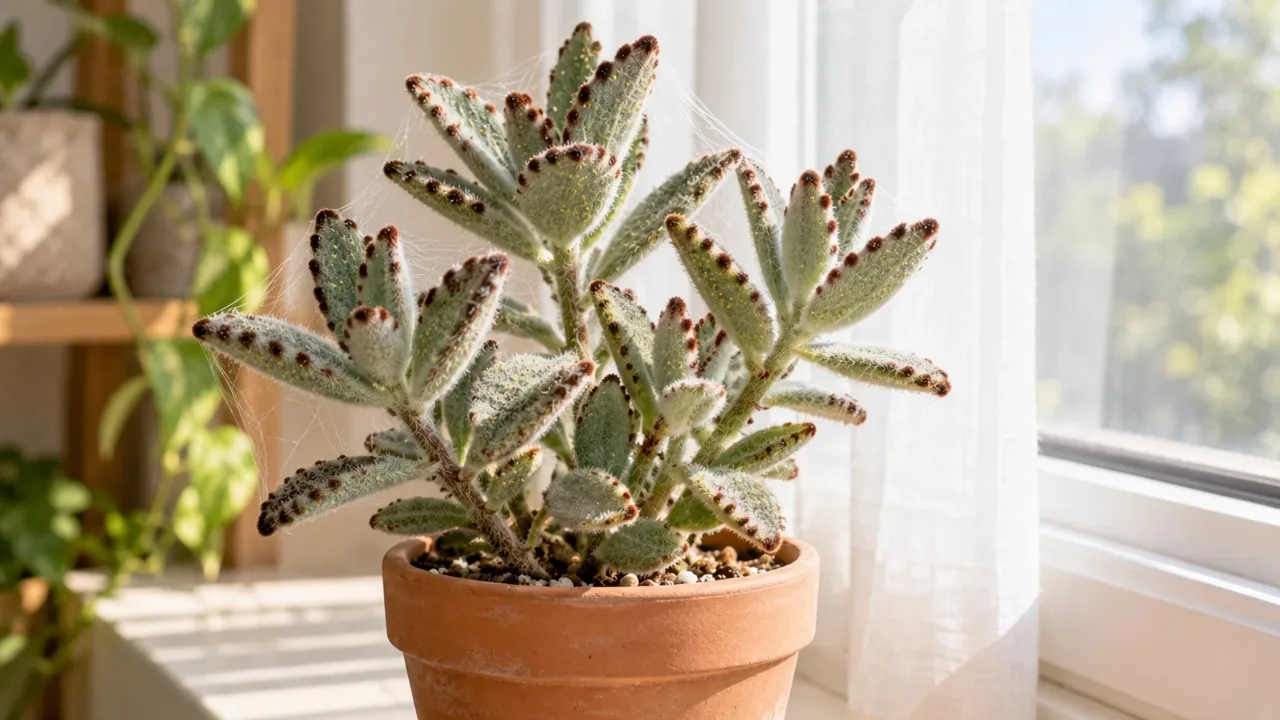
Spider Mites on Panda Plant: Diagnosis, Trichome-Safe Removal & Webbing Fixes
This guide covers spider mites on Panda Plant. See also the general Spider Mites guide, watering, and light pages for this plant.
Spider Mites on Panda Plant: Diagnosis, Trichome-Safe Removal & Webbing Fixes
Quick answer
Spider mites (Tetranychidae) represent one of the most persistent pest threats to Panda Plant (Kalanchoe tomentosa). Thriving in the warm, dry indoor air typical of succulent growing spaces, these microscopic arachnids pierce succulent leaf cells to suck out chloroplasts and cellular fluids. The diagnostic indicators are fine silk webbing anchored across the chocolate tooth margins and dense yellow stippling dots that turn the silver velvet dull and bronzed. For universal mite biology and chemical resistance management, explore our comprehensive spider mites guide.
Your first fix requires protecting the plant’s delicate felted texture: never spray broad-spectrum neem oil, horticultural oil, or heavy insecticidal soaps onto a Panda Plant. Oils permanently dissolve and mat the protective foliar trichomes, causing severe chemical burn and leaf loss. Instead, isolate the plant immediately, spot-treat webbing clusters using a cotton swab moistened with 70% isopropyl alcohol, or deploy beneficial predatory mites.
What spider mites look like on Panda Plant
Because Kalanchoe tomentosa naturally possesses a dense, velvety coat of silvery-white hairs, distinguishing early spider mite activity requires careful inspection:
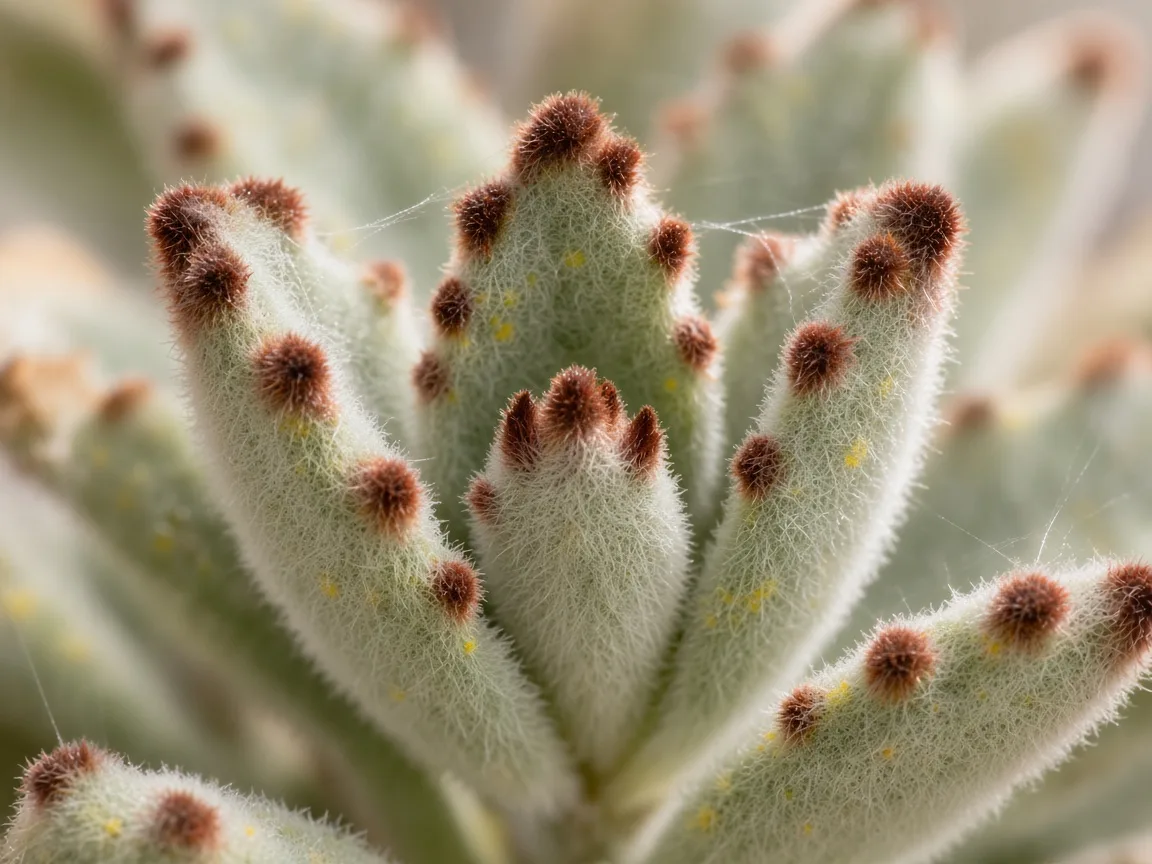
Fine silken webbing and yellow chlorotic stippling on the velvety leaves of a Panda Plant.
- Silk webbing: Unlike the random, thick threads of common household spiders, two-spotted spider mites (Tetranychus urticae) spin ultra-fine, dense, silken sheets that bridge the narrow gaps between adjacent leaf pairs, span the serrated chocolate tooth tips, and wrap around newly unfurling central buds.
- Chlorotic stippling: Under a 10x magnifying loupe, each mite feeding puncture appears as a tiny, bleached-white or pale yellow pinprick dot. As thousands of cells are evacuated, entire leaves take on a dull, dusty, bleached-bronze cast.
- The paper tap test: Hold a piece of white printer paper underneath a branch and tap the foliage firmly with a pencil. Tiny, dark specks will fall onto the paper. Watch them closely for 10 seconds: if the specks begin walking smoothly across the white paper, they are active spider mites.
- Loss of foliar luster: Infested leaves lose their stiff, plush velvet feel, becoming brittle, limp, and prone to premature shedding.
Why spider mite sprays ruin Panda Plant felt
Standard gardening advice often recommends thoroughly spraying spider mite-infested houseplants with insecticidal soap or neem oil. Applying these products to Panda Plant causes catastrophic damage.
According to research documented by NC State Extension, the dense trichomes covering Kalanchoe tomentosa leaves serve vital physiological roles: they reflect harsh solar radiation and insulate the leaf against extreme moisture loss.
The risks of foliar sprays on pubescent succulents include:
- Wax dissolution and hair matting: Clemson Cooperative Extension cautions that horticultural oils act by dissolving protective lipophilic wax layers. On a Panda Plant, oil melts the microscopic hair coating, gluing the trichomes together into greasy, dark brown, permanent streaks.
- Severe chemical phytotoxicity: Trapped inside the felted pelt, oils cannot evaporate. When exposed to bright windowsill light, the oil magnifies heat and solar radiation, scorching the living leaf cells beneath and triggering widespread necrotic leaf drop.
- Crown rot from pooled liquid: Heavy aqueous sprays pool deep inside the tight apical rosette, inviting bacterial rot in a species adapted to bone-dry foliage.
Confirming spider mites vs. lookalikes
| Symptom / Sign | Most Likely Cause | Diagnostic Confirmation | Correct Action |
|---|---|---|---|
| Fine, tight silken webbing between leaf teeth; tiny walking dots | Spider mites (Tetranychidae) | Positive paper tap test; yellow stippling dots | Isolate → alcohol swab → shielded rinse |
| Fluffy, irregular cottony white wax in leaf axils and stem joints | Mealybugs (Pseudococcidae) | Segmented pink bodies under wax; dissolves to red smear | Treat per mealybugs guide |
| Single, loose silken strands across outer leaves with no damage | Harmless house spider | Clear web; no stippling or foliar chlorosis | Leave alone or brush away gently |
| Natural chocolate, cinnamon, or rusty spots on tooth tips | Normal leaf margin genetics | Felted, plush, firm tissue; no webbing | Healthy growth; no action needed |
| Pale, washed-out leaves without webbing; wide stem gaps | Insufficient light | Measured light is under 400 foot-candles | Follow not enough light guide |
Step-by-step trichome-safe eradication protocol
Follow this proven protocol to eradicate spider mites without damaging the delicate velvet foliage:
Step 1: Immediate isolation
Move the infested Panda Plant to a separate room immediately. In warm indoor conditions (75°F to 85°F / 24°C to 29°C), spider mites complete their entire egg-to-adult lifecycle in under 7 days, allowing single females to establish massive colonies on neighboring plants, as noted by UC IPM pest notes.
Step 2: Mechanical stream wash (Shielded pot method)
For moderate to heavy infestations:
- Wrap the container and soil surface tightly in plastic cling wrap or a plastic grocery bag, taping it around the main stem collar to prevent water from saturating the potting mix.
- Take the plant to a sink, tilt it horizontally, and use a moderate, narrow stream of lukewarm water from the sprayer to blast the webs and mites off the terminal rosettes and leaf clefts.
- Place the plant immediately in front of an oscillating fan set on low to evaporate all lingering foliar moisture within 30 minutes, preventing fungal rot.
Step 3: Precision alcohol spot treatment
For remaining mites or isolated early webbing:
- Dip a fine-tipped cotton swab into 70% isopropyl alcohol and tap off any excess liquid.
- Gently roll the swab across the webbing, leaf notches, and terminal clefts.
- The alcohol dissolves the mites’ protective outer membranes on contact, causing instant desiccation while leaving dry surrounding tissue undamaged.
- Repeat this swab check every 4 to 5 days for 3 consecutive weeks to catch newly hatched nymphs.
Step 4: Biological control with predatory mites (Ideal chemical-free fix)
For serious collectors or sensitive specimens, University of Minnesota Extension recommends predatory mites. Introducing commercially available Phytoseiulus persimilis or Neoseiulus californicus delivers complete pest eradication:
- Predatory mites aggressively hunt and devour adult spider mites, nymphs, and eggs deep inside felted leaf axils.
- They require zero liquid sprays, leaving the silvery foliar trichomes 100% pristine.
- Once the pest population is exhausted, the beneficial mites naturally die off.
Long-term prevention for Panda Plant
- Increase ambient airflow: Spider mites flourish in hot, stagnant air pockets. Keep an oscillating fan circulating gentle air across your plant shelves.
- Maintain moderate humidity (40% to 50%): While Panda Plant handles dry air, extremely arid air (under 25% relative humidity) accelerates spider mite egg production. Maintaining 40% to 45% humidity deters mites without causing fungal problems for succulents.
- Quarantine new plant arrivals: Always isolate newly purchased houseplants or succulents for 14 to 21 days, performing the paper tap test before placing them near your Panda Plant.
- Regular hand-lens inspections: Inspect the apical rosettes and chocolate margins weekly with a 10x jeweler’s loupe during watering checks.
Related tool
Use our Pest Identifier Tool to verify whether tiny pests on your succulent are spider mites, thrips, or aphids before choosing an eradication plan.
Related Panda Plant guides
- Panda Plant overview — comprehensive natural profile and species care requirements
- Light guide — lighting thresholds to promote thick cuticles and compact rosettes
- Watering guide — soak-and-dry irrigation practices to keep succulents robust
- Soil guide — mineral pumice and grit formulations for succulent drainage
- All Panda Plant problems — full diagnostic troubleshooting index