Aphids on Pencil Cactus: Causes, Checks & Fixes
Quick answer
Sticky residue plus tiny clustered insects on the newest pencil tips usually means aphids, not thirst. First step: put on gloves and eye protection, isolate the plant, and blast the colonies off the branchlet tips with a firm stream of water.
Aphids on Pencil Cactus: Causes, Checks & Fixes
This guide covers aphids on Pencil Cactus. See also the general Aphids guide, watering, and light pages for this plant.
Aphids on Pencil Cactus: Causes, Checks & Fixes
Quick answer
If the newest green pencil tips feel tacky and carry clusters of tiny soft insects while older stems look normal, aphids are more likely than thirst. NC State Extension lists aphids among the pests to watch for on Euphorbia tirucalli — and because this plant’s milky sap is very caustic, protection comes before treatment.
First step: put on gloves and eye protection, isolate the plant, and blast the colonies off the branchlet tips with a firm stream of water. One targeted wash lets you read the response; do not stack soap, oil, repotting, and pruning on the same day.
For general aphid mechanics, see our aphids guide. On pencil cactus, the pattern usually shows up as tip-only stickiness on otherwise firm stems — the rest of this page is about that plant-specific picture.
What aphids look like on pencil cactus
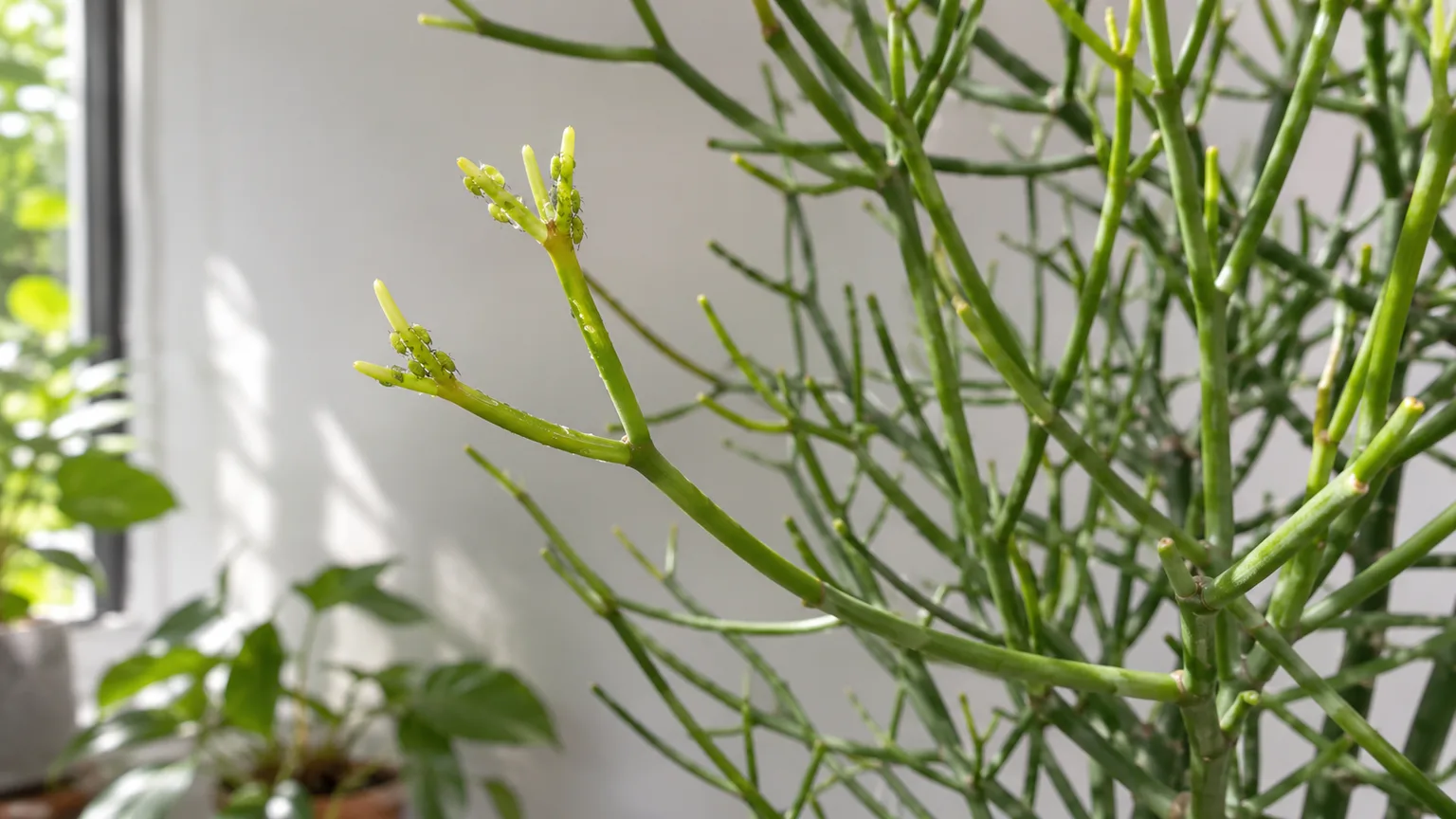
Pencil cactus is nearly leafless indoors — its tiny leaves fall early — so aphids colonize the soft green branchlets themselves rather than leaf undersides. Expect sap-sucking insects between 1 and 7 mm long, pear-shaped, green, black, yellow, or pink, packed along the youngest tips and the joints where new segments branch.

Look for small aphid colonies and sticky honeydew on the newest soft branchlet tips.
Telltale signs in order:
- Dense clusters on the newest 1–2 inches of green stems, especially at branching joints
- Sticky honeydew on stems or the pot rim that returns within a day of wiping
- Honeydew on which sooty moulds can grow, dulling green stems gray-black
- Ants traveling up bare stems toward the tips
- Newest segments emerging curled, stunted, or slightly yellowed while older wood looks fine
- White cast skins shed on the stems after molting
Do not confuse honeydew with latex. Honeydew is a thin sugary film from the insects; latex is the plant’s own thick white sap that beads only where a stem is broken or cut. If stickiness appears without any wound, suspect the insects first.
Why pencil cactus gets aphids
Soft new tips are the target. Pencil cactus pushes tender cylindrical branchlets during warm bright growth — exactly the tissue aphids pierce. Damage stays tip-localized because there is no broad leaf canopy to spread across.
Indoors, aphids never fully clock out. The RHS notes aphids stay active all year round indoors, so a warm windowsill plant can carry a slow colony through winter while outdoor specimens rest. Winged adults arriving through open windows or on a new nursery plant seed most indoor outbreaks.
Soft over-fed growth invites them. Heavy nitrogen during strong light produces succulent tips aphids favor. Match feeding to the Pencil Cactus fertilizer guide instead of pushing fast green extension.
Entry routes are predictable. New imports, summer time outdoors, and crowded shelves let winged aphids walk from plant to plant. Colonies often appear two to three weeks after the plant comes home — which is why quarantine matters more than any spray.
Latex-sap safety: protect yourself before you touch the plant
This section would be pointless on most houseplants; on pencil cactus it is the most important one. Every wash, squash, and prune risks snapping a brittle stem and releasing caustic latex.
- Wear gloves when working with this plant to avoid contact with its toxic sap, and add eye protection — glasses or goggles — before aiming water at stems.
- Keep the plant away from children and pets during treatment, and rinse skin immediately if sap contacts you.
- If latex reaches eyes or is ingested, seek medical attention immediately rather than finishing the pest treatment.
- For neem or soap products, follow label instructions and the first-aid directions on the product label.
- Prune only what treatment requires; each cut is another latex source. See the Pencil Cactus pruning guide for safe-cut technique.
Choose finger-squashing only for small reachable colonies — the RHS lists squash aphid colonies with finger and thumb among the lowest-harm controls — and stop immediately if a stem cracks and bleeds latex. Water blasting keeps your hands off the plant and is the safer default here.
Confirm aphids vs. mealybugs, mites, rot, and light stress
Work in order so you do not spray insects while the base is rotting:
- Safety and base check — Gloves and glasses on. Squeeze lower stems gently: firm means pests are the main story; soft, dark, or collapsing bases on damp mix mean root rot takes priority.
- Tip scan — Start at the newest green segments and branching joints, using a bright side light. Aphids cluster; mites stipple.
- Wipe test — Wipe a tacky stem with a damp cloth. Stickiness that returns within a day means active sap feeders.
- Ant follow — Ants climbing firm bare stems almost always lead to an aphid colony above.
- Magnifier pass — Pear-shaped slow-moving insects confirm aphids; stationary white cotton means mealybugs instead.
Symptom lookalike comparison
| What you see | Likely cause | Key check |
|---|---|---|
| Soft clustered insects on newest tips plus returning stickiness | Aphids (this page) | Colonies move when disturbed; ants above firm stems |
| White cottony masses in stem joints | Mealybugs | Stationary wax that turns orange-gray in alcohol |
| Fine webbing with yellow stippling, no sticky film | Spider mites | Dry air history; tiny dots under magnification, not tip clusters |
| Soft black base, wet gritty mix, sour odor | Root rot from overwatering | No insect clusters; base mush is the emergency |
| Stretched pale-green segments, wide joint gaps | Not enough light | No insects or honeydew; see the Pencil Cactus light guide |
| Red-orange tip color on firm stems in strong sun | Normal Firesticks stress color | Firm tissue, no insects, no stickiness |
Confirmed diagnosis — Visible pear-shaped colonies plus honeydew or ants on firm-stemmed tips. Suspected — Returning stickiness without visible insects needs a magnifier on the youngest joints before any spray.
First fix: isolate and wash the tips
Isolate the plant away from other houseplants until new growth stays clean for two full weeks. Then, wearing gloves and eye protection, blast colonies off with a firm stream of water aimed at branchlet tips and joints — leaf undersides barely exist on this species, so tips and forks are the whole target.
Rinse in the morning so stems dry quickly in good air movement, and repeat every two to three days for a week to catch nymphs hatching between washes. This water-first sequence mirrors standard indoor practice of isolating, rinsing, and repeating treatment on a cycle until colonies stop returning.
Follow-up sprays without drowning a succulent
If colonies persist after two or three rinses, step up to contact sprays — but keep the gritty mix dry while you do it. Pencil cactus roots rot in lingering moisture (see the Pencil Cactus watering guide and soil guide), so shield the pot surface with a plastic cover or tilt the plant while spraying, and never let runoff pool in a cachepot.
- Use an insecticidal soap labeled for ornamentals, starting around 1 teaspoon per gallon of water and coating only the infested tips and joints — contact sprays kill only insects they touch.
- Use neem according to label instructions as a repellent and feeding disruptor, applied in early morning or evening so wet stems are not sitting in harsh midday sun.
- Patch-test one lower segment and wait 24 hours before treating the whole crown; brittle euphorbia tips scorch more easily than broad leaves.
- Repeat every five to seven days for two to three cycles, then stop and reassess — persistent reinfestation after that points to a missed source plant, not a weak spray.
- Wipe residual honeydew with a damp cloth so sooty mold has nothing to grow on.
Do not fertilize during treatment and do not repot the same week you start spraying — either masks whether pests or care stress caused the setback. The plant thrives in bright indirect light or direct sun with watering only when you allow the soil to dry out between waterings; hold that rhythm steady while sprays do their work.
What not to do
- Do not hose the whole plant daily without letting stems dry — wet crowns invite fungal problems on a succulent.
- Do not apply soap or oil at midday on a sun-baked windowsill plant; heat plus oil burns tender tips.
- Do not snap off large sections of stem to “remove” aphids — each break releases caustic latex and the regrowth is slower than a wash.
- Do not drench the soil with extra water because tips look stressed — thirsty pencil tips wrinkle, while aphid tips stay plump but sticky.
- Do not use harsh indoor pesticides without ventilation or around flowering plants visited by pollinators.
Recovery timeline
Visible colonies should clear within one to two weeks of consistent washing or soap cycles. Expect clean firm tip extension within three to five weeks during warm active growth. Already-curled or dulled segments rarely perfect themselves — judge success by new clean joints and honeydew that stops returning, not by old damage disappearing.
A firm base throughout treatment is the good sign. Softening at the soil line means rot, not aphids, and needs the rot response immediately.
How to prevent aphids next time
Quarantine every new pencil cactus for two weeks before shelving it with others. Inspect branchlet tips weekly through spring and summer, and give stems an occasional rinse after outdoor spells. Keep care aligned with the full Pencil Cactus overview — strong light, very gritty fast-draining mix, and full dry-downs so growth stays firm rather than soft and aphid-friendly. Repot only when unstable or the mix breaks down, per the Pencil Cactus repotting guide, and start new plants from clean calloused cuttings as described in the Pencil Cactus propagation guide.
When to worry
Escalate if tips stay coated after three full treatment cycles, if sooty mold spreads across most stems, or if ants make colonies impossible to wash away. A local extension office or IPM professional can confirm the pest and discuss options for chronic greenhouse-style infestations. Any latex in eyes or mouth — yours, a child’s, or a pet’s — outranks the plant problem entirely: rinse and get medical or veterinary help at once.
When to use this page vs other Pencil Cactus guides
| Pattern | Read next |
|---|---|
| Clustered insects plus returning stickiness on firm tips | Aphids (this page) |
| White cottony masses in stem joints | Global mealybugs pattern |
| Fine webbing, stippled dull stems, no honeydew | Global spider mites pattern |
| Soft black base on wet mix, sour odor | Overwatering and root rot |
| Stretched pale segments, no insects | Not enough light and the Pencil Cactus light guide |
| Routine moisture and mix questions | Pencil Cactus watering and soil guides |
| Browse every issue on this species | Pencil Cactus problems |
Related Pencil Cactus guides
- Pencil Cactus overview — Full care baseline: sun, dry-down watering, and sap safety.
- Pencil Cactus watering — Use for moisture rhythm checks before blaming pests.
- Pencil Cactus light — Use when segments stretch pale without any insects.
- Pencil Cactus soil — Use when the mix stays wet and rot signs overlap pest stress.
- Pencil Cactus fertilizer — Use to correct soft over-fed growth that attracts aphids.
- Pencil Cactus pruning — Use for safe-cut technique that limits latex exposure.
- Pencil Cactus problems — Browse all issues on this species when the pattern is unclear.
Related tool
Use the Pest Identifier Tool to narrow causes for aphids on this plant before changing multiple variables at once.