Not Enough Light on Philodendron Florida Beauty: Causes
Quick answer
Not enough light on Philodendron Florida Beauty shows as fading cream variegation, smaller new lobes, and longer gaps between leaves. First fix: move the vine to bright filtered light — an east window with the moss-pole top 30–60 cm from the glass, or a sheer-filtered south or west window — and judge the move by the next two new leaves.
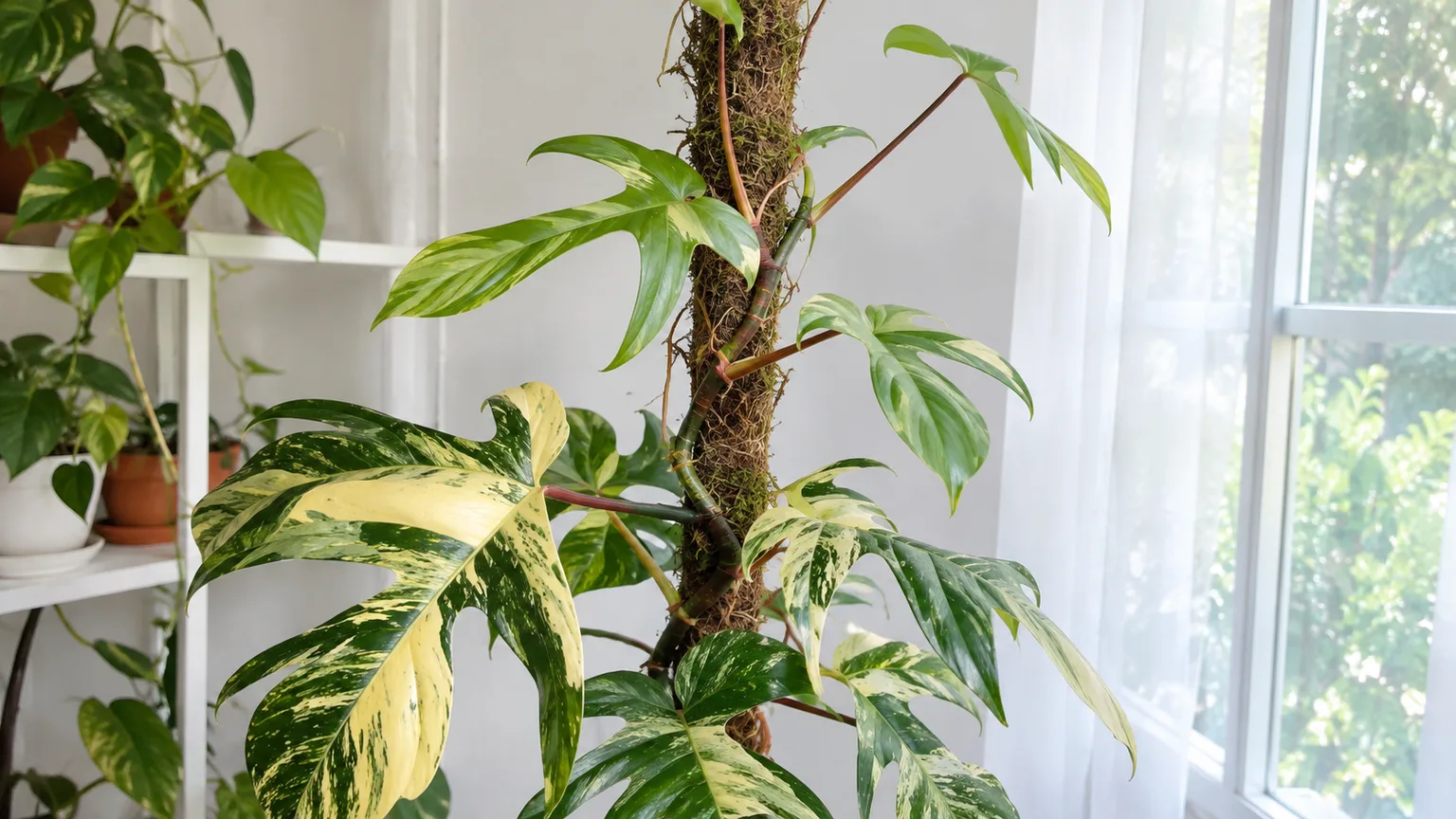
Not Enough Light on Philodendron Florida Beauty: Causes, Checks & Fixes
This guide covers not enough light on Philodendron Florida Beauty. See also the general Not Enough Light guide, watering, and light pages for this plant.
Not Enough Light on Philodendron Florida Beauty: Causes, Checks & Fixes
Quick answer
Not enough light on Philodendron Florida Beauty shows as fading cream variegation, smaller new lobes, and longer gaps between leaves along the vine. First fix: move the plant to bright filtered light — an east window with the top of the moss pole 30–60 cm from the glass, or a south or west window softened with a sheer curtain. For how dim conditions weaken houseplants in general, see our not-enough-light guide. On Florida Beauty, the tell is always the newest leaves: stable cream splashes and compact nodes mean the spot works, while consecutive green leaves with stretched stems mean it does not.
What not enough light looks like on Florida Beauty
Low light rarely announces itself with dramatic damage on this plant. Instead, the vine quietly greens out. New lobes open with duller cream or none at all, each leaf slightly smaller than the last, and the stem stretches so internodes lengthen from a compact few centimetres to long bare gaps. Older leaves keep whatever pattern they already had, which is why owners often miss the problem for weeks — the plant looks fine until they compare the growing tip against leaves from two months ago.
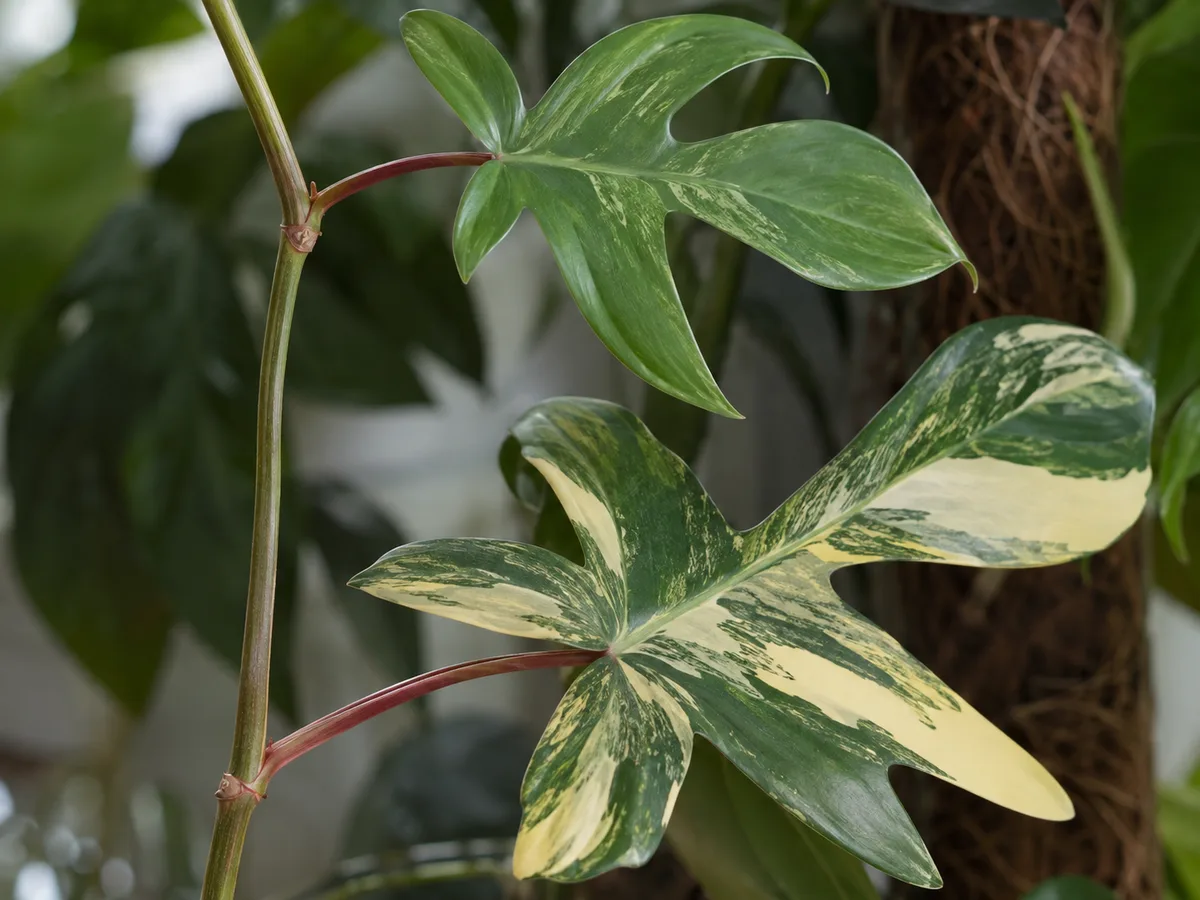
Compare successive leaves at the growing tip: low light can fade the cream pattern and lengthen the gaps between nodes.
Check the stem, not just the leaf faces. Healthy Florida Beauty stems carry cream streaks and mottling at the nodes. When light stays weak, new stem sections arrive mostly green and the mottling fades. That stem check matters because it separates a temporary light dip from node-level reversion, and it decides whether brighter placement alone will work or whether a pruning cut is also needed.
Why Florida Beauty greens out before other philodendrons
Florida Beauty is a pedatum × squamiferum hybrid grown for yellow-and-cream splashes on mature lobed foliage. Those pale sectors carry little chlorophyll, and white tissue produces no food for the plant — the green parts must photosynthesize for the whole leaf. In dim conditions the vine compensates the only way it can: it makes more green chlorophyll, stretches toward the light, and puts out smaller leaves it can afford to support. Colored foliage needs higher light to hold its color, so a variegated climber like this fails in spots where a solid-green heartleaf philodendron would cope.
Climbing habit makes the problem worse indoors. Florida Beauty grows up a moss pole, and its newest leaves sit high — often above the window line where brightness is weakest. A pot that looks well placed at table height can still starve its own growing tip. Our light guide covers window direction in detail; the short version is that the top of the pole, not the pot base, must sit in the light column.
How to confirm the cause
Run these checks in order on a clear day before moving anything.
Shadow test at the growing tip. Hold your hand between the vine tip and the window. A soft shadow with readable edges means workable bright indirect light. A faint or absent shadow means the spot is too dim, whatever the room looks like to your eyes.
Newest-leaf comparison. Unfurl the last three leaves mentally: are cream splashes shrinking leaf over leaf while gaps between leaves grow? That gradient is the low-light signature. One dull leaf after shipping or repotting is stress noise; three in a row is a light verdict.
Node inspection. Look along the newest 15–20 cm of stem for cream streaks. Streaked nodes with fading leaves mean brighter placement should recover the next growth. Fully green stem with three or more consecutive green leaves points to reversion on that runner — light alone will not repaint it.
Watering cross-check. Press the top 3–5 cm of mix. In weak light the plant drinks slowly, so persistently soggy mix corroborates the diagnosis — and warns you to lengthen the dry window once light improves. If the mix dries fast and leaves still green out, recheck distance from the glass rather than assuming water is the issue. Our watering guide has the dry-down rhythm to pair with any light change.
First fix for Florida Beauty
Move the vine closer to bright filtered light — one move, nothing else that week. Set the moss-pole top 30–60 cm from an east window, or behind a sheer curtain the same distance from a south or west exposure. Morning sun through east glass is the safest default because cream tissue scorches before green, and bright but indirect light with protection from harsh summer sun is the standing philodendron guidance.
Do not fertilize, repot, or prune on moving day. A light move needs two to three new leaves to prove itself, and stacked changes make the response unreadable. If the only available window is north-facing or the room stays dim through winter, add a full-spectrum LED grow light 30–45 cm above the canopy for 10–12 hours daily — supplementation that grow light to supplement dim windows is standard practice for holding this cultivar’s whiteness.
Step-by-step recovery
Days 1–3: Place the plant in the brighter spot for morning hours, returning it if harsh afternoon sun hits the leaves directly. Watch cream patches for bleaching — pale tissue shows stress first.
Days 4–10: Leave it full-time behind sheer filtering if the window faces west or south. East glass usually needs no curtain. Keep the previous watering rhythm until the mix tells you otherwise.
Weeks 2–4: Read the newest unfurling leaf. Shorter internodes and returning splashes confirm the fix. If bleaching or crisp edges appear instead, pull back 30 cm and hold — that is too much direct exposure, not failure of the plan.
If a runner has reverted: Once the plant is stable in better light, prune the all-green runner back to just above the highest node that still shows cream on stem or leaf, following our pruning guide. Variegated philodendrons that lose its variegation in low light need reverted sections removed so new growth can emerge variegated. Never prune before the light is fixed — cuts made in a still-dim spot regrow green.
Adjust water to the new light. Brighter placement speeds transpiration, so revisit the top 3–5 cm dry checkpoint rather than keeping the old calendar. A chunky aroid mix that drains freely, as described in our soil guide, keeps the faster rhythm safe.
Recovery timeline
Expect the first improved leaf within three to six weeks in the growing season, slower in winter. Full confirmation takes two to three new leaves with stable splashes and compact spacing. Existing green leaves will never regain cream — judge only new growth, and do not keep moving the plant while waiting. If three new leaves still open mostly green on a cream-streaked stem, brightness is still below target and a grow light is the next step, not fertilizer.
Lookalike symptoms
Low light is easy to confuse with other Florida Beauty problems. Use this table before acting.
| What you see | More likely | How to tell |
|---|---|---|
| Lower leaves yellowing, mix soggy for days | Overwatering in a dim spot | Pot feels heavy; stems soft at the base — fix drainage and light together |
| Bleached cream patches, crisp pale edges | Too much direct sun | Damage sits on window-facing cream tissue after a sudden move — filter, don’t darken the room |
| Tiny stippled leaves, fine webbing underneath | Spider mites | Pests cluster on undersides and new growth regardless of window — treat pests first |
| All-white new leaf that ages green | Florida Ghost confusion, not a problem | Ghost-type new growth is normal for that cultivar; Beauty should hold splashes at maturity |
| One dull leaf after repotting or shipping | Transient stress | Next leaf on the same node recovers without any move |
Philodendrons kept too dim also turn leggy with fewer, smaller leaves, so legginess plus greening together is a stronger light verdict than either sign alone.
Mistakes to avoid
Do not feed a greening Florida Beauty to “bring back” variegation — color follows light and node genetics, and fertilizer on a stressed plant burns roots without adding a single cream cell. Do not swing the pot from a dark corner straight to an unfiltered south sill; hardened dim-grown leaves scorch within days, and direct sunlight should also be avoided for indoor climbing philodendrons. Do not judge placement by how bright the room feels to you — judge by the shadow test and newest leaves. And do not stack a repot, a hard prune, and a window move in one weekend; each hides the others’ effects.
How to prevent it next time
Keep the vine where the top leaves live in bright filtered light year-round: east glass or sheer-filtered south or west, moss-pole top inside 60 cm of the pane. Rotate the pole a quarter turn weekly so growth stays balanced, but treat rotation as shaping — it never fixes a fundamentally dim room. From late autumn through winter, when east rooms fade, move the plant 15–30 cm closer or switch on the grow light before cream dulls rather than after. Repot on a normal 2–3 year cycle into airy mix so roots keep pace with brighter, thirstier growth.
When to worry
Most low-light Florida Beauty recovers with placement alone. Escalate if the growing tip blackens or stalls entirely, if several leaves yellow at once while the mix stays wet (suspect root rot setting in under weak light), or if a reverted runner keeps pushing green leaves after pruning above a variegated node. Those cases need root inspection or a second, harder cut — not more patience in the same dim spot.
Related tool
Use the Light Requirement Calculator to estimate the right brightness and placement for philodendron-florida-beauty before moving the plant again.