Fungus Gnats on Philodendron Majestic: Causes, Checks &
Quick answer
Fungus gnats on Philodendron Majestic almost always mean the top of the mix — and often the moss pole — stays wet too long. First step: let the top 3–5 cm of mix dry fully and place a yellow sticky trap at soil level today. Follow with a Bti soil drench weekly for three weeks to kill larvae.
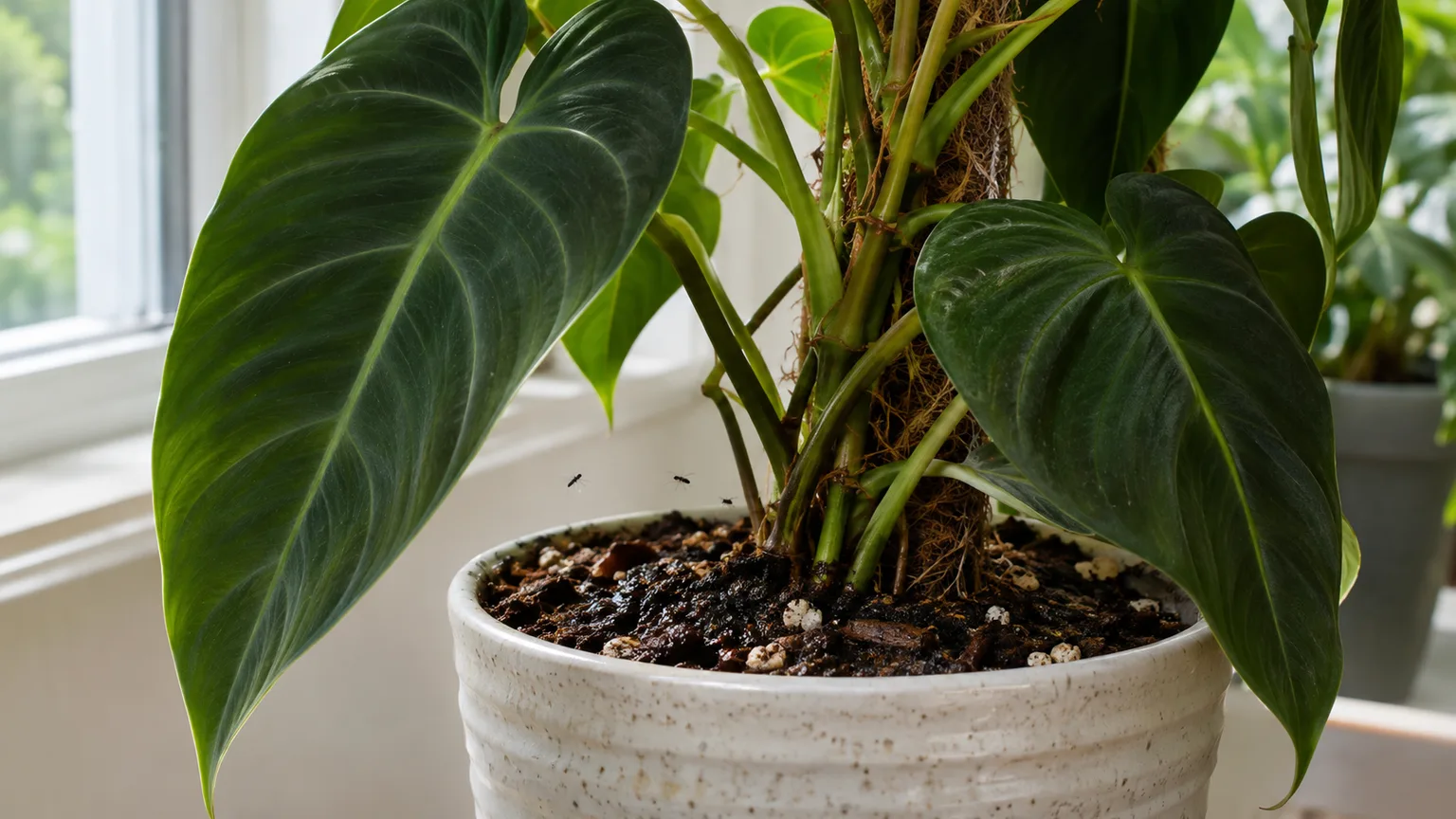
Fungus Gnats on Philodendron Majestic: Causes, Checks & Fixes
This guide covers fungus gnats on Philodendron Majestic. See also the general Fungus Gnats guide, watering, and light pages for this plant.
Fungus Gnats on Philodendron Majestic: Causes, Checks & Fixes
Quick answer
Fungus gnats on Philodendron Majestic almost always mean the top of the mix — and often the moss pole — stays wet too long. Adults are a nuisance; the real problem is the larvae grazing fungi and fine root hairs in damp organic matter.
First step: stop top-watering, let the top 3–5 cm of mix dry fully, and place a yellow sticky trap flat at soil level today. That single drying-plus-trapping move breaks the egg-laying cycle while you line up larval treatment. Then drench the soil with Bti once a week for three weeks. For the general mechanics of how wet mix breeds these flies, see our fungus gnat hub — everything below is Majestic-specific.
What fungus gnats look like on Philodendron Majestic
Adults are dark greyish-brown flies about 3–4 mm long that run across the mix surface and lift in a small cloud when you tap the pot or water. You will notice them most in the still, humid air around a cabinet-grown Majestic, where weak fliers gather rather than disperse. They do not chew leaves, so velvet foliage looks untouched even in a heavy infestation — the visible show is entirely at soil level.
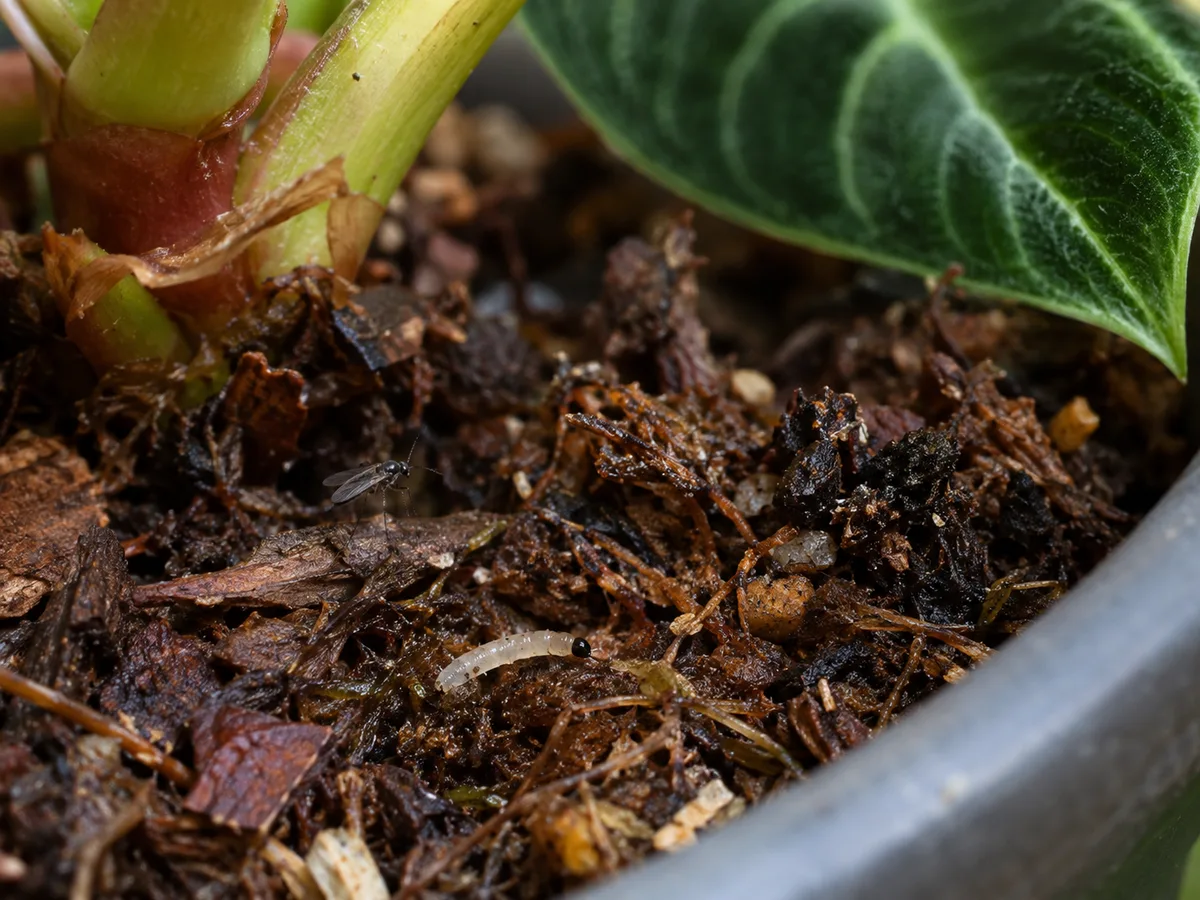
Fungus gnat larvae are slender and pale with a distinct dark head, and remain in damp organic mix.
The larvae live out of sight: slender whitish maggots up to 6 mm long with black heads, semi-transparent enough that you can sometimes see dark gut contents. On Majestic they concentrate in the top few centimetres of bark-and-peat mix and in damp sphagnum on the moss pole. Plant damage shows indirectly — a stalled cataphyll, a new leaf that unfurls small, or a young cutting that wilts despite damp mix — because larvae prune the fine root hairs the plant needs to drink.
Why Majestic pots breed them so readily
Majestic is grown warm, humid, and vertically — three conditions gnats love. Philodendrons prefer warm temperatures between 65 and 85°F with moist, well-drained organic soil according to NC State Extension, and Majestic targets 60–75% humidity on top of that. In a humid cabinet or tent, the mix surface can stay damp for a week after watering even when the root zone is fine, giving females a permanent nursery.
Two Majestic-specific features make it worse:
The moss pole is a second breeding surface. Sphagnum or coco fibre kept constantly wet for aerial roots holds eggs and larvae exactly like potting mix does. Growers who mist the pole daily while the pot stays wet run two gnat nurseries stacked vertically.
Chunky mix hides surface wetness. Orchid bark and sphagnum chunks look dry on top while the layer 2–3 cm down stays moist — precisely where females deposit eggs in the top 2–3 inches of potting soil. As bark breaks down past twelve months into moisture-holding fines, the surface stays wet longer each cycle and populations climb. If your mix is over a year old, review the soil guide before assuming watering alone is at fault.
How to confirm the cause
Run these checks in order on a dry morning:
- Tap test. Tap the pot rim sharply and watch the mix. Fungus gnats lift off, hover weakly, and resettle on the soil within seconds. Flies that ignore the pot and orbit fruit, bins, or drains are fruit flies — a different problem.
- Trap count. Lay one yellow sticky trap horizontally just above the mix for 48 hours. A dozen or more tiny black flies confirms an active breeding population; one or two strays may have drifted in from another plant.
- Potato slice test. Press a 1-cm raw potato slice onto the damp mix overnight. By morning, feeding larvae appear as tiny translucent worms with dark heads on the underside. This is the most reliable confirmation when adults are scarce.
- Moisture audit. Probe 3–5 cm deep and lift the pot, following the watering guide check-first rhythm. Cool, clinging soil plus a heavy pot days after watering confirms the wet-surface conditions larvae need.
- Pole squeeze. Squeeze the moss pole fibre at aerial-root height. If water runs out or it feels soggy days after watering, the pole is part of the nursery and needs the pole protocol below.
The first fix to try
Today: dry the surface and trap the adults. Move the nursery pot out of any cachepot holding runoff, empty the saucer, and do not water until the top 3–5 cm is dry and the pot feels clearly lighter. Place the sticky trap and leave the plant in bright indirect light with airflow so the surface dries faster. Do not repot, fertilise, or spray anything today — one variable at a time.
This works because the RHS notes that allowing the compost surface to dry reduces gnat numbers without chemicals, and adults caught on traps cannot lay the next generation of eggs. Most Majestic owners see flying adults drop sharply within a week on drying plus trapping alone.
Step-by-step recovery over three weeks
Gnats cycle egg to adult in roughly three to four weeks in warm rooms — females lay hundreds of eggs that hatch within days, and larvae feed for about two weeks before pupating, per Epic Gardening’s life-cycle rundown. Treatment must outlast one full cycle:
Week 1: Keep the dry-down going. Bottom-water once if the root zone truly needs it — set the pot in a tray so roots drink from below while the surface stays dry. Begin a Bti soil drench: soak Mosquito Bits in watering-can water per the label and apply to the mix. The bacterium Bacillus thuringiensis var. israelensis kills larvae in the soil without harming the plant, pets, or people.
Week 2: Repeat the Bti drench. Replace the sticky trap and compare counts — they should be falling. Scrape off any algae or slime on the mix surface, since larvae graze it. Keep velvet leaves dry throughout; water the mix only, never overhead, because wet velvet overnight invites fungal spotting.
Week 3: Third Bti drench. If trap counts are near zero and the potato test comes back clean, resume the normal watering guide rhythm — soak-and-drain only when the top 3–5 cm is dry. If adults persist, extend Bti one more week rather than reaching for broad insecticides indoors.
Repot only if the mix has failed: sour smell, water pooling on the surface, or bark collapsed into sludge. In that case unpot, shake off old mix, and repot into fresh chunky blend following the repotting guide — fresh compost discards existing eggs and larvae in one move.
Moss pole protocol during treatment
A wet pole reinfests a clean pot, so treat both zones:
- Stop daily pole misting for the treatment period. Let the outer fibre dry to barely damp while keeping the inner core slightly moist so attached aerial roots do not desiccate.
- Pour the Bti drench down the pole as well as into the pot so the solution reaches larvae in the sphagnum.
- Water the pole in bright morning conditions only, so the surface dries by evening.
- If the pole is sodden and smells musty, unwrap and replace the outer sphagnum layer — it is spent organic matter functioning as a gnat hotel.
Once trap counts hit zero, resume normal pole hydration: evenly damp fibre, not dripping, watered on the same dry-down rhythm as the pot.
Lookalike symptoms
| What you see | Likely cause | How to tell |
|---|---|---|
| Tiny flies over mix, plant otherwise firm | Fungus gnats | Tap test lifts flies off soil; potato slice shows larvae |
| Flies near fruit bowl, drains, or wine glass | Fruit flies | Ignore the pot entirely; breed in produce and drains |
| White fuzzy patches on bark surface | Mold on soil | No flying insects; usually follows the same wet-surface cause |
| Yellowing lower leaves plus heavy wet pot | Overwatering / early root rot | Few or no flies; leaves limp despite wet soil — probe depth and pot weight before adding any water |
| Wilting cutting, dense larvae in root ball | Severe larval root damage | Potato test teeming; roots stubby with missing fine hairs — see the propagation guide for rescue depth |
Shoreflies are the closest lookalike: stouter, stronger fliers that run on algae. They respond to the same dry-down, so the treatment plan holds either way.
Mistakes to avoid
- A sand or gravel top layer on chunky bark. It shifts around the bark pieces, traps moisture against the stem base, and barely slows egg-laying. Dry-down plus Bti outperforms it.
- Hydrogen peroxide drenches at kitchen-sink strength. Strong mixes burn the fine roots a stressed Majestic needs most. Bti is the safer larval killer.
- Misting velvet leaves to “deter” gnats. Adults do not care, and wet velvet in still air invites fungal spots. Keep all treatment at soil and pole level.
- Repotting on day one. Fresh mix helps only when old mix has structurally failed. Otherwise repotting a stressed climber adds transplant shock to a problem drying plus Bti would solve — and twists aerial roots off the pole.
- Fertilising during treatment. Salts stress damaged fine roots and do nothing to larvae. Hold feed until new growth unfurls clean.
- Treating one plant in a crowded cabinet. Adults drift to neighbouring pots. Trap and dry the adjacent plants too, and quarantine newcomers for three to four weeks before shelving them with the collection.
How to prevent it next time
Prevention is the Majestic watering rhythm done properly. Water only when the top 3–5 cm is dry and the pot has lost weight — the Clemson check-depth and heft method beats any calendar. Always remove the nursery pot from its cachepot to water, drain fully, and empty runoff within 30 minutes.
Pair that with mix maintenance from the soil guide: refresh bark-heavy blend every one to two years before it collapses into fines, keep the pot only slightly larger than the root ball, and confirm light is bright enough that the pot actually dries between drinks. A Majestic in dim light with wet feet breeds gnats no matter how carefully you dose Bti.
Recovery timeline and when to worry
Trap counts usually fall within one week of drying, hit near zero by week three, and stay there if the surface rhythm holds. New cataphylls unfurling to full size with clean silver veining are the true recovery signal — not the absence of the last stray fly.
Worry if a seedling or fresh cutting wilts in damp mix, if yellowing climbs multiple nodes with a sour smell from the drainage hole, or if larvae are visibly dense throughout the root ball on inspection. That is larvae plus likely root decay, and the plant needs unpotting and root triage the same day.
One handling note: Majestic contains calcium oxalate crystals that irritate mouths and skin, so wear gloves for root work and keep the plant away from pets and children during treatment.
Related Philodendron Majestic guides
- Philodendron Majestic overview — whole-plant context: humidity, climbing support, toxicity
- Philodendron Majestic watering — dry-down rhythm that prevents reinfestation
- Philodendron Majestic soil — chunky mix recipe and refresh timing
- Philodendron Majestic light — bright placement that keeps pots drying on schedule
- Philodendron Majestic repotting — when mix failure forces a full repot
- Philodendron Majestic propagation — protecting cuttings, the most gnat-vulnerable stage
Related tool
Use the Pest Identifier with philodendron-majestic pre-selected to confirm the pest matches fungus gnats before starting treatment.
Frequently Asked Questions
How can I confirm fungus gnats on my Philodendron Majestic?
Tap the pot and watch for tiny dark flies lifting off the mix, then check for slender whitish larvae with black heads in the top few centimetres of soil. A raw potato slice laid on the mix overnight will collect feeding larvae by morning. If flies cluster around fruit or drains instead of the pot, they are likely fruit flies, not fungus gnats.
What should I check first before treating?
Probe the top 3–5 cm of mix, lift the pot to judge weight, and squeeze the moss pole fibre. If the surface is damp only days after watering, or the pole never dries between waterings, you have found the breeding ground. Also check whether a cachepot is holding runoff and whether bark in the mix has broken down into soggy fines.
Will my Majestic recover from a fungus gnat infestation?
Yes, in most cases. Adults are a nuisance and larvae mostly graze fungi and fine root hairs, so an established vine rebounds within a few weeks once the surface dries and larvae are knocked back. Watch for clean new unfurlings and falling trap counts. Seedlings, fresh cuttings, and recently repotted plants recover more slowly because they have fewer roots to spare.
When is a gnat problem urgent on Philodendron Majestic?
Escalate fast if a seedling or new cutting wilts despite damp mix, if larvae are dense in the root ball, or if yellowing spreads alongside a sour smell from the pot. That combination suggests larvae plus root rot, not gnats alone. Isolate the plant and inspect the roots the same day rather than waiting out another treatment week.
How do I prevent fungus gnats from coming back on Majestic?
Water only when the top 3–5 cm is dry, empty cachepot runoff within 30 minutes, and let the moss pole surface dry between waterings while keeping its core barely damp. Refresh bark-heavy mix every one to two years before it collapses into fines, and quarantine new plants for three to four weeks before placing them near your Majestic.