Leggy Growth on Philodendron Majestic: Causes, Checks &
Quick answer
Leggy growth on Philodendron Majestic shows as long bare stem gaps between small, pale new leaves that never size up. The usual drivers are too little usable light plus a missing or dry climbing surface. First step: move the plant to bright indirect light and tie the lead vine to a moist moss pole, then prune stretched stems only after new growth comes in tighter.

Leggy Growth on Philodendron Majestic: Causes, Checks & Fixes
This guide covers leggy growth on Philodendron Majestic. See also the general Leggy Growth guide, watering, and light pages for this plant.
Leggy Growth on Philodendron Majestic: Causes, Checks & Fixes
Quick answer
Leggy growth on Philodendron Majestic means long bare gaps between leaves that keep getting wider, with new leaves opening smaller and paler than the older velvet foliage below. Because Majestic is a verrucosum × sodiroi climbing hybrid, two things usually go wrong together: the light is too weak to build compact tissue, and the vine has nothing moist to climb so it stays in loose juvenile trailing mode.
First step: move the pot to bright indirect light — near an east window or a sheer-filtered south window — and tie the lead stem loosely to a moist moss pole with aerial roots facing the support. Use this page when stems are visibly stretched with shrinking new leaves; when leaves look pale but spacing is still normal, start with the Majestic light guide for placement diagnosis first.
What leggy growth looks like on Philodendron Majestic
On a healthy Majestic, each new leaf should emerge close above the last and open into a large cordate blade with bold silver veining over the velvet textured patterned leaves this group is known for. A leggy plant breaks that rhythm: internodes stretch to several centimetres, new blades stay narrow and juvenile, silver contrast fades, and the vine leans hard toward the window instead of climbing upward.
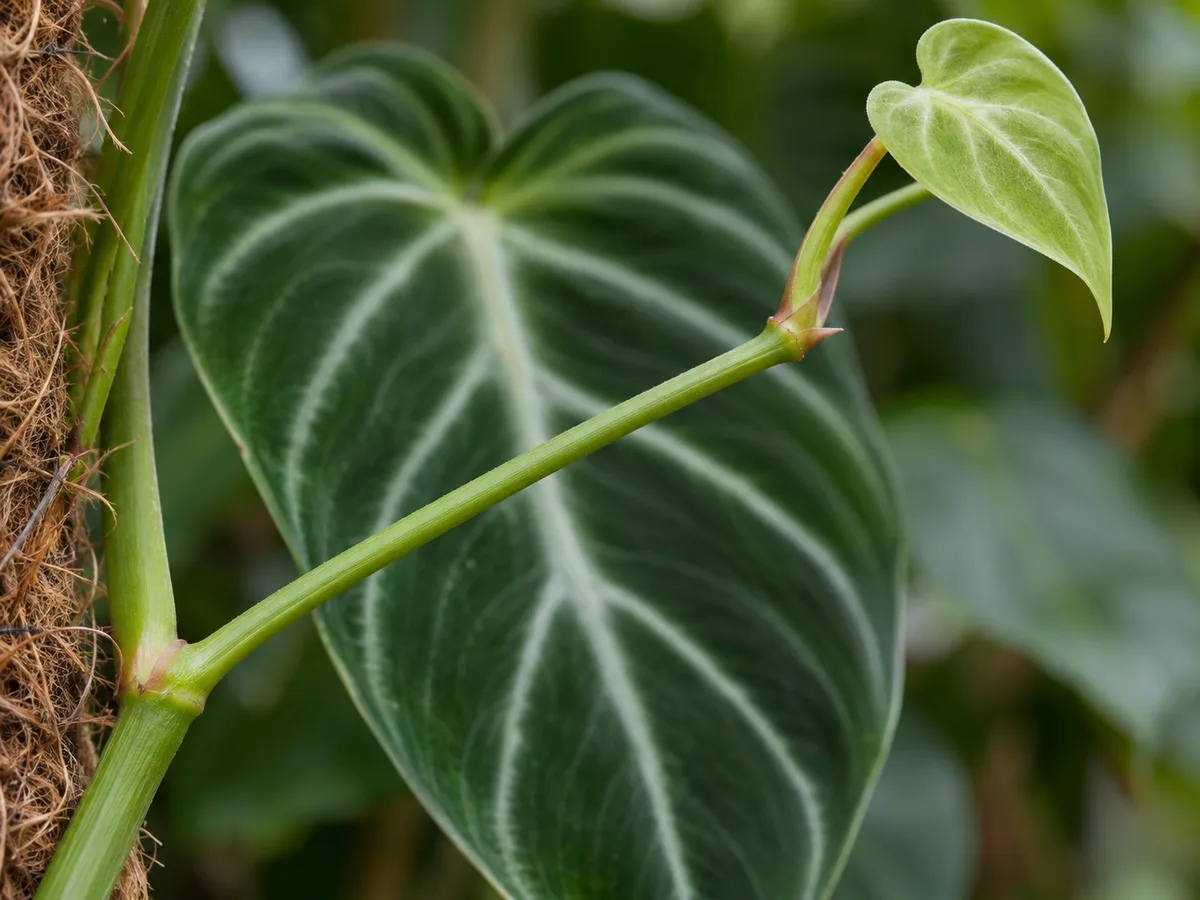
Newer stem gaps widen as leaves shrink and lose their strong silver contrast when light is insufficient.
Check the newest three leaves against three older ones. If spacing widens toward the tip while blades shrink and pale, the stretch is active right now. Even gaps across the whole vine with firm stems and normal velvet color more often mean an untrained trailer that was never given a pole, not an emergency.
Why Majestic stretches: the two-driver pattern
For how weak light stretches houseplants in general, see our leggy growth guide. On Majestic, the pattern usually shows up as light hunger tangled together with missing support, and the fix has to address both.
Low usable light drives etiolation
Philodendrons want indirect light, and a room that looks bright to you can still starve the leaves. Stretching is driven by a hormonal imbalance in the shoot tip that elongates stem cells toward the light while short-changing leaf development — which is why leggy Majestic leaves come out small and washed out. Clemson notes that the death of the growing tips can be caused by too little light, so a stalled or blackening tip on a dim shelf is a light problem until proven otherwise.
A climber with nothing to climb stays juvenile
In the wild this kind of philodendron roots onto tree trunks and shifts into large-leaf mature growth once attached. Indoors it can be a climber on a moss pole or trellis, and without that surface it keeps producing long-internode juvenile growth with small blades — even in decent light. Tell-tale signs: aerial roots dangling at nodes with nothing to grip, a dry decorative coco pole the roots ignore, or a vine trained sideways along a shelf instead of upward. Majestic is a vigorous climber rather than a crawler, so trailing culture practically guarantees a sparse look over time.
Warm dim corners and feeding a stretching plant
Majestic prefers warmth around 65 to 85 degrees Fahrenheit indoors, but warmth without enough light produces soft, floppy extension instead of sturdy growth — the classic setup is a plant above a radiator near a mediocre winter window. And fertilizer is not a cure for poor light: nitrogen pushed into a stretching vine grows longer weak internodes, sometimes with a white salt crust on the mix confirming overfeeding.
How to confirm the cause
Work through these checks on the actual plant before cutting anything:
- Light distance — hold your hand where the leaves sit. More than a metre from the main window, or behind heavy sheers plus neighbouring plants, usually means too little usable light even if the room feels bright.
- Newest three leaves — widening gaps plus shrinking, paler blades confirm active stretch. Normal spacing with small leaves points to support or feeding history instead.
- Pole contact — look for aerial roots at the nodes. Roots reaching into air, a bone-dry pole, or no pole at all confirm the support half of the problem.
- Direction of lean — a hard sideways lean toward glass implicates light; even all-round sparseness implicates training.
- Feeding and warmth — recent full-strength feeds, salt crust, or a heat vent within a metre explain soft floppy extension on otherwise green growth.
- Roots and mix — lift the nursery pot to judge weight. A heavy, sour-smelling mix with collapsing stems means root trouble riding along with the stretch, which changes the priority order.
The first fix to try
Move the plant into brighter indirect light and fasten the lead vine to a moist pole.
Set the pot near an east window or a sheer-filtered south or west window where leaves get strong ambient light without midday sun striking the velvet directly. Soak the moss pole, press aerial roots against it, and tie the stem loosely at one or two nodes with soft ties. Water the pole when you water the pot so roots keep gripping. Leave everything else alone for two to three weeks and watch the next leaf: tighter spacing and a larger, better-marked blade prove both halves of the fix are working.
Step-by-step recovery
Once fresh growth confirms the correction, rebuild the shape in this order:
- Wait for proof — one or two new leaves with shorter spacing and stronger new leaves before any pruning.
- Cut back bare sections — with clean sharp snips, cut leggy stems just above a healthy node, since existing stretched stems must be pruned back to a healthy node rather than expected to compact. Take no more than a third of the plant in one session.
- Root the cuttings — Majestic stems can be propagated at any season from stem cuttings: sections with two nodes, lower leaves stripped, rooted in water or moist perlite, then potted back into the parent container for density. Full technique lives on the Majestic propagation guide.
- Pin and train — tie remaining stems and new cuttings to the pole as they grow, keeping aerial roots in contact with moist moss.
- Resume feeding lightly — only after compact growth is clearly established; match watering to the brighter spot per the Majestic watering guide.
- Supplement in dark winters — when no window delivers enough usable light, add a full-spectrum grow light on a timer for roughly 12–14 hours and do not exceed 16 total hours of combined light so the plant keeps a dark rest overnight.
Wear gloves while pruning: philodendron sap can be a skin irritant, and velvet foliage plus fresh cuts deserve clean hands and tools.
Recovery timeline
| Milestone | What to expect |
|---|---|
| 1–2 weeks | Sideways lean slows; the newest emerging leaf looks slightly larger and better marked. |
| 3–4 weeks | Two or more new leaves open with visibly tighter spacing and stronger silver veining. |
| After pruning | Side shoots break from nodes below cuts within a few weeks in warm, bright conditions. |
| One season | A full climbing framework with sizing-up leaves if light and pole contact hold steady. |
Old stretched sections never shorten — judge everything by new growth, not by whether bare middle sections fill in.
Lookalike symptoms
Stretch gets confused with these patterns on velvet climbing philodendrons:
- Natural trailing habit — even gaps, firm stems, normal leaf size and color on a plant never given support. Training, not rescue, is the answer.
- Low humidity damage — stuck new leaves, crispy margins, and dull velvet with normal spacing point to dry air rather than stretch. Majestic wants roughly 60–75% humidity; misting spots velvet leaves instead of helping.
- Overwatering with root trouble — yellowing lower leaves, soft stem bases, and a heavy sour mix alongside stretch. Fix drainage and roots before any cosmetic pruning.
- Nitrogen overfeed — rapid soft growth with large dark limp leaves and salt crust, rather than small pale ones.
- Spider mite decline — stippled, dusty velvet undersides with fine webbing and weakening growth. Check leaf undersides with a lens before blaming light alone.
What not to do
Do not prune a stretching Majestic before improving light and pole contact — replacement shoots will stretch again from the same nodes. Do not shove velvet leaves into direct midday sun to compensate; scorched patches are permanent and invite secondary infection. Hold off repotting, heavy feeding, and major relocation in the same week as pruning, and never try to force compact growth with extra fertilizer while the light is still weak.
How to prevent it next time
Install a textured moss pole while the plant is still small, with aerial roots facing the support from the start, and place the pot where bright indirect light actually lands on the leaves. Rotate a quarter turn weekly so all sides develop evenly. Recheck placement each autumn — summer-bright spots often fall short in winter — and keep a simple log of feed dates so weak winter growth never gets a full-strength push. Seasonal placement and fixture detail live on the Majestic light guide, and cut placement for shaping belongs to the Majestic pruning guide.
Related Philodendron Majestic guides
- Philodendron Majestic overview — hub for climbing habit, humidity, and velvet-leaf basics
- Majestic light guide — window placement and grow-light setup before stretch turns severe
- Majestic watering guide — dry-down rhythm matched to brighter placement
- Majestic pruning guide — cut height and shaping after light and support improve
- Majestic propagation guide — node cuttings for refilling bare vines
FAQs
How can I tell legginess from normal trailing on my Philodendron Majestic?
Compare the newest three leaves with older growth on the same vine. Widening gaps plus shrinking, paler blades with stronger lean toward the window mean active light-driven stretch. Even spacing with firm stems, normal-size velvet leaves, and visible aerial roots means a healthy climber that was simply never given a pole — train it upward rather than treating it as sick.
Should I prune leggy Majestic stems right away?
No — fix light and pole contact first, then wait for one or two tighter, larger new leaves as proof. Cut bare sections just above a healthy node in spring or early summer when the plant is actively growing, taking no more than a third at once. Pruning before the cause is fixed just produces a second round of stretched shoots from the same nodes.
Will the bare stretched sections ever fill back in?
No, elongated internodes are permanent structural tissue and never shorten. Root the removed sections as node cuttings and pot them back into the parent container for fullness. Judge recovery only by fresh growth: closer spacing, larger blades, and returning silver-vein contrast.
Can a grow light alone fix a leggy Majestic without a moss pole?
It fixes half the problem. Stronger light tightens new internodes, but without a moist climbing surface the vine keeps its loose juvenile form with smaller leaves than it is capable of. Pair roughly 12–14 hours of full-spectrum supplemental light with a moist pole the aerial roots can grip, and keep a dark rest overnight.
Why are new leaves small and pale even though my room looks bright?
Human eyes adjust to dim rooms, but leaves respond to usable light over time — a pot a metre or two from the window lives in very different conditions than the sill itself. Crowding from neighbouring plants and one-sided exposure add to the shortfall. Move the plant so strong indirect light actually lands on the blades, rotate weekly, and confirm improvement in the next leaf pair before changing anything else.
Conclusion
Leggy Majestic growth is the plant telling you it needs stronger indirect light and a moist surface to climb. Confirm the pattern in the newest leaves, correct placement and pole contact as a single first move, then prune bare sections to nodes and re-root the cuttings once compact growth proves the fix. Keep the pole moist and the light steady, and each new leaf should open larger, closer-spaced, and more boldly veined than the last.
Related tool
Use the Plant Problem Diagnosis Tool to narrow causes for leggy growth on this plant before changing multiple variables at once.