Drooping Leaves on Philodendron Ring of Fire: Causes & Fixes
Quick answer
Drooping leaves on Philodendron Ring of Fire almost always mean a watering mismatch: a light pot with papery leaves needs a deep soak, while a heavy pot with limp stems means soggy roots that need drying out, not more water. First step: lift the pot and push a finger 5 cm into the mix before you change anything else.
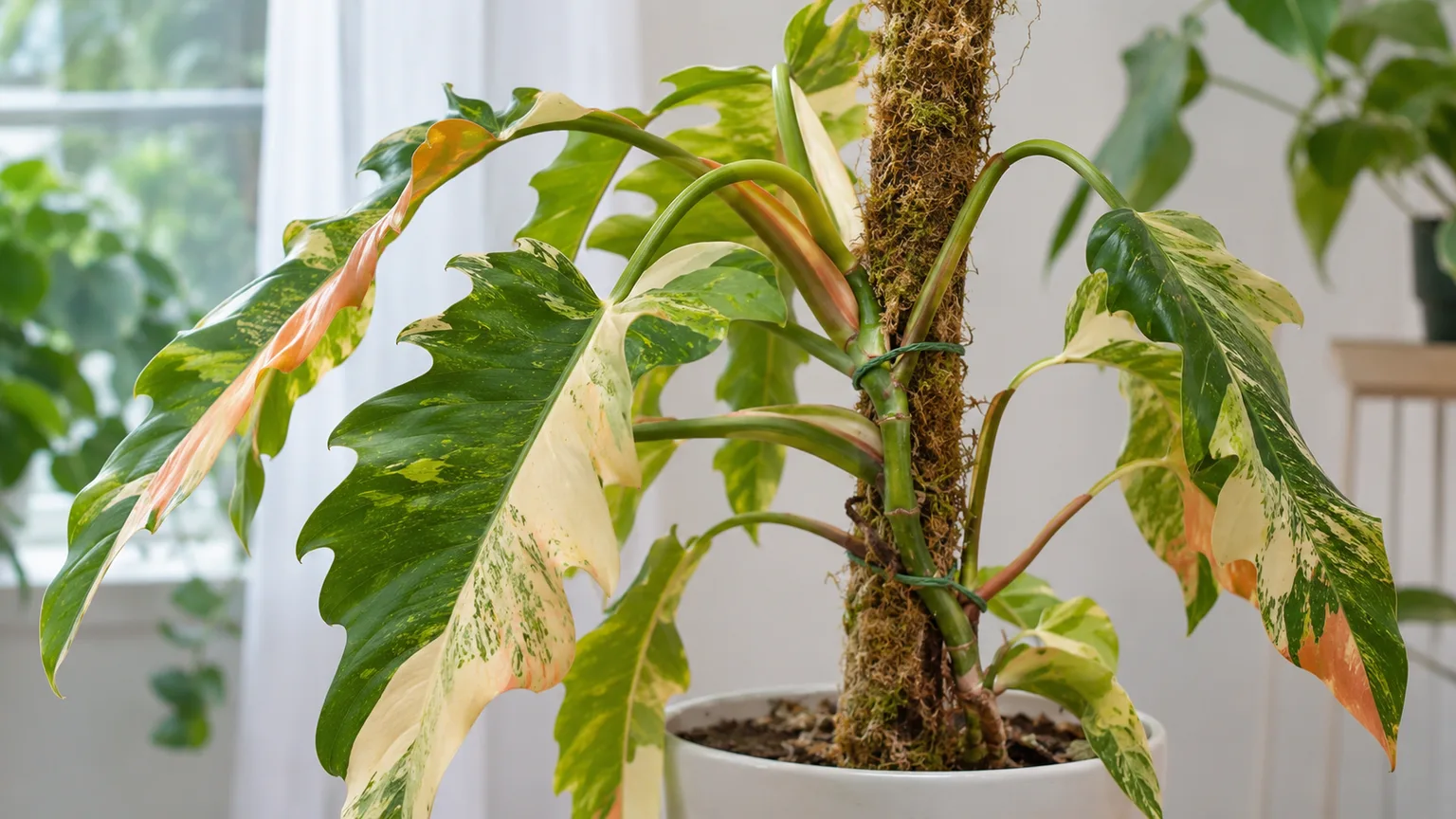
Drooping Leaves on Philodendron Ring of Fire: Causes, Checks & Fixes
This guide covers drooping leaves on Philodendron Ring of Fire. See also the general Drooping Leaves guide, watering, and light pages for this plant.
Drooping Leaves on Philodendron Ring of Fire: Causes, Checks & Fixes
Quick answer
Drooping leaves on Philodendron Ring of Fire almost always mean a watering mismatch: a light pot with papery leaves needs a deep soak, while a heavy pot with limp stems means soggy roots that need drying out, not more water. First step: lift the pot and push a finger 5 cm into the mix before you change anything else. For how wilt works across houseplants in general, see our drooping leaves guide — on Ring of Fire, the heavy serrated blades, the moss pole, and the pale variegated sectors each add a clue the general guide cannot give you.
What drooping looks like on Ring of Fire
On this cultivar, droop shows first in the big serrated blades: leaf edges curl downward, the blade hangs from its petiole instead of holding semi-upright, and the whole stem may lean away from its moss pole. Because mature leaves are large and jagged, a thirsty plant looks dramatic fast — several blades can fold in a single day. New leaves emerge reddish and unfurl from a spear; a floppy new spear alongside firm older leaves points at the growing tip (cold shock or tip damage), while all-over wilt points at the roots.
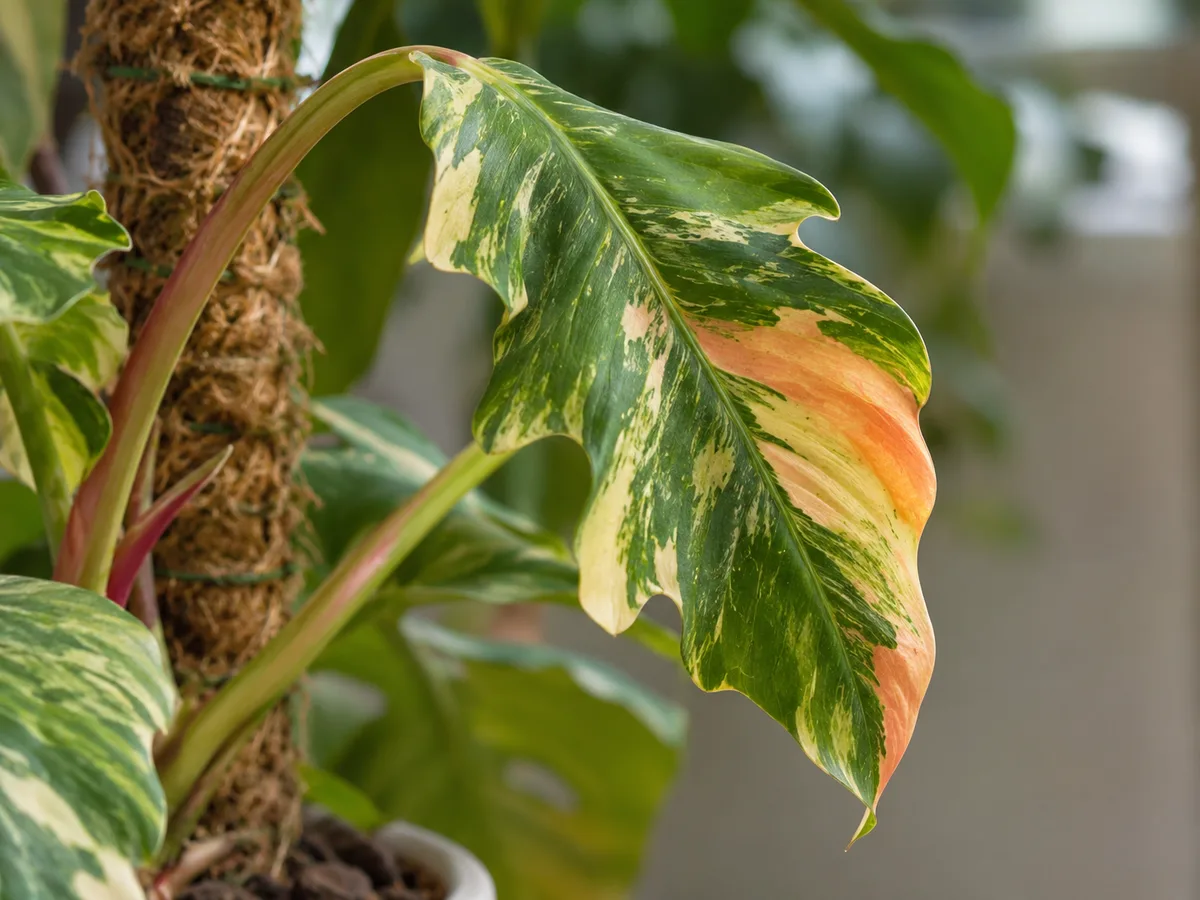
Downward-curled serrated blades can signal a watering mismatch; check the mix and pot weight before changing the routine.
Variegation adds a second readout. The cream, yellow, and orange sectors carry less chlorophyll and scorch sooner, so pale patches may crisp or bleach at the same time the green tissue droops — that combination suggests too much direct sun plus uneven watering rather than thirst alone. If only the lowest oldest leaf droops while the tip keeps pushing firm growth, that is often normal turnover, not an emergency.
Why Ring of Fire droops
The two dominant causes are opposite sides of watering. Underwatering drops turgor pressure: cells lose water, petioles soften, and blades hang. Overwatering rots fine root hairs so they cannot take up water even in wet mix — the plant wilts while sitting in mud, which is why adding more water makes it worse. Ring of Fire is extra sensitive to this trap because its chunky aroid mix can look dry on top while the lower root ball stays saturated.
Three plant-specific contributors matter here. First, the climbing habit: stems trained up a moss pole depend partly on aerial roots, and a desiccated pole plus dry room air pulls moisture from the stem faster than the pot roots replace it. Second, light and temperature: this cultivar wants bright indirect light and warmth, and nights near cold glass stall water movement enough to collapse leaves overnight. Third, pot setup: a decorative cachepot with no drainage, or a saucer left full for days, keeps the lower mix airless until roots suffocate.
How to confirm the cause
Work in this order and let the evidence pick the branch:
- Lift the pot. Feather-light plus dry, shrunken mix means thirst. Heavy plus cool, damp mix means excess water.
- Finger-test 5 cm deep, near the middle of the pot — not just the surface. Epic Gardening’s philodendron guide recommends watering only when the top two inches feel dry rather than following a fixed schedule.
- Feel the petioles. Thin and papery with dry soil fits underwatering. Soft, limp, or translucent-feeling with wet soil fits root trouble.
- Check the pole and ties. A bone-dry pole, tight ties strangling the stem, or a stem that slipped off its support can droop one section while the rest looks fine.
- Smell and inspect the base. A sour smell, mushy stem base, or blackened lower petioles mean unpot and look at the roots: firm and pale is salvageable, brown and mushy is rot.
- Scan for lookalikes. Sticky residue, fine webbing, or stippled pale sectors mean pests rather than water — NC State notes philodendrons should be monitored for aphids, spider mites, mealybugs, and scale.
The first fix to try
Do one thing first: correct only what the finger test found. If the mix is dry 5 cm down, soak thoroughly until water flows from the drainage holes, then empty the saucer completely. If the mix is wet, do not water — empty the saucer, move the plant to bright indirect light with gentle airflow, and leave it alone until the top 3–5 cm dries. Making a single targeted correction lets you read the plant’s response instead of stacking shocks.
Step-by-step recovery
Once the first fix is in, follow through in order:
- Stabilize the support. Re-tie slipped stems loosely to a moistened moss pole so heavy blades are not hanging from their own weight.
- Prune only what is dead. Remove fully brown, mushy petioles at the base; leave limp-but-green blades — they may firm up and still photosynthesize.
- If rot was confirmed, unpot, trim brown mushy roots back to firm pale tissue with clean scissors, and repot into fresh chunky mix (potting mix plus perlite and orchid bark) in a pot with drainage holes. Epic Gardening stresses that philodendrons need pots with drainage holes so excess water can escape and roots can exchange gases.
- Reset the watering rhythm to the finger test, not the calendar — the same guide advises removing excess saucer water within an hour of watering so the mix never sits saturated.
- Hold fertilizer until a new leaf emerges firm; feeding stressed roots risks salt burn on top of existing damage.
Wear gloves when cutting stems or handling damaged tissue: philodendron sap irritates skin and the plants contain calcium oxalates that are toxic to cats and dogs.
Recovery timeline
Thirst-only droop usually visibly firms within a few hours of a deep soak, with full posture back by the next day. Overwatered plants without rot need one to two full dry-down cycles — often one to three weeks — before new growth looks normal. After root trimming for rot, expect a month or more: the plant must regrow fine root hairs before it can support new blades, and the next unfurling leaf is your report card. The RHS notes that many houseplants recover quickly once growing conditions improve, so steady conditions beat repeated interventions.
Lookalike symptoms to rule out
Not every limp Ring of Fire is a watering problem. Root rot from Rhizoctonia starts on lower leaves that yellow, brown, and drop while vigor fades — Connecticut’s plant pest handbook describes exactly this yellowing, browning, and dropping from the lower leaves upward and warns that severely affected plants rarely recover. Bacterial leaf spot (Erwinia) shows water-soaked patches expanding into tan-to-black lesions, and when bacteria reach the petiole the whole leaf collapses — that sudden single-leaf collapse with spots is infection, not thirst.
Cold damage mimics wilt overnight: leaves go limp and dark after a night near an open window, with no soil-moisture cause. Heat or direct-sun scorch, by contrast, bleaches the pale variegated sectors first while green tissue stays upright longer. Pest feeding (spider mites, thrips) stipples and dulls blades before any droop, so always check leaf undersides with your phone light before treating the roots.
Mistakes to avoid
- Watering on a schedule without checking the mix — the most common trigger for the drown-while-wet trap.
- Misting drooping leaves as the “fix” while the pot sits saturated; wet foliage plus wet roots invites bacterial spot.
- Repotting, pruning hard, fertilizing, and spraying pests all on the same day — pick the single most likely cause first.
- Leaving the nursery pot sitting in a full cachepot or saucer for days. The RHS warns growers to never leave philodendrons standing in water because waterlogged compost leads to root rot and eventual collapse.
- Fertilizing a wilted plant to “perk it up” — salts on damaged roots burn the tissue you are trying to save.
Ring of Fire care cross-check
Droop keeps returning when baseline care drifts. Confirm the plant gets bright indirect light that keeps variegation colorful without scorching pale sectors (see the light guide), water only when the top 3–5 cm dries with full drainage (see the watering guide), and grows in an open bark-and-perlite mix that never stays soggy (see the soil guide). NC State advises keeping philodendron soil slightly moist while slowing watering in winter, and keeping indoor temperatures in the 65 to 85°F band that climbing philodendrons prefer. If the plant has outgrown its pot — roots circling, water running straight through — read the repotting guide before the next watering cycle fails.
How to prevent it next time
Anchor three habits. First, the finger test before every watering, with the pot lifted for weight as a backup sense. Second, infrastructure: drainage holes, chunky mix, saucer emptied within the hour, moss pole kept lightly moist so aerial roots contribute. Third, placement: bright filtered light, 18–29°C, 55–70% humidity, away from radiators and cold drafts. Plants on poles dry faster than bushy pots, so check pole-mounted specimens a day earlier than you think necessary in summer.
When to worry
Treat droop as urgent if stems turn soft and translucent at the base, several leaves collapse within days, the mix smells sour, or spots with yellow halos spread across blades — those signal rot or bacterial infection, not simple thirst. Connecticut’s handbook advises growers to never let philodendrons sit in standing water and to discard severely rotted plants, since recovery is unlikely once the crown is involved. If the mother plant is lost but a section of stem with a firm node and aerial root survives, that cutting can root into a new plant — philodendrons propagate readily from stem cuttings with nodes.
Related tool
Use the Drooping Leaves Diagnosis Tool to rank thirst, overwatering, cold shock, and root problems for your plant before changing more than one variable at a time.