Philodendron Ring of Fire Care Guide
Philodendron 'Ring of Fire'
Philodendron Ring of Fire needs bright indirect light for orange, yellow, and white variegation on serrated leaves, watering every 7–10 days, 55–70 % humidity, and a climbing support. Toxic to pets.
Philodendron Ring of Fire Care Guide
Start with wateringThe most common care mistake for Philodendron Ring of FireWatering guide →Philodendron Ring of Fire care essentials
About Philodendron Ring of Fire
Philodendron Ring of Fire has a upright growth habit. It is also known as Ring of Fire Philodendron and Philodendron Henderson's Pride.
| Detail | Information |
|---|---|
| Also known as | Ring of Fire Philodendron, Philodendron Henderson's Pride |
| Growth habit | Upright |
| Scientific name | Philodendron 'Ring of Fire' |
Philodendron Ring of Fire Care Guide
Philodendron Ring of Fire is one of those collector plants people buy for a visual punch — jagged leaves splashed with cream, yellow, orange, and green — and then spend the next year learning that the care is straightforward while the foliage keeps changing shape. The routine itself is standard climbing aroid culture: bright filtered light, a chunky mix that dries on a predictable rhythm, and a support pole so new leaves do not shrink as the vine climbs. What makes Ring of Fire different from a generic philodendron is multicolor variegation on serrated mature leaves, plus a juvenile phase where smooth edges and muted color can look nothing like the seller photos.
This guide is for the owner who already has the plant or is about to pay collector prices. You will learn what Philodendron ‘Ring of Fire’ actually is, how it differs from Pink Princess and plain tortum, how to set Philodendron Ring of Fire light and Philodendron Ring of Fire watering so new leaves keep contrast, when reversion is a lighting problem versus a stem problem, and what to inspect on the growth tip before you hand over money. By the end you should have a complete indoor framework — not a guarantee of five-color leaves on every node, but the same observation-based routine serious aroid growers use.
What Philodendron Ring of Fire Actually Is
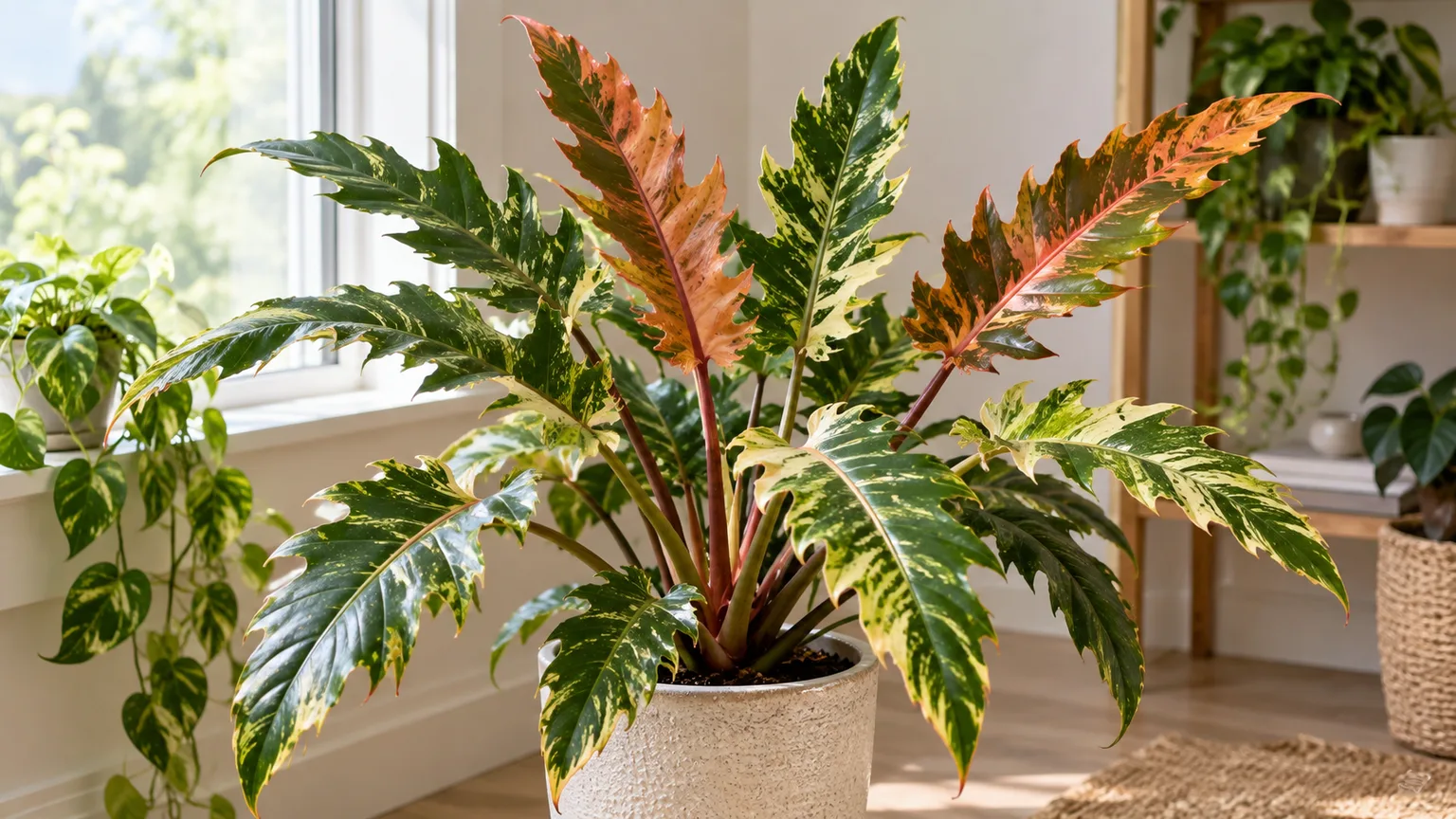
Philodendron Ring of Fire is an accepted variegated cultivar (syn. Henderson’s Pride), sometimes sold as Philodendron Narrow Variegata. It is not a Philodendron erubescens cultivar like Pink Princess or White Princess. Mature leaves show deeply cut, serrated margins with cream, yellow, orange, and green variegation — a look often compared to Philodendron tortum in shape but with stable multicolor sectors collectors chase. The result is a climbing tropical aroid in the Araceae family with new leaves that often emerge reddish or orange-toned and mature into dramatic, jagged foliage.
Like other vining philodendrons, Ring of Fire is an epiphytic climber in nature — it wants something to attach to, not a life sprawled across a shelf. NC State Extension notes that climbing philodendrons grown indoors perform best on a moss pole or trellis, producing larger leaves when supported vertically. Ring of Fire follows that pattern: without a pole, stems elongate, internodes stretch, and serration plus variegation intensity often disappoint on the newest leaves.
Ring of Fire vs Pink Princess and Plain Tortum
Pink Princess is Philodendron erubescens ‘Pink Princess’ — heart-shaped leaves, pink chimeric variegation, Colombian species background. Ring of Fire is a different cultivar with serrated margins and warm multicolor tones rather than bubblegum pink splashes. Care overlaps (bright indirect light, chunky mix, climbing support), but Ring of Fire typically grows faster than heavily variegated White Princess in good light and shows stronger leaf-shape change as it matures.
Plain Philodendron tortum has green, deeply cut leaves without stable cream-to-orange variegation. Juvenile Ring of Fire can resemble tortum before serration and color develop — which is why mislabeling happens. When buying, inspect multiple new leaves and the growth habit, not one mature photo leaf. If a “Ring of Fire” shows only green tortum-like foliage across several nodes with no variegation streaking on the stem, treat it as a different plant until proven otherwise.
Variegation in Ring of Fire is chimeric — green cells photosynthesize; pale cream, yellow, and orange sectors carry less chlorophyll. The plant will favor greener, more efficient tissue when light is weak or when a green-dominated stem outruns variegated sections. That biology is shared with Pink Princess, but Ring of Fire expresses it through warm sunset tones and toothy margins, not pink half-moons.
Growth Habit and Mature Size Indoors
Ring of Fire grows as an upright climber when staked and as a sprawler when left unsupported. In most homes, expect moderate to fast growth during warm, bright months and slower pushes in winter. Individual mature leaves on a well-supported plant can exceed 20–30 cm in length with pronounced serration; a young import in a 12 cm pot will look modest for the first year even when healthy.
Clemson HGIC describes vining philodendrons as limited in height mainly by their support and training. Ring of Fire is not a self-heading “tree philodendron” type — it will keep producing new nodes as long as it has light, moisture, and a surface for aerial roots. Indoors, plan for vertical space or regular pruning to manage height.
Temperature-wise, treat it like other tropical philodendrons: NC State recommends 65 to 85 °F (18 to 29 °C) with protection from cold drafts. Sudden drops below 15 °C stall new leaves and can yellow lower foliage on wet mix.
Juvenile vs Mature Serrated Leaves
The most common buyer surprise is smooth-edged juvenile foliage. New Ring of Fire plants — especially tissue-culture or recently imported starters — often produce narrower, less serrated leaves with lighter variegation. Serration deepens as leaves enlarge and as the plant climbs. Rejecting a young plant solely for smooth margins misses healthy stock.
New leaves frequently open reddish, orange, or copper before settling into green with cream, yellow, or orange patterning. Color on the most recent two or three leaves tells you whether today’s light and humidity work — not the one spectacular leaf from the seller’s greenhouse six months ago.
Best Light for Multicolor Variegation
If you remember one rule: bright, indirect light is non-negotiable for holding Ring of Fire’s multicolor contrast. Dim rooms do not usually kill the plant quickly, but they reliably produce longer internodes, larger plain-green blades, and faded variegation because the plant adds chlorophyll wherever it can capture energy.
The target is several hours of bright indirect light daily — east-facing window light, or several feet back from a south- or west-facing window with a sheer curtain. Gentle morning sun is often fine; harsh midday or afternoon sun scorches pale cream, yellow, and orange sectors first because those cells lack protective pigment. Brown crispy patches on variegated tissue while green remains intact is classic sun stress, not underwatering.
Variegated philodendron references commonly cite roughly six to ten hours of bright indirect light, or supplemental grow lighting when natural light is insufficient. Ring of Fire often benefits from more brightness than a solid-green heartleaf philodendron — but always filtered, never blazing beam on pale tissue.
Windows, Grow Lights, and New-Leaf Signals
A practical default: within roughly 1–2 meters of an east window, or 2–3 meters from a filtered south or west window. Rotate the pot a quarter turn weekly so the vine does not lean hard toward one side; uneven exposure makes it harder to read whether variegation is stable.
If new leaves arrive mostly green with stretched internodes, increase light before you increase fertilizer. Move closer to the glass, clear obstructing curtains, or add a full-spectrum LED grow light 30–45 cm above the canopy for 10–12 hours daily in winter. NParks notes that variegated philodendrons grow best under bright indirect sunlight and that direct hot sun burns leaves — the same rule applies to Ring of Fire’s pale sectors.
If cream or orange sections brown while green stays firm, pull back from direct sun or add diffusion. Judge success on the last two or three leaves and any variegation streaking on the stem between nodes, not on older foliage produced under different conditions. Full detail lives in the Philodendron Ring of Fire light guide.
Watering Philodendron Ring of Fire
Ring of Fire wants the standard aroid rhythm: let the mix approach dryness, then water thoroughly — never leave roots sitting in stale water. Heavily variegated leaves photosynthesize less per square inch than all-green ones, so the plant often uses water more slowly than fast-growing green philodendrons. Overwatering is the more common killer.
A reliable starting rhythm in most homes: water when the top 3–5 cm of mix feels dry — NParks recommends watering variegated philodendrons when about 5 cm of surface mix is completely dry — roughly every 7–10 days in active summer growth and every 10–14 days in cooler, dimmer winter. That interval is a starting point, not a calendar rule. A small pot in bright light dries faster than a large pot in a dark corner. Always confirm with your finger or a chopstick before you pour.
When you water, soak until excess runs from drainage holes, then empty the saucer within thirty minutes. If the pot stays heavy for days after watering, the mix retains too much moisture, the pot is oversized, or light is too low for the root system to breathe. Fix the environment before chasing fertilizer.
How to Check Soil Moisture Before You Water
Insert your index finger to the second knuckle — about 3–5 cm — or push a dry bamboo chopstick into the mix and leave it ten seconds. A cool, damp stick means wait. A dry surface with cool-damp deeper mix means you are approaching the right window. Lift the pot occasionally; a dry pot is noticeably lighter.
Avoid daily dribbles that keep the surface wet without hydrating roots deeply, and avoid calendar watering while the plant sits in a cold, dim room using almost no moisture. Ring of Fire tolerates a brief dry spell better than chronic soggy roots. See the dedicated Philodendron Ring of Fire watering guide for seasonal adjustments and pot-size effects.
Soil, Pots, and Drainage for Climbing Aroids
Use a chunky, well-draining aroid mix, not straight peat-heavy bagged soil that compacts into a wet brick after a few months. A proven home recipe: potting mix + perlite + orchid bark, roughly equal parts by volume, adjusted toward more bark if you tend to overwater. LeafyPixels plant data targets pH 5.5–6.5, which matches the slightly acidic conditions most aroid mixes already provide.
Drainage holes are mandatory. Terracotta dries faster and forgives heavy-handed waterers; plastic holds moisture longer and suits attentive underwaterers in bright light. Choose based on your habits, not the cache pot aesthetic alone.
Repot into fresh mix every one to two years, or when roots circle the pot and water runs straight through. Go up one pot size at a time. An oversized pot holds water the root system cannot use, especially in winter — a common post-repot decline on collector plants. The Philodendron Ring of Fire soil guide covers DIY versus store mixes in more depth.
Humidity and Temperature Indoors
Ring of Fire prefers moderate to high humidity, roughly 55–70%, and warm stable temperatures. Average indoor humidity near 50% is often acceptable if light and watering are correct; below that, watch for crispy edges on pale variegated sectors, which desiccate faster than green tissue.
Raise humidity with a pebble tray, plant grouping, or a small humidifier — the humidifier wins in dry winter heating. Misting leaves is a poor substitute: the humidity spike lasts minutes, and wet foliage in stagnant air can invite fungal spotting. Keep the plant away from cold window glass, radiators, and direct AC blasts.
NC State Extension lists climbing philodendrons as humidity tolerant houseplants that still prefer moist, well-drained organic mix and warm conditions — a useful baseline for Ring of Fire even though the hybrid is not the erubescens species itself.
Fertilizer During Active Growth
Fertilizer does not create orange or cream variegation. Light and stable genetics express color; fertilizer only fuels growth once the basics are right. Feed lightly during active growth — typically monthly in spring and summer with a balanced liquid fertilizer diluted to half strength on already-moist soil. Skip feeding in winter, after repotting, during pest recovery, or whenever the plant is yellowing on wet mix.
High nitrogen pushes lush green growth, which on a variegated plant can mean more reversion on stems already leaning green. If new growth is fading, fix light and pruning before chasing color with nutrients. Never fertilize a dry root ball; salts burn aroid roots quickly. More detail: Philodendron Ring of Fire fertilizer guide.
Climbing Support and Moss Pole Benefits
Ring of Fire is a climber, not a self-heading bush. Without support, stems sprawl, leaves shrink, and serration may never reach the dramatic mature form you see in reference photos. Clemson HGIC notes that vining philodendrons can be trained on bark- or moss-covered totems, giving aerial roots a surface to attach.
Install a moss pole, coir pole, or trellis early, while stems are still flexible. Secure petioles loosely with soft ties; do not strangle the stem. Climbing plants in good light produce larger leaves with deeper serration and more predictable internode spacing. A mature Ring of Fire on a pole, in bright indirect light, with variegation streaking on the stem is the reference image — not a tiny pot with one colorful leaf dangling from sphagnum.
Pruning and Managing Reversion
Pruning Ring of Fire is variegation management, not just aesthetics. Green stems grow faster than variegated stems because they photosynthesize more efficiently. If you ignore an all-green runner, it can dominate the plant even when older leaves still show color.
Use clean, sharp shears wiped with alcohol between cuts. Remove dead or fully brown leaves anytime. When addressing reversion, think in nodes — the bumps where leaves and roots emerge.
If a stem produces multiple consecutive all-green leaves, trace it to the last node that shows variegation on the stem or on a marbled leaf. Cut about 0.5 cm above that node. The goal is to force new growth from tissue that still carries variegated cells.
If an entire branch is green from base to tip, cut back to the main stem or to a node with visible variegation streaking. Do not leave all-green runners hoping light alone will restore cream or orange — green-dominated stems often will not. When a heavily variegated stem produces one random green leaf, wait for the next leaf if you recently improved light; otherwise prune. Full technique: Philodendron Ring of Fire pruning guide.
Repotting and Root Health
Repot Ring of Fire every one to two years, or when roots emerge from drainage holes, water runs straight through, or the mix has broken down into fine, water-retentive muck. The best window is early active growth in spring, when longer days support recovery.
Slide the plant out, tease circling roots gently, and move to a pot one size larger with fresh chunky mix. Water lightly after repotting and keep the plant in bright indirect light without direct sun for a week while roots heal. Do not repot on day one after purchase unless the mix is clearly failing or pests are present — quarantine and observe first. See Philodendron Ring of Fire repotting guide.
Propagation from Stem Cuttings
The reliable home method is stem cuttings with at least one node, taken from healthy stems that show visible variegation on the stem, not just on a single old leaf. A cutting with variegation at the node has a better chance of producing multicolor offspring than a green tip from a reverting plant — though no propagation guarantees identical five-color leaves.
Cut below a node with sterilized shears. Root in water, sphagnum moss, or airy potting mix kept evenly moist but not wet. Bright indirect light and humidity around 60% speed rooting. NParks notes that philodendron stem cuttings with at least one leaf and one node root in roughly four to five weeks under humid conditions. Once roots are 2–5 cm, pot into the same chunky mix you use for the parent.
Collectors often propagate pruned variegated sections to preserve genetics when a main plant pushes green growth. Step-by-step detail: Philodendron Ring of Fire propagation guide.
Buying Ring of Fire: What to Inspect Before You Pay
Ring of Fire is a collector plant with prices driven by pattern and size, not just health. Slow down before you pay premium prices for a single photogenic leaf.
Inspect the active growth tip and stem, not only the top leaf. Variegation travels through nodes; cream or orange streaking on the stem over several nodes is a stronger signal than one spectacular mature leaf above a green growth point. Avoid plants with mushy petioles, sour-smelling moss, or unrooted cuttings sold as established specimens unless you knowingly pay cutting prices.
Ask whether new leaves match the advertised pattern. One colorful leaf on an otherwise green plant is a gamble. Firm new growth, clean leaf undersides, and roots visible at drainage holes (without circling wildly) are baseline health checks.
Be cautious of listings promising permanent five-color leaves on every node — biology does not work that way. Juvenile plants with smooth edges can still be legitimate Ring of Fire if variegation shows on the stem and recent leaves. Pay for healthy structure, active tip, and stem pattern, not lottery tickets.
Pet Toxicity and Safe Placement
Philodendron Ring of Fire is toxic to cats and dogs. Like other members of Araceae, it contains insoluble calcium oxalate crystals that cause oral irritation, drooling, pawing at the mouth, and difficulty swallowing if chewed. The ASPCA lists philodendron as toxic to pets; severity is generally moderate, but individual reactions vary.
Place Ring of Fire out of reach — high shelves, wall-mounted planters, or rooms pets do not access. If ingestion is suspected, contact ASPCA Animal Poison Control at 888-426-4435 (US) and your veterinarian promptly.
The RHS notes that philodendrons are harmful if eaten and can irritate skin and eyes; wear gloves if sap contact bothers you during pruning. Clemson HGIC confirms all philodendron parts are toxic if eaten due to calcium oxalate crystals.
Common Problems and Real Fixes
Most Ring of Fire problems are environmental, and the diagnostic order is always moisture in the pot, then light, then pests, then salts. Variegation complaints aside, a healthy aroid root system in bright indirect light is a straightforward houseplant.
Yellow leaves on wet mix usually mean overwatering or compacted soil — check roots before you assume hunger. Yellow leaves on very dry mix mean underwatering or root loss from past rot. Brown crispy edges on cream or orange sectors often mean low humidity, direct sun on variegated tissue, or salt buildup; flush the pot and review placement. Leggy stems with large plain-green leaves mean insufficient light — move it or add a grow light before pruning green runners.
Faded variegation across several new leaves points to weak plant-facing light first. Three or more consecutive all-green leaves on one stem suggest node-level reversion; light alone may not restore color on that runner — prune above the last variegated node.
Spider mites appear as stippling and fine webbing in dry air; shower the plant, raise humidity, and treat with insecticidal soap. Mealybugs hide in leaf axils; alcohol on a swab plus follow-up soap treatments work if caught early. Root rot from chronic overwatering shows as yellowing on wet mix, soft petioles, and sour smell — unpot, trim mushy roots, repot into fresh airy mix, and withhold water briefly.
Conclusion
Philodendron Ring of Fire is a variegated climbing cultivar prized for serrated, multicolor leaves — beautiful, expensive, and manageable when you treat light, climbing support, and stem genetics as the main levers. Give it bright indirect light, a chunky aroid mix, watering when the top 3–5 cm dries, moderate humidity, warm stable temperatures, and a moss pole so mature serration can develop. Feed lightly in growth season, repot every year or two, and prune green reverted stems back to the last node that still shows variegation.
It is not a beginner plant if your home is dark or pets chew foliage. It is not a failure if juvenile leaves look smooth or a single leaf comes in mostly green — read the next two leaves, fix light, prune if the stem goes green, and propagate the best section if you want insurance. That is collector care: less panic, more observation, and enough honesty to enjoy the fire tones when they show up.
When to use this page vs other Philodendron Ring of Fire guides
- Philodendron Ring of Fire overview — Canonical hub for this plant; care topics branch from here.
- Use sibling guides when you need depth on one topic — light placement, watering checks, soil recipes, propagation steps, or pruning reversion without rereading the full overview.
Related Philodendron Ring of Fire guides
How to care for Philodendron Ring of Fire?
When should you water Philodendron Ring of Fire?
Every 7–10 days in summer - allow top 3–5 cm to dry. Every 10–14 days in winter.
- Check top 2 inches - Every 7–10 days in summer - allow top 3–5 cm to dry.
- Drain excess water - Empty the saucer after watering so the roots are not sitting in standing water.
What soil works best for Philodendron Ring of Fire?
Chunky well-draining aroid mix: potting mix + perlite + orchid bark. pH 5.5–6.5.
- Well-draining mix - Chunky well-draining aroid mix: potting mix + perlite + orchid bark.
Grower notes for Philodendron Ring of Fire
What makes Ring of Fire different
Ring of Fire is an accepted variegated cultivar (syn. Henderson's Pride) — not a plain erubescens type. Mature leaves have jagged, serrated margins and multicolor variegation that can include orange and yellow tones. New leaves emerge reddish and mature into dramatic patterns. It climbs and benefits strongly from a moss pole.
Ring of Fire light note
Bright indirect light intensifies variegation colors; dim light produces larger green leaves with less contrast. Protect from harsh direct sun on pale sectors. Stable light produces more predictable new-leaf color.
Ring of Fire buying note
Look for active growth tips and variegation on multiple recent leaves — not one colorful mature leaf on a green stem. Juvenile leaves are less serrated; do not reject young plants for smooth edges alone.
What matters most with Philodendron Ring of Fire
Bright indirect light, climbing support, chunky mix, consistent humidity. Faster grower than White Princess — still check soil before watering.
Best placement in a real home
Bright filtered window or grow light. Water when top 3–5 cm dries. Humidity 55–70%. 18–29°C. Moss pole for mature serrated foliage.
Before you buy this plant
Healthy tip, no rot at nodes, pest-free undersides. Beware mislabeled juvenile tortum without stable variegation on new growth.
First month after bringing it home
Acclimate without repot. New leaves may look different from seller photos — serration and color develop with maturity and light.
Is it pet safe?
Philodendron Ring of Fire is toxic to cats and dogs.
Toxic - calcium oxalate crystals.
Watering Philodendron Ring of Fire
Every 7–10 days in summer - allow top 3–5 cm to dry. Every 10–14 days in winter.
Soil & potting for Philodendron Ring of Fire
Chunky well-draining aroid mix: potting mix + perlite + orchid bark. pH 5.5–6.5.
Humidity & temperature for Philodendron Ring of Fire
Fertilizer & pruning for Philodendron Ring of Fire
Common problems on Philodendron Ring of Fire
Yellow Leaves
MediumLikely cause: Common on this plant type; confirm with recent watering, light, and root checks.
Quick fix: Inspect the plant and correct the most likely care stressor before stacking treatments.
Full fix guide →Brown Tips
MediumLikely cause: Common on this plant type; confirm with recent watering, light, and root checks.
Quick fix: Inspect the plant and correct the most likely care stressor before stacking treatments.
Full fix guide →Root Rot
MediumLikely cause: Common on this plant type; confirm with recent watering, light, and root checks.
Quick fix: Inspect the plant and correct the most likely care stressor before stacking treatments.
Full fix guide →Overwatering
MediumLikely cause: Common on this plant type; confirm with recent watering, light, and root checks.
Quick fix: Inspect the plant and correct the most likely care stressor before stacking treatments.
Full fix guide →Underwatering
MediumLikely cause: Common on this plant type; confirm with recent watering, light, and root checks.
Quick fix: Inspect the plant and correct the most likely care stressor before stacking treatments.
Full fix guide →Spider Mites
MediumLikely cause: Common on this plant type; confirm with recent watering, light, and root checks.
Quick fix: Inspect the plant and correct the most likely care stressor before stacking treatments.
Full fix guide →Mealybugs
MediumLikely cause: Common on this plant type; confirm with recent watering, light, and root checks.
Quick fix: Inspect the plant and correct the most likely care stressor before stacking treatments.
Full fix guide →Aphids
MediumLikely cause: Common on this plant type; confirm with recent watering, light, and root checks.
Quick fix: Inspect the plant and correct the most likely care stressor before stacking treatments.
Full fix guide →Leggy Growth
MediumLikely cause: Common on this plant type; confirm with recent watering, light, and root checks.
Quick fix: Inspect the plant and correct the most likely care stressor before stacking treatments.
Full fix guide →Slow Growth
MediumLikely cause: Common on this plant type; confirm with recent watering, light, and root checks.
Quick fix: Inspect the plant and correct the most likely care stressor before stacking treatments.
Full fix guide →Wilting
MediumLikely cause: Common on this plant type; confirm with recent watering, light, and root checks.
Quick fix: Inspect the plant and correct the most likely care stressor before stacking treatments.
Full fix guide →Drooping Leaves
MediumLikely cause: Common on this plant type; confirm with recent watering, light, and root checks.
Quick fix: Inspect the plant and correct the most likely care stressor before stacking treatments.
Full fix guide →Low Humidity
MediumLikely cause: Common on this plant type; confirm with recent watering, light, and root checks.
Quick fix: Inspect the plant and correct the most likely care stressor before stacking treatments.
Full fix guide →Not Enough Light
MediumLikely cause: Common on this plant type; confirm with recent watering, light, and root checks.
Quick fix: Inspect the plant and correct the most likely care stressor before stacking treatments.
Full fix guide →Fungus Gnats
MediumLikely cause: Common on this plant type; confirm with recent watering, light, and root checks.
Quick fix: Inspect the plant and correct the most likely care stressor before stacking treatments.
Full fix guide →Mold on Soil
MediumLikely cause: Common on this plant type; confirm with recent watering, light, and root checks.
Quick fix: Inspect the plant and correct the most likely care stressor before stacking treatments.
Full fix guide →