Spider Mites on Philodendron Ring of Fire: Checks & Fixes
Quick answer
Spider mites on Philodendron Ring of Fire show as fine pale stippling on the broad serrated leaves, tiny moving dots on the undersides, and silk tucked into the jagged margin notches — worst in hot, dry rooms. First step: isolate the plant, then force-rinse every leaf underside thoroughly, aiming into the serration notches and around the moss pole ties.
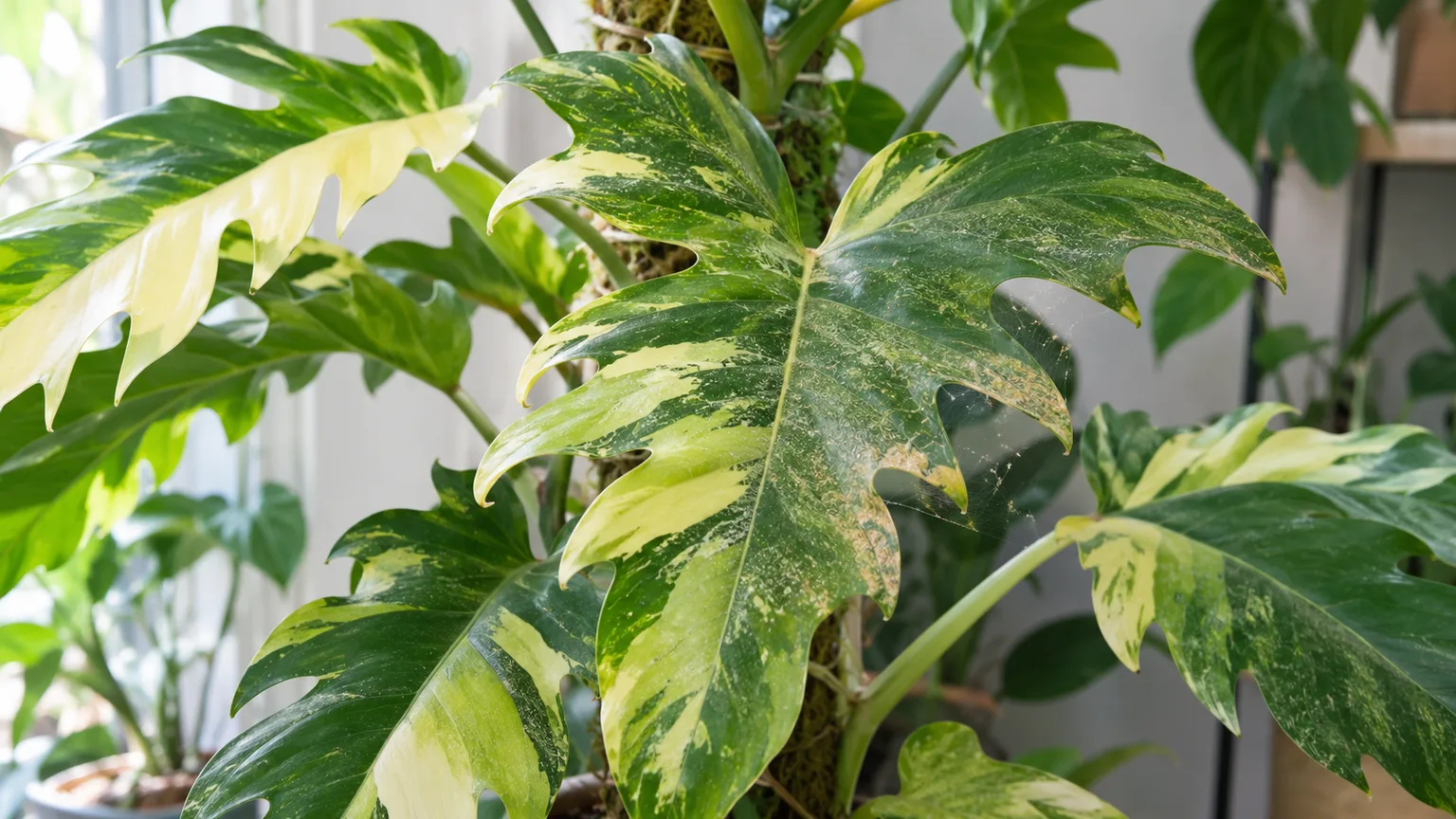
Spider Mites on Philodendron Ring of Fire: Serrated-Leaf Checks & Fixes
This guide covers spider mites on Philodendron Ring of Fire. See also the general Spider Mites guide, watering, and light pages for this plant.
Spider Mites on Philodendron Ring of Fire: Serrated-Leaf Checks & Fixes
Quick answer
Spider mites on Philodendron Ring of Fire feed on the undersides of the broad, jaggedly serrated leaves, leaving fine pale stippling that later bronzes, plus silk tucked into the margin notches and around moss pole ties. Outbreaks explode in hot, dry, dusty rooms and on plants left drought-stressed between waterings. For general mite biology and natural enemies, see our spider mites guide. On Ring of Fire, the diagnostic pattern is stippling across textured variegated blades, silk in the serration notches, and colonies hidden where leaves meet the climbing support — not cottony axil wax or sticky honeydew.
First fix: isolate the plant, then force-rinse every leaf underside. Aim the spray into the serrated notches and around the pole attachments until silk loosens and mites wash off. Do not soak the moss pole for hours as a humidity “cure.”
What spider mites look like on Ring of Fire
Ring of Fire carries big, leathery, deeply serrated leaves with cream, yellow, orange, and green variegation, climbing on a support when mature. That architecture shapes the symptoms.
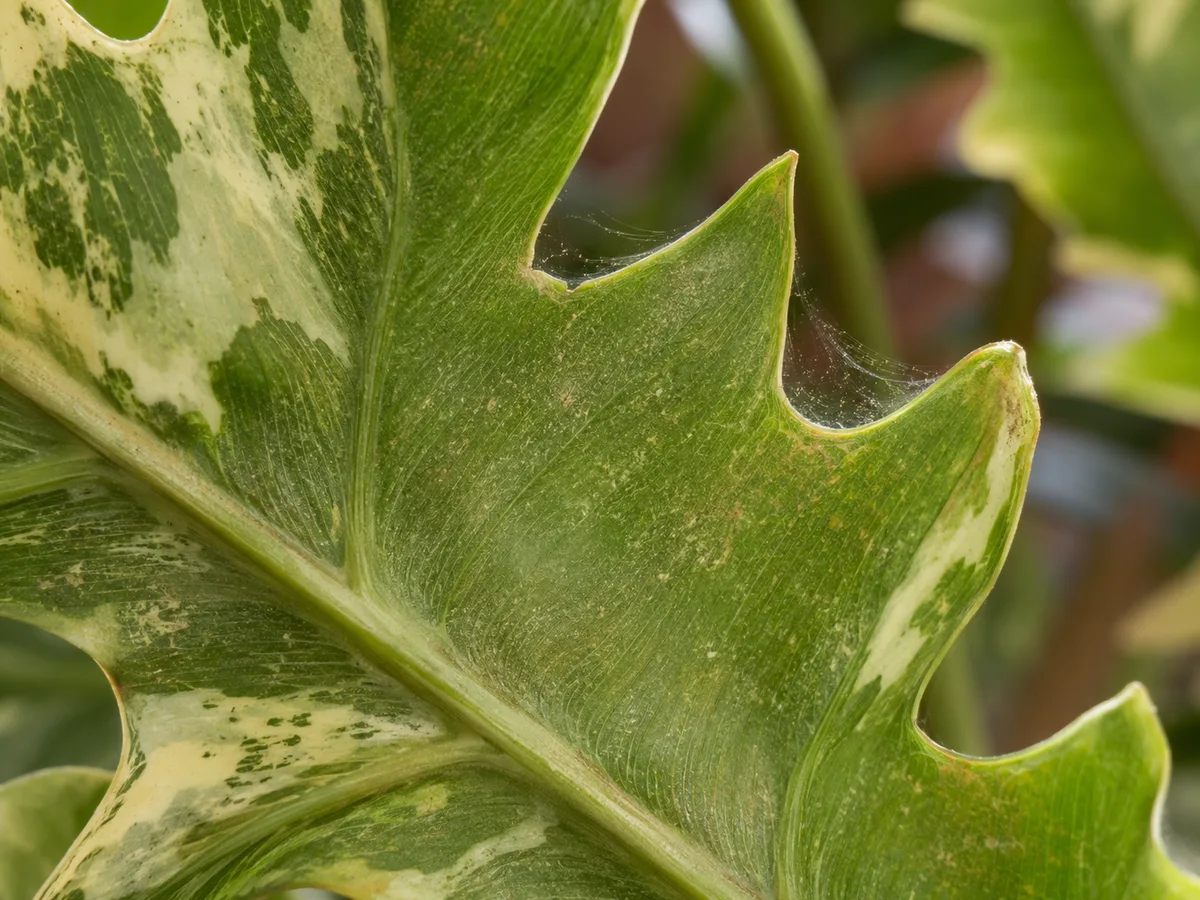
Spider mites leave pale feeding stipples and fine silk tucked into the jagged leaf margins.
Expect these plant-specific signs:
- Stippling with a twist: Fine yellow or white feeding dots scatter across the blade. On green sectors they read clearly; on cream and pale-yellow sectors they hide until damage is advanced, so inspect pale areas deliberately.
- Mites: Tiny oval arachnids — moving dust specks to the naked eye — living in colonies mostly on the underside of leaves. A 10x lens reveals oval bodies; adults are less than 1/20 inch long with eight legs.
- Silk in the notches: Fine webbing collects in the jagged margin sinuses, at the petiole-blade junction, and where leaves press against the moss pole or ties — the clearest separator from thrips or mealybugs.
- Bronzing and drop: Damage first appears as a stippling of light dots, sometimes turning bronze, with heavily infested leaves yellowing and dropping. Pale variegated sectors crisp first because they hold less chlorophyll reserve.
- New-growth confusion: Fresh Ring of Fire leaves emerge reddish before maturing into patterned green. Red emergent color is normal; stippled, dusty, silk-threaded red is not.
Why Ring of Fire gets spider mites
Dry indoor air meets a humidity lover. This cultivar grows best around 55–70% humidity, yet it typically lives in heated or air-conditioned rooms that sit far drier in winter. Dry conditions greatly favor all spider mites: they feed more in low humidity while most of their natural enemies need moister air.
Chunky mix plus calendar drift equals drought stress. Ring of Fire wants its aroid mix to dry out slightly between waterings — roughly the top 3–5 cm. When a busy owner stretches that into a full drought, the plant becomes exactly the water-stressed host on which mite damage is most severe. Keep the rhythm in the Ring of Fire watering guide rather than flooding to compensate, since soggy mix invites root rot on climbing philodendrons.
Broad textured blades trap dust. The large serrated leaves collect household dust that both shelters mites and interferes with mite predators. Plants near heat vents, radiators, or dusty balcony doors are hit first.
Spray blowback. A broad-spectrum insecticide aimed at fungus gnats or mealybugs often kills mite predators and triggers spider mite flares. Check the undersides a week after any such spray.
Bright light is not the enemy — dim dusty corners are. Strong indirect light keeps growth vigorous per the Ring of Fire light guide. Mites favor the stressed plant in the dry corner, not the vigorous one in good light.
How to confirm the diagnosis
Work through these checks before spraying anything on variegated foliage:
- Paper-tap test. Hold a mature leaf over white paper and tap the petiole firmly. Moving specks are mites; static grit is dust.
- Flip mature leaves, not just the new tip. Start with mid-canopy and sun-facing blades — stippling usually begins there.
- Search the serration notches. Use a flashlight along the jagged margins and the petiole-blade crease, plus the wraps and ties where the stem meets its support.
- Rule out honeydew pests. Sticky residue, black sooty film, or cottony wax points to aphids or mealybugs, not spider mites.
- Rule out thrips. Silvery scraped patches with tiny black droppings and deformed new leaves suggest thrips; stippling plus silk with crawling dots means mites.
- Check room dryness. A hygrometer under 40% RH beside the plant plus stippling strongly supports mites — but dry air alone without moving dots is not a diagnosis.
| Sign | Most likely | How it differs | Next step |
|---|---|---|---|
| Pale stippling + underside silk + moving dots | Spider mites | No honeydew; silk in notches | Isolate, rinse undersides, repeat |
| Cottony white masses in axils | Mealybugs | Waxy smear; sticky honeydew | Dab and treat as sucking pests |
| Silvery scraping + black specks | Thrips | Scarred new growth, no webbing | Isolate; treat for thrips |
| Crisp pale sectors, no silk, light pot | Drought stress | No crawling dots on paper test | Recheck the watering guide |
| Uniform brown edges, no stippling | Dry-air tip burn | Margin crisp, not speckled | Raise ambient humidity |
If the pest is still unclear, use the Pest Identifier Tool with a sharp underside photo before stacking treatments.
First fix for Ring of Fire
Isolate, then wash the undersides hard. Move the plant away from your other aroids — mites walk and drift between touching leaves. In a sink, shower, or outdoors, blast the underside of every leaf with a forceful jet, concentrating on the serration notches, the petiole junction, and the stem-and-tie zone. Periodic hosing with a forceful jet physically removes and kills many mites and clears the dust that shields them, and UC IPM puts underside water sprays first for infested plants.
Shield the pot so the mix does not flood, then empty the saucer — this cultivar’s roots punish sitting water. Repeat the wash every few days while you recheck the paper-tap test. Mild outbreaks often collapse with washing plus steadier humidity alone.
Full treatment sequence when washing is not enough
If live mites persist after two solid wash cycles, escalate one rung at a time:
- Wipe large blades. For plants too big to shower, wipe leaves of larger plants with a soft, damp cloth, undersides included, and rinse the cloth between leaves.
- Use insecticidal soap or horticultural oil second-line. If a spray is needed, use an insecticidal oil or insecticidal soap with complete coverage of the leaf undersides, and confirm mites are present before treating. Oils at the summer rate around 2 percent are among the most effective home miticides, while soap alone can struggle once dense webbing shields colonies.
- Protect the variegation. Spray in cool evening shade, never on drought-stressed leaves or in heat — do not spray when plants are water-stressed or it is very hot. Pale cream sectors burn first, so test one leaf and keep the plant out of direct sun until dry.
- Repeat on the mite clock. A female can lay up to 100 eggs over a few weeks with generations finishing in under a week in warmth (Epic Gardening). Plan a second thorough pass five to seven days later to catch newly hatched mites, then keep checking for two weeks.
- Never substitute dish soap. Use a commercial insecticidal soap — household dishwashing liquid is not a safe substitute and can injure variegated tissue.
- Hold fertilizer. Do not push soft new flush while the canopy is still bronzed; resume the feeding rhythm in the Ring of Fire fertilizer guide only after clean leaves expand.
Moss pole and climbing-stem handling
Ring of Fire climbs, and the support changes mite control. Climbing philodendrons root onto their supports, so treat the pole as part of the plant:
- Inspect the contact zone. Check stem nodes, aerial roots, Velcro ties, and the pole face behind each leaf — silk anchors there first and re-seeds washed leaves.
- Rinse the pole surface. A firm wipe-down or rinse of the pole face and ties during each wash removes webbing bridges. Let the pole dry to damp, not dripping.
- Do not keep the pole sopping to “raise humidity.” A constantly soaked pole against the stem invites stem-base rot while barely lifting room RH. Raise air moisture with a humidifier or pebble tray instead.
- Prune only the spent. Remove fully yellowed, web-choked leaves after rinsing so they stop sheltering mites; keep every green blade, even stippled ones, to power recovery. Major reshaping waits until the plant is clean — see the pruning notes only after mites are gone.
Recovery timeline
- Days 1–3: Washes remove most active mites; webbing loosens; paper-tap counts drop.
- Days 4–14: Spot-treat survivors at notches and pole ties; watch mid-canopy leaves, where rebounds start.
- Weeks 3–6: Clean new leaves with crisp variegation are the recovery signal; old stippled blades stay dull.
- Tissue reality: Heavily fed leaves never return to deep patterned green. Protect remaining canopy so fresh growth, not repaired old damage, tells you the plant is winning.
Mistakes to avoid on Ring of Fire
- Spraying only the easy upper leaf surfaces and skipping the notched undersides — a tops-only spray leaves a functioning population untouched underneath.
- Oiling pale variegated sectors in midday heat or sun.
- Daily misting instead of raising ambient humidity.
- Flooding the chunky mix after every rinse and trading mites for root rot — keep the free-draining structure in the Ring of Fire soil guide.
- Reaching for pyrethroids or other broad-spectrum sprays that erase predators and worsen mites (Epic Gardening flags this home-grower trap).
- Repotting on day one. Unpot only if the mix has collapsed into sludge; otherwise let the roots stay stable while you fight the mites.
How to prevent spider mites next time
Scout leaf undersides weekly in hot dry weather, especially after bringing patio plants indoors. Quarantine new plants for one to two weeks with repeated inspection before they join the collection — new nursery aroids are the classic mite Trojan horse. Wipe dust off the broad blades monthly so colonies cannot hide. Keep temperatures in the 65–85°F band climbing philodendrons prefer with steady watering so drought stress never invites the next flare. Prefer selective contact products over broad-spectrum sprays whenever other pests appear.
When to worry
Act the same week if webbing spans multiple leaves, stippling blankets most of the canopy, new leaves emerge already speckled, or the growth tip stalls and unfurling leaves deform. A juvenile with four leaves and three of them bronzed is in more danger than a pole-grown specimen losing lower foliage. If the stem base softens or the whole crown yellows despite clean paper-tap tests, suspect a root problem instead and check the mix before spraying again.
When to use this page vs other Ring of Fire guides
Use this page when you see stippling, underside silk, and moving specks. Use the watering and soil guides when foliage declines with no pests on the paper test. Use humidity and light guidance when margins crisp or variegation fades without webbing. Start from the Ring of Fire overview if you are still sorting the symptom.
Related Philodendron Ring of Fire guides
- Ring of Fire overview — growth habit, variegation, and where underside pests hide
- Ring of Fire watering — even moisture so drought stress does not accelerate mite damage
- Ring of Fire light — strong indirect light that keeps growth sturdy
- Ring of Fire soil — chunky free-draining mix that still holds even moisture
- Ring of Fire fertilizer — when to resume feeding after the canopy recovers
Related tool
Use the Pest Identifier Tool to narrow stippling and webbing pests on this plant before changing multiple treatments at once.
Conclusion
On Ring of Fire, spider mites win by hiding under broad serrated blades and spinning silk into the margin notches and pole ties while dry room air speeds every generation. Isolate early, wash the undersides hard, treat the climbing support as part of the plant, and reserve labeled soaps or oils — applied cool, shaded, and repeated — for survivors. Clean new leaves with crisp variegation, not repaired old stippling, tell you the plant is winning.