Mealybugs on Philodendron Ring of Fire: Causes, Checks &
Quick answer
Mealybugs on Philodendron Ring of Fire hide as white cottony wax in leaf axils, along serrated leaf margins, inside the unfurling new-leaf spear, and where stems meet the moss pole. First step: move the plant away from all others and dab every visible cluster with a cotton swab dipped in 70% rubbing alcohol before any spray.
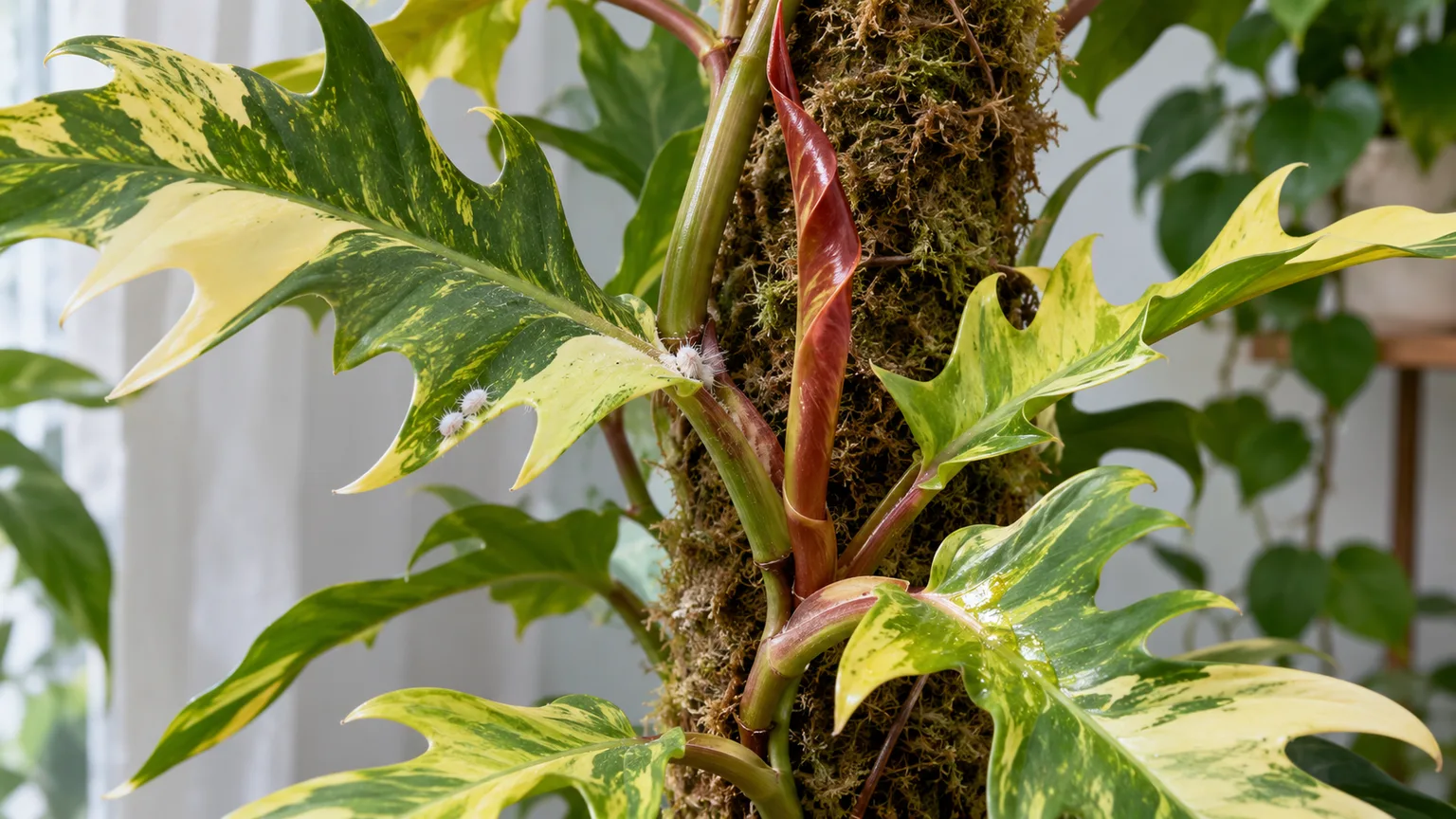
Mealybugs on Philodendron Ring of Fire: Causes, Checks & Fixes
This guide covers mealybugs on Philodendron Ring of Fire. See also the general Mealybugs guide, watering, and light pages for this plant.
Mealybugs on Philodendron Ring of Fire: Causes, Checks & Fixes
Quick answer
Mealybugs on Philodendron Ring of Fire appear as white, cottony wax clusters tucked into leaf axils, the notches of serrated margins, the unfurling new-leaf spear, and crevices where the stem meets its moss pole. They suck sap, drip sticky honeydew onto leaves below, and that honeydew can grow black sooty mould that is especially visible on pale variegated sectors.
First step: isolate the plant and dab every visible cluster with a cotton swab dipped in 70% rubbing alcohol. That kills the adults you can reach and stops crawlers walking to neighboring pots. Only after this manual pass should you plan repeat sprays for hidden eggs and hatchlings. For how mealybugs behave on houseplants in general, see our mealybugs guide — the rest of this page covers what is different on Ring of Fire.
What mealybugs look like on Philodendron Ring of Fire
Ring of Fire’s architecture gives mealybugs more hiding places than a smooth-leafed philodendron has. Glasshouse mealybugs live in clusters in inaccessible parts of plants such as leaf axils and leaf sheaths, and on this cultivar those refuges include:
- White cottony tufts where each petiole meets the upright stem
- Wax packed into the V-notches along jagged, serrated leaf margins
- Cotton deep inside the unfurling new-leaf spear, which emerges reddish and tightly rolled
- Clusters around aerial-root nodes and stem scars on climbing stems
- Colonies behind moss-pole ties, velcro straps, and anywhere the pole presses damp sphagnum against the stem
- Shiny, tacky honeydew on leaves below the colony, sometimes with black sooty film
- Stunted or misshapen new spears when feeding concentrates at the growing tip
- Ant trails on the pot rim farming the honeydew
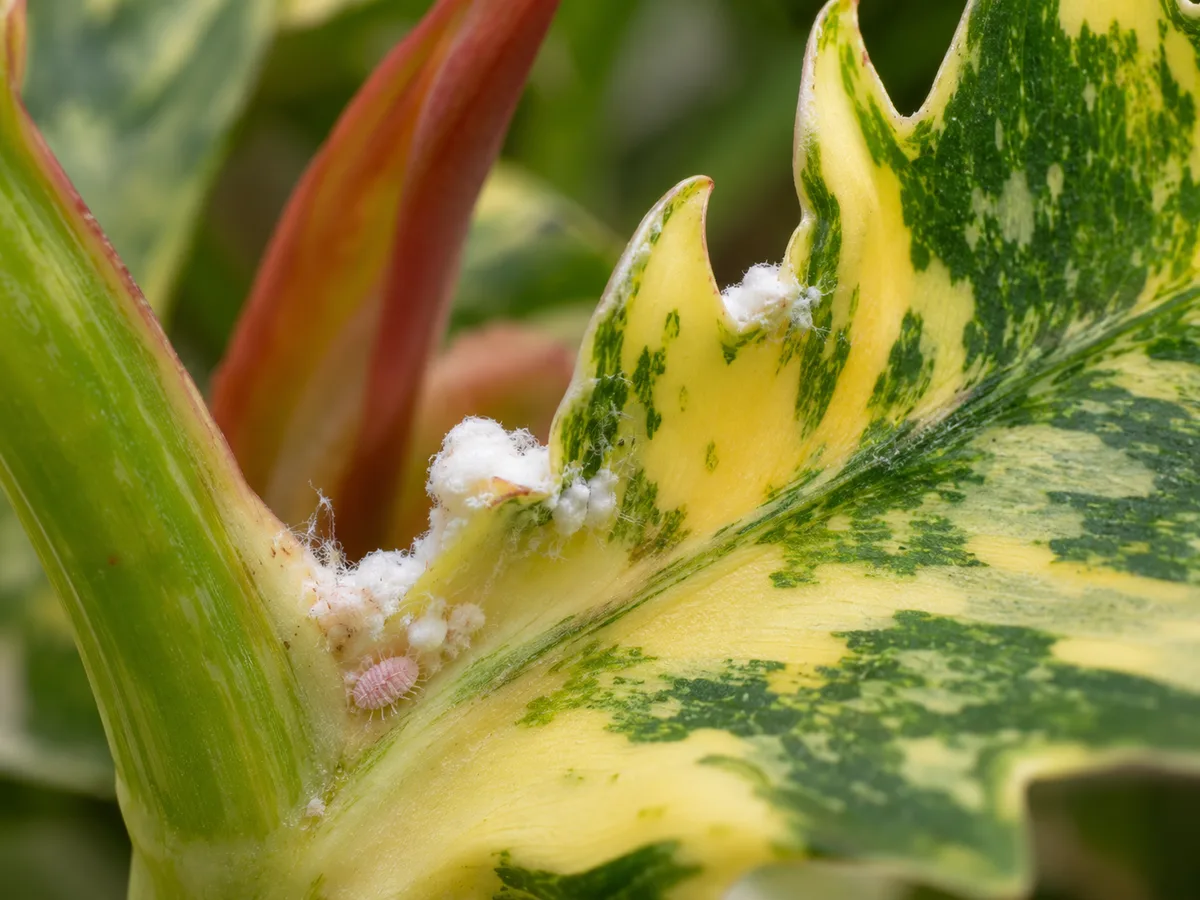
Mealybugs hide in leaf axils, serrated notches, and other protected folds.
Mealybugs are usually first noticed as fluffy white wax, with the insects or their orange-pink eggs found underneath. Part the cotton gently: live mealybugs show soft oval bodies up to 4 mm, sometimes pinkish beneath the white powder. Pale cream and yellow variegation complicates early detection, since white wax blends into light sectors — run inspections by touch and with a phone light, not by color contrast alone.
Why Philodendron Ring of Fire gets mealybugs
Healthy Ring of Fire plants do not spontaneously generate pests. Outbreaks almost always trace to introduction plus the plant’s own crevices and climbing setup.
New plants skip quarantine. Female mealybugs do not fly or crawl far, so they are usually brought in on an affected plant. Collector aroids like Ring of Fire often arrive from greenhouses and swaps already carrying hidden crawlers in one leaf axil.
The serrated, clasping growth habit shelters them. Deeply lobed margins, clasping petiole bases, and a rolled emerging spear create exactly the small clusters around leaf axils and places where plant tissues abut that mealybugs prefer. Sprays that would clear a smooth leaf miss these folds.
The moss pole stays inviting. Ring of Fire climbs and sizes up best on a moss pole with steady moisture, but constantly damp sphagnum pressed against nodes gives crawlers a humid refuge. Check pole contact points, not just leaves.
Soft new growth draws feeding. New leaves emerge reddish, tender, and nutrient-rich before hardening off. Sap feeders concentrate on exactly this tissue, so a plant pushing a flush of growth after a light improvement deserves extra inspection.
Stress lowers resistance. A Ring of Fire sitting in dim light with faded variegation, or in soggy mix from too-frequent watering, grows soft tissue and stalls — easier prey than a stable plant with firm stems and predictable dry-downs.
How to confirm the cause
Work through these checks before buying any spray:
- Map the locations — Mealybugs cluster in axils, serration notches, the unfurling spear, nodes, and pole ties. Random white dust scattered across open blade faces alone is less typical.
- Part the cotton — Gently open a tuft. Soft pinkish-gray ovals that smear confirm mealybugs. Hard domes glued to the stem are scale instead.
- Check for movement — Disturbed crawlers and adults shift slowly. Mineral deposits and dried sap never move.
- Feel for honeydew — Rub a leaf below the suspect colony. Tacky residue, with or without black sooty film, points to sap feeders rather than dust.
- Open the new spear — Peel light around the emerging leaf without forcing it. Wax hidden inside the roll is a classic early colony on this plant.
- Inspect the pole and ties — Loosen one tie and look behind it; check damp sphagnum at node height for white wax.
- Survey neighbors — Examine every aroid, hoya, and orchid within reach. Mealybugs rarely stay on one pot once crawlers are mobile.
- Cross-check the base — Firm stem with chunky mix drying normally suggests pest-only stress. A soft stem base with sour, soggy mix points to root rot compounding the problem.
Lookalike symptoms to rule out
| What you see | Likely culprit | How to tell it apart |
|---|---|---|
| Hard brown or tan bumps glued along stems | Scale insects | Domes do not wipe off; no cottony mass |
| Fine stippling plus delicate webbing under leaves | Spider mites | No cottony wax; damage worst in hot dry air |
| White organismos on leaf undersides that fly up when touched | Whiteflies | Adults take flight; mealybugs never fly |
| White crust on the mix surface only | Mold on soil or mineral salts | Grows on the potting mix, not on stems; no honeydew on leaves |
| Pale, washed-out variegation with no wax | Too little light | Whole-plant fading; new leaves larger and greener, per the light guide |
First fix for Philodendron Ring of Fire
Move the plant to an isolated room, then dab every visible mealybug with a cotton swab dipped in 70% isopropyl alcohol.
Isolation first, because crawlers bridge between touching leaves overnight. Separate plants with sap-feeder populations from unaffected houseplants to minimise spread. Then work systematically: open each leaf axil, trace every serrated margin, unroll the spear’s outer edge, and check behind each pole tie. Dipping a cotton swab in rubbing alcohol and dabbing each cottony mass directly dissolves the waxy coating that plain water cannot penetrate.
Two cautions specific to this cultivar: test alcohol on one variegated leaf first and let the plant dry in shade — pale sectors scorch easily if alcohol pools on tissue sitting in direct sun. And wear gloves while handling stems: philodendron sap contains insoluble calcium oxalates that irritate skin, and this plant’s brittle petioles snap if wrestled.
Do not repot on day one unless you find wax on roots below the soil line. Do not fertilize a pest-hit plant to push growth — tender forced flushes are exactly what surviving mealybugs colonize next.
Step-by-step recovery
After the alcohol dab pass:
- Repeat manual removal every three to five days until two full inspections find no live clusters. Nymphs can complete development in about a month in warm conditions, with breeding continuing year-round indoors, so one pass never finishes the job.
- Apply insecticidal soap to every hiding spot — axils, serration notches, nodes, spear exterior, and pole contact zones. Soap works on contact only, so coverage into crevices matters more than strength. Reapply in 7 to 10 days if mealybugs persist, continuing through at least three to four weeks to catch staggered hatching.
- Rotate in neem or horticultural oil around week two if colonies persist. Neem oil works by a different mechanism and suits rotation with soap. Test on one pale leaf first; keep the plant out of direct sun until sprays dry to protect variegated sectors.
- Treat the moss pole. If wax hides in damp sphagnum,drench that pole section with insecticidal soap solution and let it dry down before re-wetting. A pole that never dries becomes a permanent refuge.
- Wipe honeydew and sooty mold from leaves with a damp cloth once live feeding stops. Trim only leaves more than half-coated and nonfunctional — variegated leaves are slow to replace.
- Manage ants if trails appear on the pot or shelf, since ants farm mealybugs for honeydew and defend them. Break the trail with a clean saucer and shelf wipe-down.
- Hold quarantine for six weeks. Eggs and hidden nymphs hatch after the first treatment wave; most failures come from rejoining the collection too early.
Recovery timeline
Visible reduction follows the first thorough alcohol pass within days when colonies are small. A full soap cycle with label-interval repeats typically clears light infestations in three to four weeks; plants with pole-hidden colonies may need six weeks of monitoring.
Damaged pale sectors and sooty-coated leaves rarely regain showroom color. Judge recovery by the growing tip: new spears unfurling clean, with crisp serration and stable cream-yellow-orange patterning, mean feeding has stopped. Because Ring of Fire grows moderately fast in good bright indirect light, a refreshed canopy follows within one to two growth flushes once pests are gone.
Mistakes to avoid
Do not return the plant to your collection after a single treatment. Staggered hatching guarantees survivors.
Do not blast the plant with a hard hose stream to dislodge bugs. Forcing water into the unfurling spear invites bacterial soft rot at the exact tissue mealybugs already weakened.
Do not stack alcohol, soap, oil, repotting, and pruning on the same day. Variegated tissue burns and drops under chemical overload — sequence treatments days apart.
Do not overwater while fighting pests. Soggy chunky mix plus sap loss stalls the growing tip faster than mealybugs alone; keep the normal top few centimeters dry-down rhythm.
Do not use broad outdoor pesticides indoors without a label that clears houseplant and indoor use.
Philodendron Ring of Fire care cross-check
Keep baseline culture stable while treating — recovery depends on it:
- Light — Bright indirect light that keeps variegation crisp. Most philodendrons prefer indirect or curtain-filtered sunlight; harsh direct sun scorches pale sectors already stressed by treatment.
- Water — Let the top 3–5 cm of chunky mix dry, then soak and drain. Keep soil evenly moist but never let plants stand in water.
- Humidity and airflow — Aim for 55–70% humidity with gentle air movement so wet axils and pole surfaces dry between waterings.
- Temperature — Night temperatures of 65 to 70°F and day temperatures of 75 to 85°F are ideal for philodendrons, matching the 65 to 85°F indoor range that keeps this climber growing through rehab.
- Fertilizer — Hold all feed until new spears unfurl clean for two weeks. Resume at dilute strength only on an actively growing, pest-free plant.
How to prevent mealybugs next time
Inspect new plants carefully before adding them to a collection and quarantine new acquisitions in isolation for at least a month — the single highest-value habit for collector aroids. Check leaf axils and the spear at purchase; dealers routinely miss one tucked colony.
Fold pest checks into watering day: lift each leaf at the axil, glance along serrated margins, and peek into the new spear. Monitor houseplants frequently so action can be taken before damaging populations develop.
Let the moss pole breathe between waterings rather than keeping it constantly saturated, and space pots so Ring of Fire’s broad leaves never touch neighbors — crawlers cross on contact. Clean saucers and shelves after any outbreak, since wax and eggs persist on surfaces.
When to worry
Treat as urgent when cottony colonies span multiple nodes, honeydew drips daily, ants patrol the plant, new spears emerge twisted, or the stem base softens while mix stays wet. Plants can tolerate some mealybug levels, although populations can quickly build if left unchecked — and on a climbing aroid, unchecked spread means dismantling pole, ties, and all.
Heavily affected plants can be simpler to dispose of than to clear, especially if the growing tip has rotted or every node carries colonies after six weeks of diligent treatment. A few isolated tufts caught at one axil, by contrast, are a weekend fix. Scale your response to the spread you actually see, keep the tip firm and dry, and this cultivar’s steady growth will cover old damage faster than you expect.
Related tool
Use the Pest Identifier Tool to narrow causes for mealybugs on this plant before changing multiple variables at once.